RF IC Market Insights
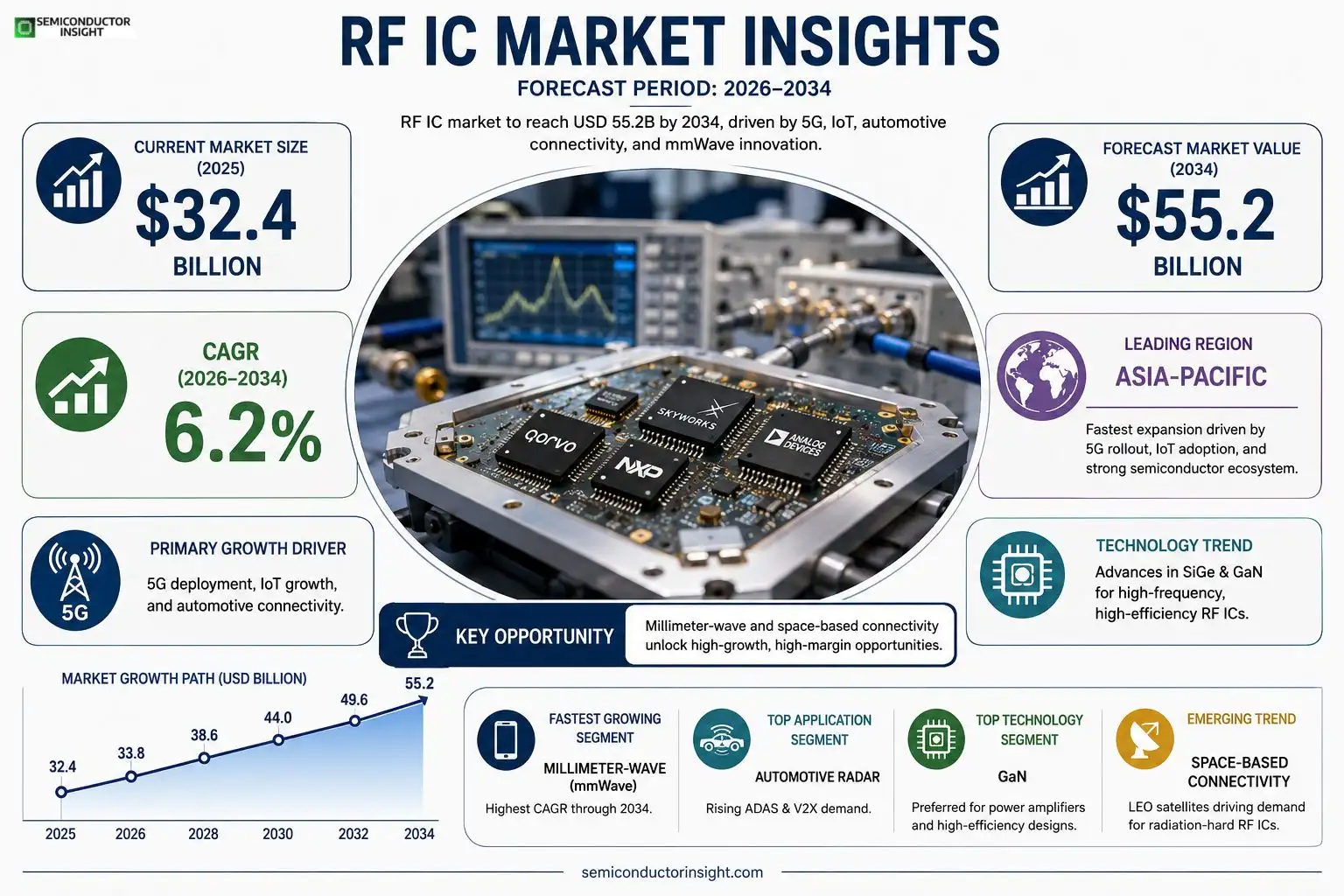
Global RF IC Market size was valued at USD 32.4 billion in 2025. The market is projected to grow from USD 33.8 billion in 2026 to USD 55.2 billion by 2034, exhibiting a CAGR of 6.2% during the forecast period.
Radio‑frequency integrated circuits (RF ICs) are semiconductor components that generate, amplify, filter or switch radio‑frequency signals for wireless communication systems such as smartphones, IoT devices, satellite links and automotive radar. These chips integrate transceiver front‑ends, power amplifiers and low‑noise amplifiers on a single silicon die to enable compact and energy‑efficient designs.The market is accelerating because demand for high‑speed mobile broadband, massive‑MIMO deployments and connected‑car technologies continues to surge. Furthermore, the rollout of 5G networks and emerging interest in mmWave applications are driving higher performance requirements for RF ICs. Key players,including Qorvo Inc., Skyworks Solutions, NXP Semiconductors and Analog Devices,are expanding their portfolios through advanced SiGe and GaN processes to capture this growth.
MARKET DRIVERS
5G Deployment and Spectrum Expansion
The rapid rollout of 5G networks is a primary catalyst for RF IC Market. Mobile operators are upgrading base stations to support higher frequencies, which demand advanced RF front‑end modules with improved power efficiency and linearity. This transition is expected to increase overall market demand by double‑digit percentages annually.
IoT and Automotive Connectivity
Smart‑city initiatives and the proliferation of connected sensors are driving IoT deployments that rely on compact, low‑power RF chips. Simultaneously, automotive manufacturers are integrating radar and V2X (vehicle‑to‑everything) systems, creating a sustained need for high‑performance RF ICs across passenger‑car and commercial‑vehicle segments.
➤ RF IC revenue is projected to exceed $20 billion by 2028, reflecting robust adoption across 5G, IoT, and automotive sectors.
Regulatory bodies worldwide are allocating additional spectrum bands for unlicensed use, which encourages device manufacturers to develop next‑generation RF solutions. This policy support reinforces long‑term growth prospects for RF IC Market.
MARKET CHALLENGES
Cost Sensitivity and Integration Complexity
Designers face pressure to reduce bill‑of‑materials while integrating multiple functionalities into a single chip. The high engineering effort required for advanced node processes can limit price competitiveness, especially for low‑margin consumer devices.
Other Challenges
Supply Chain Vulnerabilities
Global semiconductor shortages and geopolitical tensions have exposed fragile supply chains, leading to longer lead times for critical RF substrates and packaging materials.
MARKET RESTRAINTS
Manufacturing Yield and Process Complexity
Advanced RF ICs often require specialized processes such as silicon‑on‑insulator (SOI) or GaAs, where achieving high yield is challenging. Yield losses increase per‑unit cost and can discourage new entrants.The need for stringent testing at mmWave frequencies adds further complexity, extending time‑to‑market for innovative designs. These technical hurdles act as a restraint on rapid market expansion.Material costs for high‑frequency substrates remain volatile, influencing pricing strategies and potentially dampening demand in price‑sensitive segments.
MARKET OPPORTUNITIES
Emerging Millimeter‑Wave Applications
Beyond 5G, millimeter‑wave (mmWave) technologies are gaining traction in satellite communications, point‑to‑point backhaul, and defense systems. These high‑frequency bands require bespoke RF ICs with superior gain and low noise, opening a lucrative niche for specialized vendors.
Space‑Based Connectivity
The surge in low‑earth‑orbit (LEO) constellations creates demand for radiation‑hard RF components capable of operating reliably in harsh environments. Companies that can certify RF ICs for space use are positioned to capture sizable contracts.Environmental sustainability is becoming a market differentiator. Designers are exploring low‑power architectures and recyclable packaging, presenting an opportunity for firms that can deliver greener RF solutions without compromising performance.
RF IC Market Trends
Growth Driven by 5G and Connected Vehicles
The ongoing deployment of 5G networks and the rapid expansion of connected‑car platforms are reshaping demand for high‑performance radio‑frequency integrated circuits. Designers seek chips that combine transceiver front‑ends, power amplifiers and low‑noise amplifiers on a single silicon die, enabling smaller, more power‑efficient wireless modules. This integration aligns with the shift toward compact IoT devices and advanced automotive radar, where space and energy constraints are critical. As a result, component suppliers are accelerating development cycles to meet tighter specifications for bandwidth, linearity and thermal management, positioning the market for sustained growth. Regulatory bodies in major regions are also tightening efficiency standards for wireless transmitters, which drives manufacturers to adopt more integrated RF solutions that meet both performance and emission criteria. Moreover, the push for greener electronics encourages designs that reduce component count, translating into lower material usage and simplified recycling processes.
Other Trends
Integration of SiGe and GaN Technologies
Leading vendors such as Qorvo, Skyworks, NXP and Analog Devices are expanding their portfolios through silicon‑germanium (SiGe) and gallium‑nitride (GaN) processes. SiGe enables higher frequency operation with lower noise, while GaN provides superior power density and efficiency for high‑output amplifiers. The combined use of these materials allows manufacturers to address diverse performance envelopes across mobile broadband, satellite links and automotive radar. Production scaling and cost‑optimization efforts are reducing the price gap between traditional silicon and these advanced substrates, encouraging broader adoption across mid‑range and premium device segments. Additionally, the adoption of advanced packaging such as wafer‑level integration is shortening time‑to‑market and improving thermal performance for high‑power applications.
Emergence of mmWave Applications
The shift toward millimeter‑wave (mmWave) spectrum in 5G and automotive radar is creating a new set of challenges for RF IC design. At frequencies above 24 GHz, signal loss and linearity become critical concerns, prompting manufacturers to incorporate advanced matching networks and novel substrate technologies. Early adopters are integrating mmWave front‑ends directly into system‑on‑chip solutions, reducing board‑level complexity and improving overall module reliability. This trend is expected to influence product roadmaps for both consumer electronics and safety‑critical automotive systems, reinforcing the strategic importance of continuous innovation in the RF IC space. In parallel, ecosystem partners are standardizing interface specifications, which facilitates cross‑vendor compatibility and accelerates deployment in dense urban networks. The convergence of these technical advances positions the industry to capture emerging revenue streams from next‑generation smartphones, autonomous driving platforms, and satellite‑based broadband services. Customer expectations for seamless connectivity are also influencing design cycles, prompting early‑stage validation of RF performance across diverse use cases.
COMPETITIVE LANDSCAPEKey Industry Players
RF IC Market Competitive Overview 2024‑2034
RF IC Market is dominated by a handful of large semiconductor firms that control the majority of high‑performance transceiver, power‑amplifier and low‑noise amplifier portfolios. Qorvo Inc. leads in GaN‑based power solutions for 5G and automotive radar, while Skyworks Solutions capitalizes on its extensive RF front‑end modules for smartphones and IoT devices. NXP Semiconductors leverages its broad automotive semiconductor suite to integrate RF functions with vehicle‑to‑everything (V2X) communication, and Analog Devices distinguishes itself with precision RF signal‑chain components for infrastructure and aerospace. Collectively, these four companies account for roughly 55 % of global RF IC shipments, setting technology roadmaps around SiGe, CMOS‑RF and GaN processes that drive higher frequency, power efficiency and integration density.Beyond the tier‑one leaders, a vibrant cohort of niche innovators enriches the competitive landscape. Qorvo’s rivals such as Qorvo’s spin‑off Qorvo Flex and US‑based MACOM focus on millimeter‑wave and defense‑grade solutions. European firms like Infineon Technologies and STMicroelectronics deliver automotive‑centric RF ICs, while Taiwan’s MediaTek and China’s Hisilicon (Huawei) expand system‑on‑chip RF capabilities for consumer devices. Smaller specialists including Nujira, RFMD (now part of Qorvo), and Laird Technologies contribute unique filter, switch and antenna‑integrated modules, enabling diversified sourcing strategies for OEMs and fostering rapid innovation across frequency bands.
List of Key RF IC Market Companies Profiled
- Qorvo Inc.
- Skyworks Solutions
- NXP Semiconductors
- Analog Devices
- Infineon Technologies
- STMicroelectronics
- MediaTek Inc.
- Hisilicon (Huawei)
- MACOM Technology Solutions
- RFMD (integrated into Qorvo)
- Nujira Ltd.
- Laird Technologies
- Qorvo Flex
- Skyworks Innovations
- Samsung Electronics (RF Subsystems)
Segment Analysis:
| Segment Category | Sub-Segments | Key Insights |
| By Type |
|
Power Amplifier
|
| By Application |
|
Mobile Handsets
|
| By End User |
|
Device Manufacturers
|
| By Frequency Band |
|
Millimeter‑Wave
|
| By Technology |
|
GaN
|
Regional Analysis: North America
United States
The automotive sector represents a significant driver for RF IC demand in the US, with increasing integration in advanced driver-assistance systems (ADAS), vehicle-to-everything (V2X) communication, and in-car entertainment systems. The need for reliable and high-performance RF ICs to support these applications is steadily rising, contributing to market growth.
The ongoing deployment of 5G networks is a major catalyst for RF IC demand in the US. The need for advanced RF ICs in base stations and network infrastructure is crucial for enabling high-speed wireless communication and supporting the growing number of connected devices.
The proliferation of IoT devices and the increasing demand for industrial connectivity are driving the adoption of RF ICs in various applications, including smart homes, industrial automation, and asset tracking. These applications require energy-efficient and compact RF ICs, leading to innovation in this segment.
The aerospace and defense sector utilizes RF ICs for communication systems, radar technology, and electronic warfare applications. The demand for high-reliability and high-performance RF ICs in this sector remains steady, supported by ongoing technological advancements and government investments.
Europe
Europe presents a substantial RF IC market, characterized by a strong emphasis on technological innovation and a diverse range of end-use industries. The region’s focus on sustainable technologies and increasing adoption of 5G are key growth drivers. The automotive sector in Europe, particularly with the push towards electric vehicles, is creating new opportunities for RF ICs. Furthermore, the growing demand for connected devices in smart cities and industrial settings is contributing to market expansion. European manufacturers are increasingly investing in research and development to maintain a competitive edge in RF IC Market. The market is also seeing a rise in specialized RF ICs for applications like automotive radar and wireless charging.
Asia-Pacific
Asia-Pacific is the fastest-growing RF IC market globally, fueled by rapid industrialization, increasing disposable incomes, and a large consumer base. China, in particular, is a dominant player, driving demand through its extensive manufacturing capabilities and growing electronics sector. The region’s strong focus on 5G infrastructure deployment and the expanding IoT market are creating significant opportunities. The automotive industry in countries like China and India is also contributing to the demand for RF ICs. Competition in the Asia-Pacific market is intense, with numerous regional and global players vying for market share. The focus is on cost-effective RF IC solutions for mass-market applications.
South America
South America’s RF IC market is experiencing moderate growth, driven by increasing adoption of wireless technologies and the expanding telecommunications infrastructure. The growing demand for smartphones, connected devices, and 5G services is fueling market expansion. The automotive sector is also contributing to demand, with increasing integration of RF ICs in vehicles. The region’s economic development and increasing internet penetration are expected to further drive market growth in the coming years. The focus remains on affordable and reliable RF IC solutions for consumer electronics and telecommunications applications.
Middle East & Africa
The Middle East & Africa RF IC market is characterized by growing investments in infrastructure development and increasing adoption of wireless communication technologies. The expansion of 5G networks and the growing demand for IoT devices are key growth drivers. The automotive sector in countries like the UAE and Saudi Arabia is also contributing to demand. Government initiatives promoting technological advancement and digital transformation are expected to further stimulate market growth in the region. The focus is on robust and reliable RF IC solutions for telecommunications, automotive, and industrial applications.
Report Scope
This market research report provides a comprehensive analysis of the RF IC Market , covering the forecast period 2026–2034. It offers detailed insights into market dynamics, technological advancements, competitive landscape, and key trends shaping the industry.
Key focus areas of the report include:
- Market Overview: The report begins with an overview outlining its current market scenario, key growth indicators, and industry transformation drivers. It discusses macroeconomic factors, demand–supply balance, regulatory landscape, and the strategic role of semiconductors in powering advancements across industries such as automotive, telecommunications, consumer electronics, and industrial automation.
- Market Size & Forecast: Historical data and future projections for revenue, unit shipments, and market value across major regions and segments.
- Segmentation Analysis: Detailed breakdown by product type, technology, application, and end-user industry to identify high-growth segments and investment opportunities.
- Regional Insights: Insights into market performance across North America, Europe, Asia-Pacific, Latin America, and the Middle East & Africa, including country-level analysis where relevant.
- Competitive Landscape: Profiles of leading market participants, including their product offerings, R&D focus, manufacturing capacity, pricing strategies, and recent developments such as mergers, acquisitions, and partnerships.
- Technology Trends & Innovation: Assessment of emerging technologies, integration of AI/IoT, semiconductor design trends, fabrication techniques, and evolving industry standards.
- Market Drivers & Restraints: Evaluation of factors driving market growth along with challenges, supply chain constraints, regulatory issues, and market-entry barriers.
- Stakeholder Insights: Insights for component suppliers, OEMs, system integrators, investors, and policymakers regarding the evolving ecosystem and strategic opportunities.
Primary and secondary research methods are employed, including interviews with industry experts, data from verified sources, and real-time market intelligence to ensure the accuracy and reliability of the insights presented.
FREQUENTLY ASKED QUESTIONS:
What is the current market size of RF IC Market?
-> RF IC Market was valued at USD 32.4 billion in 2025 and is expected to reach USD 55.2 billion by 2034.
Which key companies operate in RF IC Market?
-> Key players include Qorvo Inc., Skyworks Solutions, NXP Semiconductors, and Analog Devices.
What are the key growth drivers?
-> Key growth drivers include high‑speed mobile broadband demand, massive‑MIMO deployments, connected‑car technologies, 5G rollout, and emerging mmWave applications.
Which region dominates the market?
-> The reference highlights global activity with strong contributions from Asia‑Pacific, North America, and Europe, but does not single out a dominant region.
What are the emerging trends?
-> Emerging trends include advancements in SiGe and GaN processes, integration of AI/IoT for smarter RF solutions, and increasing focus on mmWave and 5G‑compatible architectures.

Get Sample Report PDF for Exclusive Insights
Report Sample Includes
- Table of Contents
- List of Tables & Figures
- Charts, Research Methodology, and more...
 Download Sample Report PDF