Wearable Electronics Semiconductor Market Insights
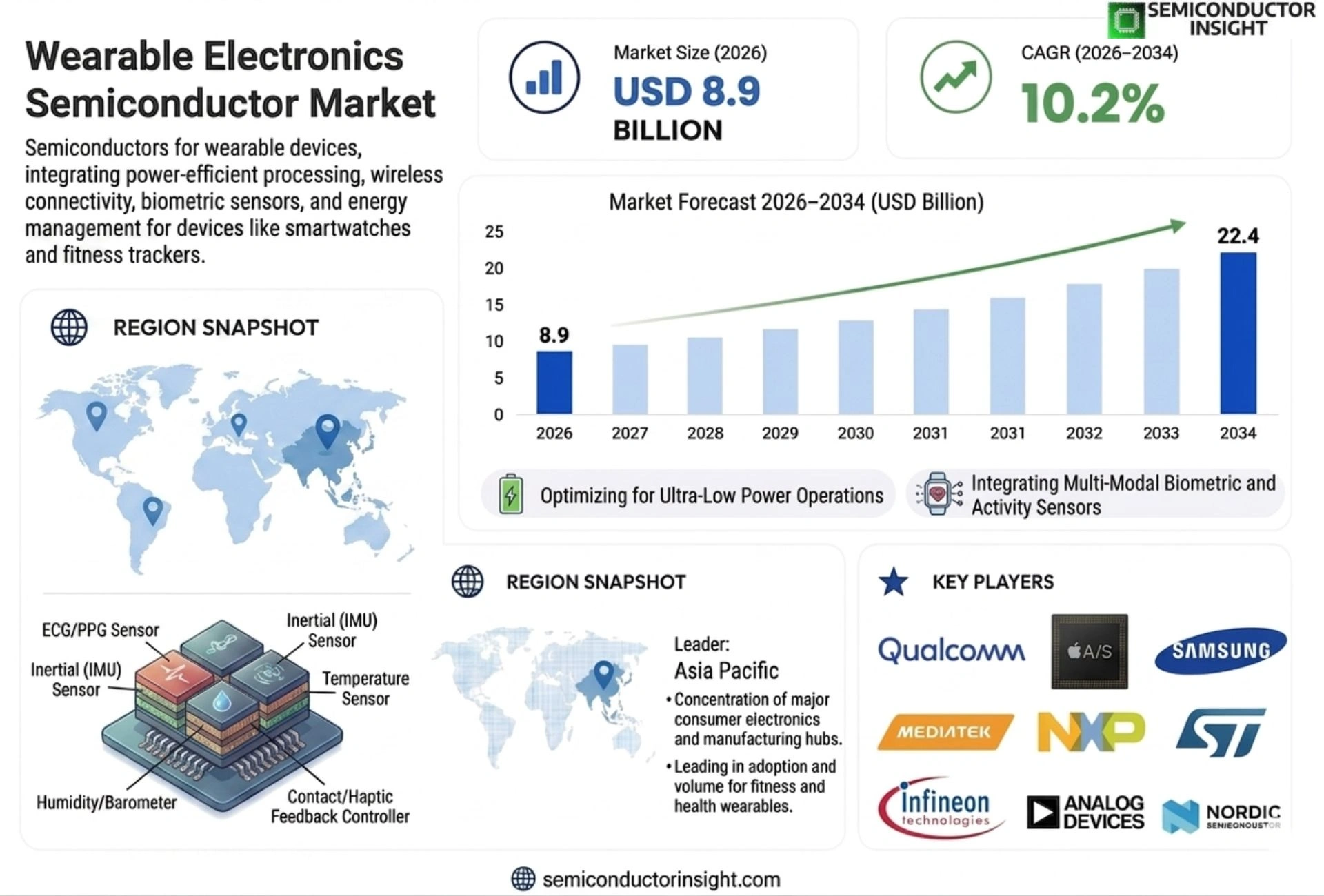
Global Wearable Electronics Semiconductor Market size was valued at USD 8.1 billion in 2025. The market is projected to grow from USD 8.9 billion in 2026 to USD 22.4 billion by 2034, exhibiting a CAGR of 10.2% during the forecast period.
Wearable electronics semiconductors are integrated circuits designed specifically for low‑power, compact devices such as smart watches, fitness trackers, health‑monitoring patches, and augmented‑reality glasses. These chips typically incorporate mixed‑signal processing, Bluetooth Low Energy radios, power‑management units, and sensor interfaces that enable continuous biometric data capture while maintaining battery life of several days.
The market is accelerating because consumer demand for health‑focused wearables is rising, enterprise IoT deployments are expanding, and advances in ultra‑low‑power silicon are reducing form‑factor constraints. Moreover, strategic collaborations,such as the partnership announced in March 2024 between a leading fabless chip designer and a major smartwatch manufacturer,to co‑develop next‑generation system‑in‑package solutions are further fueling growth.
MARKET DRIVERS
Rising Consumer Demand for Health Monitoring
Wearable Electronics Semiconductor Market is being propelled by a surge in consumer interest in continuous health‑tracking devices such as fitness bands and smart watches. Users increasingly expect real‑time heart‑rate, blood‑oxygen, and sleep analytics, which drives manufacturers to integrate more sophisticated semiconductor solutions that can process sensor data locally.
Advances in Low‑Power Semiconductor Technologies
Recent innovations in ultra‑low‑power CMOS and FinFET architectures enable chips to operate for weeks on a single battery charge. This technical breakthrough reduces device size and cost, making wearable prototypes attractive to both premium and mass‑market segments.
➤ “Power efficiency remains the single most critical factor influencing component selection for next‑generation wearables.”
Combined with expanding IoT ecosystems, these drivers create a virtuous cycle: improved semiconductors lower barriers to entry, encouraging new product launches and further expanding Wearable Electronics Semiconductor Market.
MARKET CHALLENGES
Integration Complexity with Diverse Wearable Form Factors
Designers must reconcile varying form‑factor constraints,from thin skin‑adhesive patches to rugged sports watches,while maintaining signal integrity and thermal performance. This complexity raises development costs and lengthens time‑to‑market.
Other Challenges
Supply Chain Constraints
Global shortages of silicon wafers and specialized packaging materials have led to longer lead times, pressuring manufacturers to secure reliable sources and manage inventory more tightly.
MARKET RESTRAINTS
Regulatory Compliance and Data Privacy
Wearable devices that collect health data are subject to stringent medical device regulations in major markets. Achieving certification adds design overhead and can delay product launches.
Data‑privacy legislation such as GDPR and emerging health‑data standards require robust encryption and secure firmware updates, increasing the cost of semiconductor solutions.
These regulatory and privacy hurdles act as a restraint, limiting the speed at which new semiconductor innovations can be deployed in consumer wearables.
MARKET OPPORTUNITIES
Growth of Edge‑AI Enabled Wearables
Embedding AI inference engines directly on semiconductor chips opens opportunities for real‑time health diagnostics, personalized fitness coaching, and gesture recognition without relying on cloud connectivity.
Edge‑AI reduces latency and mitigates privacy concerns, positioning it as a key growth vector for Wearable Electronics Semiconductor Market amid rising demand for intelligent, autonomous wearables.
Manufacturers that can deliver low‑power, high‑performance AI‑capable semiconductors are poised to capture significant market share as the wearable ecosystem evolves toward smarter, context‑aware devices.
Wearable Electronics Semiconductor Market Trends
AI‑Enabled Edge Processing in Wearables
Wearable Electronics Semiconductor Market is increasingly defined by chips that embed on‑device artificial‑intelligence (AI) inference engines. By moving pattern‑recognition workloads from the cloud to the silicon, manufacturers can deliver sub‑second response times for activity classification, arrhythmia detection, and gesture control while preserving battery life. Recent design cycles focus on heterogeneous integration of digital cores, mixed‑signal sensor front‑ends, and dedicated tensor accelerators within a single package. This approach reduces board‑level complexity and supports form factors as thin as 3 mm, which is critical for next‑generation health patches and smart‑glasses. The trend is driven by consumer expectations for real‑time feedback and by enterprise requirements for secure, offline data processing.
Other Trends
Low‑Power Connectivity and Power Management
Bluetooth Low Energy (BLE) radios and ultra‑efficient power‑management units (PMUs) remain core components of wearable semiconductor solutions. Advances in sub‑threshold design and dynamic voltage scaling enable continuous sensor sampling with average currents below 5 µA. System‑in‑package (SiP) architectures now combine BLE, NFC, and high‑precision analog front‑ends in a unified die, shortening interconnect paths and trimming parasitic losses. Strategic collaborations announced in early 2024 between leading fabless designers and smartwatch OEMs have accelerated the rollout of these SiPs, delivering batteries that last up to two weeks under typical usage scenarios. The convergence of low‑power connectivity and integrated PMUs directly supports the market’s push toward longer‑lasting, thinner wearables.
Enterprise IoT Integration and Health‑Focused Wearables
Beyond consumer fitness devices, Wearable Electronics Semiconductor Market is experiencing a pronounced shift toward enterprise Internet of Things (IoT) deployments and medically oriented wearables. Companies in logistics, manufacturing, and field services are adopting ruggedized smart bands that monitor vital signs, exposure metrics, and location in real time. Semiconductor suppliers respond by offering hardened interfaces, secure boot, and encrypted communication stacks that meet industry‑specific compliance standards. Simultaneously, health‑focused wearables benefit from higher‑resolution biosensors integrated with on‑chip algorithms that flag anomalies such as irregular heart rhythms or dehydration trends. These dual pathways,industrial IoT and advanced health monitoring,create a diversified demand profile that fuels continued innovation across the semiconductor supply chain.
COMPETITIVE LANDSCAPE
Key Industry Players
Wearable Electronics Semiconductor Market: Competitive Dynamics, Strategic Alliances, and Leading Innovators Shaping the Industry Through 2034
The global Wearable Electronics Semiconductor Market is characterized by intense competition among a diversified mix of large integrated device manufacturers and specialized fabless chip designers. Qualcomm holds a prominent position in this space, leveraging its Snapdragon Wear platform to power a wide range of smartwatches and fitness-enabled devices across both consumer and enterprise segments. Texas Instruments and STMicroelectronics maintain strong footholds by supplying mixed-signal processors, power-management ICs, and sensor interface solutions tailored to ultra-low-power wearable applications. NXP Semiconductors and Nordic Semiconductor are widely recognized for their Bluetooth Low Energy and near-field communication chipsets, which are integral to health-monitoring patches, smart bands, and connected eyewear. With the market projected to grow from USD 8.9 billion in 2026 to USD 22.4 billion by 2034 at a CAGR of 10.2%, established players are aggressively investing in system-in-package architectures and advanced process nodes to meet shrinking form-factor requirements while extending battery life across multi-day usage cycles.
Beyond the dominant players, a robust ecosystem of niche and emerging semiconductor companies is intensifying competitive pressure across specific wearable verticals. Ambiq Micro has carved out a differentiated position through its sub-threshold voltage technology, enabling exceptional energy efficiency in smartwatches and health trackers. Dialog Semiconductor, now part of Renesas Electronics, continues to supply power-management and Bluetooth SoC solutions widely adopted by wearable OEMs globally. Synaptics Incorporated contributes touch and display controller ICs for premium wearables, while Maxim Integrated, now integrated within Analog Devices, delivers precision health-sensing analog front-end chips. Companies such as Silicon Laboratories and InvenSense, a TDK subsidiary, further enrich the competitive field with wireless connectivity solutions and MEMS motion sensors respectively. Strategic collaborations between fabless designers and leading smartwatch manufacturers,such as those announced in early 2024 to co-develop next-generation SiP modules,are redefining competitive differentiation, making technology partnership strategies and supply-chain agility as critical as silicon innovation in sustaining market share within the rapidly expanding wearable electronics semiconductor landscape.
List of Key Wearable Electronics Semiconductor Companies Profiled
- Qualcomm Incorporated
- Texas Instruments Incorporated
- STMicroelectronics N.V.
- NXP Semiconductors N.V.
- Nordic Semiconductor ASA
- Ambiq Micro, Inc.
- Renesas Electronics Corporation (Dialog Semiconductor)
- Synaptics Incorporated
- Analog Devices, Inc. (Maxim Integrated)
- Silicon Laboratories Inc.
- InvenSense, Inc. (TDK Corporation)
- MediaTek Inc.
- Samsung Semiconductor
- Apple Inc. (Apple Silicon)
- Broadcom Inc.
Segment Analysis:
| Segment Category | Sub-Segments | Key Insights |
| By Type |
|
Analog Mixed‑Signal ICs
|
| By Application |
|
Smart Watches
|
| By End User |
|
Consumer Electronics
|
| By Connectivity |
|
Bluetooth Low Energy
|
| By Form Factor |
|
System‑in‑Package (SiP)
|
Regional Analysis: North America
North America
North America boasts prominent innovation hubs, particularly in Silicon Valley and Boston, driving advancements in semiconductor technology for wearable devices. These centers attract top talent and foster collaborations between startups and established companies in the Wearable Electronics Semiconductor Market.
The healthcare sector is a significant driver for semiconductor demand in wearable electronics within North America. Continuous health monitoring through smartwatches and other wearables necessitates advanced sensor technology and efficient processing capabilities, creating substantial opportunities for specialized semiconductor solutions.
Seamless integration of wearable electronics with other consumer devices, such as smartphones and smart home systems, is a key trend in North America. This integration requires advanced semiconductor components that support connectivity, data processing, and power management, expanding the application scope of the Wearable Electronics Semiconductor Market.
North American companies are increasingly focused on strengthening their semiconductor supply chains to mitigate risks and ensure a stable supply of components for wearable electronics. This involves diversifying sourcing strategies and investing in domestic manufacturing capabilities within the Wearable Electronics Semiconductor Market.
Europe
Europe’s Wearable Electronics Semiconductor Market is characterized by a strong emphasis on privacy and data security, influencing the design and development of semiconductor solutions for wearable devices. The region’s robust regulatory environment, particularly GDPR, compels manufacturers to prioritize data protection, shaping the demand for secure and privacy-focused semiconductor technologies. Key markets like Germany, the UK, and France are experiencing significant growth in wearable adoption, driven by an aging population and increasing health consciousness. Emphasis on sustainable manufacturing practices is also evident, encouraging the development of energy-efficient semiconductor components.
Asia-Pacific
Asia-Pacific is the largest and fastest-growing market for the Wearable Electronics Semiconductor Market, fueled by a massive consumer base, increasing disposable incomes, and a strong digital ecosystem. China dominates the region, representing a significant share of both manufacturing and consumption. The demand for affordable wearable devices is particularly high, driving the adoption of cost-effective semiconductor solutions. Strong government support for technology innovation and a burgeoning consumer electronics industry further contribute to the growth of the Wearable Electronics Semiconductor Market in this region.
South America
South America presents a promising, albeit less mature, market for the Wearable Electronics Semiconductor Market. Growing awareness of health and fitness, coupled with increasing smartphone penetration, are driving initial adoption of wearable devices. Brazil and Mexico are key markets, with opportunities for manufacturers offering value-for-money solutions. The region’s economic stability and increasing internet access are expected to further accelerate market growth in the coming years, potentially opening avenues for semiconductor suppliers in the Wearable Electronics Semiconductor Market.
Middle East & Africa
The Middle East & Africa region represents a nascent but high-potential market for the Wearable Electronics Semiconductor Market. Rising disposable incomes, especially in countries like the UAE and Saudi Arabia, are driving demand for premium wearable devices. Increasing health awareness and a young, tech-savvy population are also contributing to market growth. The region’s focus on smart cities and digital transformation presents opportunities for specialized semiconductor solutions within the Wearable Electronics Semiconductor Market. The adoption rate is still relatively low compared to other regions, but the long-term growth prospects are significant.
Report Scope
This market research report provides a comprehensive analysis of the Wearable Electronics Semiconductor Market , covering the forecast period 2026–2034. It offers detailed insights into market dynamics, technological advancements, competitive landscape, and key trends shaping the industry.
Key focus areas of the report include:
- Market Overview: The report begins with an overview outlining its current market scenario, key growth indicators, and industry transformation drivers. It discusses macroeconomic factors, demand–supply balance, regulatory landscape, and the strategic role of semiconductors in powering advancements across industries such as automotive, telecommunications, consumer electronics, and industrial automation.
- Market Size & Forecast: Historical data and future projections for revenue, unit shipments, and market value across major regions and segments.
- Segmentation Analysis: Detailed breakdown by product type, technology, application, and end-user industry to identify high-growth segments and investment opportunities.
- Regional Insights: Insights into market performance across North America, Europe, Asia-Pacific, Latin America, and the Middle East & Africa, including country-level analysis where relevant.
- Competitive Landscape: Profiles of leading market participants, including their product offerings, R&D focus, manufacturing capacity, pricing strategies, and recent developments such as mergers, acquisitions, and partnerships.
- Technology Trends & Innovation: Assessment of emerging technologies, integration of AI/IoT, semiconductor design trends, fabrication techniques, and evolving industry standards.
- Market Drivers & Restraints: Evaluation of factors driving market growth along with challenges, supply chain constraints, regulatory issues, and market-entry barriers.
- Stakeholder Insights: Insights for component suppliers, OEMs, system integrators, investors, and policymakers regarding the evolving ecosystem and strategic opportunities.
Primary and secondary research methods are employed, including interviews with industry experts, data from verified sources, and real-time market intelligence to ensure the accuracy and reliability of the insights presented.
FREQUENTLY ASKED QUESTIONS:
What is the current market size of Wearable Electronics Semiconductor Market?
-> Wearable Electronics Semiconductor Market was valued at USD 8.1 billion in 2025 and is expected to reach USD 22.4 billion by 2034.
Which key companies operate Wearable Electronics Semiconductor Market?
-> Key players include leading fabless semiconductor designers and major wearable‑device manufacturers that partner to deliver integrated system‑in‑package solutions.
What are the key growth drivers?
-> Growth is driven by rising consumer demand for health‑focused wearables, expanding enterprise IoT deployments, advances in ultra‑low‑power silicon that enable longer battery life, and strategic collaborations between chip designers and smartwatch makers.
Which region dominates the market?
-> The market exhibits robust activity across North America, Europe, and Asia‑Pacific, with all three regions contributing significantly to overall growth.
What are the emerging trends?
-> Emerging trends include the integration of system‑in‑package (SiP) architectures, AI‑enabled biometric analytics, and the development of ultra‑compact, ultra‑low‑power chips for next‑generation AR glasses and health‑monitoring patches.

Get Sample Report PDF for Exclusive Insights
Report Sample Includes
- Table of Contents
- List of Tables & Figures
- Charts, Research Methodology, and more...
 Download Sample Report PDF