
Industrial Ethernet and Automotive Ethernet within Ethernet PHY Chip Market Compared
Behind every cloud server, industrial robot, autonomous vehicle, enterprise switch, and smart factory lies a semiconductor component that quietly enables digital communication the Ethernet Physical Layer (PHY) chip. While processors and AI accelerators often receive the spotlight, Ethernet PHY devices remain fundamental to moving data accurately and at extremely high speeds between connected systems.
As artificial intelligence, industrial automation, hyperscale computing, and automotive electronics continue expanding, Ethernet PHY Chip Market is becoming increasingly important for building faster and more reliable communication infrastructure.
Ethernet PHY chips transform digital impulses into electrical or optical signals and vice versa, in contrast to network processors that control packet routing. They ensure compliance with IEEE Ethernet standards while maintaining reliable transmission across copper cables, fiber optics, or emerging Single Pair Ethernet (SPE) architectures. Their growing importance reflects the rapid expansion of bandwidth-intensive applications worldwide.
You can freely browse our most recent updated report to learn more about it before scrolling further: https://semiconductorinsight.com/report/ethernet-phy-chip-market/
Network Speeds Continue Reaching New Performance Levels
- Modern Ethernet has evolved far beyond traditional office networking.
- Enterprise networks now routinely deploy 10 Gigabit Ethernet (10GbE), while cloud service providers increasingly operate 100GbE, 200GbE, 400GbE, and even 800GbE network infrastructures to support AI workloads and hyperscale computing.
- According to the IEEE Standards Association, Ethernet technology has progressed from the original 10 megabits per second (Mbps) standard introduced in the 1980s to 800 gigabits per second (Gbps) today, representing an 80,000-fold increase in transmission speed.
- Meanwhile, the Ethernet Alliance estimates that billions of Ethernet-enabled ports are deployed globally across enterprise equipment, industrial automation, consumer electronics, telecommunications infrastructure, and automotive platforms, making Ethernet the world’s most widely adopted wired networking technology.
- These continuous improvements require increasingly sophisticated PHY chips capable of maintaining signal integrity, reducing power consumption, and supporting extremely low transmission latency.
Ethernet Is Becoming the Language of Intelligent Infrastructure
The role of Ethernet PHY chips has expanded well beyond office computers. Today they connect autonomous mobile robots inside factories, machine vision systems, industrial sensors, medical imaging equipment, edge AI servers, smart traffic systems, and renewable energy infrastructure.
Industrial automation continues accelerating this demand. According to the International Federation of Robotics (IFR), manufacturers installed more than 540,000 industrial robots worldwide in a single year, with many modern robotic platforms relying on Industrial Ethernet protocols for deterministic communication between controllers, sensors, and actuators.
Similarly, hyperscale cloud providers continue expanding AI-ready data centers containing hundreds of thousands of interconnected servers, where multi-gigabit Ethernet PHY chips support high-speed switching fabrics and storage networks required for large language models and AI inference platforms.
One Small Chip Supporting Multiple Industries
Rather than serving a single application, Ethernet PHY chips now support an increasingly diverse technology ecosystem.
Ethernet PHY Chip
│
Data Centers
│
Industrial Automation
│
Connected Vehicles
│
Medical Equipment
│
Telecommunications
│
Smart Buildings
This versatility has encouraged semiconductor manufacturers to develop specialized PHY architectures optimized for automotive Ethernet, industrial networking, Power over Ethernet (PoE), low-power IoT devices, and next-generation AI infrastructure.
Automotive Electronics Are Creating a New Generation of Ethernet Networks
- Vehicle electronics have become significantly more complex as advanced driver assistance systems (ADAS), surround-view cameras, LiDAR sensors, radar modules, infotainment systems, and centralized computing platforms generate enormous volumes of real-time data.
- The OPEN Alliance and IEEE Automotive Ethernet standards continue driving adoption of 100BASE-T1, 1000BASE-T1, and 10GBASE-T1 technologies that reduce wiring complexity while increasing communication bandwidth inside vehicles. Instead of relying on numerous legacy communication buses, automotive manufacturers are increasingly consolidating vehicle architectures around Ethernet-based networking, creating new opportunities for advanced PHY chip development.
- As software-defined vehicles become mainstream, Ethernet PHY chips are evolving from simple communication interfaces into foundational components that enable safer, faster, and more intelligent transportation systems.
AI Data Centers Are Raising the Bar for Ethernet Innovation
The rapid expansion of generative AI has fundamentally changed data center architecture. Training a single frontier AI model can involve tens of thousands of GPUs operating simultaneously, requiring ultra-low-latency communication between servers, storage systems, and networking equipment. While AI accelerators perform the computation, Ethernet PHY chips ensure that data moves efficiently across every physical connection inside these facilities.
The Ultra Ethernet Consortium, launched with participation from leading semiconductor and networking companies including AMD, Arista, Broadcom, Cisco, Eviden, HPE, Intel, Meta, and Microsoft, is accelerating Ethernet technologies specifically for AI and high-performance computing.
At the same time, IEEE continues developing next-generation Ethernet standards that support increasingly demanding workloads across hyperscale infrastructure. These developments demonstrate that Ethernet is no longer viewed solely as an enterprise networking technology it has become a cornerstone of AI computing infrastructure.
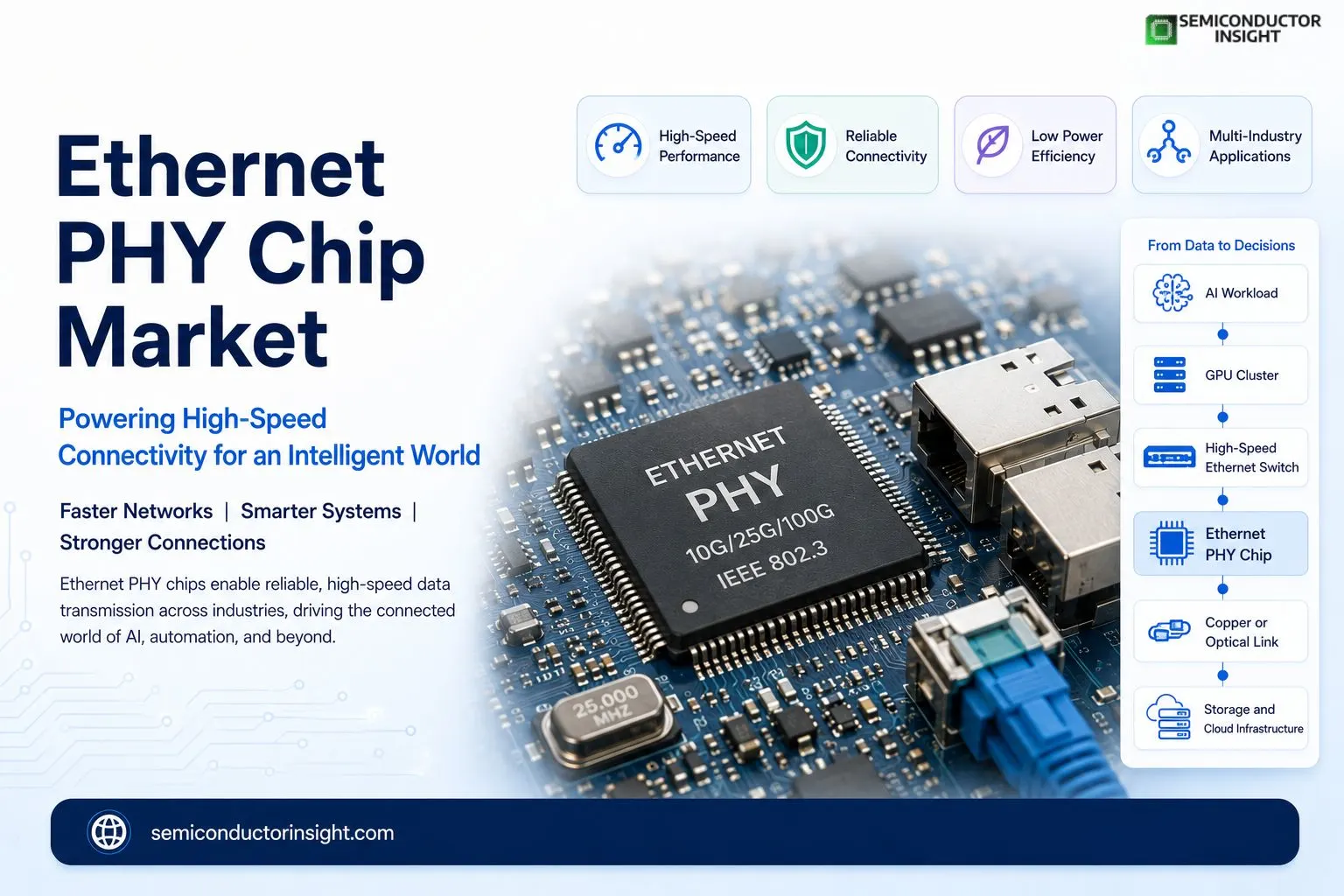
From Data to Decisions
AI Workload
│
GPU Cluster
│
High-Speed Ethernet Switch
│
Ethernet PHY Chip
│
Copper or Optical Link
│
Storage and Cloud Infrastructure

Comments (0)