

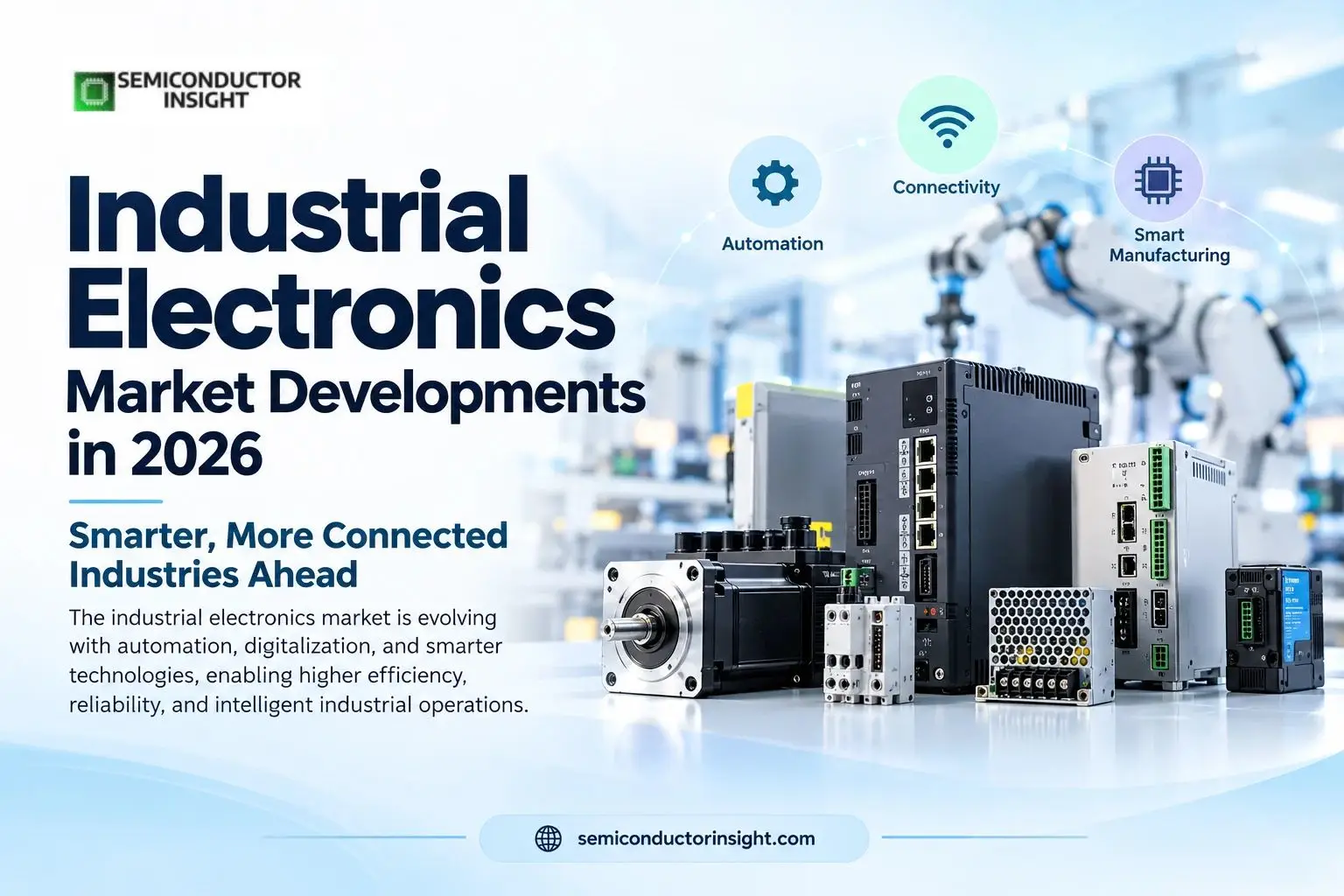
Industrial Electronics Market Developments in 2026 Reflecting a New Factory Era Built on AI Controls Sensors Robotics and Power Systems
Industrial electronics is undergoing a structural change. Equipment that once depended primarily on motors, mechanical controls and standalone programmable logic controllers is increasingly being built around sensors, embedded processors, power semiconductors, industrial networks and software.
The shift is visible in the World Economic Forum’s 2026 Intelligent Industrial Operations Outlook, which describes manufacturing moving from conventional automation toward connected, intelligent and increasingly autonomous operations. The emphasis is no longer simply on automating an individual machine but on connecting machines, people and production decisions in real time.
Electricity Is Creating a Bigger Hardware Footprint
The industrial electronics opportunity is closely tied to electrification. The IEA expects global electricity demand to grow by 3.6% in 2026, with industrial activity, electric vehicles, cooling, heat pumps and data centres contributing to the increase. It estimates that roughly 1,100 TWh of additional electricity demand will be added annually on average through 2030.
Every additional electrically powered industrial process creates requirements for conversion, protection, measurement and control.
That puts components such as:
- power modules
- motor drives
- industrial sensors
- controllers
- circuit protection
- converters and inverters
- embedded processors
Closer to the centre of modern production equipment.
AI Is Moving From the Server Room into Machinery
The most important technology change is the arrival of intelligence at the machine level. Instead of sending every piece of sensor information to a distant cloud platform, industrial systems can increasingly analyse data at or near the point where it is generated.
This enables machinery to detect abnormal vibration, monitor temperature, identify production defects and adjust operating parameters with much lower latency.
Siemens describes the convergence of AI, edge computing and industrial automation as an important pathway for improving productivity and machine transparency. Its industrial electronics environment increasingly connects IT and operational technology rather than treating them as separate systems.
The result is a new architecture:
Sensor → Edge processor → Industrial network → Controller → Power electronics → Machine action
Robotics Is Providing a Real-World Demand Signal
Robotics offers one of the clearest demonstrations of electronics moving deeper into industrial equipment. According to the International Federation of Robotics, global robot installations reached a record 603,000 units in 2025, while the operational stock exceeded 5 million robots. Electronics and automotive installations each increased by 10%, while metal and machinery installations grew by 22%.
Each robotic installation can require motion controllers, servo drives, position sensors, encoders, communications hardware, safety electronics and power-management components.
That means the industrial electronics market is increasingly connected to the physical expansion of automated production rather than being limited to conventional control cabinets.
Semiconductor Content Is Becoming More Visible
- Industrial machinery is also absorbing more semiconductor technology. Modern motor drives require power devices; machine-vision systems require image-processing hardware; autonomous equipment needs processors and connectivity; and predictive-maintenance systems depend on sensor interfaces and edge computing.
- The Semiconductor Industry Association’s 2026 industry assessment highlights the breadth of semiconductor use in transportation, communications, industrial equipment and other applications. It also notes that an AI server rack can contain more than 4,500 packaged chips, illustrating the extraordinary semiconductor intensity of modern computing infrastructure.
- Industrial equipment does not approach that level of chip density, but the direction is important: electronic intelligence is increasingly becoming embedded in physical infrastructure.
India Is Turning Smart Manufacturing into an Active Industrial Theme
India provides a useful current example of this transition. Rockwell Automation’s 2026 India manufacturing event brought together more than 1,200 attendees and 70 speakers across more than 30 sessions focused on AI-driven, digital and sustainable manufacturing. The discussions specifically connected these technologies with automotive, life sciences, food and beverage, semiconductor and electronics manufacturing.
This signals a broader shift from viewing factory automation as an isolated engineering function toward treating it as part of manufacturing strategy.
Power Electronics Is Becoming the Quiet Enabler
Behind intelligent machinery sits an equally important layer of power electronics. Electrified motors, variable-speed drives, charging systems, industrial robots and automated production lines all need precise conversion and regulation of electrical energy.
- The IEA’s latest electricity assessment describes industrial electrification as one of the forces contributing to the new “Age of Electricity”, while noting that electricity demand is increasingly being shaped by advanced manufacturing, EVs, data centres and other electricity-intensive applications.
This creates an important link between industrial electronics and semiconductor technologies such as silicon carbide and gallium nitride, particularly where higher switching performance, efficiency or power density becomes important.
To find out more, feel free to browse our latest updated report: https://semiconductorinsight.com/report/industrial-electronics-market/
From Connected Machines to Semi-Autonomous Production
The next phase is not simply adding more sensors. It is creating systems in which machines can interpret information and respond with limited human intervention.
A production line can therefore evolve through several stages:
- Standalone machine → Connected machine → Sensor-rich machine → Edge-intelligent machine → Coordinated autonomous production
The World Economic Forum’s 2026 outlook identifies this movement toward more adaptive and self-orchestrating industrial operations as a defining transformation in modern manufacturing.
For industrial electronics suppliers, this changes what customers increasingly value. Hardware must work reliably for long periods, communicate seamlessly with other equipment, process more information locally and operate efficiently under demanding industrial conditions.
Why 2026 Represents a Turning Point for Industrial Electronics?
Industrial electronics is no longer confined to PLCs and control panels. It now sits at the intersection of semiconductor innovation, industrial software, robotics, electrification, edge computing and AI.
With global electricity consumption continuing to rise, robot installations reaching record levels and manufacturers moving toward intelligent operations, the electronic content of industrial machinery is becoming strategically important.
The defining development in 2026 is therefore not simply that factories are becoming automated. It is that the machines themselves are becoming increasingly aware, connected and electronically controlled turning industrial electronics into one of the foundations of the intelligent manufacturing era.

Comments (0)