
How the High-Bandwidth Data Infrastructure Market Is Changing with PCIe 5.0 SSD Controller Chips?
PCIe 5.0 SSD controller chip market represents one of the most transformative segments within semiconductor storage architecture, enabling ultra-high data transfer speeds and advanced memory management for modern computing environments. These controller chips act as the central processing unit of solid-state drives, managing data flow between NAND flash memory and host systems while ensuring reliability, security, and performance optimization.
PCIe (Peripheral Component Interconnect Express) technology enables high-speed communication between storage devices and processors. Compared with earlier generations, PCIe 5.0 architecture delivers significantly higher bandwidth and throughput capabilities, making it essential for artificial intelligence workloads, cloud computing, and enterprise data centers.
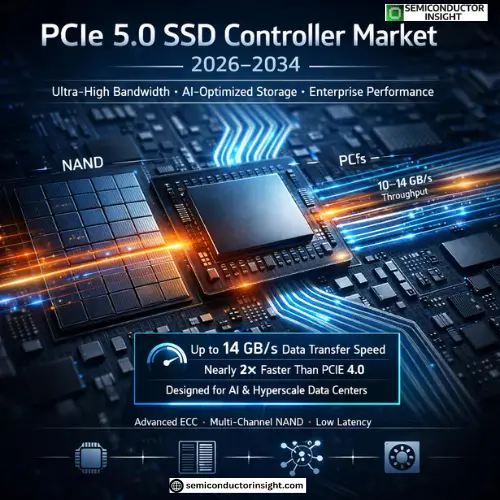
Next-generation PCIe 5.0 SSD controllers can achieve data transfer speeds exceeding 10-14 GB/s, nearly doubling the performance of PCIe 4 storage systems. This leap in performance is accelerating adoption across high-performance computing environments and enterprise infrastructure.
Technology Architecture Driving Market Expansion
PCIe 5.0 SSD controller chips are complex semiconductor components designed to manage parallel data processing, memory interface operations, and signal transmission efficiency. Their architecture integrates advanced error correction, NAND management, and power optimization features.
The controller typically supports multi-channel NAND flash architecture, enabling simultaneous data operations across several memory chips. This architecture improves throughput and reduces latency, which is essential for real-time data analytics and machine learning environments. SSD controllers manage communication with host systems through interfaces such as PCIe, which offers far higher bandwidth compared with SATA-based storage technologies.
Another defining feature is thermal management capability, as PCIe 5.0 systems generate higher heat due to increased data throughput. Semiconductor manufacturers are integrating advanced packaging materials and heat dissipation technologies to maintain operational stability.
Semiconductor Manufacturing and Chemical Dependencies
The development of PCIe 5.0 SSD controller chips relies heavily on advanced semiconductor fabrication processes and specialized materials. High-density integrated circuit design requires advanced lithography, wafer processing, and chemical mechanical polishing techniques.
The production process involves:
- High-purity silicon wafers and advanced photolithography chemicals for Nano scale circuit fabrication
- Chemical mechanical polishing slurries for surface precision
- Dielectric materials and conductive interconnect chemicals for signal transmission efficiency
These chemical inputs directly influence chip performance, signal integrity, and energy efficiency. As semiconductor nodes shrink below 10 nm, chemical purity and process control become critical competitive factors.
Demand Drivers Reshaping Industry Structure
The market’s expansion is closely tied to global digital infrastructure transformation. Increasing data generation and computational intensity require storage solutions with minimal latency and higher throughput.
The most influential demand catalysts include artificial intelligence computing, hyperscale data centers, and edge processing infrastructure. AI model training environments require extremely fast data access, making PCIe 5.0 controllers a strategic component in server architecture.
Enterprise data centers are also adopting PCIe 5.0 storage to manage large-scale workloads. Industry deployments show that high-performance storage adoption in enterprise servers continues to expand, particularly in cloud service environments where performance bottlenecks directly affect operational efficiency.
Consumer electronics represent another emerging segment. High-end gaming systems and workstations increasingly incorporate PCIe 5 storage technology to improve system responsiveness and load times.
You Can Freely Surf Our Latest Updated Report Here:
https://semiconductorinsight.com/report/pcie-5-0-ssd-controller-chip-market/
Performance Benefits and System Limitations
PCIe 5.0 SSD controller chips offer significant performance advantages, but they also introduce engineering challenges that influence market adoption.
Key advantages include superior data transfer rates, reduced latency, and improved system responsiveness, making them suitable for high-performance computing environments. Enhanced parallelism allows faster data processing and more efficient resource utilization.
However, the technology presents challenges related to power consumption and thermal management. Higher performance levels result in increased heat generation, requiring advanced cooling solutions and energy optimization strategies. Infrastructure upgrades may also be necessary for full compatibility with PCIe 5.0 systems.
Regional Technology Adoption Patterns
Global adoption of PCIe 5.0 SSD controllers varies across regions depending on semiconductor manufacturing capabilities and digital infrastructure maturity.
North America leads in data center deployment and high-performance computing adoption. Asia-Pacific plays a central role in semiconductor fabrication and NAND memory production, positioning the region as a key supplier of storage components. Europe emphasizes industrial automation and enterprise digital transformation, supporting steady demand for high-performance storage solutions.
Innovation Pipeline and Future Development Direction
Research initiatives in the PCIe 5.0 SSD controller market are focused on improving efficiency, scalability, and system integration. Manufacturers are developing controllers optimized for emerging technologies such as autonomous computing systems, real-time analytics platforms, and next-generation enterprise servers.
Future development areas include PCIe 6 transition preparation, AI-optimized storage controllers, and enhanced memory interface technologies. Integration of machine learning algorithms within controller architecture is expected to improve data management efficiency and predictive error handling.
Why This Market Matters for Semiconductor Ecosystems?
PCIe 5.0 SSD controller chip market plays a strategic role in modern semiconductor value chains by enabling faster computing infrastructure and supporting data-driven economies. Storage performance increasingly determines overall system efficiency, making controller innovation essential for next-generation electronics.
The market represents a critical intersection of semiconductor engineering, chemical materials science, and digital infrastructure development. Its evolution reflects broader industry trends toward high-performance computing, advanced memory technologies, and scalable data architectures.
As global data generation continues to expand rapidly, PCIe 5.0 controller chips are positioned to become foundational components in enterprise computing, artificial intelligence systems, and future semiconductor platforms.

Comments (0)