

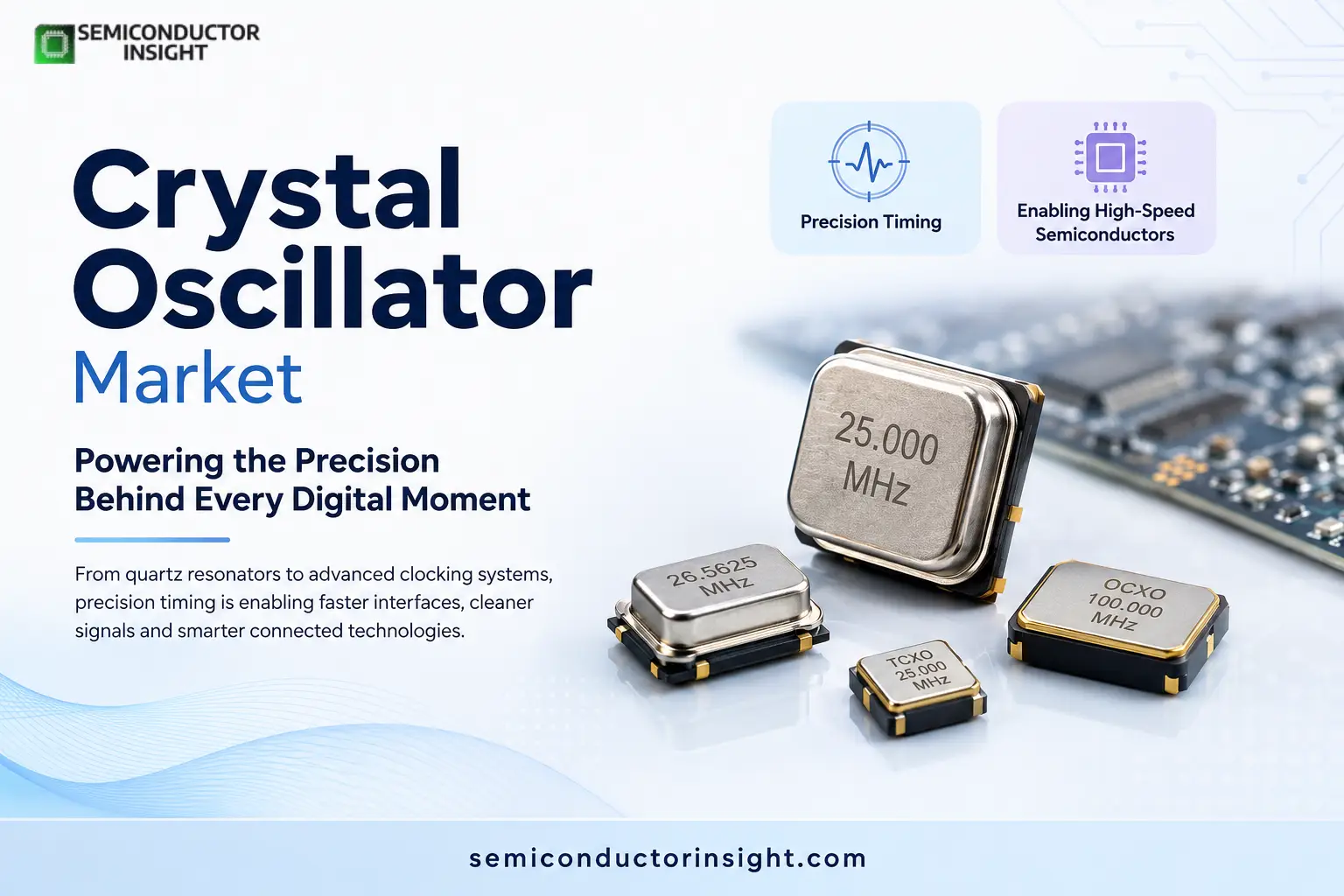
How Small Timing Errors Become Big System Problems in the Crystal Oscillator Market in 2026
A processor can have billions of transistors, but those transistors still need something remarkably simple to keep them coordinated: time. That is where the Crystal Oscillator Market becomes strategically important. Quartz-based oscillators generate stable reference frequencies that support processors, communications equipment, networking hardware, measurement instruments and countless embedded systems.
NIST explains that the quartz crystal acts as the resonator, using the piezoelectric effect to sustain oscillation, while the crystal’s size and cut determine its resonance frequency. Modern quartz oscillators generally use synthetic quartz, with typical quality factors ranging from 10⁴ to 10⁶.
The Real Product Is Not the Crystal Alone
- A modern oscillator is better understood as a timing subsystem.
- The quartz resonator establishes a highly stable reference, while electronics sustain the oscillation and may add temperature compensation, voltage control, frequency multiplication or clock conditioning.
- That distinction is becoming important as semiconductor systems demand cleaner timing.
- A reference such as 25 MHz or 26.5625 MHz can be fed into a clock-generation architecture and transformed into substantially higher-frequency outputs.
- Texas Instruments, for example, documents clock-generator devices accepting crystal references around this range and producing outputs reaching hundreds of megahertz.
The Numbers Are Moving Into the Femtosecond Zone
Frequency accuracy is only one part of the modern timing equation. Jitter the short-term variation in the timing of a clock edge has become a major specification for high-speed semiconductor interfaces.
The scale is striking. TI’s LMK04808 clock conditioner specifies 111 femtoseconds RMS jitter over a 12 kHz to 20 MHz integration range, while its architecture combines a low-noise crystal oscillator path with dual PLLs and an integrated VCO. Another TI clock-conditioning family specifies 150 fs RMS jitter over the same 12 kHz to 20 MHz range.
At this level, the conversation is no longer simply about producing a frequency. It is about preserving the cleanliness of that frequency as it travels through increasingly complex silicon.
Why High Speed Interfaces Are Changing the Design Brief?
The emergence of faster interconnect standards is pushing clock designers toward increasingly sophisticated architectures. TI’s current clock-generator portfolio, for instance, includes devices designed for PCIe Gen 1 through Gen 7, with configurations providing 4 or 8 outputs and reference-less BAW technology.
This illustrates an important transition. The oscillator increasingly operates as one part of a larger timing chain:
Quartz reference → oscillator → PLL → frequency multiplication → jitter cleaning → clock distribution → processor / accelerator / interface
The better each stage preserves phase integrity, the easier it becomes for high-speed semiconductor systems to maintain reliable data transfer.
A 3.3 V Reference Can End Up Driving GHz-Class Timing
- Clock technology also demonstrates how a relatively modest reference frequency can become the foundation for much faster system clocks.
- TI’s CDCM61001, for example, accepts crystal inputs including 24.8832 MHz, 25 MHz and 26.5625 MHz, while its integrated VCO operates from 1.75 GHz to 2.05 GHz. Another family reaches output frequencies up to 3.072 GHz.
- That frequency multiplication is particularly relevant to processors, networking equipment, data converters and communication infrastructure where synchronized high-speed clock domains must coexist.
Temperature Has Its Own Timing Signature
A crystal does not operate in isolation from its surroundings. Temperature can shift its frequency, which is why specialized architectures such as TCXO and OCXO exist. NIST describes an OCXO as an oven-controlled crystal oscillator that places the crystal inside a temperature-controlled environment to reduce temperature-related effects. The oven also introduces a warm-up period before the resonator and enclosure stabilize.
For industrial, telecom and instrumentation equipment, that trade-off can be worthwhile because timing stability can matter more than minimizing every millimeter or milliwatt.
Where the Semiconductor Demand Becomes Visible
Crystal oscillators appear in a surprisingly wide range of electronics. NIST identifies their use in counters, signal generators and oscilloscopes, while semiconductor clock architectures extend the same fundamental timing principle into networking, processors, communication systems and high-speed interfaces.
The application landscape is therefore expanding in several directions at once:
- High-speed networking requires clean reference clocks.
- Data-center hardware needs tightly controlled clock distribution.
- Automotive electronics increasingly depend on synchronized electronic control systems.
- Industrial equipment relies on stable timing under changing environmental conditions.
- Test and measurement systems require precise frequency references.
The Design-In Question Is Becoming More Sophisticated
Engineers are no longer asking only, “What frequency do we need?” The specification can involve frequency tolerance, aging, temperature stability, startup behavior, phase noise, RMS jitter, output format, supply voltage and clock fan-out.
One TI clock conditioner, for example, supports as many as 14 outputs, frequencies up to 3.072 GHz, and multiple output standards including LVCMOS, LVDS and LVPECL.
This creates a new competitive dimension for the Crystal Oscillator Market: the value increasingly lies in how effectively the reference can be integrated into the complete clock architecture.
Our most recent updated related study is available for free at this link: https://semiconductorinsight.com/report/crystal-oscillator-market/
The Next Clocking Battlefield Is Precision per Millimeter
The Crystal Oscillator Market is entering an interesting phase. Quartz remains an established resonator technology, but the surrounding semiconductor circuitry is becoming dramatically more sophisticated. Modern systems are combining crystal references with PLLs, VCOs, jitter cleaners and programmable clock distribution to support frequencies reaching the GHz range while targeting timing errors measured in femtoseconds.
That makes the humble quartz resonator part of a much bigger semiconductor story. In 2026, the most interesting development is not simply whether crystal oscillators remain relevant. It is how precisely their timing can be transformed, cleaned and distributed once it enters increasingly demanding silicon architectures.

Comments (0)