
Piezoelectric MEMS Foundry Service Market Insights
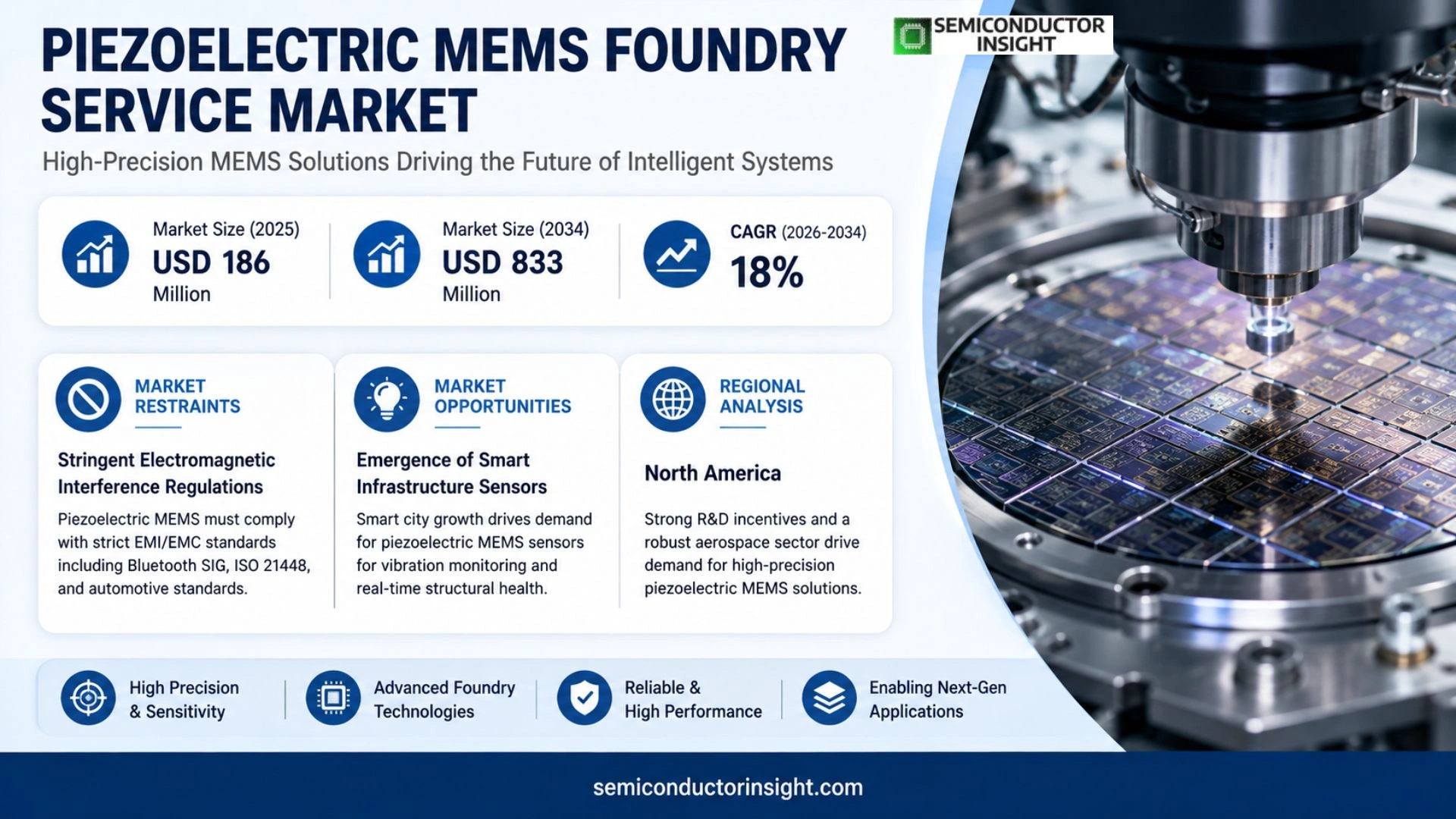
Piezoelectric MEMS Foundry Service market was valued at USD 186 million in 2025 and will expand toward USD 833 million by 2034, reflecting a CAGR of roughly 18% over the forecast period.
Piezoelectric MEMS foundry services provide end‑to‑end fabrication solutions that integrate piezoelectric materials such as lead zirconate titanate (PZT) or aluminum nitride (AlN) into microelectromechanical devices used as sensors or actuators.
The expansion reflects growing demand from Internet‑of‑Things platforms, automotive safety systems, wearable health monitors and portable power harvesters that require compact high‑performance transducers.
MARKET DRIVERS
Rising Demand for Miniaturized Actuators
The push toward smaller, lighter vehicles and mobile devices has elevated the need for compact, high‑performance actuators. Within this context, Piezoelectric MEMS Foundry Service Market is seeing increased deployment in automotive braking systems, where piezoelectric force sensors provide precise brake‑force feedback. Integration of these sensors into next‑generation electric vehicles fuels a global growth trajectory, with adoption rates climbing steadily year over year as safety regulations tighten. The industry is leveraging multiplexed sensor arrays to reduce wiring complexity, resulting in lower assembly costs and improved reliability. Practical deployments in energy‑harvesting applications, such as piezoelectric generators tapeters in roads and pedestrian walkways, also contribute to steady uptake, as infrastructure projects aim to generate clean energy while maintaining structural integrity. Muscular synergy between automotive OEMs and key suppliers is translating into expanded fab partnerships, thereby raising the profile of the foundry ecosystem. Manufacturers that can provide rapid, custom chip‑outs with integrated packaging are positioned to capture a growing share, as end‑users prioritize reliability and time‑to‑market, shaping procurement agendas across sectors.
Advancements in 3‑D Packaging Technologies
Three‑dimensional packaging breakthroughs support the evolution of high‑density MEMS device stacks, allowing multiple piezoelectric layers to be stacked without compromising signal fidelity. Engineers are exploiting vertical interconnects to decrease the effective footprint and elevate performance metrics for force transduction and acoustic steering. In the smart manufacturing curve, dedicated foundry facilities have introduced standardized encapsulation kits that facilitate cosmic‑field stress tolerance, a necessity for aerospace and high‑frequency radar applications. By incorporating thermally‑stable bonding materials, producers can meet stringent test protocols for extended life cycles, making the marketplace more attractive to OEMs eager to meet certification benchmarks. The confluence of low‑power sensors for wearables and the need for integrated power management modules encourages the development of homogenized solution portfolios, bounded by a single provider. The marketplace’s dynamic stator demands that foundry players expand their capacity for precise lithography and robust annealing workflows, thereby establishing a competitive edge in product quality and response times.
➤ Foundry Capability Expansion Enables Rapid Prototyping. The ability to iterate within a week rather than months directly translates into cost savings and accelerated time‑to‑deployment for end users.
Looking ahead, the integration of AI‑driven design automation tools in fab operations is setting a new standard for yield optimization. By incorporating machine‑learning algorithms into fabrication process controls, foundries can pre‑emptively adjust etch parameters to preserve critical dimensions on piezoelectric films. This translates into a more predictable reliability margin across large‑scale production runs, a factor that is now increasingly demanded by both automotive safety committees and industrial automation bodies. As a result, the combination of lower defect rates and faster turnaround positions Piezoelectric MEMS Foundry Service Market to secure a commanding role in sectors where precision and uptime are paramount. The ripple effect extends to lower overall cost of ownership for end users, thereby reinforcing a virtuous cycle of demand growth and technology advancement.
MARKET CHALLENGES
Capital‑Intensive Equipment Depreciation
Improvements in lithography and deposition technologies come with a steep financial outlay. Foundry operators must amortize high‑cost, state‑of‑the‑art equipment within a narrow timeframe, pressuring profit margins throughout the supply chain. In addition, the necessity to maintain stringent environmental controls adds operating overhead, as temperature‑controlled reactors and clean‑room facilities demand significant energy consumption. While steady margins are achievable through economies of scale, the demand for incremental thrift,essentially the financial resilience to absorb slow market cycles,remains a notable constraint for smaller players. The ripple effect extends to service portfolios, where less‑experienced foundries may marginally lag behind in delivering clean‑room-compatible, high‑density piezoelectric structures, thus compromising on unit cost versus quality trade‑offs. Furthermore, short‑cycle device development demands a rapid response to changing standards, which in turn calls for continually upgraded testing equipment,a lag that can impede compliance with evolving safety certifications and standards used by semiconductor regulators.
Other Challenges
Silicon Wafer Supply Variability
The heterogeneity of silicon feedstock quality can cause variations in piezoelectric film adhesion and uniformity. Even minor deviations in thickness or defect density influence the ultimate actuation performance, demanding rigorous pre‑fabrication inspection protocols. As a result, foundry operators must allocate resources toward advanced witness wafers and inline metrology, which raises per‑unit costs and limits the ability to publish predictable lead times. Moreover, global trade fluctuations can exacerbate supply chain vulnerabilities, particularly in regions where tariffs affect the importation of ultra‑precise lithography equipment and high‑grade semiconductor materials.
MARKET RESTRAINTS
Stringent Electromagnetic Interference Regulations
In industrial and automotive contexts, piezoelectric MEMS devices must meet rigorous electromagnetic interference (EMI) and electromagnetic compatibility (EMC) standards, such as those set by the Bluetooth SIG, ISO 21448, and automotive body‑structure standards. Failure to comply can lead to costly redesigns, licensing hurdles, and delayed product launches. The chemical compatibility requirements for encapsulating epoxy resins are also tightening, especially for aerospace applications where thermal cycling and vibration stresses impose strict material limits. These factors bark in as significant barriers to entry for nascent foundry entrants. The price of remediation,whether through redesign, testing, or material procurement,is amplified by the off‑spec production mode that many orphan facilities currently adopt, thereby stifling the overall economy of scale in Piezoelectric MEMS Foundry Service Market.
MARKET OPPORTUNITIES
Emergence of Smart Infrastructure Sensors
The rise in smart city initiatives is creating a fertile field for piezoelectric MEMS sensors capable of mapping ambient vibration and monitoring bridge health in real time. By embedding micro‑actuators into structural elements, cities can collect valuable data on dynamic stresses and predict maintenance windows, which are especially valuable for critical transport assets. The need for low‑profile, high‑sensitivity devices coupled with the ability to function in harsh outdoor environments positions the Marketplace as both a technological and economic catalyst. The roll‑out of regional mesh‑networks for civil engineering diagnostics is slated for expansion, enhancing sensor density and data granularity. Foundry providers who secure long‑term supply agreements with municipal authorities will therefore be primed to capture a sizeable share of this nascent market segment, while also benefiting from predictable revenue streams and enhanced brand recognition across multiple cities.
Piezoelectric MEMS Foundry Service Market Trends
Advances in CMOS‑Compatible Deposition
As Piezoelectric MEMS foundry service market continues its ascent, the most compelling driver is the maturation of CMOS‑compatible deposition processes. Traditional piezo materials such as lead zirconate titanate had long resisted integration with mainstream silicon photonics, largely due to stoichiometry drift and phase‑purity requirements. Recent advances in chemical solution deposition and template‑guided patterning have closed this gap, enabling deposition temperatures below 500 °C and sub‑nanometre thickness control. The result is a new class of thin‑film transducers that can be stacked directly onto logic layers without sacrificing device yield, thereby removing a key barrier that once limited sensor‑to‑actuator throughput.
Other Trends
Sustainability and Raw Material Costs
Lead‑free piezo stacks, based on bismuth‑based perovskites, now exhibit comparable d33 coefficients while eliminating hazardous waste streams. Transitioning to these formulations has tightened supply chain risk, as rare‑earth‑free compositions sidestep geopolitical tension that historically disrupted lead supply. The cost smoothing these alternatives brings translates into a tighter gross‑margin squeeze for foundries, especially those with high‑volume fabrication lines. Consequently, investors scrutinise capital allocation toward green‑chemistry R&D as a differentiator in pricing strategy, a trend increasingly visible across Piezoelectric MEMS foundry service market.
Geographic Competitive Landscape
Market leadership remains concentrated in North America, where Piezoelectric MEMS foundry service market is dominated by the top three manufacturers,Bosch, STMicroelectronics, and ROHM,which collectively capture approximately 84 % of the share. These incumbents leverage deep customer relationships within automotive and industrial sectors, while the Asia‑Pacific region lags behind in mature foundry capacity despite robust demand driven by consumer electronics. Increasing import tariffs and domestic policy incentives are spurring regional fabs, but these new plants must achieve expertise in low‑temperature deposition to match the premium quality required by high‑end medical sensors.
IoT‑Driven Demand Explosion
Second, the explosion of IoT and wearable platforms has forged a new ecosystem for MEMS transducers. Embedded sensors now occupy a critical slot in next‑generation smartphones and fitness trackers, where power budget and footprint dictate the choice of material stack. As cellular networks transition to 5G, the need for miniature, high‑bandwidth sensors in base‑band and antenna feeds accelerates fabrication demand. Foundries that combine rapid prototyping cycles with on‑demand batch release gain a foothold in these fast‑moving verticals. For growth‑oriented operators, aligning supply chain capabilities with emerging application requirements will remain the decisive lever for capturing market share in an environment where bandwidth, power, and size increasingly govern competitive advantage.
COMPETITIVE LANDSCAPE
Key Industry Players
Piezoelectric MEMS Foundry Service Market Landscape
Piezoelectric MEMS Foundry Service market is dominated by a trio of integrated manufacturing leaders,Bosch, STMicroelectronics, and ROHM,who control roughly 84 % of global revenue. Their ascendancy stems from the ability to navigate two pivotal technical hurdles that have historically confined piezoelectric integration: stoichiometric precision in lead zirconate titanate (PZT) deposition, and the incompatibility of conventional piezoelectric chemistries with standard CMOS back‑end processes. By investing heavily in chemical‑solution deposition facilities and developing proprietary low‑temperature sputtering recipes, these firms deliver ceramic layers that retain crystalline integrity while remaining CMOS‑ready. Their manufacturing footprints in North America, Europe, and Asia‑Pacific enable a supply chain that supports the rising demand for compact, low‑power transducers in 5G, wearable, and medical devices. The geographic weight of the market,35 % in North America, followed by 29 % in Europe and 28 % in Asia Pacific,further underscores the strategic alignment of production capacity with end‑user concentration. Additionally, their average gross‑margin band between 35 % and 55 % allows for reinvestment into research that smooths the cost escalations associated with exotic material synthesis. The result is a self‑reinforcing position where these incumbents can absorb volatility in commodity raw‑material costs while still offering competitive pricing to high‑growth verticals.
The competitive landscape is, however, enriched by a cohort of specialized suppliers who deliver complementary capabilities or serve adjacent market segments. Silex Microsystems, for example, has carved out a niche by mastering sub‑micron PZT patterning that enables ultra‑compact resonators for next‑generation auditory sensors. Infineon Technologies, through its integration of piezoelectric actuators into automotive engine management systems, demonstrates the application‑specific value that niche providers bring. Murata Manufacturing and TDK Corp focus on high‑volume passive component production, leveraging bulk‑sintered piezo powders to achieve cost efficiencies that appeal to consumer‑electronics assemblers. Advanced Technologies like Silicon Micro provide rapid prototyping services, allowing smaller OEMs to test sensor architectures without large capital commitments. NXP Semiconductors offers a suite of micro‑electromechanical switches that marry piezoelectric actuation with silicon‑based logic, creating hybrid modules that reduce board real estate. Texas Instruments supplies high‑performance drive electronics that complement MEMS sensor production, while COCODA offers low‑noise signal conditioning tailored to biomedical instrumentation. Collectively, these niche players fill the gaps left by the baseline incumbents,in areas of ultra‑thin film processing, region‑specific supply chain resilience, or highly specialized application bundles,thereby sustaining a vibrant ecosystem that can accelerate entry of new technologies such as energy harvesting modules for implantable devices or micro‑actuators for automotive sensor arrays.
List of Key Piezoelectric MEMS Companies Profiled
- Bosch
- STMicroelectronics
- Silex Microsystems
- Infineon Technologies
- ROHM
- Murata Manufacturing
- TDK Corp
- Silicon Micro
- Advanced Technologies
- Texas Instruments
- COCODA
- Micron Electric
Segment Analysis:
| Segment Category | Sub-Segments | Key Insights |
| By Type |
|
MEMS Sensor Foundry drives the rapid adoption of piezoelectric sensing across consumer, automotive and industrial ecosystems. • Surging demand from Internet of Things and wearable devices fuels deployment in miniature sensors. • Integration into safety‑critical automotive systems enhances reliability and fault tolerance. • Prolonged use in medical diagnostics offers non‑invasive, high‑resolution monitoring solutions. |
| By Application |
|
Consumer Electronics is the leading application domain, powering next‑generation smartphones, wearables, and home IoT hubs. • Modular piezoelectric panels enable ultra‑compact vibration and pressure sensors. • Energy harvesting modules reduce battery dependence in portable gadgets. • High‑density integration supports advanced touch and motion sensing with minimal form factor. |
| By End User |
|
Automotive leverages piezoelectric MEMS to enhance safety and performance. • Advanced driver assistance systems (ADAS) rely on precise, low‑power vibration sensors. • Structural health monitoring of autonomous vehicles improves durability and maintenance planning. • Low‑drift, high‑resolution sensors support real‑time diagnostics for predictive maintenance. |
| By Device Complexity |
|
High‑Complexity Integrated Chips combine piezoelectric transduction with on‑chip electronics, enabling dense sensor arrays. • Facilitates multi‑axis motion detection in confined spaces. • Demands advanced chemical‑solution deposition and patterning techniques. • Higher technical barriers translate into premium pricing and improved gross margins. |
| By Integration Level |
|
System‑on‑Chip (SoC) Integration transforms piezoelectric MEMS into scalable, cost‑effective modules. • Eliminates external wiring, reducing assembly complexity in smartphones. • Enables firmware‑controlled sensor calibration, enhancing performance. • Batch‑processing of SoCs drives volume manufacturing efficiencies. |
Regional Analysis: Piezoelectric MEMS Foundry Service Market
North America
North American firms have accelerated deployment of hybrid piezoelectric‑MEMS units, blending silicon and lead‑free thin films to meet stringent emission regulations.
Native fab capabilities and strong logistics ecosystems give local manufacturers a swift response window to OEM demands across automotive and medical sectors.
Stringent safety standards and data‑protection mandates drive a move toward certified, tamper‑proof MEMS sensors in critical applications.
Venture capital flowing into consolidating startups signals confidence in sustained growth among piezoelectric MEMS startups.
North America
North America’s piezoelectric MEMS foundry ecosystem thrives on a synergy between deep‑tech research grants and an established automotive component supply chain. The presence of national standards bodies has accelerated the adoption curve, allowing suppliers to embed advanced actuation modules in safety‑critical vehicles with confidence. Furthermore, the region’s focus on carbon‑neutral manufacturing is fostering collaboration with energy‑storage companies that require high‑responsivity vibration sensors for battery health monitoring. Capital deployment by private‑equity funds earmarked for next‑generation MEMS is ensuring that independent foundries remain flexible, mitigating the risk of single‑point bottlenecks for niche piezoelectric applications. Optional regulatory pushes are also nudging OEMs to favour hardware that offers built‑in tamper‑detection, a feature where the region’s skilled workforce is already proving competitive.
Europe
European markets balance rapid tech uptake with stringent environmental concerns. Local manufacturers are pursuing low‑emission fabrication processes, which dovetails with the EU’s Green Deal objectives, and this dual drive shapes their approach to piezoelectric MEMS services. Investors are channeling resources into clean‑tech spin‑offs that specialise in lead‑free piezo arrays, recognizing the key role of components in the renewable‑energy sector. However, regional trade barrier uncertainties and a comparatively smaller domestic fab footprint can impose higher lead times for bespoke sensor arrays. The prevailing regulatory emphasis on data integrity in industrial IoT deployments, meanwhile, creates a premium market for certified, tamper‑resistant MEMS modules that underpin critical control systems.
Asia‑Pacific
The Asia‑Pacific region remains the most dynamic contender for piezoelectric MEMS foundry services, driven by a convergence of high‑density electronics manufacturing and exploding automotive sensor demand. Sub‑regional players such as Korea and Japan are renowned for precision grids, whereas emerging foci in India and Southeast Asia are carving out niches in cost‑effective production. The symbiosis between regional electronics hubs and the burgeoning autonomous vehicle corridor enhances the value proposition of miniature, high‑frequency piezoactuators. Yet, barriers such as limited access to advanced lithography tools and a fragmented patent landscape create an uneven playing field for global leaders. Government‑backed incubation programmes are attempting to level this field, but the current pace of change demands agility from firms willing to co‑develop next‑generation platform technology with OEM partners.
South America
In South America, piezoelectric MEMS foundry activity is in a nascent phase, with only a handful of fabrication facilities strategically positioned near automotive clusters. The region’s growing renewable‑energy projects are catalysing early adopter interest in vibration control and energy harvesting modules, even though local capital markets remain cautious. Regional trade agreements that reduce import duties on semiconductor equipment are encouraging the gradual establishment of in‑house lithography setups, with Brazil leading the charge in relocating test beds to domestic hubs. Challenges lie in scarcity of specialised talent and uneven policy frameworks, which urge multinational the landscape to navigate variable regulatory standards and uneven infrastructure investment to sustain a high‑density sensor output.
Middle East & Africa
The Middle East & Africa’s piezoelectric MEMS fragment offers a patchwork of nascent investment, primarily focused on defense and infrastructure projects. Emerging sovereign wealth funds have started funding pilot programmes that integrate piezoactuation technology into unmanned aerial platforms and smart‑grid monitoring nodes. Nevertheless, the region lacks a robust domestic fabrication ecosystem, and core skill deficits impede rapid scale‑up. Governance frameworks that emphasise technology sovereignty are spurring local enterprises to engage in off‑shoring agreements with established foundries in Europe and Asia, creating hybrid supply chains that provide incremental resilience but prolong lead times. The resulting market is therefore a high‑risk, high‑potential niche that demands precise partnership alignment from global players.
Report Scope
This market research report provides a comprehensive analysis of the Piezoelectric MEMS Foundry Service Market , covering the forecast period 2026–2034. It offers detailed insights into market dynamics, technological advancements, competitive landscape, and key trends shaping the industry.
Key focus areas of the report include:
- Market Overview: The report begins with an overview outlining its current market scenario, key growth indicators, and industry transformation drivers. It discusses macroeconomic factors, demand–supply balance, regulatory landscape, and the strategic role of semiconductors in powering advancements across industries such as automotive, telecommunications, consumer electronics, and industrial automation.
- Market Size & Forecast: Historical data and future projections for revenue, unit shipments, and market value across major regions and segments.
- Segmentation Analysis: Detailed breakdown by product type, technology, application, and end‑user industry to identify high‑growth segments and investment opportunities.
- Regional Insights: Insights into market performance across North America, Europe, Asia-Pacific, Latin America, and the Middle East & Africa, including country‑level analysis where relevant.
- Competitive Landscape: Profiles of leading market participants, including their product offerings, R&D focus, manufacturing capacity, pricing strategies, and recent developments such as mergers, acquisitions, and partnerships.
- Technology Trends & Innovation: Assessment of emerging technologies, integration of AI/IoT, semiconductor design trends, fabrication techniques, and evolving industry standards.
- Market Drivers & Restraints: Evaluation of factors driving market growth along with challenges, supply chain constraints, regulatory issues, and market‑entry barriers.
- Stakeholder Insights: Insights for component suppliers, OEMs, system integrators, investors, and policymakers regarding the evolving ecosystem and strategic opportunities.
Primary and secondary research methods are employed, including interviews with industry experts, data from verified sources, and real‑time market intelligence to ensure the accuracy and reliability of the insights presented.
FREQUENTLY ASKED QUESTIONS:
What is the current market size of Piezoelectric MEMS Foundry Service Market?
-> Piezoelectric MEMS Foundry Service market will expand toward USD 833 million by 2034, reflecting a CAGR of roughly 18% over the forecast period.
Which key companies operate in Piezoelectric MEMS Foundry Service Market?
-> Key players include Bosch, STMicroelectronics, ROHM, and Silex Microsystems, whose combined market share accounts for about 84% of the global market.
What are the key growth drivers?
-> Key growth drivers include the explosive growth of Internet of Things and 5G communications, increasing demand for wearable device sensors, medical sensor applications, and advancements in low‑cost, high‑quality deposition processes for piezoelectric materials.
Which region dominates the market?
-> North America holds the largest market share of approximately 35%, followed by Europe 29% and Asia Pacific 28%.
What are the emerging trends?
-> Emerging trends include integration of piezoelectric MEMS with standard CMOS technology, energy harvesting solutions, AI‑enabled sensor analytics, and the rapid adoption of micro‑sensors in wearable devices and smartphones.
Get Sample Report PDF for Exclusive Insights
Report Sample Includes
- Table of Contents
- List of Tables & Figures
- Charts, Research Methodology, and more...

