
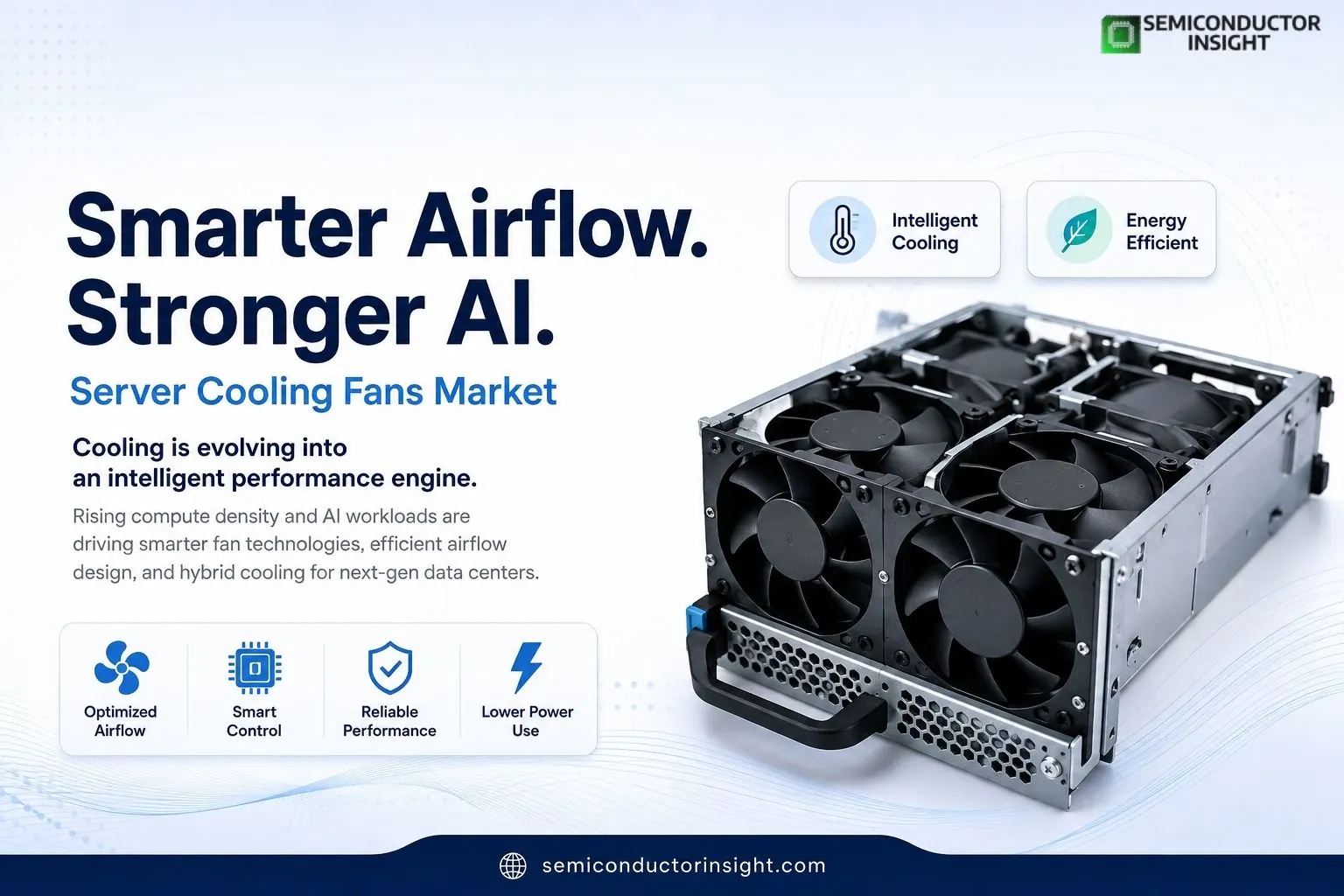
How Much Airflow Does Modern Computing Need and What Does It Mean for the Server Cooling Fans Market?
The semiconductor industry’s AI race is creating a thermal problem that is easy to overlook. More powerful processors generate more heat, and that heat must be removed continuously if servers are to maintain performance and reliability.
Cooling fans remain an important part of this equation, particularly in conventional air-cooled servers. But their role is changing. Instead of simply moving air through a chassis, modern fan assemblies are becoming electronically controlled thermal components that respond to processor workload, inlet temperature, pressure requirements and system-level control algorithms.
ASHRAE’s data-center guidance specifically recommends variable fan-speed control, airflow optimization and granular temperature monitoring rather than simply supplying excessive airflow.
A New Thermal Benchmark Is Emerging
- The scale of current AI hardware explains why server cooling has become such a prominent engineering issue. NVIDIA’s GB200 NVL72 combines 36 Grace CPUs and 72 Blackwell GPUs in a single rack-scale system. It uses liquid cooling because the thermal density is substantially different from conventional CPU-only servers.
- NVIDIA specifies 130 TB/s of NVLink bandwidth for the GB200 NVL72 and positions the system for trillion-parameter AI workloads. Such configurations illustrate why cooling engineers increasingly consider the rack, rather than an individual server, as the thermal design unit.
This creates a clear progression:
Higher compute density → greater heat generation → tighter airflow requirements → advanced fan control → hybrid or liquid cooling
Fan Engineering Is Becoming More Intelligent
The modern server fan is no longer simply an on/off mechanical device. Fan speed can be dynamically adjusted according to workload and temperature conditions.
ASHRAE notes that advanced control algorithms can vary server fan speeds and airflow according to usage models, while sensors provide the information needed for thermal and power-management decisions. It also identifies fan selection and airflow management as fundamental elements of server thermal design.
This makes PWM-controlled fans, electronically commutated motors, tachometer feedback and intelligent fan curves increasingly relevant to server manufacturers.
The practical objective is straightforward: deliver enough airflow to protect components without wasting electrical energy by operating every fan at maximum speed.
The 20 to 30°C Temperature Rise Matters
A useful technical indicator comes from ASHRAE’s server thermal guidance. For servers operating within recommended inlet-temperature conditions, a temperature rise through the equipment of approximately 20°C to 30°C is common.
That seemingly simple range has major implications for fan design. If airflow is insufficient, component temperatures rise. If airflow is excessive, fan power and acoustic output increase.
Consequently, manufacturers are increasingly balancing three variables simultaneously:
Airflow volume + Static pressure + Fan electrical efficiency
The winning design is not necessarily the fan that moves the most air. It is the fan that delivers the required thermal performance at the lowest practical system penalty.
AI Is Changing Where Air Cooling Stops Making Sense
- The expansion of AI data centers is pushing thermal architectures toward a mixed model.
- NVIDIA’s GB200 NVL72 is already a liquid-cooled rack-scale platform, while NVIDIA reports that liquid cooling can substantially reduce dependence on energy-intensive cooling fans in high-density systems.
- NVIDIA also cites a 132 kW-per-rack liquid-cooling capability in Schneider Electric infrastructure supporting GB200 NVL72 deployments.
- This does not mean server fans are disappearing. Instead, the market is becoming segmented. Conventional CPU servers, storage systems, networking equipment and many edge systems continue to depend heavily on forced-air cooling, while the hottest AI accelerators increasingly move toward direct liquid cooling.
Electricity Is Turning Cooling Into an Efficiency Metric
The thermal discussion is becoming inseparable from electricity consumption. The International Energy Agency reported in April 2026 that data-center electricity demand increased 17% during 2025, while electricity use from AI-focused data centers grew even faster. It projects total data-center electricity consumption to double by 2030.
That makes every watt consumed by cooling hardware more consequential.
For fan manufacturers, efficiency is therefore shifting from a component-level specification to a data-center economics issue. Better motor efficiency, optimized blade geometry, lower vibration, intelligent speed control and improved airflow paths can collectively influence the energy profile of an entire server fleet.
You Can Freely Surf Our Latest Updated Report Here: https://semiconductorinsight.com/report/server-cooling-fans-marketsize-share-trends-market/
What Is Being Redesigned Inside the Server?
The next generation of server cooling is increasingly built around coordinated thermal zones rather than identical fans running at identical speeds. ASHRAE describes fan-zone approaches in which fans serving highly stressed components can operate differently from those serving less thermally demanding areas.
This opens several design opportunities for semiconductor and server OEMs:
- Higher static-pressure fan geometries for dense heatsinks
- Sensor-linked variable-speed operation
- Smaller fan modules for localized thermal zones
- Redundant fan arrangements for mission-critical systems
- Hybrid air-and-liquid architectures
- Firmware-controlled thermal response
The Server Fan Market Is Entering a Different Phase
The defining change in 2026 is not simply that data centers need more fans. It is that cooling hardware is becoming increasingly tied to compute architecture.
As AI accelerators become more densely packaged, some of the highest-power systems are moving toward liquid cooling. At the same time, enormous volumes of conventional servers, storage platforms, networking equipment and edge infrastructure still require sophisticated air movement.
That creates a two-track opportunity for the server cooling fans market: higher-performance airflow components for air-cooled systems and smarter, more selectively deployed fan architectures for hybrid environments.
The fan is no longer just the component that keeps a server cool. In the AI era, it is becoming part of the system’s power, performance, reliability and control strategy.

Comments (0)