
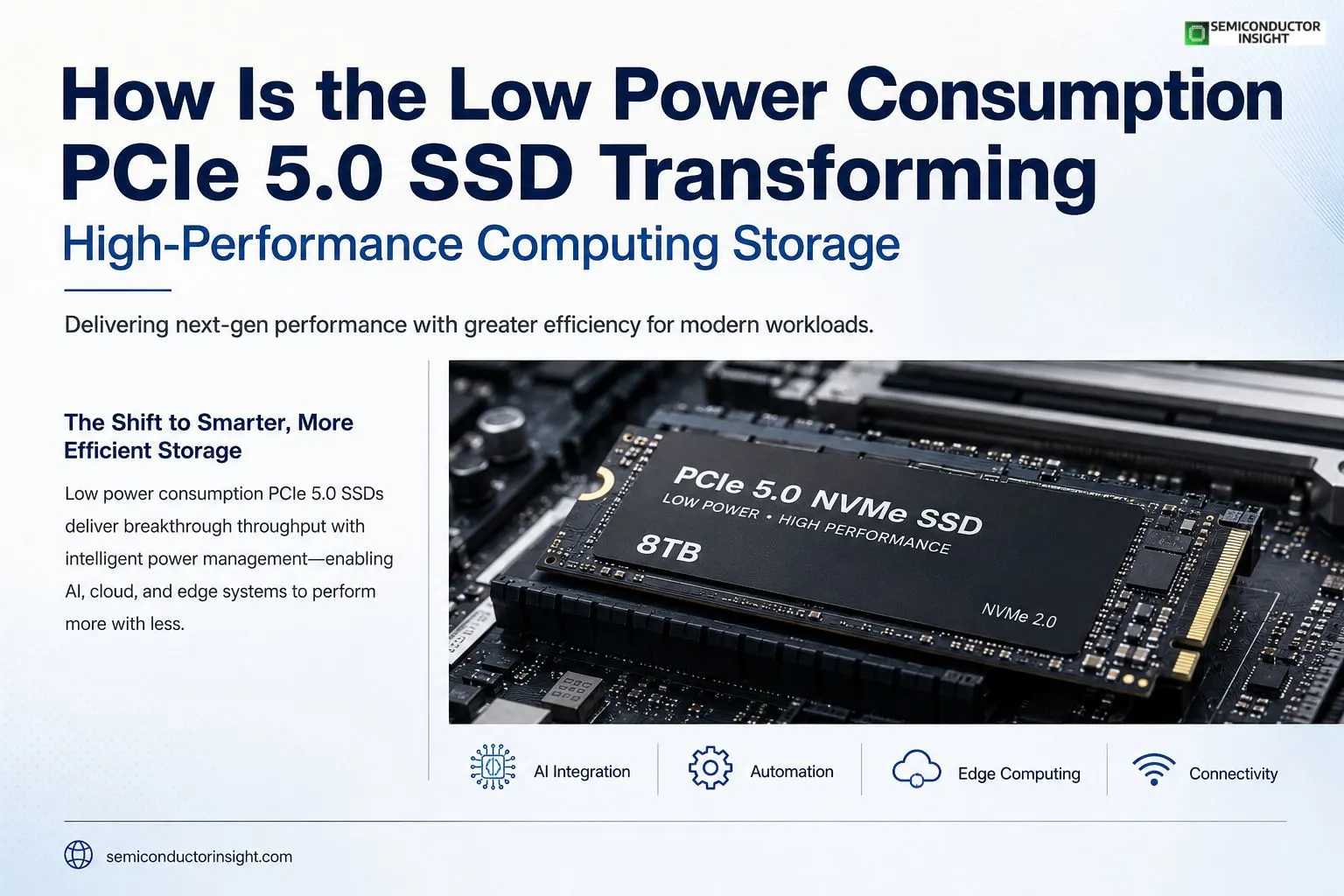
How Is the Low Power Consumption PCIe 5.0 SSD Market Transforming High-Performance Computing Storage in 2026?
The semiconductor space continues pushing boundaries with storage solutions that deliver exceptional throughput while keeping energy demands in check. Low power consumption variants of PCIe 5.0 SSDs stand out by pairing doubled bandwidth potential over previous generations with smarter power management features. These drives support demanding environments like AI inference, cloud computing, and high-performance client systems without excessive heat or electricity draw.
ü Recent product introductions showcase this balance clearly.
ü In April 2026, KIOXIA launched its BG8 Series SSDs aimed at mainstream client PCs.
ü Built on BiCS FLASH generation 8 TLC memory, these DRAM-less designs leverage Host Memory Buffer technology to maintain strong performance while optimizing power usage across slim laptops and notebooks.
ü They comply with PCIe 5.0 x4 and NVMe 2.0 standards, emphasizing flexibility for both consumer and commercial setups.
Timing Solutions for Ultra-Low Power IoT Integration with PCIe 5.0 SSDs
When designing battery-powered IoT sensors that connect to or feed data into low power consumption PCIe 5.0 SSD systems, timing components significantly impact overall energy efficiency. SiTime’s MEMS-based clocks generally offer lower power consumption compared to traditional Renesas crystal oscillators in these scenarios.
SiTime MEMS devices excel with standby currents as low as 0.7-1.5 µA and fast startup times, eliminating external capacitors while providing strong vibration resistance. Renesas crystal oscillators typically consume 2-5 µA or more in standby, depending on supporting circuitry.
For edge IoT nodes paired with energy-efficient PCIe 5.0 SSD storage, SiTime MEMS timing helps minimize auxiliary power draw, extending battery runtime and supporting sustainable high-performance data handling.
Technical Foundations Enabling Efficiency
PCIe 5.0 doubles the per-lane data rate to 32 GT/s compared to PCIe 4.0, reaching up to 64 GB/s bidirectional on x4 configurations. Low power implementations focus on controller optimizations, advanced NAND flash, and features like dynamic power states.
Recent notes that high-performance SSDs generally consume half to a third the power of traditional HDDs, with modern PCIe variants refining this further through better idle and active management.
Representation of Data Path in Low Power PCIe 5.0 SSD:
Host System → PCIe 5.0 Lane Negotiation → Controller with HMB/Advanced Power Gating → NAND Flash Access (BiCS8 or equivalent) → NVMe Command Processing → Efficient Data Transfer with Minimal Latency Spikes.
Notable Deployments and Product Examples
Kingston’s DC3000ME enterprise U.2 SSDs target hyperscale data centers with PCIe 5.0 NVMe, delivering consistent low latency for demanding workloads. Lenovo’s ThinkSystem CD9P mixed-use drives reach capacities up to 12.8 TB, with documented power figures showing active efficiency suitable for server environments (typical power in low single-digit watts range depending on workload).
Samsung’s 9100 PRO series and hybrid-interface models like the 990 EVO demonstrate versatility, running in PCIe 5.0 x2 or 4.0 x4 modes while controlling thermal profiles. In client space, newer controllers from Silicon Motion and Phison have lowered average active power to around 6.5-7W during sustained operations, enabling standard heatsink usage without throttling.
Example Power and Performance Indicators (Approximate from Recent Releases)
o The latest PCIe Gen5 SSDs are being designed across both client and enterprise segments to deliver higher capacity, faster performance, and better power efficiency. For example, the KIOXIA BG8 Series is built on a PCIe 5.0 x4 interface and is aimed at client-focused use, with HMB optimization helping balance performance and efficiency.
o On the enterprise side, the Kingston DC3000ME uses a PCIe 5.0 interface in a U.2 form factor and is designed for low-latency data center operations. Meanwhile, various 2025-2026 Gen5 SSDs based on PCIe 5.0 x4 are expected to reach capacities of up to 8TB and beyond, while operating at around 6.5-7W active power thanks to newer controller designs.
Integration with Broader System Architectures
These SSDs pair effectively with EDSFF form factors like E1.S and E1.L, which enhance serviceability, cooling, and density in hyperscale racks. SNIA resources highlight how such designs improve TB/W (terabytes per watt) metrics, supporting more efficient storage consolidation.
In AI contexts, drives benefit from NVMe 2.0+ features such as Zoned Namespaces (ZNS) for reduced write amplification and better endurance, alongside power states that scale bandwidth dynamically. Micron’s work on subsequent Gen6 previews further efficiency gains, but PCIe 5.0 low-power models already deliver measurable improvements in energy per operation for random reads and writes.
Operational Impact in Real Scenarios
Data centers handling massive parallel tasks see advantages in reduced overall rack power budgets. Client devices gain longer battery life or quieter operation under load.
Community and review data from 2025-2026 testing periods show newer Gen5 drives maintaining high IOPS while staying cooler than early implementations, thanks to 6-7nm controller processes and refined firmware.
To Stay Tuned with More meaningful and In-Depth Insights, Do Visit here:
Pointer Highlights on Usage Patterns:
- Enterprise arrays prioritizing consistent low-latency access for virtualized environments.
- Edge computing nodes where thermal and power constraints limit traditional high-performance options.
- Creative workstations managing large media files with sustained transfers but controlled energy profiles.
- AI inference servers leveraging fast random access without proportional power spikes.
Stay connected for additional in-depth information right here: https://semiconductorinsight.com/report/low-power-consumption-pcie-5-0-ssd-market/
Forward Momentum in Semiconductor Storage
Ongoing refinements in flash memory, controller silicon, and interface standards keep expanding what low power PCIe 5.0 SSDs can achieve. From optical-assisted concepts explored by Kioxia collaborations to broader NVMe specification updates targeting energy savings, the focus remains on practical, deployable efficiency at scale.
These solutions quietly underpin much of today’s digital infrastructure, enabling faster data handling while respecting growing sustainability expectations across global deployments.

Comments (0)