

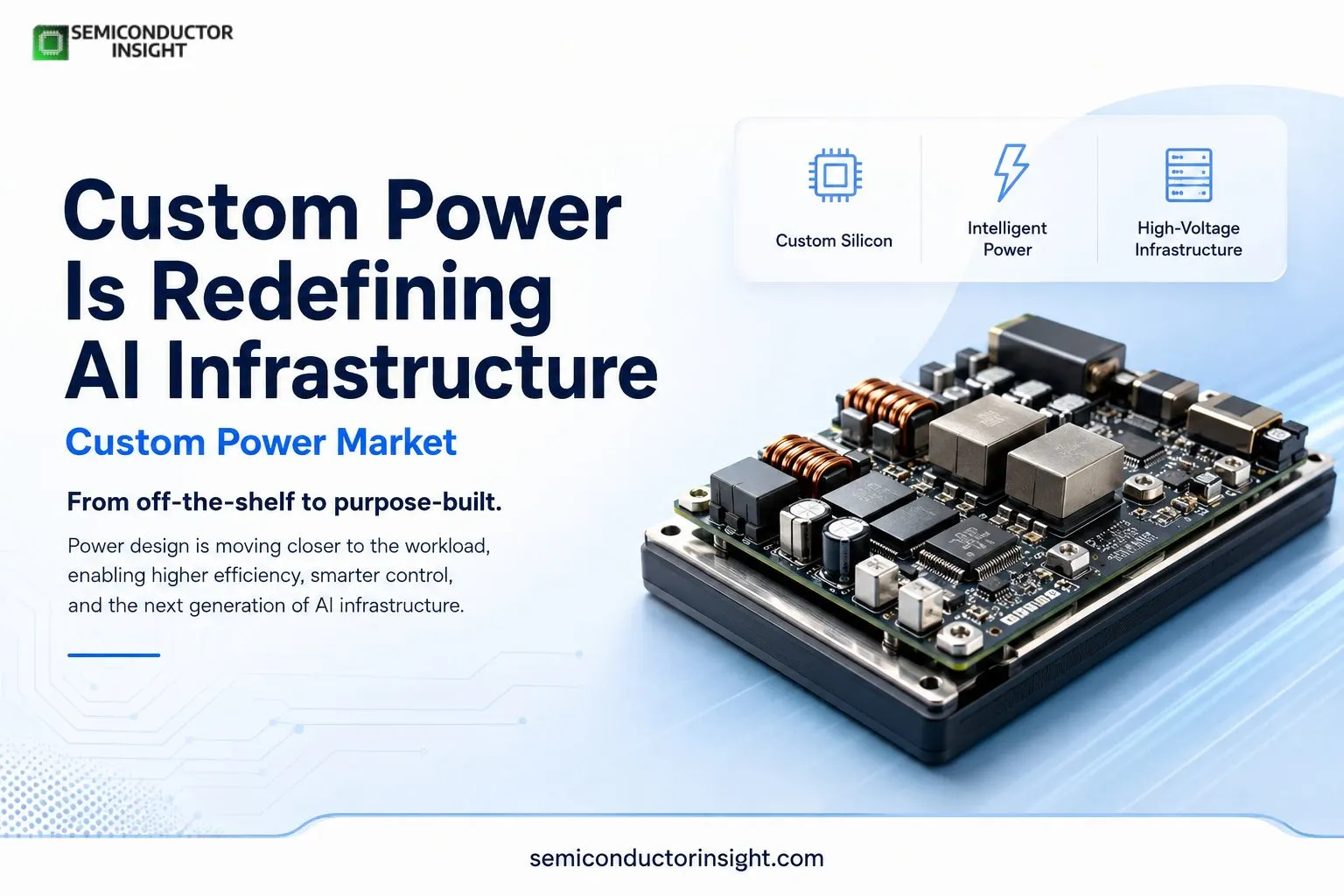
How Is Custom Power Market Evolving as AI Racks Move Toward Higher Power Density in 2026?
Custom Power Market is entering a different phase as semiconductor design moves closer to the power architecture itself. The traditional model of selecting off-the-shelf power components is increasingly being supplemented by purpose-built power management, regulation and delivery solutions designed around a particular processor, accelerator, server or system.
The change is especially visible in AI infrastructure. Modern accelerator platforms are pushing power density upward, forcing chip designers and data-center architects to consider power delivery alongside compute, memory, networking and thermal management rather than treating it as a separate engineering layer.
Power Design Is Moving Closer to the Workload
- One of the clearest developments in 2026 is the emergence of workload-specific silicon.
- Hyperscalers including Google, Microsoft, Meta and Amazon have been developing custom processors and accelerators because their workloads are sufficiently large and predictable to justify specialized architectures.
- Microsoft is taking this concept further by integrating finer-grained power control into its Azure Cobalt custom CPU.
- The company says this silicon-level approach can enable more servers to operate from the same number of megawatts by coordinating power management with the workload and broader infrastructure stack.
- That illustrates where custom power technology is heading: power management is becoming part of system architecture rather than simply a supporting component.
The AI Rack Is Changing the Electrical Equation
The growth of AI computing is creating a much more demanding environment for power semiconductors. Higher accelerator density means more electricity has to reach processors within tighter voltage, current, thermal and space constraints.
- The Open Compute Project reported in August 2026 that Google, Microsoft and NVIDIA are collaborating around 800 VDC as an open architecture for next-generation AI data centers.
- Higher-voltage DC distribution can transfer more power while reducing the amount of conductor material required compared with lower-voltage architectures.
This transition creates opportunities for custom power solutions spanning voltage conversion, power regulation, monitoring and protection.
From Generic PMICs to System Specific Power Control
Power-management ICs are also becoming more intelligent. Instead of performing a single narrowly defined function, newer architectures can combine sensing, control and power-stage functions to respond dynamically to system conditions.
This is particularly relevant to AI accelerators, where power consumption can change rapidly according to workload intensity. A custom power architecture can therefore be optimized around the electrical behaviour of a particular chip instead of forcing the chip to operate within the limitations of a generic power solution.
Our most recent updated related study is available for free at this link: https://semiconductorinsight.com/report/custom-power-market/
Broadcom Shows Where Custom Silicon Is Heading
A major current example is Broadcom, whose custom AI semiconductor business has become closely tied to hyperscaler infrastructure. On September 2, 2026, Reuters reported that Broadcom raised its expected AI semiconductor revenue for fiscal 2027 to approximately $115 billion, with the company projecting approximately $230 billion in 2028. Its third-quarter AI semiconductor sales reached $16.7 billion, while custom AI chips represented about 73% of that amount.
The significance for Custom Power Market goes beyond one supplier. Custom accelerators require equally specialized approaches to power delivery, signal integrity, thermal management and system integration.
Advanced Packaging Is Becoming Part of Power Engineering
- Power architecture cannot be separated from packaging as semiconductor systems become larger and more heterogeneous.
- TSMC’s 3DFabric portfolio combines technologies including SoIC, CoWoS and InFO, enabling processors, memory and other dies to be integrated into increasingly complex packages.
- TSMC’s latest CoWoS roadmap also illustrates the scale of the shift. Its CoWoS-S platform can accommodate interposers up to approximately 2,700 mm², or around 3.3 times reticle size, while newer approaches target even larger configurations.
- For custom power designers, this creates another engineering question: how can power be delivered efficiently across increasingly dense packages without sacrificing thermal or electrical performance?
Three Layers Are Converging
Custom silicon → intelligent power management → High-voltage infrastructure
This convergence is creating a new design philosophy in which the processor, package, power electronics and data-center electrical architecture are optimized together.
Intel’s 2026 process roadmap provides another indication of this direction. Its 18A technology combines RibbonFET transistors with PowerVia backside power delivery, placing power delivery directly into the advanced-node design strategy.
What Makes 2026 Different
- Custom Power Market is no longer defined only by conventional regulators, converters and PMICs.
- Its boundaries are expanding toward custom AI silicon, backside power delivery, wide-bandgap devices, intelligent power control, and 800 VDC data-center architectures and advanced packaging.
The commercial question is increasingly simple: when every watt matters, should power architecture remain standardized, or should it be engineered specifically around the workload?

Comments (0)