PMIC for Smartphones Market Insights
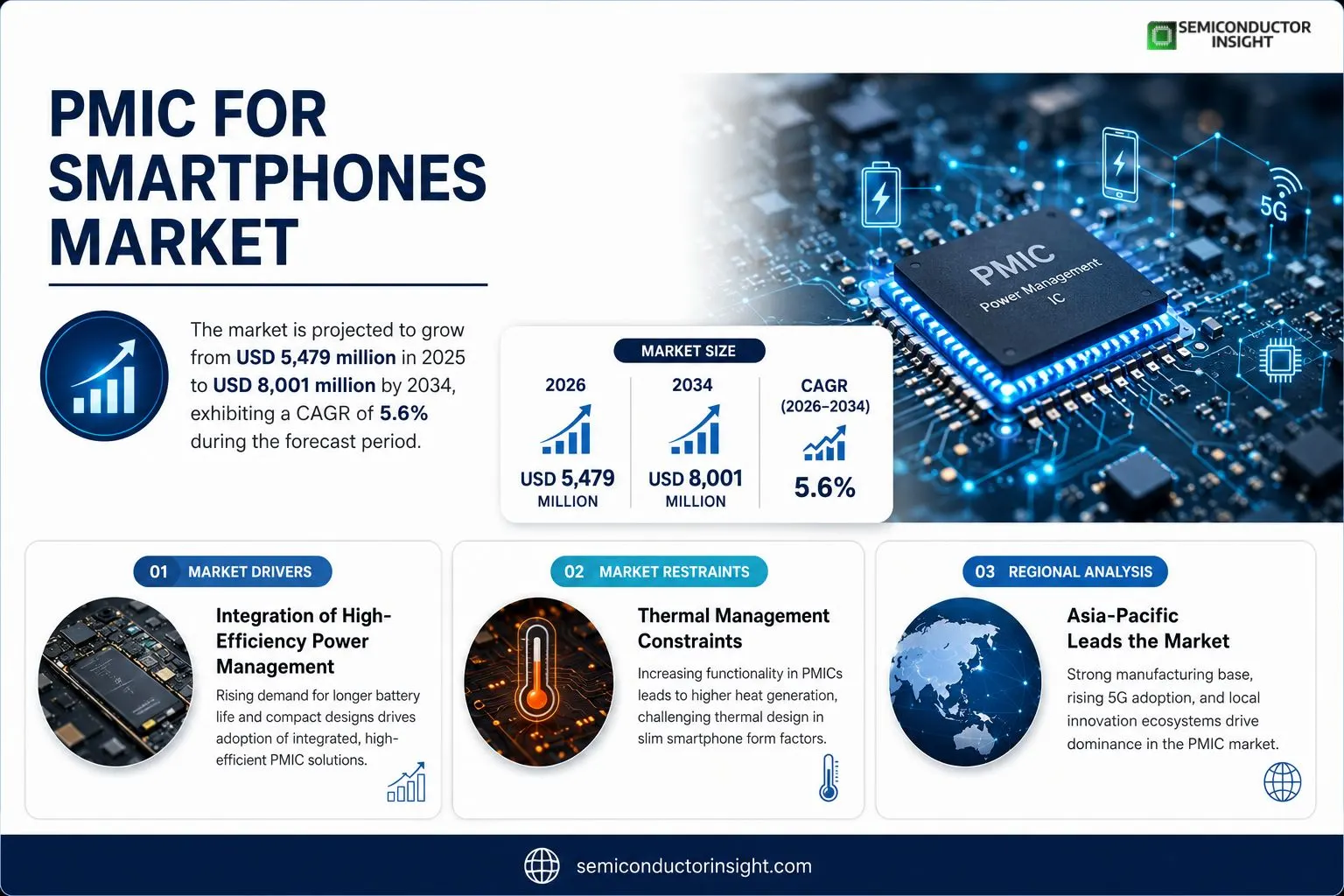
PMIC for Smartphones market was valued at USD 5,479 million in 2025 and is projected to reach USD 8,001 million by 2034, exhibiting a CAGR of 5.6% during the forecast period.
Smartphone Power Management Integrated Circuits (PMICs) are highly integrated analog‑mixed‑signal chips that regulate, sequence, protect and convert power between the single‑cell battery, adapter input and internal rails. They deliver matched voltage and current to application processors, display panels, camera modules, memory and peripheral blocks while supporting high efficiency, low noise and fast transient response. Typical portfolios comprise main PMICs, charger ICs, direct‑charge/charge‑pump fast‑charging ICs, display PMICs, camera PMICs and multi‑channel solutions for SoCs. Customers range from OEM brands and ODMs to module suppliers, who increasingly demand system‑level coordination because of faster charging standards, advanced imaging sensors and on‑device AI workloads.
MARKET DRIVERS
Integration of High‑Efficiency Power Management
PMIC for Smartphones Market is gaining momentum as OEMs seek to extend battery endurance without enlarging device footprint. By consolidating voltage regulation, load‑switching and battery‑charging functions into a single silicon block, manufacturers reduce board‑level component count, consequently lowering assembly time and improving reliability. This consolidation also enables more aggressive power‑saving algorithms that are critical for AI‑enhanced camera pipelines and always‑on voice assistants.
Adoption of Multi‑Function Chipsets
Recent silicon releases embed dynamic voltage scaling and integrated safety features, allowing device designers to tailor power delivery to heterogeneous processing cores. The ability to fine‑tune power rails on‑the‑fly translates into smoother user experiences during intensive tasks such as gaming or video streaming. Companies that master this integration can differentiate their flagship offerings, prompting a swift uptake across premium and mid‑range segments.
➤ Converging power‑management and communication functions is reshaping system‑in‑package architectures, creating a fertile ground for differentiated handset designs.
Beyond performance, the shift toward integrated PMICs addresses regulatory pressure on energy efficiency. Governments worldwide are tightening standby‑power limits, and integrated solutions provide the granularity needed to meet those standards without sacrificing feature sets.
MARKET CHALLENGES
Thermal Management Constraints
As PMICs absorb more functions, heat dissipation becomes a critical bottleneck, especially in slim smartphones where thermal pathways are limited. Engineers must balance waveform fidelity with temperature ceilings to avoid throttling of high‑performance cores. Inadequate thermal design can erode user perception of speed, undermining the value proposition of advanced power‑management chips.
Other Challenges
Supply‑Chain Volatility
The reliance on advanced CMOS nodes for PMIC fabrication ties the market to a narrow set of foundries. Recent geopolitical tensions have exposed vulnerabilities in wafer capacity, leading to longer lead times and occasional price spikes. Manufacturers that lack diversified sourcing strategies may face production delays, affecting launch calendars for new smartphones.
MARKET RESTRAINTS
Cost Sensitivity in Tier‑2 Segments
While premium devices can absorb the incremental expense of sophisticated PMICs, price‑conscious segments in emerging markets remain reluctant to adopt higher‑priced solutions. The narrow margin environment forces handset makers to prioritize component cost over marginal efficiency gains, limiting the overall penetration of next‑generation power‑management chips in volume‑driven product lines.
MARKET OPPORTUNITIES
Emergence of 5G‑Enabled Devices
The rollout of 5G across consumer devices introduces new RF front‑end power demands that traditional regulators struggle to meet. PMICs capable of handling higher frequency bands while maintaining low‑noise performance are positioned to become essential enablers for 5G smartphones. Early movers that align their product roadmaps with 5G power‑budget requirements can secure sizable design wins as carriers expand ultra‑fast service coverage.
PMIC for Smartphones Market Trends
Shift Toward Whole‑System Power Coordination
The most visible evolution in PMIC for Smartphones Market is the transition from isolated power‑regulation blocks to a coordinated power‑management architecture that spans the entire handset. Vendors now present portfolios that bundle main PMICs, display, camera and charging ICs together, enabling tight sequencing, unified fault monitoring and programmable power paths. This approach reduces board space, simplifies BOM management and delivers a smoother user experience, especially as processors, AI accelerators and high‑resolution sensor arrays demand synchronous voltage ramps. For OEMs, the shift translates into shorter design cycles because a single supplier can deliver a calibrated power tree that matches the SoC roadmap, lowering integration risk and unlocking higher efficiency margins. The result is a measurable uplift in battery endurance under mixed‑load scenarios, which translates into longer screen‑on time and higher customer satisfaction scoresa competitive advantage that OEMs can leverage in marketing campaigns.
Other Trends
Fast‑Charging and Efficiency Pressures
Fast‑charging performance has become a decisive attribute for flagship devices, and PMIC for Smartphones Market responds with increasingly sophisticated power‑path control and higher conversion efficiency. Contemporary charger ICs must handle multi‑amp currents while maintaining low‑noise operation, a requirement that pushes silicon designs toward programmable I2C interfaces and advanced protection schemes. The ripple‑free power supplied to camera modules, for instance, directly influences image quality, prompting manufacturers to develop dedicated camera PMICs with stringent PSRR specifications. These technical demands create a premium segment where value is tied to performance rather than component cost, encouraging OEMs to partner with suppliers that can co‑engineer fast‑charging solutions aligned with their device‑level power strategy. As AI inference workloads expand, the power‑budget ceiling tightens, prompting designers to rely on PMICs capable of dynamic voltage scaling that matches real‑time processor demand, thereby preserving efficiency without sacrificing performance.
Regional Competitive Landscape and Policy Influence
Regional supply chains shape competitive dynamics, as U.S. and Japanese firms excel in multi‑channel, platform‑agnostic PMICs, while Korean and Chinese players dominate display‑power and charge‑pump niches. This geographic specialization forces smartphone makers to assemble a mixed vendor portfolio that satisfies both performance criteria and cost targets. Meanwhile, regulatory mandates such as the EU’s universal USB‑C charging directive impose stricter efficiency and safety thresholds, compelling OEMs to adopt PMICs with built‑in compliance features. Consequently, vendors that pre‑empt regulatory timelines by integrating over‑temperature protection and adaptive charging algorithms gain preferential treatment in tier‑1 OEM supply chains, reinforcing their position as preferred power‑architecture partners. The combined effect is a market where technical leadership and regulatory foresight become decisive levers for securing design wins, prompting vendors to deepen collaboration with chipset and module partners to lock in early‑stage architecture decisions.
COMPETITIVE LANDSCAPE
Key Industry Players
Smartphone Power Management IC Market: Competitive Overview
Qualcomm dominates the high‑volume segment by leveraging its integrated platform strategy, which bundles SoC and power‑management functions into a unified solution. Samsung’s diversified portfolio, encompassing charge ICs, display PMICs, SoC PMICs and camera PMICs, enables the firm to capture both premium flagship orders and mid‑range volume. MediaTek follows a similar model, bundling its Dimensity processors with closely‑tuned PMIC families, which shortens time‑to‑market for ODMs that prefer a single‑source approach. STMicroelectronics and Renesas provide strong multi‑channel and sequencing capabilities, positioning themselves as preferred suppliers for OEMs that require extensive fault protection across multiple power rails. This upper tier shapes the market’s architecture, influencing how handset designers partition power domains and adopt programmable I²C interfaces.Beyond the headline names, a cohort of specialized vendors adds depth to the competitive set. Richtek and SG Micro excel in fast‑charging and power‑path management, delivering high‑efficiency charger ICs that meet emerging USB‑C standards. Southchip focuses on OLED display power and LPDDR supply, while Halo Microelectronics and Awinic target camera‑module PMICs with ultra‑low noise specifications. Nisshinbo, Silicon Mitus, onsemi and Analog Devices round out the landscape, each supplying niche analog front‑ends or substrate‑level protection blocks that complement the broader system‑level offerings. The mixture of broad‑portfolio giants and focused innovators creates a dynamic where strategic alliances and joint‑development programs become decisive factors for securing platform wins.
List of Key PMIC for Smartphones Companies Profiled
- Qualcomm
- Samsung Electronics
- MediaTek
- STMicroelectronics
- Renesas Electronics
- Richtek Technology
- Southchip Semiconductor Technology (Shanghai) Co., Ltd.
- SG Micro Corp
- Halo Microelectronics Co., Ltd.
- Awinic Technology Co., Ltd.
- Nisshinbo Micro Devices Inc.
- Silicon Mitus, Inc.
- onsemi
- Analog Devices Inc.
Segment Analysis:
| Segment Category | Sub-Segments | Key Insights |
| By Type |
|
Integrated Power Solutions have become the primary value driver. • Customers prioritize high‑efficiency conversion and low‑noise operation to support fast‑charging and AI workloads. • The shift from discrete regulators to portfolio‑level PMIC families enables tighter power sequencing and fault monitoring across subsystems. • Vendors that can deliver programmable I²C interfaces and multi‑channel architectures gain stronger design‑win potential. |
| By Application |
|
AI‑Enabled Handsets are reshaping power requirements. • On‑device AI drives dynamic voltage scaling and fast transient response needs. • OLED and high‑refresh displays demand dedicated display PMICs with tight voltage tolerance. • Fast‑charging ecosystems push charger‑IC integration and power‑path management to the forefront of design decisions. |
| By End User |
|
Platform‑Centric OEMs demand close co‑development. • Brands seek PMICs that are pre‑matched to chipset roadmaps, reducing integration cycles. • ODMs value customizable sub‑system solutions that can be adapted across multiple handset models. • Module suppliers focus on reliability and fault‑tolerant features to guarantee high‑volume production yields. |
| By Integration Depth |
|
System‑Level Integration is the emerging premium. • Consolidating multiple power domains into a single PMIC reduces board area and BOM cost. • System‑level devices enable unified sequencing, improving overall handset stability. • The architectural shift encourages deeper collaboration between PMIC vendors and SoC designers. |
| By Product Role |
|
Intelligent Management Functions differentiate market leaders. • Advanced sequencing ensures safe power‑up across heterogeneous blocks, reducing field failures. • Integrated fault detection and protection meet stringent safety regulations and enhance user confidence. • Dynamic scaling algorithms allow real‑time adaptation to workload changes, crucial for AI‑intensive experiences. |
Regional Analysis: PMIC for Smartphones Market
Asia‑Pacific
Local designers are prioritising dual‑port fast‑charging topologies that support both USB‑PD and proprietary quick‑charge protocols, a move driven by consumer demand for sub‑30‑minute recharge cycles in flagship devices.
Integration of on‑chip AI engines enables dynamic scaling of power rails, allowing smartphones to allocate energy precisely where the operating system predicts workload peaks.
Chip‑on‑wafer‑stack (CoWoS) and fan‑out wafer‑level packaging (FOWLP) techniques are becoming mainstream, reducing footprint while boosting thermal performance for high‑end PMICs.
Regional fabs are diversifying material sources and adopting modular fab‑as‑a‑service models to mitigate disruptions and keep lead times short for smartphone manufacturers.
North America
The United States and Canada host a mature ecosystem of design houses that specialize in ultra‑low‑power PMICs for premium smartphones. While volume is lower than in Asia‑Pacific, the emphasis on regulatory compliance, security, and energy‑efficiency certifications drives a differentiated product set. Collaboration between Silicon Valley start‑ups and established fabless firms yields niche solutions such as voltage‑regulated modules tuned for 5G radio subsystems. Supply‑chain visibility and a strong IP enforcement framework give North American customers confidence to adopt cutting‑edge power architectures, albeit at a premium price point.
Europe
European smartphone brands place a premium on environmental responsibility, prompting local PMIC developers to embed sophisticated bat‑life optimization algorithms that extend device usage without compromising performance. The region’s stringent RoHS and REACH regulations encourage the adoption of lead‑free, high‑reliability components, which in turn fosters innovation in silicon‑level power gating. Moreover, cross‑border research initiatives among Germany, France, and the Nordic states accelerate the rollout of adaptive voltage scaling techniques that align with the EU’s energy‑efficiency targets.
South America
In Brazil and Argentina, market growth is fueled by a surge in mid‑range smartphone adoption, where cost‑effective PMIC designs become a decisive factor. Local assemblers favor integrated solutions that combine multiple power rails into a single package, simplifying board layouts and reducing assembly time. Telecom operators’ push for broader 4G/5G coverage encourages device makers to select PMICs with robust RF power management, ensuring reliable connectivity in diverse terrain.
Middle East & Africa
The Middle East & Africa region experiences a blend of high‑end demand in the Gulf states and budget‑driven growth across Sub‑Saharan Africa. OEMs targeting the Gulf market integrate premium PMICs that support rapid charging and high‑capacity batteries, aligning with consumer expectations for luxury smartphones. Conversely, African manufacturers prioritize rugged, low‑cost power solutions capable of withstanding temperature extremes and intermittent power supplies, prompting vendors to offer ruggedized PMICs with extended voltage tolerance.
Report Scope
This market research report provides a comprehensive analysis of the PMIC for Smartphones Market , covering the forecast period 2026–2034. It offers detailed insights into market dynamics, technological advancements, competitive landscape, and key trends shaping the industry.
Key focus areas of the report include:
- Market Overview: The report begins with an overview outlining its current market scenario, key growth indicators, and industry transformation drivers. It discusses macroeconomic factors, demand–supply balance, regulatory landscape, and the strategic role of semiconductors in powering advancements across industries such as automotive, telecommunications, consumer electronics, and industrial automation.
- Market Size & Forecast: Historical data and future projections for revenue, unit shipments, and market value across major regions and segments.
- Segmentation Analysis: Detailed breakdown by product type, technology, application, and end-user industry to identify high-growth segments and investment opportunities.
- Regional Insights: Insights into market performance across North America, Europe, Asia-Pacific, Latin America, and the Middle East & Africa, including country-level analysis where relevant.
- Competitive Landscape: Profiles of leading market participants, including their product offerings, R&D focus, manufacturing capacity, pricing strategies, and recent developments such as mergers, acquisitions, and partnerships.
- Technology Trends & Innovation: Assessment of emerging technologies, integration of AI/IoT, semiconductor design trends, fabrication techniques, and evolving industry standards.
- Market Drivers & Restraints: Evaluation of factors driving market growth along with challenges, supply chain constraints, regulatory issues, and market-entry barriers.
- Stakeholder Insights: Insights for component suppliers, OEMs, system integrators, investors, and policymakers regarding the evolving ecosystem and strategic opportunities.
Primary and secondary research methods are employed, including interviews with industry experts, data from verified sources, and real-time market intelligence to ensure the accuracy and reliability of the insights presented.
FREQUENTLY ASKED QUESTIONS:
What is the current market size of PMIC for Smartphones Market?
-> PMIC for Smartphones Market was valued at USD 5,479 million in 2025 and is expected to reach USD 8,001 million by 2034, at a CAGR of 5.6% during the forecast period.
Which key companies operate in PMIC for Smartphones Market?
-> Key players include Qualcomm, Samsung, MediaTek, Renesas Electronics, Richtek Technology, Southchip Semiconductor, SG Micro, Halo Microelectronics, Awinic Technology, Nisshinbo Micro Devices, Silicon Mitus, onsemi, Analog Devices, STMicroelectronics, among others.
What are the key growth drivers?
-> Key growth drivers include fast‑charging adoption, advanced imaging systems, on‑device AI demand, higher OLED display penetration, and regulatory standardization of charging interfaces.
Which region dominates the market?
-> Asia‑Pacific remains the dominant region, driven by major smartphone manufacturing hubs and strong OEM investments.
What are the emerging trends?
-> Emerging trends include multi‑channel system‑level PMICs, AI‑enabled power management, integration of charge‑pump fast‑charging ICs, and increased focus on energy‑efficiency and fault‑tolerant designs.
Get Sample Report PDF for Exclusive Insights
Report Sample Includes
- Table of Contents
- List of Tables & Figures
- Charts, Research Methodology, and more...