

Power Semiconductor Manufacturing 2026: How Higher Switching Speeds Are Changing Film Capacitors
Capacitors are no longer passive components that simply sit at the edge of an electronic circuit. As semiconductor systems become faster, smaller and more power-intensive, the capacitor has become an important part of power integrity, voltage stabilization and energy management.
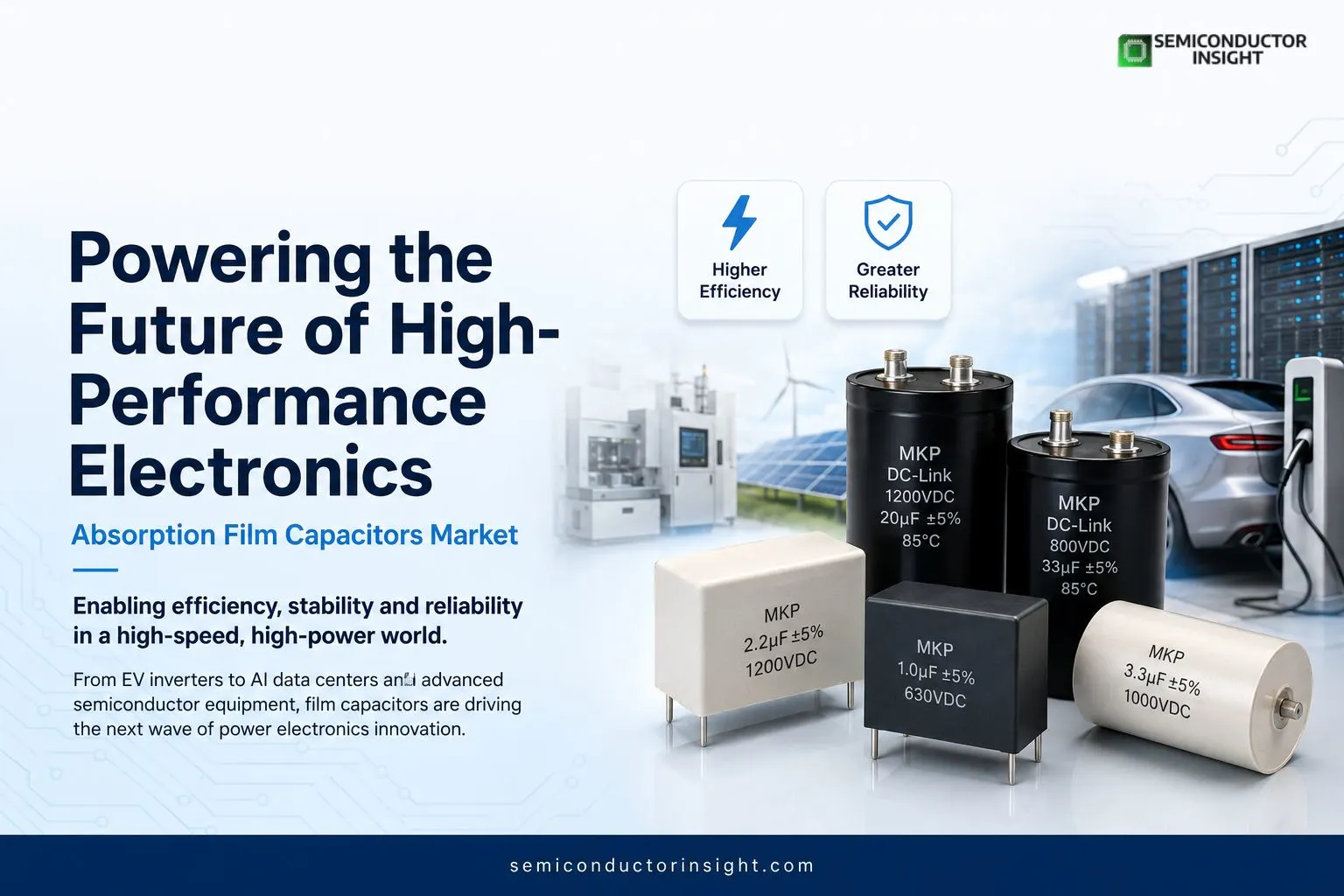
Absorption film capacitors use polymer film dielectric structures designed for applications where low dielectric losses, stable electrical characteristics and reliable operation are important. Their relevance is particularly visible in power electronics, semiconductor equipment, industrial controls, automotive electronics and high-frequency systems.
The shift toward wide-bandgap semiconductors such as silicon carbide and gallium nitride is adding another layer to this requirement because faster switching can expose weaknesses in conventional passive-component architectures.
A Different Kind of Pressure Is Coming From Switching Speed
- The growth of SiC and GaN power devices is changing the electrical environment in which capacitors operate.
- Silicon carbide MOSFETs can support high-voltage switching while reducing switching losses compared with conventional silicon devices. GaN devices operate at even higher switching frequencies in many applications.
- The U.S. Department of Energy identifies wide-bandgap semiconductors as important technologies for improving power conversion efficiency across applications including electric vehicles, renewable energy systems, industrial equipment and data centers.
- For film capacitor manufacturers, the implication is straightforward. Higher switching speeds require components capable of managing rapid voltage changes, parasitic effects and heat without compromising long-term stability.
Why Film Structure Matters at the Circuit Level?
The dielectric film determines much of a capacitor’s electrical behavior. Polypropylene, polyester and other polymer films can be selected according to voltage, frequency, temperature and application requirements.
One important characteristic is low dissipation. When a capacitor operates at high frequency, dielectric losses can translate into additional heat. Lower-loss film structures can therefore become particularly valuable in demanding power conversion environments.
Film capacitors can also provide strong self-healing behavior. When a localized dielectric breakdown occurs, the affected metallized region can isolate itself, allowing the component to continue operating rather than experiencing an immediate catastrophic short circuit.
This characteristic makes the technology particularly interesting for systems where maintenance access is limited or unexpected component failure can have significant consequences.
EV Inverters Are Creating a More Demanding Electrical Environment
Electric vehicles are among the clearest examples of why capacitor technology is evolving.
A modern traction inverter converts the battery’s DC electricity into the controlled AC power required by the electric motor. The DC-link capacitor positioned within this power stage must handle substantial ripple currents while operating under demanding thermal and electrical conditions.
The International Energy Agency reported that global electric car sales exceeded 17 million units in 2024, with sales expected to surpass 20 million units in 2025.
That vehicle volume matters because every additional electric powertrain expands demand for power-conversion components, including DC-link and filtering capacitors.
The movement toward 800 V vehicle architectures also raises the importance of insulation, voltage endurance and thermal performance in capacitor design.
AI Infrastructure Is Opening another High-Power Application
- The semiconductor industry’s AI expansion is creating an unusual demand pattern. AI accelerators require enormous amounts of electrical power, while data-center operators increasingly focus on efficiency at every stage from grid connection to processor voltage regulation.
- NVIDIA’s latest data-center platforms illustrate the direction of travel. Modern AI systems combine CPUs, GPUs, networking devices and high-speed interconnects within increasingly dense rack architectures.
- The U.S. Department of Energy has noted that data centers represented approximately 4% of U.S. electricity consumption in 2023, with that figure projected to rise substantially by 2028.
- This creates opportunities for advanced capacitors in power supplies, voltage conversion, cooling infrastructure and semiconductor manufacturing equipment.
Semiconductor Manufacturing Equipment Adds a Less Visible Demand Stream
The capacitor opportunity does not stop inside the finished chip.
Wafer fabrication equipment uses sophisticated plasma systems, RF generators, vacuum equipment, power supplies and motion-control systems. These machines depend on stable power delivery to maintain precise manufacturing conditions.
The semiconductor industry’s capital intensity makes reliability especially important. SEMI reported that global semiconductor manufacturing equipment sales reached approximately $117 billion in 2024, establishing another large equipment ecosystem where high-performance passive components can find applications.
Film capacitors used within these systems can support filtering, energy storage and power conditioning across multiple equipment architectures.
Take a Quick Glance at Our In-Depth Analysis Report: https://semiconductorinsight.com/report/absorption-film-capacitors-market/
Packaging Density Is Changing Where Capacitors Can Be Placed
Advanced semiconductor packaging is also influencing capacitor requirements.
Chiplet architectures, 2.5D integration and 3D packaging bring electrical connections closer together while reducing available physical space. This increases the importance of compact power-delivery components with predictable parasitic characteristics.
The semiconductor industry is consequently moving toward shorter electrical paths and increasingly localized power delivery. Capacitors positioned closer to demanding loads can help manage transient current requirements and reduce unwanted voltage fluctuations.
The Next Design Question Is Not Simply Capacitance
- The market is increasingly being evaluated through several specifications at once.
- Engineers must consider capacitance, rated voltage, ripple-current capability, equivalent series resistance, equivalent series inductance, operating temperature, dielectric loss and physical dimensions.
- That combination is pushing capacitor development toward application-specific designs rather than one-size-fits-all components.
- Automotive inverters, semiconductor manufacturing equipment, renewable-energy converters and AI power systems can require very different electrical characteristics even when they all use film-based capacitor technologies.
The result is a market increasingly connected to the semiconductor industry’s broader shift toward higher switching frequencies, greater power density, electrification and increasingly demanding power-management architectures.

Comments (0)