Cables for Semiconductor Equipment Market Insights
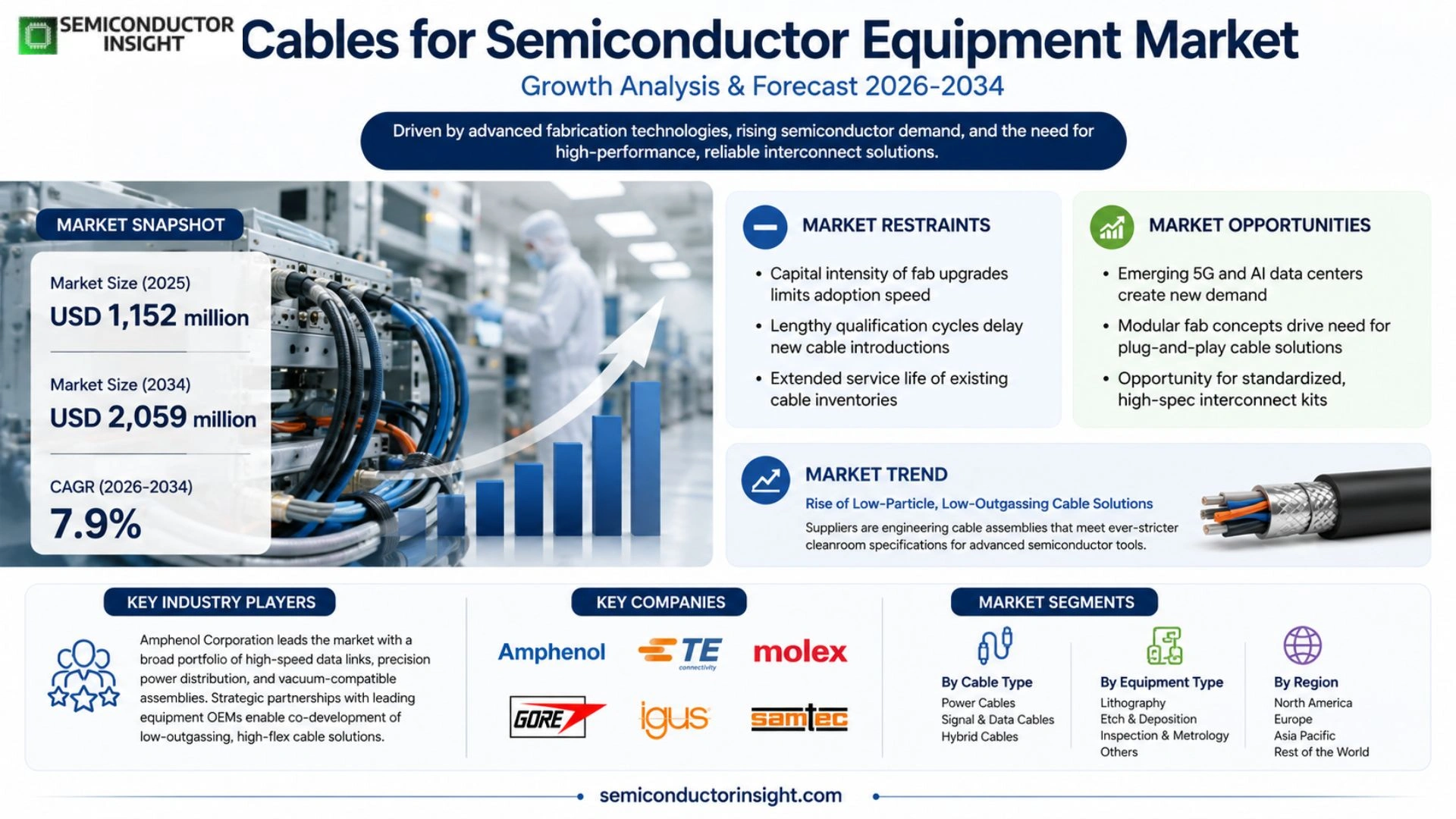
Global Cables for Semiconductor Equipment market is set to rise from USD 1,152 million in 2025 to USD 2,059 million by 2034, exhibiting a CAGR of 7.9% during the forecast period.
Wires, cables and cable assemblies for semiconductor manufacturing equipment refer to specialized wires, cables, harnesses and cable assemblies installed inside semiconductor manufacturing, lithography, etch, deposition, ion implantation, cleaning, CMP, thermal processing, metrology, inspection, wafer handling, test, advanced packaging and related automation equipment. These products provide power delivery, heater and temperature control, sensing and feedback, motion control, RF and microwave transmission, high‑speed data, optical communication, vacuum‑compatible interconnection, cleanroom motion cabling and safety interlock functions. Key technical requirements include low particulation, low outgassing, low friction, long flex life, ESD control, chemical resistance and temperature resistance.
The market is expanding because semiconductor equipment spending continues its upward trajectory; SEMI reported worldwide equipment sales of $135.1 billion in 2025. As tools become more intricate,particularly in lithography and advanced packaging,the need for precision interconnects with cleanroom compatibility and high‑speed signal integrity grows. Recent product introductions from suppliers such as TE Connectivity and Molex highlight low‑particle and vacuum‑compatible designs, reinforcing the upward trend.
MARKET DRIVERS
Technology scaling demands high‑performance interconnects
As semiconductor nodes shrink below 10 nm, manufacturers encounter tighter signal‑integrity constraints and higher thermal loads. Cables for Semiconductor Equipment Market suppliers that deliver ultra‑low‑capacitance, temperature‑resistant conductors become indispensable for maintaining yield in advanced fabs.
Shift toward advanced packaging fuels cable innovation
3D‑IC and fan‑out wafer‑level packaging introduce dense routing paths where conventional wiring cannot meet the required bandwidth. Companies that invest in micro‑structured dielectric materials and high‑frequency shielding are positioned to capture a growing slice of the equipment supply chain.
➤ Manufacturers that fuse low‑loss transmission lines with robust insulation enjoy lower rework rates and faster line turn‑around.
Regulatory emphasis on energy efficiency has also nudged fabs to adopt cables with reduced loss profiles, translating into measurable operational cost savings across large‑scale production sites.
MARKET CHALLENGES
Stringent purity standards increase material costs
Fabrication environments enforce sub‑part‑per‑billion contaminant thresholds; any impurity in cable jackets can precipitate particle generation that jeopardizes wafer quality. This compels suppliers to adopt premium grade polymers and advanced cleaning processes, inflating unit prices for end users.
Other Challenges
Supply chain volatility
Global logistics disruptions and uneven semiconductor demand cycles create inventory imbalances, making it difficult for fab managers to secure a steady flow of specialized interconnects without resorting to higher safety stock levels.
MARKET RESTRAINTS
Capital intensity of fab upgrades limits adoption speed
Upgrading to next‑generation equipment often requires multi‑year capital commitments; as a result, fabs prioritize incremental improvements over wholesale cable replacements, dampening short‑term market acceleration.
Furthermore, the lengthy qualification cycles for new cable assemblies,required to demonstrate reliability under extreme thermal cycling,delay entry of innovative products into production lines.
These financial and procedural constraints lead many manufacturers to extend the service life of existing cable inventories, thereby tempering demand growth.
MARKET OPPORTUNITIES
Emerging 5G and AI data centers create new demand
High‑performance compute clusters that support 5G back‑haul and AI inference impose stringent latency and bandwidth requirements on inter‑equipment cabling. Suppliers that can certify their products for these environments stand to win contracts beyond traditional semiconductor fabs.
Parallelly, the rise of modular fab concepts,where equipment footprints are reconfigured on demand,stimulates a market for plug‑and‑play cable solutions, opening a niche for standardized, yet high‑spec, interconnect kits.
Cables for Semiconductor Equipment Market Trends
Rise of Low‑Particle, Low‑Outgassing Cable Solutions
Suppliers are engineering cable assemblies that meet ever‑stricter cleanroom specifications, a response to the heightened sensitivity of advanced lithography and metrology tools. The shift away from conventional industrial wiring toward compounds that emit fewer particles and generate minimal outgassing directly improves wafer yield and reduces downtime associated with cleaning cycles. This evolution is driven by the adoption of sub‑nanometer patterning techniques, where even microscopic contaminants can cause critical defects. Companies that embed contamination‑control expertise into their design processes are now commanding premium pricing, because tool manufacturers view these cables as essential contributors to overall equipment reliability rather than ancillary components.
Other Trends
Integration of Hybrid Fiber‑Optic and Copper Paths
Modern test and packaging platforms require simultaneous delivery of high‑speed data and substantial power within a constrained footprint. Hybrid cables that merge single‑mode fiber for terabit‑level communication with copper conductors for power and control signals are gaining traction. This architecture eliminates the need for separate routing bundles, thereby simplifying cable harnesses and reducing the mass of moving parts inside the tool. Engineers report that the combined solution also eases the validation of signal integrity under vacuum conditions, because the fiber segment remains immune to electromagnetic interference while the copper segment can be shielded to meet EMI standards.
Growth of High‑Flex Flat Cables for Motion‑Critical Tool Modules
Flat‑flex circuits are increasingly used in wafer‑handling robots and inspection scanners where repeated flex cycles demand exceptional durability. Manufacturers now specify substrates that resist friction‑induced wear and maintain low particulate release over millions of bends. The market impact is twofold: equipment uptime improves as cable‑related failures drop, and maintenance crews spend less time replacing worn harnesses. As a result, OEMs are embedding these high‑flex solutions early in the design phase, treating them as a strategic differentiator that supports faster tool changeovers and higher throughput in high‑volume fabs.
COMPETITIVE LANDSCAPE
Key Industry Players
Competitive Dynamics in Semiconductor Equipment Cabling
Amphenol Corporation commands the upper tier of the semiconductor‑equipment cabling arena, leveraging a portfolio that spans high‑speed data links, precision power distribution, and vacuum‑compatible assemblies. Its long‑standing engineering ties with leading tool OEMs such as ASML and Applied Materials translate into co‑development programs that embed Amphenol’s low‑outgassing, high‑flex flat‑cable designs directly into next‑generation lithography and etch platforms. The firm’s ability to certify products against stringent SEMI standards underpins a reputation for reliability, a factor that directly influences equipment uptime and lithography yield. Revenue streams from custom cable assemblies outpace generic industrial wiring, reflecting a market structure where a handful of specialists capture the majority of value‑added contracts while peripheral suppliers contend for niche segments. Amphenol’s recent acquisition of a cleanroom‑grade fiber‑optic specialist broadened its signal‑integrity offering, allowing it to address emerging needs for 400‑Gbps interconnects in advanced packaging stations. The company’s global footprint, with manufacturing hubs in the United States, Europe, and Singapore, ensures rapid response to localized demand spikes, a logistical advantage that deep‑price competition struggles to match.
Beyond the market leader, a cadre of firms sustains the ecosystem through focused expertise. TE Connectivity supplies ruggedized RF/microwave assemblies that meet the stringent outgassing limits of vacuum‑based deposition tools, while Molex’s modular harness systems cater to the high‑flex demands of wafer‑handling robots. W. L. Gore & Associates differentiates itself with anti‑static, low‑particle cable solutions prized by inspection and metrology equipment makers. European specialist LAPP Group leverages its cleanroom certification to dominate cable assemblies for lithography, whereas igus GmbH excels in long‑life, low‑friction cable carriers for motion‑intensive modules. Samtec and Winchester Interconnect provide high‑density interconnect platforms that enable compact tool designs. BizLink Holding and Nexfa focus on customized feedthrough assemblies that preserve vacuum integrity, and LS Cable & System brings a strong presence in high‑voltage power delivery for large‑scale deposition systems. This layered competitive set creates a market where collaboration, niche engineering capability, and compliance with rigorous cleanliness standards dictate success.
List of Key Cables for Semiconductor Equipment Companies Profiled
- Amphenol Corporation
- TE Connectivity
- Molex
- W. L. Gore & Associates
- igus GmbH
- Samtec
- Winchester Interconnect
- LAPP Group
- BizLink Holding Inc.
- Nexfa
- ThomasCable Co., Ltd
- LS Cable & System Ltd.
Segment Analysis:
| Segment Category | Sub-Segments | Key Insights |
| By Type |
|
Power Cables
|
| By Application |
|
Lithography Equipment
|
| By End User |
|
Equipment OEMs
|
| By Technical Requirement |
|
Low‑outgassing / Vacuum‑compatible Cables
|
| By Electrical Function |
|
Power Delivery
|
Regional Analysis: Cables for Semiconductor Equipment Market
Asia‑Pacific
Recent disruptions have compelled manufacturers to re‑examine inventory policies. Firms now favour dual‑sourcing arrangements and regional buffer stocks, reducing lead‑time volatility for critical cable components while preserving cost discipline.
As fabs transition to extreme ultraviolet (EUV) lithography, cable designs must support higher currents and tighter tolerances. Early adopters are integrating advanced shielding techniques to mitigate electromagnetic interference.
Emerging environmental directives across the region mandate lead‑free and halogen‑free insulation. Suppliers that certify compliance ahead of mandates gain preferential access to high‑value contracts.
Joint development programs between cable firms and equipment OEMs are accelerating bespoke solutions, shortening time‑to‑market for new fab lines and reinforcing long‑term partnership structures.
North America
North America continues to host a mature base of semiconductor assembly and test facilities, especially in the United States’ Southwest corridor. Cable providers here leverage sophisticated engineering services to address the high‑mix, low‑volume production model typical of advanced packaging. The market rewards firms that can rapidly prototype custom harnesses and integrate with strong after‑sales support networks. Environmental compliance remains a driver, with many customers seeking cables that meet RoHS and Restriction of Hazardous Substances standards without compromising performance. The region’s competitive landscape is shaped by a blend of legacy players and agile startups that focus on niche applications such as quantum‑computing interconnects.
Europe
European semiconductor hubs in Germany, the Netherlands and Ireland maintain a steady demand for precision cabling, largely driven by automotive electronics and industrial automation. Manufacturers emphasize reliability and long‑term durability to satisfy stringent automotive safety standards. Collaborative initiatives between cable firms and research institutes are fostering incremental improvements in dielectric performance, catering to the continent’s push toward electric‑vehicle powertrain integration. Trade policies within the EU encourage local sourcing, prompting suppliers to establish design‑centers near key fabs to minimise logistics costs and accelerate feedback loops.
South America
South America’s semiconductor footprint remains modest, centered around Brazil’s emerging fab capacity. The region’s cable market is therefore focused on equipment upgrades and maintenance rather than new‑build projects. Providers that can offer cost‑effective, standardized solutions while ensuring compliance with local import regulations gain a foothold. Emerging investment in display manufacturing and telecommunications infrastructure is sparking incremental interest in higher‑frequency cable assemblies, positioning the market for gradual expansion as domestic production scales.
Middle East & Africa
The Middle East & Africa region is at an early stage of semiconductor equipment adoption, with most activity tied to test and assembly operations in the United Arab Emirates and South Africa. Demand for cables is driven primarily by equipment refurbishment cycles and the need for robust, temperature‑tolerant products suited to harsh operating environments. Companies that can demonstrate reliability under high ambient temperatures and provide flexible financing arrangements are well‑placed to capture the nascent opportunities as regional governments invest in technology parks and smart‑manufacturing initiatives.
Report Scope
This market research report provides a comprehensive analysis of the Cables for Semiconductor Equipment Market , covering the forecast period 2026–2034. It offers detailed insights into market dynamics, technological advancements, competitive landscape, and key trends shaping the industry.
Key focus areas of the report include:
- Market Overview: The report begins with an overview outlining its current market scenario, key growth indicators, and industry transformation drivers. It discusses macroeconomic factors, demand–supply balance, regulatory landscape, and the strategic role of semiconductors in powering advancements across industries such as automotive, telecommunications, consumer electronics, and industrial automation.
- Market Size & Forecast: Historical data and future projections for revenue, unit shipments, and market value across major regions and segments.
- Segmentation Analysis: Detailed breakdown by product type, technology, application, and end-user industry to identify high-growth segments and investment opportunities.
- Regional Insights: Insights into market performance across North America, Europe, Asia-Pacific, Latin America, and the Middle East & Africa, including country-level analysis where relevant.
- Competitive Landscape: Profiles of leading market participants, including their product offerings, R&D focus, manufacturing capacity, pricing strategies, and recent developments such as mergers, acquisitions, and partnerships.
- Technology Trends & Innovation: Assessment of emerging technologies, integration of AI/IoT, semiconductor design trends, fabrication techniques, and evolving industry standards.
- Market Drivers & Restraints: Evaluation of factors driving market growth along with challenges, supply chain constraints, regulatory issues, and market-entry barriers.
- Stakeholder Insights: Insights for component suppliers, OEMs, system integrators, investors, and policymakers regarding the evolving ecosystem and strategic opportunities.
Primary and secondary research methods are employed, including interviews with industry experts, data from verified sources, and real-time market intelligence to ensure the accuracy and reliability of the insights presented.
FREQUENTLY ASKED QUESTIONS:
What is the current market size of Cables for Semiconductor Equipment Market?
-> Global Cables for Semiconductor Equipment market is set to rise from USD 2,059 million by 2034, exhibiting a CAGR of 7.9% during the forecast period.
Which key companies operate in Cables for Semiconductor Equipment Market?
-> Key players include W. L. Gore & Associates, BizLink Holding Inc., Junkosha, Amphenol Corporation, TE Connectivity, Molex, igus GmbH, Samtec, Winchester Interconnect, LAPP Group, Nexfa, ThomasCable Co., Ltd, LS Cable & System Ltd., Cicoil Corporation, ICS Manufacturing, JEM Electronics, NPI Solutions, HARTING Technology Group, ODU GmbH & Co. KG, Caton Connector, Taiyo Cabletec Corporation, Rosenberger, Shanghai Shenyuan Special Cable Co.,Ltd., Zhaolong Interconnect, Huizhou Voir Technology.
What are the key growth drivers?
-> Growth drivers include increasing semiconductor equipment spending, rising demand for low‑particle and low‑outgassing cables, advancements in AI‑driven chip design, stricter cleanroom standards, and expanding advanced packaging and test equipment.
Which region dominates the market?
-> Asia‑Pacific is the leading region, driven by major semiconductor manufacturing hubs in China, Japan, South Korea, and Taiwan.
What are the emerging trends?
-> Emerging trends include development of high‑flex flat cables, vacuum‑compatible and anti‑static cleanroom cables, RF/microwave test cables, high‑speed data and hybrid copper‑fiber assemblies.
Get Sample Report PDF for Exclusive Insights
Report Sample Includes
- Table of Contents
- List of Tables & Figures
- Charts, Research Methodology, and more...
 Download Sample Report PDF