USB Type-C Cables Market Insights
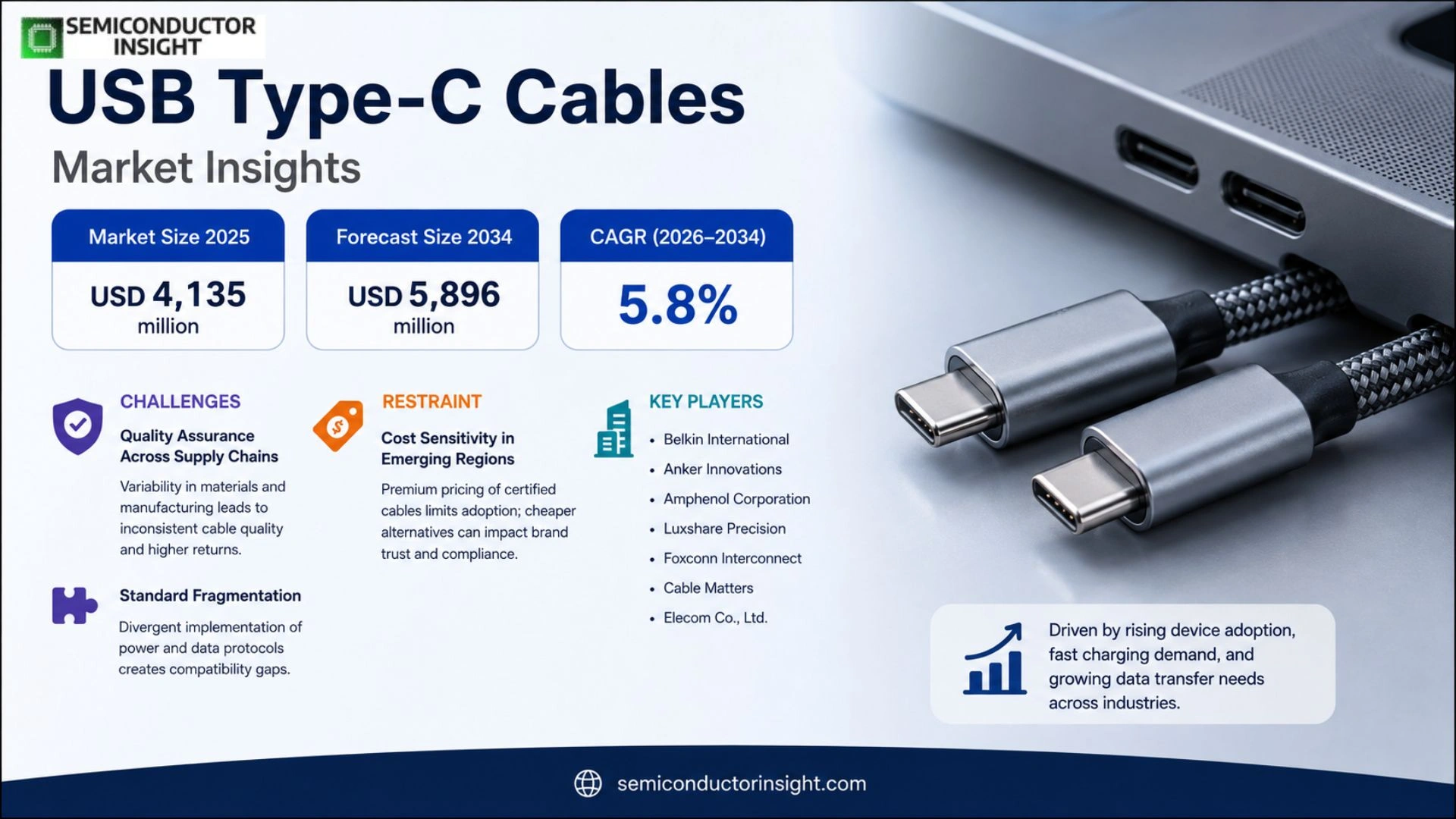
USB Type‑C Cables market was valued at USD 4,135 million in 2025 and is forecasted to rise to USD 5,896 million by 2034, reflecting a CAGR of 5.8 % over the period.
USB Type‑C cables serve as a universal conduit for data transfer, power delivery and video output. Their oval‑shaped reversible plug replaces legacy connectors, enabling faster charging,often up to 100 W,and supporting standards such as Power Delivery (PD), USB 4 and Thunderbolt 4.
The expansion stems from broader adoption of smartphones, laptops and gaming consoles equipped with the reversible connector, while rising demand for quicker charging under the PD protocol pushes manufacturers toward higher‑current designs. Environmental awareness further motivates producers to incorporate recyclable materials, raising quality expectations and creating challenges
MARKET DRIVERS
Universal Adoption Across Devices
USB Type‑C interface has become the default connector for smartphones, laptops, and peripheral equipment, compelling manufacturers to source compliant cables in bulk. As OEMs replace legacy ports, USB Type‑C Cables market experiences a widening order book that extends from consumer electronics to enterprise data‑center equipment.
Regulatory Mandates and Standards
Governmental directives in the European Union and several Asian economies now require new devices to support a reversible, power‑delivery capable connector. This policy shift eliminates lingering legacy inventories and accelerates procurement cycles for cable suppliers, reinforcing the market’s upward trajectory.
➤ “The move toward a single, reversible connector reduces design complexity and creates a steady demand pipeline for high‑quality Type‑C cables.”
Beyond compliance, the ability of Type‑C cables to transfer up to 100 W of power and support 40 Gbps data rates has unlocked new use‑cases,such as rapid‑charge stations and dock‑in‑a‑box solutions,prompting OEMs to embed multiple cables within product bundles, thereby deepening market penetration.
MARKET CHALLENGES
Quality Assurance Across Supply Chains
Rapid scaling has introduced variability in material grades and manufacturing processes. End‑users increasingly report cable failures when inexpensive, non‑compliant products are mixed with premium lines, prompting retailers to tighten acceptance criteria and raising cost pressure on distributors.
Other Challenges
Standard Fragmentation
While the USB‑IF defines specifications, divergent implementation of power‑delivery profiles and data protocols creates compatibility gaps, especially for legacy equipment retrofitted with Type‑C adapters.
MARKET RESTRAINTS
Cost Sensitivity in Emerging Regions
In markets where consumer purchasing power remains modest, the premium pricing of certified Type‑C cables deters bulk adoption. Price‑conscious distributors often resort to lower‑cost alternatives, which can erode brand equity for manufacturers committed to strict compliance.
MARKET OPPORTUNITIES
Integrated Solutions for Enterprise Environments
The rising prevalence of USB‑Type‑C docking stations, high‑resolution displays, and Thunderbolt‑compatible workstations opens a niche for bundled cable solutions that incorporate built‑in shielding and enhanced durability. Companies that can deliver turnkey packages stand to capture a sizable share of corporate procurement budgets.
USB Type-C Cables Market Trends
Universal Adoption Across Devices
USB Type-C Cables Market is witnessing a decisive shift as manufacturers embed the connector into virtually every new smartphone, laptop, tablet and gaming console. The reversible design eliminates the “right‑side‑up” dilemma, while the integrated Power Delivery protocol enables fast‑charging cycles that cut traditional charge times in half for many devices. As 5G networks push data‑intensive applications and USB‑4/Thunderbolt 4 standards raise bandwidth ceilings, developers are opting for the singular connector that can handle video, power and high‑speed data simultaneously. This convergence reduces bill‑of‑materials costs for OEMs and simplifies end‑user experience, creating a self‑reinforcing loop that fuels demand for higher‑specification cables across both consumer and enterprise segments.
Other Trends
Quality Variability and Sustainability Pressures
Because USB Type‑C specification imposes strict electrical and safety standards, the market has attracted a wide spectrum of suppliers, from premium brands to low‑cost manufacturers. The resulting quality gradient manifests in slower charging rates, overheating incidents, or premature device degradation, prompting a growing segment of buyers to seek certified products. Concurrently, heightened environmental awareness is nudging producers toward recyclable polymers and reduced plastic usage. Brands that can certify both performance and eco‑friendliness are beginning to differentiate themselves, while regulators are tightening labeling requirements, thereby reshaping the competitive balance toward higher‑quality, greener offerings.
Channel Realignment and Competitive Fragmentation
Online distribution channels now account for the majority of sales in USB Type‑C Cables market, as e‑commerce platforms provide detailed product specifications, user reviews, and price transparency that appeal to technically‑savvy purchasers. This digital shift pressures brick‑and‑mortar retailers to enhance in‑store experiences through bundled solutions and value‑added services. Meanwhile, the low entry barrier sustains a fragmented producer landscape, where dozens of firms vie for niche segments such as high‑current 5 A cables for laptops or ultra‑thin cables for wearable devices. Companies that invest in proprietary shielding technologies or establish robust after‑sales support are better positioned to capture loyalty in an otherwise price‑sensitive market.
COMPETITIVE LANDSCAPE
Key Industry Players
Competitive Overview of the Global USB‑C Cable Industry
USB Type‑C cable market is fragmented, yet a handful of manufacturers command a sizable portion of revenue. Anker leads the field with an extensive product portfolio that blends high‑speed data rates, Power Delivery support, and premium build‑quality certifications. Its dominance stems from aggressive channel coverage, strategic partnerships with OEMs, and a reputation for rigorous testing that differentiates it from lower‑grade alternatives. The company’s ability to negotiate favorable component pricing further entrenches its margin advantage, allowing it to reinvest in R&D focused on emerging standards such as USB4 and Thunderbolt 4. This top‑down structure creates a tiered competitive environment where tier‑one players set performance benchmarks that smaller entrants must meet to stay relevant.
Beyond the leader, the market hosts a diverse set of contenders that specialize in niche segments or leverage brand equity. Apple and Samsung marshal their ecosystem influence to push proprietary‑compatible USB‑C accessories that command premium pricing, while Belkin and Baseus target the mainstream consumer with cost‑effective bundles that still meet certification requirements. Asian manufacturers such as Xiaomi, Ugreen, and Cable Matters differentiate through volume‑driven supply chains, offering a breadth of cable lengths, connector types, and reinforced materials. Meanwhile, boutique firms like AINOPE and Moshi focus on design‑centric products that appeal to style‑aware users. This mosaic of players sustains competitive pressure across price, innovation, and sustainability dimensions, prompting continual upgrades in material composition and compliance testing.
List of Key USB Type-C Cables Companies Profiled
- Anker
- Anker
- Apple
- Samsung
- Belkin
- Baseus
- Ugreen
- Cable Matters
- Xiaomi
- INO (INIU)
- AMAZON BASIC
- Moshi
- AINOPE
- JSAUX
Segment Analysis:
| Segment Category | Sub-Segments | Key Insights |
| By Type |
|
Universal Data & Power
|
| By Application |
|
High‑Performance Charging & Display
|
| By End User |
|
Quality‑Driven Adoption
|
| By Power Rating |
|
Power Delivery Evolution
|
| By Compatibility |
|
Cross‑Standard Flexibility
|
Regional Analysis: USB Type-C Cables Market
North America
Recent disruptions have prompted North American manufacturers to diversify sourcing of high‑quality conductors and shielding materials. By building local supplier networks, firms reduce lead times and gain tighter control over quality, which translates into more consistent performance for end‑users of USB Type‑C cables.
Corporations are standardizing on Type‑C docking stations and power‑delivery solutions, driving demand for cables that meet rigorous data‑throughput and power‑rating specifications. This shift creates an upsell opportunity for vendors that can certify their products against corporate IT policies.
U.S. consumers increasingly favor sleek, reversible connectors that eliminate the hassle of orientation. Brands that combine ergonomic design with robust strain‑relief features are capturing higher market share among tech‑savvy buyers.
The adoption of unified charging legislation has sharpened competition, pushing cable makers to differentiate through warranty length, environmental certifications, and compliance testing visible on product packaging.
Europe
European markets are distinguished by a strong emphasis on sustainability and regulatory compliance. The EU’s eco‑design directives encourage manufacturers to incorporate recyclable materials and extend product lifecycles, prompting cable producers to adopt modular construction techniques. Simultaneously, the region’s fragmented retail landscape,ranging from high‑end specialty stores in Germany to mass‑market chains in France,creates diverse pricing pressures. Companies that can tailor their Type‑C cable portfolios to both premium and value segments find a competitive edge. Moreover, the rapid rollout of 5G infrastructure across Western Europe fuels demand for high‑speed data transfer capabilities, reinforcing the need for cables that support the upper limits of the USB‑IF specifications. Collectively, these forces shape a market that rewards innovation aligned with environmental stewardship and performance reliability.
Asia‑Pacific
Asia‑Pacific remains the engine of volume growth for USB Type‑C Cables market, driven largely by manufacturing clusters in China, Taiwan, and Vietnam. These hubs benefit from scale economies that keep unit costs low while maintaining technical standards required by global brands. Consumer behavior in the region leans toward multi‑device households, where rapid charging and high‑bandwidth video output become decisive purchasing factors. In addition, the proliferation of affordable smartphones that mandate Type‑C charging accelerates accessory turnover. While cost competitiveness dominates, manufacturers are also experimenting with premium alloys and braided sheathing to capture the upscale segment in markets such as Japan and South Korea. The juxtaposition of mass production and niche differentiation creates a dynamic ecosystem that continuously reshapes supply‑side strategies.
South America
In South America, market momentum is closely tied to the expanding middle class and the gradual penetration of 4K streaming services. Countries like Brazil and Argentina are witnessing a shift from legacy micro‑USB accessories to Type‑C solutions as consumers replace aging devices. Import tariffs and logistical challenges, however, keep price sensitivity high, prompting local distributors to prioritize bundled offerings that combine cables with chargers or adapters. Brands that can navigate the region’s fragmented distribution channels and present clear value propositions,such as extended warranties or localized customer support,are better positioned to capture share. Emerging e‑commerce platforms also provide a conduit for niche players to reach tech‑enthusiast segments without the overhead of traditional retail networks.
Middle East & Africa
The Middle East & Africa region exhibits a heterogeneous adoption curve, with Gulf Cooperation Council nations displaying early uptake due to high disposable incomes and fast‑track digital initiatives. In contrast, sub‑Saharan markets progress more cautiously, constrained by limited infrastructure and price‑driven purchasing decisions. Nonetheless, the rollout of broadband and mobile broadband services is encouraging enterprises to standardize on Type‑C docking solutions, indirectly stimulating cable demand. Vendors that align product messaging with local procurement policies,highlighting durability in harsh environments and compliance with emerging regional standards,gain a strategic foothold. Collaborative ventures with regional telecom operators further enhance visibility, enabling cable manufacturers to embed Type‑C solutions within broader connectivity packages.
Report Scope
This market research report provides a comprehensive analysis of the USB Type-C Cables Market , covering the forecast period 2026–2034. It offers detailed insights into market dynamics, technological advancements, competitive landscape, and key trends shaping the industry.
Key focus areas of the report include:
- Market Overview: The report begins with an overview outlining its current market scenario, key growth indicators, and industry transformation drivers. It discusses macroeconomic factors, demand–supply balance, regulatory landscape, and the strategic role of semiconductors in powering advancements across industries such as automotive, telecommunications, consumer electronics, and industrial automation.
- Market Size & Forecast: Historical data and future projections for revenue, unit shipments, and market value across major regions and segments.
- Segmentation Analysis: Detailed breakdown by product type, technology, application, and end-user industry to identify high-growth segments and investment opportunities.
- Regional Insights: Insights into market performance across North America, Europe, Asia-Pacific, Latin America, and the Middle East & Africa, including country-level analysis where relevant.
- Competitive Landscape: Profiles of leading market participants, including their product offerings, R&D focus, manufacturing capacity, pricing strategies, and recent developments such as mergers, acquisitions, and partnerships.
- Technology Trends & Innovation: Assessment of emerging technologies, integration of AI/IoT, semiconductor design trends, fabrication techniques, and evolving industry standards.
- Market Drivers & Restraints: Evaluation of factors driving market growth along with challenges, supply chain constraints, regulatory issues, and market-entry barriers.
- Stakeholder Insights: Insights for component suppliers, OEMs, system integrators, investors, and policymakers regarding the evolving ecosystem and strategic opportunities.
Primary and secondary research methods are employed, including interviews with industry experts, data from verified sources, and real-time market intelligence to ensure the accuracy and reliability of the insights presented.
FREQUENTLY ASKED QUESTIONS:
What is the current market size of USB Type-C Cables Market?
-> USB Type‑C Cables market is forecasted to rise to USD 5,896 million by 2034, reflecting a CAGR of 5.8 % over the period.
Which key companies operate in USB Type-C Cables Market?
-> Key players include Anker, Aukey, Apple, Samsung, Belkin, Momax, Philips, Verbatim, Satechi, Baseus, Aohi, ZMI, Cable Matters, Xiaomi, Mophie (ZAGG), Ugreen, ASUS, RAV Power, INIU, LINSEN, Moshi, AINOPE, Monprice, Otterbox, Amazon Basics, Ego, Dockcase, JSAUX.
What are the key growth drivers?
-> Key growth drivers include the rapid adoption of USB‑C as the universal interface across smartphones, laptops, tablets and gaming consoles, the increasing demand for faster charging enabled by the USB Power Delivery (PD) standard, and the emergence of high‑speed technologies such as 5G, USB4 and Thunderbolt 4 which stimulate demand for higher‑performance cables.
Which region dominates the market?
-> Asia‑Pacific leads the market owing to its large consumer electronics manufacturing base and high penetration of USB‑C enabled devices, while North America and Europe remain significant secondary markets.
What are the emerging trends?
-> Emerging trends include development of environmentally‑friendly cable materials to reduce plastic waste, integration of intelligent chipsets for adaptive power delivery, and the rollout of next‑generation standards such as USB4 and Thunderbolt 4 that enable higher data rates and power levels.
Get Sample Report PDF for Exclusive Insights
Report Sample Includes
- Table of Contents
- List of Tables & Figures
- Charts, Research Methodology, and more...
 Download Sample Report PDF