
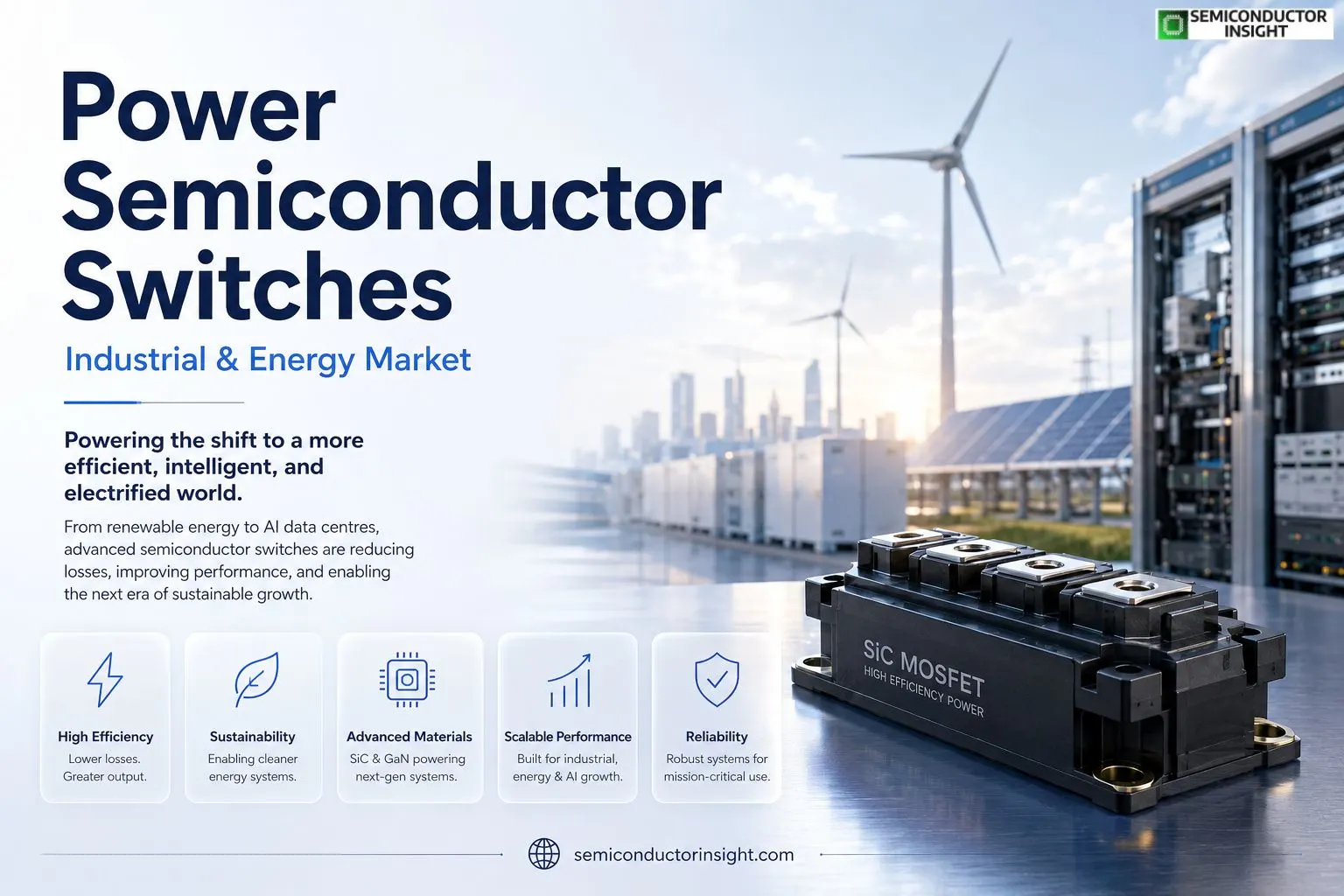
How Fast Are Power Semiconductor Switches for Industrial and Energy Market Growing in 2026?
Industrial facilities, renewable energy projects, electric transportation systems, and modern power grids all share a common requirement: efficient control of electricity. Behind this transformation lies a technology that rarely attracts public attention yet plays a decisive role in energy performance: power semiconductor switches.
As industries pursue electrification, automation, and lower energy consumption, advanced semiconductor switches are becoming essential building blocks. From solar inverters and wind turbines to industrial motor drives and battery storage systems, these components determine how effectively electricity is converted, transmitted, and utilised.
Key wafer-transition events (2025-2026)
- February 2025 – Infineon:Initiated customer rollout of first 200mm SiC products from its Villach, Austria, facility, targeting renewable energy, rail, and EV applications. Module 3 at Kulim, Malaysia, entered ramp-up in 2026.
- September 2025 – Wolfspeed:Commercially launched its 200mm SiC materials portfolio featuring 350µm substrates with industry-leading doping uniformity, empowering improved MOSFET yields across automotive, renewable energy, and industrial segments.
- January 2026 – Wolfspeed:Demonstrated the world’s first single-crystal 300mm SiC wafer, a 300mm boule, which increases die area per wafer by ~125% vs. 200mm. Backed by 2,300+ patents. Pilot customer qualification targeted for late 2027.
Why Power Switching Has Become a Boardroom Topic?
Energy efficiency is not just an engineering objective anymore. Power electronics has become a strategic infrastructure with increased electricity demand, grid upgrading plans, and sustainability goals.
The International Energy Agency (IEA) says worldwide power demand continues to climb, fueled by more industrial activity, data centres, and electric vehicles and electrified heating systems. Therefore, decreasing conversion losses in industry and energy systems is becoming increasingly crucial.
A just 1 percentage point of improvement in power conversion efficiency can equate to enormous operational savings when multiplied across utility-scale renewable projects, manufacturing operations or energy storage systems that are processing megawatts of electricity each day.
Which Power Semiconductors Improve Energy Efficiency Most?
This question is increasingly shaping investment decisions across industrial and energy sectors.
- Among today’s leading technologies, Silicon Carbide (SiC) and Gallium Nitride (GaN) devices are widely recognised for delivering substantial efficiency improvements compared with traditional silicon-based switches.
- SiC MOSFETs are particularly effective in high-voltage applications such as solar farms, battery energy storage systems, industrial drives, and electric vehicle charging infrastructure. Their ability to operate at higher temperatures and lower switching losses reduces wasted energy while enabling more compact system designs.
- GaN transistors excel in high-frequency applications where reduced switching losses and smaller magnetic components contribute to improved performance. They are increasingly appearing in power supplies, data centres, industrial automation systems, and fast-charging technologies.
- While both technologies enhance efficiency, SiC currently dominates large-scale industrial and energy applications due to its strong performance under high-voltage operating conditions.
A Technology Upgrade Visible Across Energy Infrastructure
The transition toward advanced switching technologies is no longer confined to research laboratories.
Modern solar inverters increasingly integrate SiC devices to maximise energy harvesting and improve conversion efficiency. Wind energy systems are also adopting advanced semiconductor switches to manage fluctuating power output more effectively.
The U.S. Department of Energy has repeatedly highlighted power electronics as a critical area for improving grid efficiency and renewable energy integration. Every reduction in switching losses contributes to greater utilisation of generated electricity before it reaches end users.
In large renewable installations processing hundreds of megawatts of power, even modest efficiency improvements can result in measurable increases in annual energy delivery.
800V HVDC architecture reshaping power semiconductor demand
AI rack power requirements are projected to rise from 100 kW today to over 1 MW — pushing data centre operators to adopt 800V HVDC distribution to slash conversion losses. This architectural shift creates a direct, structural pull for SiC and GaN power switches at scales never before seen in industrial power electronics.
- Texas Instruments + NVIDIA:Co-developing 800V HVDC power distribution. Proof-of-concept systems were expected in 2025; production deployments targeted for 2026 in customer systems.
- Navitas Semiconductor (May 2025):Selected by NVIDIA for its next-gen 800V HVDC architecture for Rubin Ultra GPUs. GaNFast + GeneSiC devices power rack-level Kyber systems.
- STMicroelectronics (Mar 2026):Expanded 800 VDC power conversion portfolio with new 800V-to-12V and 800V-to-6V architectures, highlighted at NVIDIA GTC 2026. October 2025 prototype achieved over 98% efficiency at 1 MHz.
- ROHM Semiconductor (2026):Plans mass production of 800 VDC and ±400 VDC AI server PSUs in Q2–Q3 2026. ROHM invests 8–10% of annual revenue in R&D and is building a total power solution from the grid to the GPU chip.
The Data Centre Connection Nobody Expected
The rapid growth of artificial intelligence and cloud computing is creating new opportunities for power semiconductor innovation.
Large data centres require highly efficient power conversion systems to support thousands of servers operating continuously. Industry reports indicate that hyperscale facilities may consume hundreds of megawatts of electricity, making efficiency improvements financially significant.
GaN-based power supplies are gaining attention because they can reduce power losses while enabling more compact equipment designs. As AI infrastructure expands globally, advanced switching technologies are becoming an increasingly important part of data centre architecture.
To Stay Tuned with More Meaningful and In-Depth Insights, Do Visit here: https://semiconductorinsight.com/report/power-semiconductor-switches-industrial-energy-market/
What Engineers Are Prioritising in 2026?
The conversation is no longer focused solely on switching speed or voltage capability. Engineers are evaluating power semiconductor switches through a broader lens that includes thermal performance, system reliability, energy efficiency, and lifecycle operating costs.
Manufacturers are investing heavily in packaging innovations, integrated power modules, and digital monitoring capabilities that improve overall system intelligence. The result is a new generation of semiconductor switches capable of supporting both industrial productivity and energy sustainability goals.
In an era defined by electrification and clean energy expansion, power semiconductor switches have evolved from supporting components into critical technologies shaping how electricity is managed across the global economy.

Comments (0)