Power Semiconductor Switches for Automotive Market Insights
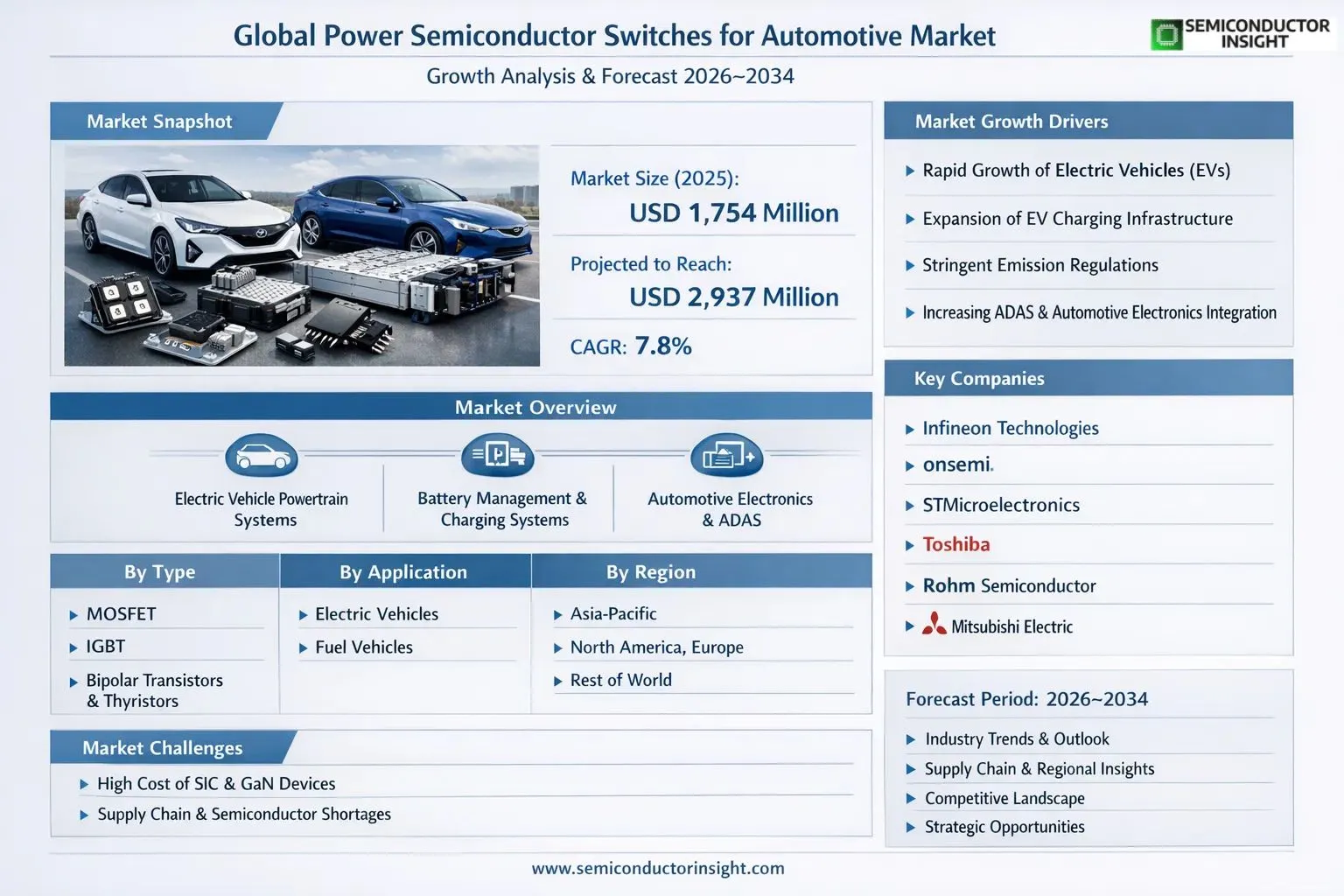
Global Power Semiconductor Switches for Automotive market size was valued at USD 1,754 million in 2025. The market is projected to grow from USD 1,754 million in 2025 to USD 2,937 million by 2034, exhibiting a CAGR of 7.8% during the forecast period.
Power Semiconductor Switches for Automotive are essential electronic components designed to control and regulate the flow of electrical power within vehicle systems. These devices encompass a range of technologies, including MOSFETs, IGBTs, Bipolar Power Transistors, and Thyristors, each serving distinct functions across fuel-based and electric vehicle platforms. As automotive architectures grow increasingly electrified and software-defined, these switches have become indispensable in managing power conversion, motor drives, battery management systems, and onboard charging modules with high efficiency and reliability.
The market is witnessing robust expansion driven by the accelerating global transition toward electric vehicles, stringent fuel efficiency regulations, and the rising complexity of automotive power electronics. Furthermore, growing demand for advanced driver assistance systems (ADAS) and electrified powertrains is intensifying the need for high-performance switching solutions. Leading manufacturers such as Infineon, onsemi, STMicroelectronics, Toshiba, Vishay, Fuji Electric, Renesas Electronics, Rohm, Nexperia, and Mitsubishi Electric are actively shaping the competitive landscape with continuous product innovation and strategic partnerships across Global automotive supply chain.
MARKET DRIVERS
Accelerating Electrification of the Automotive Sector
The rapid transition toward electric and hybrid vehicles represents one of the most significant forces shaping the power semiconductor switches for automotive market. As global automakers commit to ambitious electrification roadmaps, demand for high-performance switching devices such as IGBTs (Insulated Gate Bipolar Transistors), MOSFETs, and wide-bandgap semiconductors based on silicon carbide (SiC) and gallium nitride (GaN) has surged considerably. These components are fundamental to inverter systems, DC-DC converters, and onboard chargers that govern energy flow in battery electric vehicles (BEVs) and plug-in hybrid electric vehicles (PHEVs). The growing penetration of EVs across major markets including Europe, China, and North America continues to create sustained and expanding demand for advanced automotive-grade power switching solutions.
Stringent Emission Regulations Driving Adoption of Efficient Power Electronics
Increasingly stringent government regulations targeting carbon emissions and fuel efficiency standards are compelling automotive original equipment manufacturers (OEMs) to adopt more energy-efficient drivetrain architectures. Power semiconductor switches play a pivotal role in enabling higher system efficiencies by minimizing switching losses and thermal dissipation. Regulatory frameworks such as Euro 7 in Europe and Corporate Average Fuel Economy (CAFE) standards in the United States are pushing automakers to integrate next-generation power switches capable of operating at higher voltages and frequencies. This regulatory pressure directly strengthens the business case for deploying power semiconductor switches in automotive applications, particularly in traction inverters and power management systems.
➤ The growing adoption of 800V automotive architectures in premium electric vehicles is significantly accelerating the transition from conventional silicon-based switches to SiC MOSFETs, enabling faster charging, reduced weight, and higher powertrain efficiency across the automotive power semiconductor switches landscape.
Beyond regulatory compliance, automotive manufacturers are also responding to strong consumer preferences for longer driving ranges and faster charging capabilities. These performance imperatives are fundamentally linked to the efficiency and thermal management characteristics of power semiconductor switches used in automotive power electronics. SiC-based switches, in particular, offer switching frequencies and thermal conductivity levels that silicon-based alternatives cannot match, making them increasingly preferred for high-voltage EV platforms. As competition among automakers intensifies around range and charging speed, investment in superior automotive power semiconductor switch technology continues to grow, reinforcing this key market driver.
MARKET CHALLENGES
High Manufacturing Complexity and Cost of Wide-Bandgap Semiconductor Devices
Despite their performance advantages, wide-bandgap power semiconductor switches based on SiC and GaN remain significantly more expensive to manufacture compared to conventional silicon devices. The complexity of the SiC substrate fabrication process, including epitaxial growth and defect management, results in lower yield rates and elevated production costs. For the power semiconductor switches for automotive market, this cost differential presents a tangible challenge, particularly for mass-market vehicle segments where price sensitivity is high. While costs have been declining as manufacturing volumes increase, achieving cost parity with silicon alternatives remains a medium-term challenge that constrains broader adoption across all vehicle classes and geographic markets.
Other Challenges
Supply Chain Vulnerabilities and Raw Material Dependencies
The automotive power semiconductor supply chain has demonstrated fragility in recent years, with chip shortages causing widespread disruption across Global automotive industry. The automotive power semiconductor switches segment remains exposed to geopolitical risks and geographic concentration of key raw material sources, particularly for SiC wafers and rare materials used in GaN production. Automotive OEMs and Tier 1 suppliers are actively working to diversify supplier bases and build strategic inventories, but achieving supply chain resilience in this specialized segment requires sustained investment and long-term procurement agreements that not all manufacturers can readily secure.
Thermal Management and Reliability Qualification Requirements
Automotive-grade power semiconductor switches must meet extremely demanding reliability and thermal management standards, including AEC-Q101 qualification and extended operational lifetimes under harsh environmental conditions. Meeting these stringent requirements adds complexity and cost to the development cycle. The power semiconductor switches for automotive applications must reliably withstand wide temperature ranges, vibration, humidity, and electromagnetic interference over vehicle lifetimes that may span a decade or more. Ensuring consistent performance under such conditions demands rigorous testing protocols that extend time-to-market and increase validation costs for semiconductor suppliers targeting the automotive sector.
MARKET RESTRAINTS
Long Automotive Qualification Cycles Limiting Speed of Technology Adoption
The automotive industry operates under some of the most rigorous and time-consuming qualification processes of any end-use sector. For power semiconductor switches targeting automotive markets, gaining design wins requires passing multi-year validation cycles that assess performance, reliability, and safety across a broad range of operating conditions. These extended qualification timelines create a significant barrier for emerging semiconductor technologies, effectively slowing the pace at which newer generations of power switches can be adopted into production vehicles. Even when a new switching technology demonstrates clear technical advantages, the path from prototype validation to high-volume automotive production can span three to five years, restraining market responsiveness to technological innovation.
Dependence on Concentrated Semiconductor Manufacturing Capacity
Global production capacity for automotive-grade power semiconductor switches remains concentrated among a relatively small number of established manufacturers, many of which are headquartered in East Asia and Europe. This geographic and corporate concentration creates systemic vulnerabilities for the broader automotive power semiconductor switches market. When capacity constraints emerge — as observed during the semiconductor shortage that severely impacted automotive production globally — the entire supply chain is affected with limited flexibility for rapid capacity expansion. New fab construction for power semiconductors requires multi-billion-dollar capital investment and lead times of several years, making short-term supply responsiveness structurally constrained and acting as a persistent restraint on market scalability.
MARKET OPPORTUNITIES
Expansion of Silicon Carbide Technology Across Mid-Range Electric Vehicle Platforms
While SiC-based power semiconductor switches have initially penetrated premium and performance EV segments, a compelling growth opportunity exists in their progressive adoption across mid-range and volume EV platforms. As SiC wafer production scales and manufacturing efficiencies improve, the cost per device is expected to decline to levels competitive enough for mainstream vehicle applications. Automotive OEMs designing next-generation EV platforms are increasingly specifying SiC-based traction inverters as a standard architecture component rather than a premium differentiator. This democratization of SiC technology across the automotive power semiconductor switches landscape represents a substantial volume opportunity for both established semiconductor suppliers and emerging players investing in automotive-grade SiC production capabilities.
Growth in Autonomous and Advanced Driver Assistance Systems Creating New Power Semiconductor Demand
The proliferation of advanced driver assistance systems (ADAS) and the gradual commercialization of autonomous vehicle technologies are generating new application areas for power semiconductor switches in the automotive sector. High-performance computing platforms required for ADAS processing, along with the electrification of power steering, braking, and suspension systems, demand reliable and efficient power switching solutions across a growing number of vehicle subsystems. This diversification of application end-points beyond the primary traction drivetrain expands the total addressable market for automotive power switches significantly. As vehicles incorporate increasingly sophisticated electronic architectures, the cumulative content of power semiconductor switches per vehicle is expected to rise, creating durable long-term revenue opportunities for technology-leading suppliers in this space.
Strategic Government Investment and Incentive Programs Supporting Domestic Semiconductor Ecosystems
Governments across the United States, European Union, Japan, South Korea, and China have launched substantial industrial policy initiatives aimed at strengthening domestic semiconductor manufacturing capabilities. Programs such as the U.S. CHIPS and Science Act and the European Chips Act allocate significant funding toward expanding fab capacity, supporting research and development, and incentivizing localized supply chains. For the power semiconductor switches for automotive market, these policy tailwinds create meaningful opportunities by reducing the financial barriers to new capacity investment and encouraging strategic partnerships between semiconductor manufacturers and automotive OEMs. Domestic sourcing preferences embedded in these policy frameworks further incentivize investment in regional automotive power semiconductor ecosystems, offering long-term structural support for market expansion.
MAIN TITLE HERE () Trends
Rising Electrification of Vehicles Accelerating Demand for Power Semiconductor Switches
The Power Semiconductor Switches for Automotive Market is undergoing a significant transformation, driven primarily by Global shift toward vehicle electrification. As automotive manufacturers accelerate the development and production of electric vehicles (EVs), the demand for high-performance power semiconductor switches — including MOSFETs, IGBTs, and thyristors — has seen a marked increase. These components are essential for managing inverter systems, onboard chargers, DC-DC converters, and battery management units in modern EVs. The transition from internal combustion engines to electric drivetrains has fundamentally redefined design requirements for power electronics, pushing semiconductor developers to engineer devices capable of higher switching frequencies, improved thermal management, and greater energy efficiency. Leading manufacturers such as Infineon, STMicroelectronics, onsemi, and Renesas Electronics have intensified their R&D investments to address these evolving automotive-grade specifications.
Other Trends
Wide Bandgap Semiconductor Adoption
One of the most impactful trends in the Power Semiconductor Switches for Automotive Market is the growing adoption of wide bandgap (WBG) materials such as silicon carbide (SiC) and gallium nitride (GaN). These materials offer superior switching speed, lower conduction losses, and higher temperature tolerance compared to conventional silicon-based devices. Automotive OEMs and Tier-1 suppliers are increasingly integrating SiC MOSFETs into EV traction inverters and fast-charging systems to improve range and reduce system size. Companies including Rohm, Mitsubishi Electric, and Fuji Electric have expanded their SiC product portfolios to serve the growing EV power electronics segment.
IGBT Technology Remains Relevant in Hybrid and High-Power Applications
Despite the rise of SiC-based switches, Insulated Gate Bipolar Transistors (IGBTs) continue to play a critical role in hybrid electric vehicles and high-voltage automotive systems. Their cost-effectiveness and reliability in handling high-current loads make them a preferred choice for traction drives and powertrain management in hybrid platforms. Toshiba and Vishay remain active contributors to IGBT development for automotive-grade applications, refining chip architectures to optimize switching losses and thermal performance.
Regional Manufacturing and Supply Chain Realignment
Geopolitical shifts and supply chain disruptions have prompted automotive semiconductor manufacturers to diversify production and establish regional supply hubs. Asia — particularly China, Japan, and South Korea — remains the dominant production and consumption hub for power semiconductor switches in the automotive sector. Meanwhile, North America and Europe are investing in domestic semiconductor fabrication capabilities to reduce reliance on concentrated supply sources. This strategic realignment is reshaping procurement strategies across automakers and is expected to influence pricing dynamics, lead times, and long-term supplier partnerships within the Power Semiconductor Switches for Automotive Market through the coming years.
COMPETITIVE LANDSCAPE
Key Industry Players
Power Semiconductor Switches for Automotive Market — Competitive Dynamics and Strategic Positioning of Leading Global Manufacturers
Global Power Semiconductor Switches for Automotive market is characterized by intense competition among a concentrated group of technologically advanced players. Infineon Technologies commands a leading position in this space, leveraging its broad portfolio of automotive-grade MOSFETs, IGBTs, and SiC-based power devices tailored for electric vehicle (EV) powertrains, onboard chargers, and battery management systems. The company’s deep integration with Tier-1 automotive suppliers and OEMs across Europe, Asia, and North America has reinforced its dominant market share. onsemi and STMicroelectronics closely follow, each offering comprehensive automotive power semiconductor lineups with a strong emphasis on energy efficiency and compliance with stringent automotive reliability standards such as AEC-Q101. With Global market valued at approximately USD 1,754 million in 2025 and projected to reach USD 2,937 million by 2034 at a CAGR of 7.8%, these top-tier manufacturers are aggressively expanding their R&D investments and fab capacities to capitalize on the accelerating transition toward electrified mobility and advanced driver assistance systems (ADAS).
Beyond the frontrunners, several other significant players are carving out specialized niches within the automotive power semiconductor switches landscape. Toshiba and Mitsubishi Electric bring decades of expertise in IGBT and bipolar power transistor technologies, serving both fuel-based and electric vehicle segments with highly reliable components suited for high-voltage automotive environments. Rohm Semiconductor and Fuji Electric are gaining strategic momentum through their proprietary silicon carbide (SiC) MOSFET platforms, which offer superior switching efficiency critical for next-generation EV inverters and DC-DC converters. Renesas Electronics contributes a robust portfolio of intelligent power devices, while Vishay Intertechnology and Nexperia focus on cost-optimized, high-volume automotive discrete semiconductors targeting both traditional fuel vehicle architectures and emerging EV platforms. Collectively, these manufacturers are shaping a competitive landscape defined by technological innovation, strategic partnerships, and regional manufacturing expansion across Asia, Europe, and North America.
List of Key Power Semiconductor Switches for Automotive Companies Profiled
- Infineon Technologies
- onsemi
- STMicroelectronics
- Toshiba
- Vishay Intertechnology
- Fuji Electric
- Renesas Electronics
- Rohm Semiconductor
- Nexperia
- Mitsubishi Electric
- Texas Instruments
- NXP Semiconductors
- IXYS Corporation (a Littelfuse company)
- Semikron Danfoss
- Microchip Technology
Segment Analysis:
| Segment Category | Sub-Segments | Key Insights |
| By Type |
|
MOSFET stands as the leading segment within the Power Semiconductor Switches for Automotive market, driven by its superior switching speed, low on-resistance, and excellent thermal performance characteristics.
|
| By Application |
|
Electric Vehicle (EV) is the dominant and fastest-growing application segment, reflecting Global automotive industry’s accelerating transition toward electrification and zero-emission mobility.
|
| By End User |
|
OEM (Original Equipment Manufacturers) represents the leading end-user segment, as automotive OEMs integrate power semiconductor switches directly into vehicle platforms during the design and manufacturing phase.
|
| By Voltage Rating |
|
High Voltage (Above 600V) is the most dynamically growing sub-segment, propelled by the rapid proliferation of battery electric vehicles and the increasing voltage architectures being adopted by premium and performance EV platforms.
|
| By Material Technology |
|
Silicon Carbide (SiC) is rapidly emerging as the leading material technology segment, transforming the performance landscape of power semiconductor switches in automotive applications through its exceptional thermal conductivity, high breakdown voltage capability, and low switching losses.
|
Regional Analysis: Power Semiconductor Switches for Automotive Market
China’s dominance in the power semiconductor switches for automotive market is deeply rooted in its unparalleled electric vehicle output and state-backed industrial policy. The nation’s automotive sector has rapidly transitioned toward high-voltage architectures, intensifying demand for advanced power switching devices. Domestic semiconductor champions and international partnerships alike are scaling production to meet the surging requirements of both passenger and commercial electric platforms.
Japan and South Korea remain critical innovation hubs within the Asia-Pacific power semiconductor switches for automotive market. Tier-one automotive groups and specialized semiconductor developers in these countries are pioneering silicon carbide and gallium nitride power switch technologies. Their deep integration with global automotive supply chains ensures that next-generation power electronics solutions for hybrid and full-electric vehicle platforms continue to advance at a compelling pace.
India represents one of the most dynamic emerging opportunities in the Asia-Pacific power semiconductor switches for automotive market. Progressive electrification mandates, coupled with expanding two-wheeler and three-wheeler EV adoption, are generating fresh demand for compact and efficient power switching solutions. Growing government incentives for domestic semiconductor manufacturing are also attracting strategic investment, gradually reducing import dependence and strengthening regional supply chain resilience.
Across Asia-Pacific, the transition toward wide-bandgap semiconductor materials is fundamentally reshaping the power semiconductor switches for automotive market. Silicon carbide-based power switches are gaining strong traction in high-voltage traction inverters and onboard charging systems, offering superior thermal performance and switching efficiency. Regional manufacturers are investing heavily in SiC and GaN wafer production capacity, positioning Asia-Pacific as Global center of gravity for next-generation automotive power electronics.
North America
North America represents a highly strategic and rapidly evolving region within Global power semiconductor switches for automotive market. The United States serves as the primary growth engine, supported by substantial federal investments in electric vehicle infrastructure, domestic semiconductor production incentives, and the presence of leading automotive original equipment manufacturers aggressively electrifying their portfolios. The region’s advanced research and development ecosystem, spanning national laboratories, universities, and private sector innovators, is fostering breakthroughs in wide-bandgap power semiconductor technologies purpose-built for demanding automotive applications. Canada is contributing through targeted clean energy policies and emerging battery and power electronics manufacturing initiatives. Mexico, as a pivotal automotive manufacturing hub, is increasingly integrated into North American power semiconductor supply chains. The collective push toward vehicle electrification, grid-interactive charging solutions, and software-defined vehicle platforms is consistently elevating the performance and integration requirements placed on automotive power semiconductor switches across the region.
Europe
Europe occupies a pivotal position in Global power semiconductor switches for automotive market, shaped by some of the world’s most stringent automotive emissions regulations and a deeply established tradition of automotive engineering excellence. Germany, France, and Scandinavia are at the forefront of regional demand, driven by premium automotive brands committing to comprehensive electrification roadmaps and heavy investment in high-performance power electronics. The European Union’s regulatory environment, including aggressive fleet-wide carbon dioxide reduction targets, is acting as a powerful structural catalyst for accelerated adoption of advanced power switching technologies in both hybrid and fully electric vehicles. Regional semiconductor manufacturers and research consortia are actively developing next-generation silicon carbide and gallium nitride automotive power devices, while strong collaboration between industry, academia, and government is reinforcing Europe’s competitive standing. The ongoing expansion of charging infrastructure and the growing complexity of automotive power management systems further underscore the region’s sustained strategic importance in this market.
South America
South America is gradually gaining relevance in Global power semiconductor switches for automotive market, albeit from a comparatively nascent stage of electric vehicle adoption. Brazil leads regional activity, benefiting from a relatively mature automotive manufacturing base, expanding consumer interest in hybrid and alternative-fuel vehicles, and nascent government frameworks aimed at supporting vehicle electrification. Chile and Colombia are beginning to establish early-stage EV policies that could, over the forecast period, generate incremental demand for automotive power semiconductor switching solutions. The region’s rich natural resource endowments, particularly in lithium and copper, position it as a potentially important participant in the broader electric vehicle and power electronics value chain. However, infrastructure limitations, economic variability, and the relatively slower pace of regulatory mandates continue to moderate near-term growth momentum for power semiconductor switches across South American automotive markets.
Middle East & Africa
The Middle East and Africa region currently represents the nascent frontier of Global power semiconductor switches for automotive market, with growth prospects shaped primarily by long-term urbanization trends, diversification strategies away from hydrocarbon dependence, and selective government-led mobility modernization programs. Gulf Cooperation Council nations, particularly the United Arab Emirates and Saudi Arabia, are investing in smart city initiatives and sustainable transportation infrastructure, creating early demand signals for electrified vehicle platforms and the associated power switching technologies. South Africa represents the most established automotive manufacturing presence on the African continent, with gradually increasing engagement in hybrid powertrain technology. Across the broader region, the absence of comprehensive EV policy frameworks and limited charging infrastructure currently constrains more rapid market development. Nevertheless, the medium-to-long-term outlook for power semiconductor switches in Middle Eastern and African automotive markets carries meaningful upside potential as electrification agendas mature.
Report Scope
This market research report provides a comprehensive analysis of the Power Semiconductor Switches for Automotive Market, covering the forecast period 2026–2034. It offers detailed insights into market dynamics, technological advancements, competitive landscape, and key trends shaping the industry.
Key focus areas of the report include:
- Market Overview: The report begins with an overview outlining its current market scenario, key growth indicators, and industry transformation drivers. It discusses macroeconomic factors, demand–supply balance, regulatory landscape, and the strategic role of semiconductors in powering advancements across industries such as automotive, telecommunications, consumer electronics, and industrial automation.
- Market Size & Forecast: Historical data and future projections for revenue, unit shipments, and market value across major regions and segments.
- Segmentation Analysis: Detailed breakdown by product type, technology, application, and end-user industry to identify high-growth segments and investment opportunities.
- Regional Insights: Insights into market performance across North America, Europe, Asia-Pacific, Latin America, and the Middle East & Africa, including country-level analysis where relevant.
- Competitive Landscape: Profiles of leading market participants, including their product offerings, R&D focus, manufacturing capacity, pricing strategies, and recent developments such as mergers, acquisitions, and partnerships.
- Technology Trends & Innovation: Assessment of emerging technologies, integration of AI/IoT, semiconductor design trends, fabrication techniques, and evolving industry standards.
- Market Drivers & Restraints: Evaluation of factors driving market growth along with challenges, supply chain constraints, regulatory issues, and market-entry barriers.
- Stakeholder Insights: Insights for component suppliers, OEMs, system integrators, investors, and policymakers regarding the evolving ecosystem and strategic opportunities.
Primary and secondary research methods are employed, including interviews with industry experts, data from verified sources, and real-time market intelligence to ensure the accuracy and reliability of the insights presented.
FREQUENTLY ASKED QUESTIONS:
What is the current market size of Power Semiconductor Switches for Automotive Market?
-> Global Power Semiconductor Switches for Automotive Market was valued at USD 1754 million in 2025 and is expected to reach USD 2937 million by 2034, growing at a CAGR of 7.8% during the forecast period.
Which key companies operate in Power Semiconductor Switches for Automotive Market?
-> Key players include Infineon, onsemi, STMicroelectronics, Toshiba, Vishay, Fuji Electric, Renesas Electronics, Rohm, Nexperia, and Mitsubishi Electric, among others.
What are the key growth drivers?
-> Key growth drivers include rapid adoption of electric vehicles (EVs), increasing demand for fuel-efficient automotive systems, expansion of EV charging infrastructure, stringent emission regulations, and growing integration of advanced power electronics in modern vehicles.
Which region dominates the market?
-> Asia-Pacific is the fastest-growing region driven by strong EV adoption in China, Japan, South Korea, and Southeast Asia, while North America and Europe remain significant markets due to advanced automotive manufacturing and regulatory push for electrification.
What are the emerging trends?
-> Emerging trends include widespread adoption of MOSFET and IGBT technologies, shift toward wide-bandgap semiconductors (SiC and GaN), rising penetration of electric vehicles, smart power management integration, and increasing R&D investments by leading manufacturers to enhance switching efficiency and thermal performance in automotive applications.

Get Sample Report PDF for Exclusive Insights
Report Sample Includes
- Table of Contents
- List of Tables & Figures
- Charts, Research Methodology, and more...
 Download Sample Report PDF