
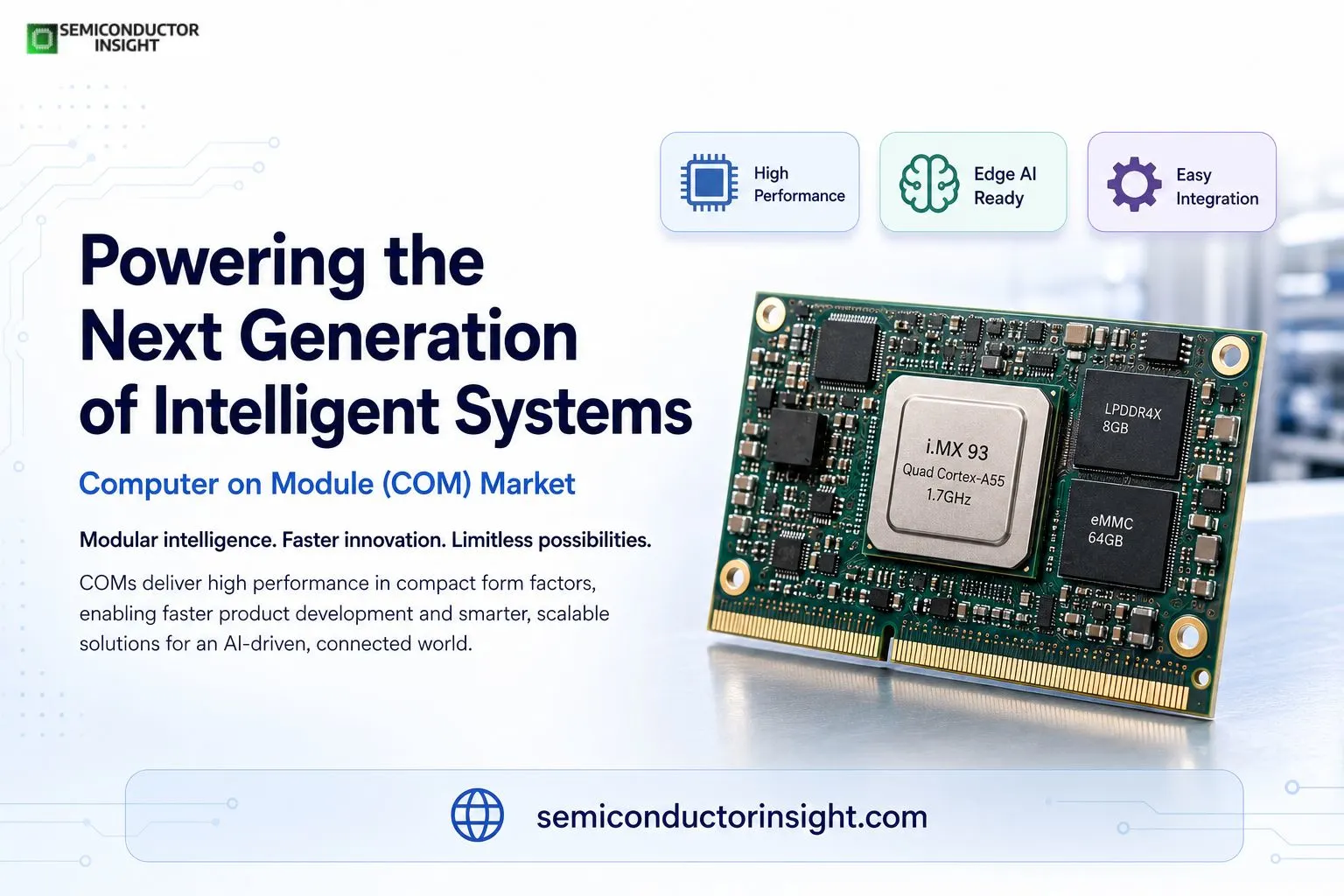
How Embedded AI Platforms Are Creating New Computer on Module Market Opportunities?
Computer on module market is entering a new phase of technological importance as industries increasingly demand compact, scalable, and high-performance embedded computing solutions for edge intelligence and industrial automation.
Computer on modules, often referred to as COMs or system-on-modules, integrate processors, memory, graphics, and connectivity interfaces into compact boards that simplify hardware development while accelerating product deployment cycles. These modular systems are very appealing for quickly developing semiconductor applications because, in contrast to traditional embedded platforms, they enable manufacturers to improve processing capabilities without completely redesigning systems.
The market is benefiting from the growing transition toward smart factories, AI-enabled industrial systems, autonomous robotics, and connected infrastructure. Industries are now prioritising decentralised computing where data can be processed closer to machines rather than relying entirely on cloud infrastructure. This shift is increasing demand for advanced COM architectures capable of handling machine vision, predictive maintenance, and real-time analytics in manufacturing environments.
To find out more, feel free to browse our latest updated report: https://semiconductorinsight.com/report/computer-on-module-com-market/
Edge AI Hardware Changing Embedded Computing Priorities
- One of the strongest transformations within the computer on module market is the rapid emergence of edge AI computing.
- Enterprises are increasingly deploying AI inference capabilities directly on industrial devices, autonomous equipment, and intelligent monitoring systems rather than processing everything through centralized cloud networks.
- Modern computer on modules equipped with AI accelerators, GPUs, and neural processing units are now supporting machine learning tasks in warehouses, manufacturing plants, agricultural automation systems, and smart transportation networks.
- Semiconductor companies are redesigning embedded architectures specifically for low-latency decision-making where milliseconds matter.
- Recent semiconductor developments also highlight how AI infrastructure demand is influencing embedded computing strategies globally.
- Reuters Technology reported that rising AI-related demand is significantly strengthening semiconductor investment across industrial and edge applications.
Embedded AI Processing Flow
Sensor Data Collection → Edge Computing Module → AI Inference Engine → Real Time Machine Decision → Cloud Synchronization
ARM Architectures Reshaping Performance Efficiency Standards
ARM-based computer on modules are gaining significant traction due to their balance between processing power and energy efficiency. Embedded system developers are increasingly selecting ARM architectures for IoT gateways, autonomous drones, portable medical devices, and smart retail systems where thermal management and power optimization are critical.
The open architecture movement surrounding RISC-V and ARM ecosystems is also encouraging faster innovation in embedded semiconductor design. Discussions within embedded engineering communities show growing interest in lightweight AI processing frameworks optimized for low-power hardware environments.
Robotics and Smart Factories Expanding COM Integration
Industrial robotics is becoming one of the most influential application areas for computer on modules. Modern robotic systems require compact computing platforms capable of supporting motion control, computer vision, and sensor fusion while operating in confined industrial environments.
Factories implementing Industry 4.0 strategies are deploying modular embedded systems because they reduce integration complexity and simplify long-term hardware upgrades. In automotive assembly facilities and electronics manufacturing plants, COM-based systems are being integrated into robotic arms, autonomous guided vehicles, inspection systems, and industrial HMIs.
The increasing use of predictive maintenance technologies is also accelerating COM adoption. Smart manufacturing equipment equipped with embedded AI modules can monitor vibration patterns, heat fluctuations, and equipment stress levels in real time. Research related to industrial edge systems highlights how embedded intelligence is becoming essential for next-generation cyber-physical manufacturing environments.
Software-Defined Hardware Accelerating Product Development Cycles
- Another major transformation within the computer on module market is the growing preference for software-defined embedded hardware.
- Manufacturers are increasingly using modular computing systems to reduce development timelines for connected products.
- Instead of redesigning complete motherboards for every new industrial machine or smart device, developers can integrate interchangeable COM platforms into standardised carrier boards.
- This approach significantly reduces engineering costs while improving hardware scalability.
- Embedded developer communities increasingly view modular computing as essential for managing future edge AI ecosystems.
Discussions among engineers highlight how embedded development roles are evolving toward AI deployment, OTA updates, and intelligent connectivity management rather than traditional firmware-only workflows.
The growing convergence of AI, industrial automation, and edge computing is positioning computer on modules as foundational semiconductor platforms for the next generation of intelligent machines, connected infrastructure, and autonomous industrial operations.

Comments (0)