Key Statistics
Key Takeaways
- x86-based modules hold the largest revenue share in 2025, carried by the industrial PC installed base, the maturity of the COM Express ecosystem and the software compatibility that lets an OEM migrate a legacy application onto a module without rewriting it.
- ARM-based modules are the fastest-growing type, expanding well above the market average as SMARC becomes the default form factor for fanless, power-constrained edge designs and as high-performance ARM silicon reaches the COM-HPC class for the first time.
- Industrial automation remains the largest application by revenue, while medical equipment is the fastest-growing, because a standardised module lets a device maker refresh compute without repeating the full regulatory validation of the carrier hardware.
- Europe holds the largest regional share in 2025 – Europe and North America together account for roughly 75% of global revenue – while Asia-Pacific is the fastest-growing region and already carries about 58% of global production capacity for the category.
- Consolidation has reshaped supply. congatec’s acquisition of Kontron’s module business in July 2025, integrated as 18 new JUMPtec product families on 8 January 2026, means roughly one in four embedded modules shipped worldwide now comes from a single vendor.
- The EU Cyber Resilience Act is the sector’s defining compliance event. Vulnerability reporting duties begin on 11 September 2026 and full application follows on 11 December 2027, shifting long-term security maintenance onto module vendors and favouring suppliers able to fund it.
Computer On Module (COM) Market Overview
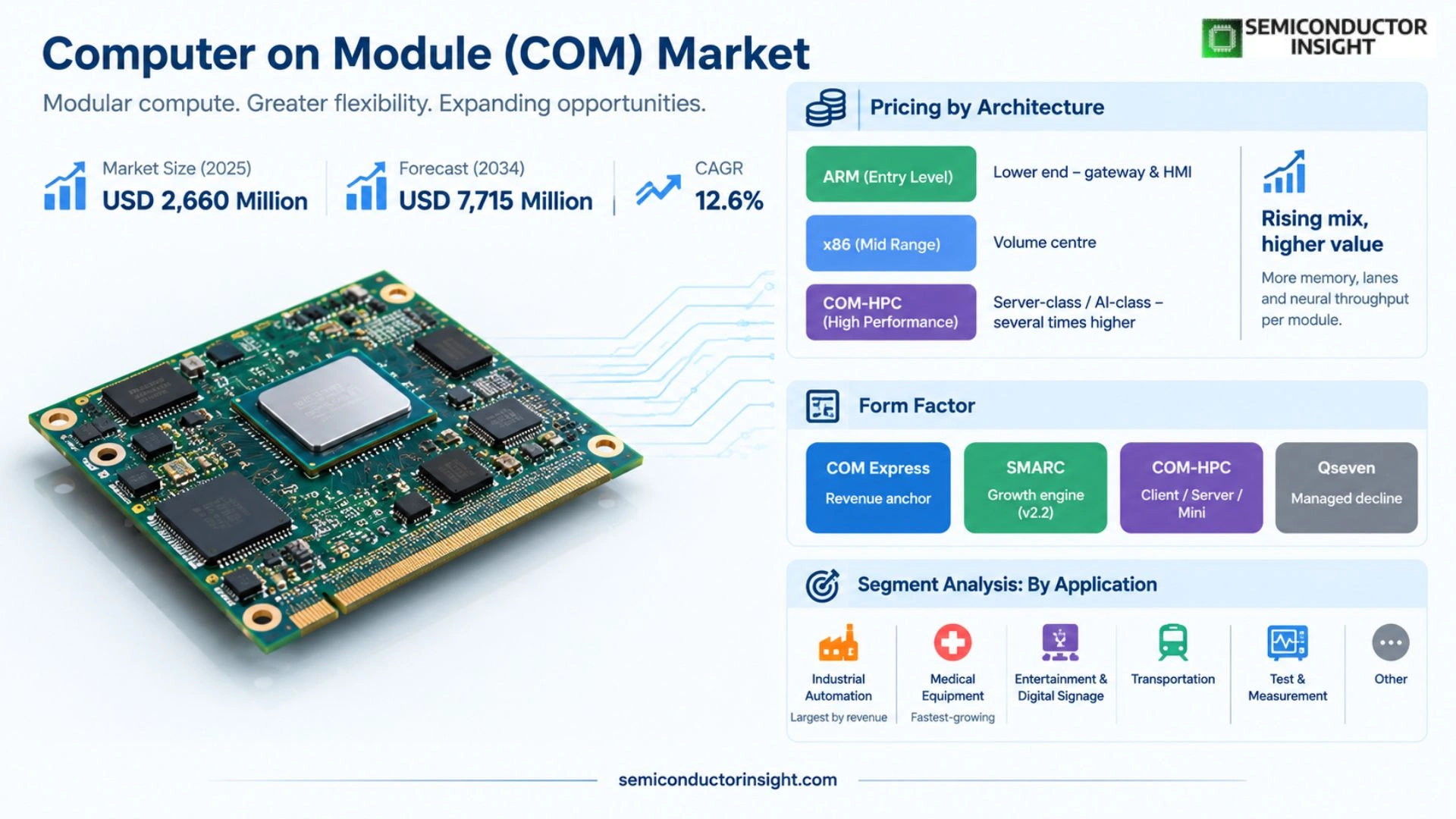
Computer on Module (COM) Market was valued at USD 2,660 million in 2025 and is projected to reach USD 7,715 million by 2034, expanding at a CAGR of 12.6% across the 2026–2034 forecast period. Europe held the largest regional share in 2025, with Europe and North America together accounting for approximately 75% of global revenue, while Asia-Pacific is the fastest-growing region and the centre of manufacturing.
A computer-on-module is a complete embedded computing subsystem – processor, memory, power sequencing, boot firmware and high-speed interfaces – built on a small board that plugs into an application-specific carrier through a standardised connector. The carrier holds the connectors, isolation, field wiring and mechanical interfaces particular to the end product, while the module holds everything that becomes obsolete first. That division of labour is the entire commercial premise of the category, and it explains why the market grows faster than the industrial computing hardware it sits inside.
The architecture answers a specific problem in embedded design. A machine builder, imaging system vendor or rail electronics supplier needs a product life measured in ten to fifteen years, but the silicon inside it changes every two to three. Designing a custom single-board computer forces a full hardware redesign, re-layout of high-speed traces, and renewed EMC and safety testing at every processor transition. Sourcing a module confines that churn to a component that the vendor has already validated, so the carrier – and the certification evidence attached to it – survives the refresh.
Four standards define the addressable market. COM Express, maintained by PICMG, serves higher-performance x86 designs and carries the largest installed base. SMARC, maintained by SGET and updated to specification version 2.2, targets low-power ARM and increasingly RISC-V designs in a compact 82 × 50 mm or 82 × 80 mm footprint. Qseven addresses legacy compact designs, while COM-HPC – including the Mini variant supported by PICMG’s Carrier Design Guide Revision 2.2 – extends the concept to server-class and AI-class workloads at the edge.
Demand has shifted materially in the past two years. What used to be a market for deterministic control compute is now substantially a market for edge inference: vision inspection on production lines, diagnostic imaging pre-processing in medical devices, perception stacks in off-highway vehicles, and protocol-heavy gateway workloads in transportation. Those applications need neural processing capability, multiple high-bandwidth camera inputs and thermal headroom inside a sealed enclosure – requirements that push buyers toward modules rather than custom boards, because the validation burden of getting them right is substantial.
Segment Analysis: By Type
By processor architecture, the computer-on-module market is segmented into x86-based, ARM-based, RISC-V based, Power Architecture and other modules. x86-based modules held the largest revenue share in 2025 on the strength of the COM Express installed base and software compatibility, while ARM-based modules are growing fastest as SMARC becomes the default choice for fanless edge AI designs.
| Architecture | Function | Market position |
|---|---|---|
| x86-based COM | Intel Core, Core Ultra, Atom and AMD Ryzen Embedded silicon on COM Express and COM-HPC carriers, running standard Windows and Linux images without recompilation | Largest share in 2025. The default where an existing application, a Windows dependency or a third-party validated software stack must be preserved. Buyers pay a power and thermal penalty for binary compatibility and accept it, because revalidating an application on a new instruction set costs more than the additional watts. congatec’s launch of five Intel Core Ultra Series 3 modules in January 2026 illustrates how quickly this segment absorbs each new processor generation. |
| ARM-based COM | NXP i.MX, Texas Instruments AM6x, Rockchip, Qualcomm Dragonwing and comparable SoCs, predominantly on SMARC and increasingly on COM-HPC Mini | Fastest-growing type. Wins where the thermal budget is sealed, the enclosure is fanless and the product runs on limited power – battery-operated instruments, sealed vehicle electronics, outdoor gateways. The arrival of high-performance ARM silicon on COM-HPC Mini, first offered with Qualcomm’s Dragonwing IQ-X in January 2026, removed the segment’s historical ceiling and opened workloads that previously required x86. |
| RISC-V based COM | Open instruction-set SoCs supplied on SMARC-compatible modules, generally with a Linux or RTOS software stack | The smallest segment and the earliest in its adoption curve, but structurally significant. Interest is concentrated where licence independence, long-horizon supply security or sovereign design control matter more than mature toolchains – European industrial programmes, defence-adjacent equipment and Chinese domestic designs. Ecosystem maturity, not silicon capability, is the binding constraint today. |
| Power Architecture | NXP QorIQ and legacy PowerPC devices supplied on long-availability modules for installed systems | A declining but resilient niche sustained by installed-base obligations rather than new design activity. Rail signalling, avionics and heavy process control carry certification evidence tied to a specific instruction set, so replacement is a recertification event. Suppliers compete on longevity guarantees and lifecycle management, not performance. |
| Others | FPGA-attached, DSP-centric and heterogeneous modules serving specialised acquisition and processing workloads | Application-specific demand in test and measurement, software-defined radio and high-rate data acquisition. Volumes are modest, but average selling prices are the highest in the category and design-in positions are unusually durable because the software investment sitting on top of the hardware is difficult to move. |
Pricing by architecture
Average selling prices span roughly an order of magnitude across the category, and the spread is widening rather than compressing. Entry-level ARM modules for gateway and HMI duty sit at the bottom, mid-range x86 modules occupy the volume centre, and COM-HPC modules carrying server-class or AI-class silicon reach several times that level. The important pricing dynamic is mix, not discounting: as edge inference workloads migrate into industrial and medical equipment, the average module shipped carries more memory, more lanes and more neural throughput than it did three years ago, which lifts blended revenue per unit even where unit pricing at each tier is competitive.
Form factor as a second segmentation axis
Architecture and form factor are separate purchasing decisions and buyers treat them that way. COM Express remains the revenue anchor because of the breadth of carriers already designed against it. SMARC is the growth engine, and its version 2.2 specification consolidated the interface set that fanless edge designs actually use. COM-HPC, with its Client, Server and Mini variants, is where new high-performance design starts are concentrating. Qseven is in managed decline, supported by replacement demand from designs that were locked years ago and are not worth re-engineering.
Segment Analysis: By Application
By application, the market is segmented into industrial automation, medical equipment, entertainment and digital signage, transportation, test and measurement, and other end uses. Industrial automation is the largest application by revenue, while medical equipment is the fastest-growing, because modular compute lets a device maker refresh processing power without repeating the regulatory validation attached to the carrier and enclosure.
| Application | Demand characteristics |
|---|---|
| Industrial Automation | The largest application. Machine controllers, vision inspection systems, robot controllers, edge gateways and industrial HMIs. Demand is capital-equipment driven and therefore cyclical, but the design-in position is unusually sticky: once a machine platform is qualified around a module family, that choice repeats across every unit built to the design, often for a decade. The clearest structural shift is the migration of quality inspection from rule-based image processing to trained inference models, which raises the compute and memory content of each new machine generation. |
| Medical Equipment | Fastest-growing application. Patient monitors, ultrasound and endoscopy front ends, laboratory analysers, infusion and dialysis platforms. The purchasing logic here is regulatory rather than technical: because the carrier, enclosure and applied parts carry the validation evidence, confining the compute to a swappable module means a processor refresh is a contained change rather than a full re-submission. Buyers pay a premium for documented ten-year availability and controlled revision management, which favours established European and North American vendors. |
| Transportation | Rail passenger information and signalling peripherals, fleet telematics, off-highway vehicle control, and increasingly perception and driver-assistance compute in specialty vehicles. Requirements are dominated by environment rather than performance: extended temperature operation, shock and vibration tolerance, EN 50155 and comparable qualification, and isolated power. Design cycles are long and qualification costs are high, which limits supplier churn but makes each win commercially valuable over the life of the platform. |
| Entertainment & Digital Signage | Media players, interactive kiosks, gaming and amusement machines, and large-format display controllers. This is the most price-sensitive and shortest-cycle segment in the category, where multi-display output, hardware video decode and remote manageability decide the specification. Volumes can be substantial and lead times short, but design-in positions are less durable than in regulated applications, and competition from consumer-derived single-board computers is persistent at the low end. |
| Test & Measurement | Instrumentation controllers, data acquisition front ends, automated test equipment and calibration systems. A smaller segment with the highest average selling prices, driven by requirements for deterministic timing, PCIe lane count and long-term firmware stability rather than by unit volume. Instrument makers value configuration control above all, because a silent silicon revision can invalidate measurement traceability across an installed fleet. |
| Others | Defence and aerospace ground equipment, energy and grid monitoring, agricultural machinery, and retail and banking terminals. Individually modest but collectively meaningful, these applications share a common requirement profile: extended lifecycle commitments, controlled supply chains and documented component provenance, which steers them toward vendors that can evidence long availability rather than toward the lowest unit price. |
Regional Analysis
Europe leads the computer-on-module market in 2025 and Asia-Pacific is its fastest-growing region. Europe and North America together account for roughly 75% of global revenue, reflecting where high-value industrial, medical and transport equipment is designed, while Asia-Pacific holds approximately 58% of global production capacity – a split between where value is captured and where hardware is built that defines the category’s commercial geography.
How does regional demand differ across the computer-on-module market?
The regions are not scaled versions of one market; they buy for structurally different reasons. Europe buys on lifecycle and compliance, and its vendors set the standards the rest of the market designs against. North America buys performance and design-in support for medical, defence-adjacent and semiconductor capital equipment. Asia-Pacific builds the hardware and is now specifying it too, as domestic machine builders move from importing modules to designing with them. Knowing which of those logics applies matters more to a supplier than any single regional growth rate.
| Region | Position | Growth outlook | Demand profile | What decides supplier selection |
|---|---|---|---|---|
| Europe | Largest | Moderate, steady | Lifecycle and compliance led | Ten-year availability commitments, CE and CRA conformity, documented revision control |
| North America | Second largest | Moderate | Performance and design-in led | FCC and UL compliance, local FAE support, medical and defence supply-chain documentation |
| Asia-Pacific | Third largest by value, largest by production | Highest in market | New-build and manufacturing led | Landed cost, local technical support, domestic silicon availability |
| South America | Fourth | Moderate | Import dependent | Landed cost, ANATEL and INMETRO conformity, distributor stocking depth |
| Middle East & Africa | Smallest base | Second highest | Project and design-house led | Project timelines, supply reliability, regional design-service presence |
Key Computer On Module Manufacturers and Competitive Landscape
The computer-on-module market shows moderate-to-high concentration at the top. congatec – following its July 2025 acquisition of Kontron’s module business – states that roughly one in four embedded modules worldwide now comes from the company, while Advantech, ADLINK Technology, Kontron and SECO hold the other leading positions. Beneath them, specialists and regional suppliers compete effectively on architecture focus, application depth and landed cost.
Competition operates on four axes rather than one, and they rarely favour the same supplier. The first is standards influence: vendors active in PICMG and SGET shape the specifications their competitors must design against, and early silicon access follows from that position. The second is lifecycle commitment – a documented ten-to-fifteen-year availability guarantee is worth more to a medical or rail customer than any benchmark result, and only vendors with the balance sheet to hold inventory and manage revisions can credibly offer it.
The third axis is software readiness. A module arrives with board support packages, hypervisor enablement, secure boot provisioning and increasingly a validated AI inference stack; the vendor that removes six months of integration work from the customer’s schedule wins designs against nominally faster hardware. The fourth is regional support presence, because design-in is a months-long engineering conversation rather than a transaction, and a field application engineer in the customer’s timezone remains a decisive commercial asset.
Tier structure
| Tier | Companies | Basis of competition |
|---|---|---|
| Tier 1 | congatec, Advantech, Kontron, ADLINK Technology, SECO srl | Portfolio breadth across all four module standards, standards-body influence, global distribution and documented long-term availability for regulated applications |
| Tier 2 | Toradex, Phytec, Eurotech, Portwell, Axiomtek, Aaeon, Avalue Technology, Variscite, CompuLab, Digi International | Architecture or application specialisation – ARM depth, medical and transport qualification, software tooling and long-tail lifecycle support |
| Tier 3 | Technexion, EMAC, Olimex, Shiratech (Aviv Technologies), Critical Link, iWave Systems Technologies, Calixto Systems | Regional presence, design-services attachment and cost leadership on ARM and RISC-V modules for volume-sensitive designs |
Key companies profiled
- Kontron
- congatec
- Advantech
- ADLINK Technology
- Portwell
- Eurotech
- SECO srl
- Technexion
- Phytec
- Axiomtek
- Aaeon
- Toradex
- EMAC
- Avalue Technology
- CompuLab
- Variscite
- Digi International
- Olimex Ltd
- Shiratech (Aviv Technologies)
- Critical Link LLC
- iWave Systems Technologies
- Calixto Systems
Computer On Module Production Capacity Analysis
Module production is concentrated in two centres with very different roles: Asia-Pacific holds approximately 58% of global production capacity, principally in Taiwan and China, while Europe retains high-mix, low-volume manufacturing tied to regulated applications where traceability outweighs unit cost. Capacity has not been the category’s constraint; component allocation and silicon lifecycle management have been.
Manufacturing a module is a surface-mount assembly operation on a dense, high-layer-count board, not a capital-intensive process. That keeps the barrier to entry moderate and explains the long tail of regional suppliers. Differentiation is created after assembly rather than during it: in the board support package, in environmental and EMC qualification, in burn-in and screening for extended-temperature variants, and in the documentation package that a medical or rail customer needs to close their own compliance file.
The real supply constraint is silicon lifecycle rather than assembly capacity. A module vendor promising fifteen-year availability is making a commitment about a processor it does not manufacture, which forces last-time-buy inventory positions, careful revision control and close alignment with the silicon supplier’s longevity programme. This is why processor vendors’ industrial longevity commitments matter more to the market’s structure than any factory expansion, and why vendors without capital to hold inventory cannot credibly serve regulated applications.
Geographic concentration has become an explicit procurement topic. With most capacity in Taiwan and China, Western OEMs qualifying a module for a long-lived platform increasingly request a documented second source, a stated geographic contingency, or European or North American final assembly for programmes with supply-chain provenance requirements. That requirement is beginning to reshape where vendors place final assembly and test, even where it raises unit cost.
Computer On Module Market Dynamics: Drivers, Restraints and Opportunities
Growth is driven by edge AI workloads migrating into industrial and medical equipment, by the widening gap between silicon refresh cycles and equipment service life, and by regulatory pressure that makes contained, documented hardware change commercially valuable. The principal restraints are competition from low-cost single-board computers at the entry level and the engineering cost of carrier design, which deters smaller buyers.
MARKET DRIVERS
Drivers Impact Analysis*
| Driver | (~) % impact on CAGR forecast | Geographic relevance | Impact timeline |
|---|---|---|---|
| Edge AI and machine vision workloads migrating into industrial equipment | +3.1% | Global; Europe and North America first | Medium term (2–4 years) |
| Widening gap between silicon refresh cycles and 10–15 year equipment life | +2.4% | Global, strongest in regulated applications | Long term (≥ 4 years) |
| Medical device makers containing revalidation cost through modular compute | +1.8% | North America, Europe, Japan | Medium term (2–4 years) |
| Arrival of high-performance ARM silicon on COM-HPC Mini | +1.4% | Global, fanless and sealed designs first | Short term (≤ 2 years) |
| Manufacturing relocation creating new equipment specification events | +1.1% | India, Vietnam, Thailand, Mexico | Long term (≥ 4 years) |
| Semiconductor capital equipment build rates lifting embedded compute demand | +0.9% | Taiwan, Korea, Japan, United States | Short term (≤ 2 years) |
Edge AI is changing what a module has to be
Inspection, guidance and diagnostic workloads that formerly ran on rule-based image processing are being replaced by trained models that need neural throughput, wider memory bandwidth and multiple camera inputs inside a sealed enclosure. Very few equipment makers want to design that hardware themselves, because the high-speed layout and thermal work is unforgiving and the software enablement is substantial. The result is that AI adoption in industrial equipment converts almost directly into module demand, and lifts the compute content of every unit shipped.
Silicon cycles and equipment life have diverged
Industrial and medical equipment is sold on a ten-to-fifteen-year life, while the processors inside it turn over every two to three years. Absorbing that mismatch with a custom board means repeating layout, EMC testing and safety certification at every transition. Confining it to a module makes the refresh a component change against an unchanged carrier. The divergence between those two clocks is structural and not narrowing, which makes this the most durable driver in the category.
Regulation rewards contained hardware change
Medical device approval, rail qualification and functional safety certification all attach evidence to a specific hardware configuration. When compute is confined to a swappable module and the carrier holds the safety-relevant circuitry, a processor refresh becomes a contained change rather than a full re-submission. That is a direct financial argument, not a technical preference, and it is why regulated applications pay module premiums that unregulated applications will not.
MARKET RESTRAINTS
Restraints Impact Analysis*
| Restraint | (~) % impact on CAGR forecast | Geographic relevance | Impact timeline |
|---|---|---|---|
| Low-cost single-board computers displacing modules in price-sensitive designs | -1.6% | Asia-Pacific, South America, entry-level signage | Short term (≤ 2 years) |
| Carrier design engineering cost deterring smaller equipment makers | -1.2% | Global, small and mid-size OEMs | Medium term (2–4 years) |
| Cyber Resilience Act compliance cost falling on module vendors | -0.8% | Europe, and exporters into Europe | Medium term (2–4 years) |
| Silicon lifecycle and last-time-buy inventory exposure | -0.7% | Global, long-life applications | Long term (≥ 4 years) |
| Production concentration in Asia-Pacific raising qualification friction | -0.5% | North America, Europe procurement | Medium term (2–4 years) |
Single-board computers compete at the entry level
Consumer-derived and low-cost industrial single-board computers undercut modules in applications where lifecycle commitments and environmental qualification are not required – basic signage, simple gateways and low-volume instrumentation. The competitive gap is not technical but contractual: the module wins where the buyer needs a decade of availability, controlled revisions and documented conformity, and loses where they do not. This caps module penetration at the bottom of the market.
Carrier design is a real barrier
A module removes processor design risk but not carrier design work, and that carrier still requires competent high-speed layout, power sequencing and EMC engineering. For a small equipment maker without that capability in house, the module route means engaging a design service – an upfront cost that a pre-integrated single-board computer avoids. Vendors have responded with reference carriers and design kits, but the barrier remains the principal reason modules under-penetrate the long tail of small OEMs.
Compliance cost lands on the vendor
The Cyber Resilience Act obliges manufacturers of products with digital elements to report actively exploited vulnerabilities within 24 hours of an early warning and 72 hours for the main notification, and to maintain security support across the product’s expected lifetime. For a module vendor supporting fifteen-year product availability, that is a substantial and permanent operating cost – one that larger suppliers can absorb and smaller ones may not, which will itself drive further consolidation.
MARKET OPPORTUNITIES
COM-HPC Mini as the edge AI standard
The combination of a standardised small form factor and high-performance silicon – ARM and x86 alike – gives edge AI designs a home they previously lacked. Vendors that establish reference carriers, thermal solutions and validated inference stacks around COM-HPC Mini early will hold design-in positions in a category that is only now forming, and those positions typically persist for the full production life of the equipment they enter.
RISC-V and supply sovereignty
Interest in RISC-V modules is driven less by cost than by control: licence independence, long-horizon supply security and, in Europe, sovereign design considerations. Ecosystem maturity is the current constraint, which means the commercial opportunity belongs to vendors willing to invest in toolchains, board support packages and long-term software maintenance rather than to those simply mounting an available SoC on a SMARC carrier.
Security provisioning as a product feature
As the Cyber Resilience Act moves from obligation to purchasing criterion, modules that ship with secure boot chains, hardware root of trust, provisioned identity and a documented vulnerability response process become materially easier to specify. This turns a compliance burden into a differentiator for vendors that build the capability early, and it reprices the low end of the market where such capability is absent.
Emerging-market design services
India’s growing base of embedded design houses, together with integrator ecosystems across Southeast Asia and Türkiye, creates a channel that did not exist five years ago: firms that design carriers for local equipment makers and specify the module in the process. Vendors that support these design services with tooling and training capture design-in positions across many end customers through a single relationship.
Computer On Module Supply Chain Analysis
The module value chain runs from processor silicon and memory through dense surface-mount assembly and environmental qualification to a channel that mixes direct OEM supply with specialist distribution and design services. Value concentrates at the two ends – silicon upstream and design-in relationships downstream – while assembly in the middle is the least defensible stage.
Upstream. Processor and memory supply dominate both cost and risk. A module vendor is exposed to the silicon supplier’s roadmap, allocation behaviour and longevity programme, none of which it controls, and to memory pricing that moves on cycles unrelated to embedded demand. The high-density board-to-board connectors that define each module standard are a smaller but genuinely concentrated input, since a specification change there ripples through every carrier already in the field.
Manufacturing. Assembly is technically demanding but not capital-intensive, which is why the supplier count is high and why assembly alone commands thin margins. The defensible work happens around it: board support packages, hypervisor and secure boot enablement, extended-temperature screening, and the EMC and environmental test evidence that a customer folds into their own compliance file. That documentation package is increasingly what the customer is actually paying for.
Channel. High-volume OEMs buy direct under multi-year agreements, while embedded specialist distributors serve mid-volume buyers who need technical support alongside stock. The fastest-changing channel is design services: firms that engineer carriers for equipment makers and select the module as part of that engagement. Winning the design house often wins several end customers at once, which makes it disproportionately valuable relative to its direct revenue.
Downstream. The specification decision is made once, during carrier design, and then repeats for the production life of the equipment – commonly a decade or more. That makes design-in position far more valuable than any individual order, and it explains why vendors invest heavily in pre-sales engineering that has no immediate revenue attached. Switching costs after design-in are high enough that displacement usually happens only at a platform generation change.
Recent Developments in the Computer On Module Market
- 11 December 2027 Upcoming
EU Cyber Resilience Act becomes fully applicable. Manufacturers of products with digital elements – which includes components such as computer-on-modules placed separately on the market – must meet essential cybersecurity requirements and maintain security support across the product’s expected lifetime. For a category built on ten-to-fifteen-year availability commitments, this converts long-term firmware maintenance from a competitive differentiator into a legal obligation.
Source - 11 September 2026 Upcoming
CRA vulnerability and incident reporting obligations commence. Manufacturers must notify their Member State CSIRT and ENISA within 24 hours for an early warning and 72 hours for the main notification, with reporting applying to products already on the market. Module vendors serving European equipment makers must have response processes operating from this date, not from full application in 2027.
Source - 11 June 2026 In force
CRA conformity assessment body provisions become applicable. Notification of conformity assessment bodies opens the route to third-party assessment for the important and critical product categories set out in the Act’s annexes, giving module vendors and their customers a defined compliance pathway ahead of the 2027 deadline.
Source - 1 April 2026 Market data
SEMI projected 300 mm fab equipment spending of USD 133 billion in 2026, an 18% increase, rising to USD 151 billion in 2027 and USD 172 billion in 2029. Semiconductor capital equipment carries substantial embedded compute for motion control, metrology and subsystem management, so tool build rates are a direct leading indicator for module demand at equipment OEMs in Taiwan, Korea, Japan and the United States.
Source - 8 January 2026 Product launch
congatec integrated 18 new JUMPtec product families into its Computer-on-Module portfolio following the July 2025 acquisition of Kontron’s module business, and simultaneously launched Qualcomm Dragonwing IQ-X on COM-HPC Mini – the first high-performance ARM option in that form factor – alongside five Intel Core Ultra Series 3 modules. The company states that roughly one in four embedded modules worldwide now comes from its portfolio.
Source - July 2025 Corporate
congatec acquired Kontron’s Computer-on-Module business. The consolidation of two founding suppliers of the category concentrated standards influence, silicon access and distribution reach in a single European vendor, and is the most consequential structural change in the market’s recent history for buyers evaluating long-term supplier viability.
Source - 2024 Published
SGET released SMARC specification version 2.2, consolidating the interface set used by low-power ARM and RISC-V modules and giving carrier designers a stable target. Because a carrier is designed once and reused for years, specification stability directly reduces the buyer’s risk in committing to the form factor.
Source - 20 March 2024 Published
PICMG published the COM-HPC Mini Carrier Design Guide Revision 2.2, completing the design documentation for the smallest COM-HPC variant. Carrier guidance is what converts a specification into shipping designs, since it removes the high-speed layout risk that otherwise deters adoption of a new form factor.
Source
REPORT SCOPE & SEGMENTATION
| Attribute | Details |
|---|---|
| Study Period | 2021–2034 |
| Base Year | 2025 |
| Estimated Year | 2026 |
| Forecast Period | 2026–2034 |
| Historical Period | 2021–2025 |
| Market Size 2025 | USD 2,660 Million |
| Market Size 2034 | USD 7,715 Million |
| Growth Rate | CAGR of 12.6% from 2026–2034 |
| Unit | Value (USD Million) and Volume (Thousand Units) |
| Segmentation | By Type, By Form Factor, By Application, and By Region |
| By Type | ARM-based COM · x86-based COM · RISC-V based COM · Power Architecture · Others |
| By Form Factor | COM Express · SMARC · Qseven · COM-HPC · Others |
| By Application | Industrial Automation · Medical Equipment · Entertainment & Digital Signage · Transportation · Test & Measurement · Others |
| By Region | Each region analysed by Type, Application and Country North AmericaU.S., Canada, Mexico EuropeGermany, Italy, Switzerland, U.K., France, Nordic Countries, Rest of Europe Asia-PacificChina, Taiwan, Japan, South Korea, India, Southeast Asia South AmericaBrazil, Argentina, Chile, Colombia, Rest of South America Middle East & AfricaIsrael, Saudi Arabia, UAE, Türkiye, South Africa, Rest of MEA |
| Key Companies Profiled | Kontron, congatec, Advantech, ADLINK Technology, Portwell, Eurotech, SECO srl, Technexion, Phytec, Axiomtek, Aaeon, Toradex, EMAC, Avalue Technology, CompuLab, Variscite, Digi International, Olimex Ltd, Shiratech (Aviv Technologies), Critical Link LLC, iWave Systems Technologies, Calixto Systems |
| Customization Scope | Free report customization (equivalent to up to 4 analyst working days) with purchase. Addition or alteration to country, regional and segment scope. |
Frequently Asked Questions
What is the current size of the computer on module (COM) market?
The global computer-on-module market was valued at USD 2,660 million in 2025 and is projected to reach USD 7,715 million by 2034, expanding at a CAGR of 12.6% across the 2026–2034 forecast period. The base year is 2025, the historical period runs from 2021, and values are reported in US dollars with volumes in thousand units. Growth is carried principally by edge AI workloads entering industrial and medical equipment, which lifts the compute content of each module shipped as well as the number of modules sold.
Which region leads the computer on module market?
Europe held the largest regional share in 2025, and Europe and North America together account for approximately 75% of global revenue, reflecting where high-value industrial, medical and transport equipment is designed and certified. Asia-Pacific is the fastest-growing region and already holds roughly 58% of global production capacity for the category. That split – value captured in Europe and North America, hardware built in Asia-Pacific – is the defining commercial geography of this market, and it is narrowing as Asian machine builders begin specifying modules themselves.
What is a computer-on-module?
A computer-on-module is a complete embedded computing subsystem – processor, memory, power sequencing, boot firmware and high-speed interfaces – built on a small board that plugs into an application-specific carrier through a standardised connector. The carrier holds the connectors, isolation, field wiring and mechanical interfaces particular to the end product, while the module holds everything that becomes obsolete first. That division means a processor refresh becomes a component change against an unchanged carrier, rather than a full hardware redesign with renewed EMC and safety testing.
What are the main types of computer-on-module?
By processor architecture the market covers x86-based, ARM-based, RISC-V based, Power Architecture and other modules, with x86 holding the largest revenue share and ARM growing fastest. By form factor the principal standards are COM Express, maintained by PICMG for higher-performance x86 designs; SMARC, maintained by SGET and updated to version 2.2 for low-power ARM and RISC-V designs; Qseven for legacy compact designs; and COM-HPC, including the Mini variant now used for edge AI workloads.
Which computer-on-module segment is growing fastest?
ARM-based modules are the fastest-growing architecture, driven by fanless, power-constrained edge AI designs on SMARC and by the arrival of high-performance ARM silicon on COM-HPC Mini – first offered with Qualcomm Dragonwing IQ-X in January 2026 – which removed the segment’s historical performance ceiling. By application, medical equipment is the fastest-growing end use, because confining compute to a swappable module lets a device maker refresh processing power without repeating the regulatory validation attached to the carrier and enclosure.
What are the key applications for computer-on-modules?
Industrial automation is the largest application by revenue, covering machine controllers, vision inspection systems, robot controllers, edge gateways and industrial HMIs. It is followed by medical equipment, transportation, entertainment and digital signage, and test and measurement. Demand across these applications shares one structural characteristic: the specification decision is made once during carrier design and then repeats for the production life of the equipment, which is commonly a decade or more and makes design-in position more valuable than any single order.
Which companies lead the computer on module market?
Leading suppliers include congatec, Advantech, Kontron, ADLINK Technology and SECO srl, followed by Toradex, Phytec, Eurotech, Portwell, Axiomtek, Aaeon, Avalue Technology, Variscite, CompuLab and Digi International, with Technexion, EMAC, Olimex, Shiratech, Critical Link, iWave Systems Technologies and Calixto Systems competing regionally. Following its acquisition of Kontron’s module business in July 2025, congatec states that roughly one in four embedded modules shipped worldwide now comes from its portfolio, making it the most consolidated position in the category.
What are the key growth drivers for the computer on module market?
The principal drivers are edge AI and machine vision workloads migrating into industrial equipment, the widening gap between two-to-three-year silicon refresh cycles and ten-to-fifteen-year equipment service life, medical device makers containing revalidation cost through modular compute, and the arrival of high-performance ARM silicon on COM-HPC Mini. Manufacturing relocation into India, Vietnam, Thailand and Mexico adds a further stream, because each relocated line is a new equipment specification event rather than a replacement purchase.
What are the main challenges facing the computer on module market?
The main restraints are competition from low-cost single-board computers in applications that do not require lifecycle commitments or environmental qualification, and the engineering cost of carrier design, which deters smaller equipment makers without high-speed layout capability in house. The EU Cyber Resilience Act adds a permanent compliance cost, with vulnerability reporting from 11 September 2026 and full application on 11 December 2027, while long availability promises create last-time-buy inventory exposure that smaller vendors struggle to fund.
What is the outlook for the computer on module market through 2034?
The market is projected to grow from USD 2,660 million in 2025 to USD 7,715 million by 2034 at a 12.6% CAGR. Three shifts define the period: edge AI adoption lifting compute content and therefore average selling price per unit; ARM-based modules taking share from x86 in fanless and sealed designs as COM-HPC Mini matures; and Asia-Pacific closing part of the value gap with Europe and North America as domestic machine builders move from importing modules to designing with them.
Get Sample Report PDF for Exclusive Insights
Report Sample Includes
- Table of Contents
- List of Tables & Figures
- Charts, Research Methodology, and more...
 Download Sample Report PDF