
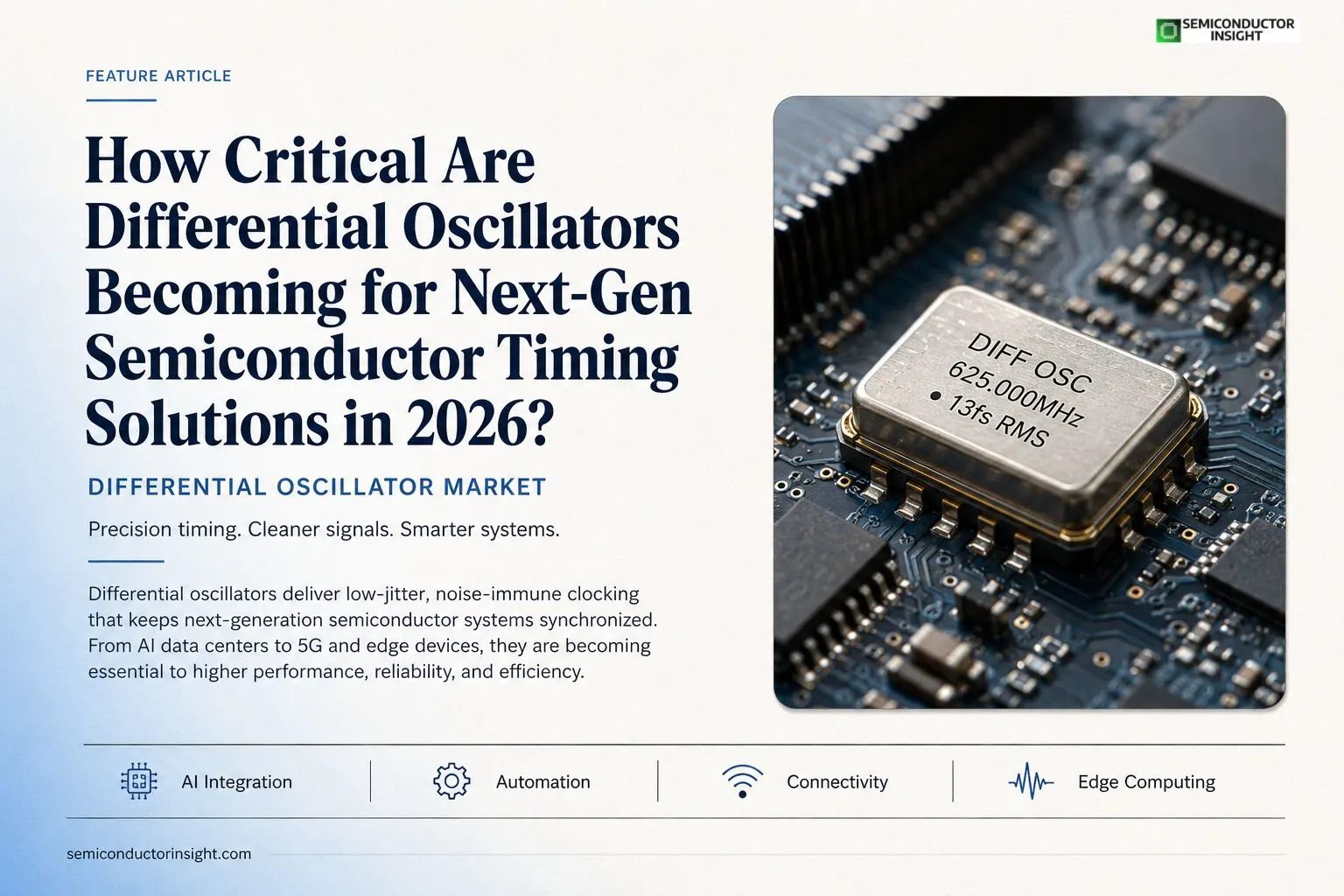
How Critical Are Differential Oscillators Becoming for Next-Gen Semiconductor Timing Solutions in 2026?
Differential oscillators stand out as specialized timing components in the semiconductor world. They generate precise clock signals using a pair of out-of-phase outputs that effectively cancel common-mode noise. This design delivers cleaner performance compared to single-ended alternatives, especially in high-speed, high-density environments where signal integrity matters most.
Engineers integrate these devices into chips and systems requiring low jitter, strong noise immunity, and reliable frequency stability. From data center servers handling massive AI workloads to 5G infrastructure and advanced optical modules, differential oscillators help maintain synchronization across complex circuits.
Inside the Technology: What Sets Differential Oscillators Apart
- These oscillators often rely on quartz crystals, MEMS technology, or integrated LC circuits. The differential output typically in formats like LVDS, LVPECL, or HCSL provides balanced signalling.
- This reduces electromagnetic interference and improves rise/fall times, making them suitable for boards packed with sensitive analog and digital blocks.
- In practice, a differential crystal oscillator might operate at frequencies from tens of MHz up to hundreds of MHz or even GHz in specialized cases.
- Recent examples include units supporting 625 MHz for 800 Gbps and 1.6 Tbps optical transceivers in AI-driven data centers, with phase jitter as low as 13 fs in fundamental-mode designs.
Global Deployment Trends and Real-World Use Cases
Worldwide semiconductor demand continues to surge, driven by AI, cloud computing, and high-speed communications. In data centers, differential oscillators distribute precise clocks across server racks and networking equipment, supporting everything from Ethernet switches to high-performance computing clusters.
One notable instance involves deployments in next-generation optical modules for AI infrastructure.
Manufacturers have introduced compact differential oscillators in 2.0 × 1.6 mm packages that handle elevated temperatures up to 105°C while delivering ultra-low jitter. These help optical transceivers push higher bandwidth without excessive power draw or noise penalties.
In 5G base stations and edge computing nodes, similar components ensure synchronization for massive data throughput. Automotive radar and industrial automation systems also benefit, where vibration resistance and reliability under harsh conditions are non-negotiable. MEMS-based differential variants gain traction here due to their shock tolerance and small size.
Evaluating and Comparing Differential Oscillators for Semiconductor Integration
Designers face important choices when selecting and integrating these components into ICs or board-level designs. Start by examining key parameters side by side.
Core Comparison Factors:
- Phase Jitter and Noise: Look for RMS jitter below 100 fs for high-speed SerDes or RF applications. Differential designs inherently reject supply and substrate noise better than single-ended ones.
- Power Consumption: Compare current draw modern low-power variants can operate efficiently at 1V supplies while maintaining performance.
- Frequency Stability: Check ppm ratings over temperature and aging, especially for crystal-based units.
- Output Type and Swing: Match LVDS, LVPECL, or programmable amplitudes to downstream receiver requirements to minimize termination components and power.
- Package Size and Integration: Smaller footprints (e.g., 2×1.6 mm) free board space in dense semiconductor modules.
- Startup Time and Reliability: Faster startup benefits dynamic systems; evaluate PSRR (power supply rejection ratio) through differential probing for real-world insight.
Practical evaluation often involves simulation in tools like SPICE, followed by prototype testing under representative noise and temperature conditions. For integration, consider on-chip versus off-chip placement differential outputs help when routing clocks across noisy PCBs or between multiple dies. Always verify EMI performance, as balanced signaling minimizes radiation.
Text-Based Decision Flow: Input Requirements (Frequency, Jitter Budget, and Power Limit) → Screen Candidates by Specs → Simulate in Target Environment → Prototype and Measure Real Jitter/PSRR → Validate Across Temperature/Vibration → Final Integration Check.
For additional report info, feel free to view our most recent edition: https://semiconductorinsight.com/report/differential-oscillator-market/
Material and Manufacturing Insights in the Semiconductor Ecosystem
Production ties closely to broader semiconductor supply dynamics. Silicon wafers and specialized packaging play supporting roles, with global wafer shipments showing steady recovery patterns projected rebounds supporting overall industry growth.
Facilities focus on precision assembly for timing devices, incorporating advanced doping and etching for low-noise performance. Government initiatives worldwide, including investments in domestic fabrication, aim to secure resilient chains for critical components like these oscillators.
Emerging Innovations Shaping Integration Pathways
Recent advances feature wide-amplitude LVDS outputs that let designers tune swing for specific ASICs, cutting unnecessary power while preserving signal quality. Fundamental-mode high-frequency oscillators bypass PLL-induced noise, appealing for clean reference clocks in AI accelerators.
- In neuromorphic and specialized computing, differential ring oscillators or relaxation types appear in low-power designs. Hybrid approaches combining MEMS with traditional crystals offer compelling trade-offs in size, cost, and resilience.
- As semiconductor nodes advance and systems demand ever-higher data rates, differential oscillators evolve from supporting players to essential enablers.
- Their ability to deliver stable, noise-resistant timing directly impacts overall system performance in everything from massive data centers to compact edge devices.
Engineers who master evaluation and thoughtful integration of these components position their designs for success in the fast-moving semiconductor landscape of 2026 and beyond. Continued focus on precision manufacturing and application-specific optimization will keep this technology at the heart of innovation.

Comments (0)