Differential Oscillator Market Insights
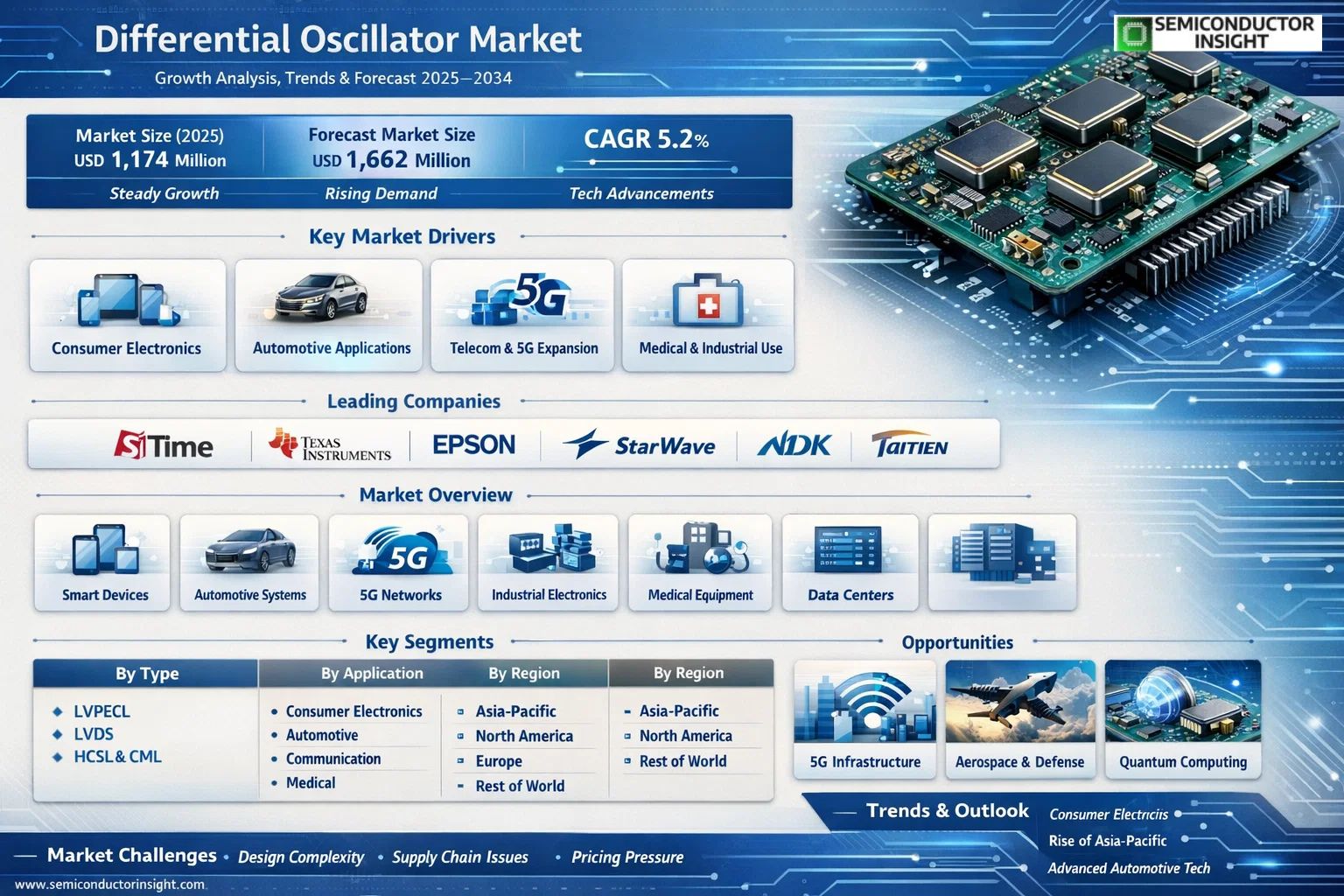
Global Differential Oscillator market was valued at USD 1,174 million in 2025 and is projected to reach USD 1,662 million by 2034, exhibiting a CAGR of 5.2% during the forecast period.
A differential oscillator is an electronic oscillator characterized by two interconnected output signals , typically a positive phase and a negative phase signal. The defining feature of this technology lies in its ability to leverage the properties of differential signals to significantly improve a system’s noise suppression capability while enhancing overall signal stability and reliability. These components are widely classified by output logic types, including LVPECL, LVDS, HCSL, and CML, each catering to distinct performance requirements across industries such as communications, automotive, medical, and industrial electronics.
The market is witnessing steady growth driven by the expanding adoption of frequency control components across consumer electronics, telecommunications infrastructure, and automotive systems. Crystal oscillators , often referred to as the “heart of digital circuits” , are increasingly integrated into smartphones, smart wearable devices, and cable TV systems. A typical smartphone or tablet design can incorporate multiple timing devices, including one or more 32 kHz quartz crystals, underscoring the critical role differential oscillators play in modern electronics. Key players operating in this market include SiTime, Texas Instruments, Epson, Renesas Electronics Corporation, NDK, Kyocera, and Taitien, among others.
MARKET DRIVERS
Rising Demand for High-Frequency Communication Systems Propelling the Differential Oscillator Market
The Differential Oscillator Market is witnessing robust growth driven by the accelerating adoption of high-frequency communication infrastructure across the globe. As 5G network deployments expand and next-generation wireless standards continue to evolve, the need for precision timing and signal integrity components has intensified significantly. Differential oscillators, known for their superior noise rejection and reduced electromagnetic interference (EMI) characteristics, have become critical enablers in RF front-end modules, base stations, and small cell deployments. The transition from single-ended to differential signal architectures in modern communication hardware underscores a structural shift in design preferences favoring differential oscillator solutions.
Proliferation of Advanced Consumer Electronics Driving Adoption Across the Differential Oscillator Market
Consumer electronics manufacturers are increasingly integrating differential oscillators into devices requiring precise clock synchronization and low phase noise performance. Smartphones, high-resolution imaging systems, wearable technologies, and ultra-thin laptops demand compact, low-power oscillator designs that maintain signal fidelity across a wide operating temperature range. The growing complexity of system-on-chip (SoC) architectures and the transition toward heterogeneous integration have further elevated the role of differential oscillators as foundational timing elements. This sustained demand from consumer-facing applications continues to act as a significant market driver within the broader Differential Oscillator Market.
➤ The increasing convergence of IoT ecosystems, edge computing platforms, and autonomous vehicle electronics is creating a sustained and diversified demand pipeline for differential oscillators, with design engineers prioritizing components that offer low jitter, wide frequency tunability, and robust performance under dynamic load conditions.
Automotive electronics represent another powerful driver reshaping the Differential Oscillator Market. Advanced Driver Assistance Systems (ADAS), LiDAR, radar modules, and vehicle-to-everything (V2X) communication platforms all require oscillators that deliver consistent and reliable timing performance under stringent thermal and vibration conditions. The automotive industry’s migration toward fully electrified and connected vehicle architectures is generating sustained procurement activity for high-reliability differential oscillator components, reinforcing long-term growth trajectories across this market segment.
MARKET CHALLENGES
Design Complexity and Integration Barriers Posing Significant Challenges in the Differential Oscillator Market
One of the most persistent challenges confronting stakeholders in the Differential Oscillator Market is the increasing complexity associated with integrating differential oscillator components into advanced multi-layer PCB designs and highly miniaturized electronic assemblies. As operating frequencies scale upward and board real estate continues to shrink, engineering teams face mounting difficulties in maintaining signal integrity, managing thermal dissipation, and mitigating crosstalk between adjacent components. The precision required in impedance matching for differential pair routing demands specialized expertise, extending design validation cycles and adding to overall product development costs. These integration challenges are particularly pronounced for smaller design houses and original equipment manufacturers (OEMs) lacking dedicated high-frequency analog design teams.
Other Challenges
Supply Chain Vulnerabilities and Raw Material Constraints
The Differential Oscillator Market remains exposed to supply chain disruptions affecting the availability of specialized piezoelectric crystals, quartz substrates, and high-purity semiconductor materials used in oscillator fabrication. Geopolitical uncertainties and concentration risks within Global quartz supply chain have periodically disrupted production schedules for oscillator manufacturers. Elevated lead times and material cost fluctuations create pricing pressures that challenge market participants, particularly those operating within cost-sensitive industrial and consumer electronics segments.
Competitive Pricing Pressures and Commoditization Risks
Intensifying competition among established oscillator manufacturers and emerging regional suppliers has introduced downward pricing pressure across standard differential oscillator product lines. As certain frequency ranges and output configurations approach commoditization, vendors face margin compression that constrains investment in research and development. Companies competing primarily on price rather than performance differentiation find it increasingly difficult to sustain profitability while simultaneously meeting the evolving technical specifications demanded by next-generation application environments within the Differential Oscillator Market.
MARKET RESTRAINTS
High Development Costs and Technical Barriers Restraining Broader Participation in the Differential Oscillator Market
The capital-intensive nature of differential oscillator design, prototyping, and qualification processes presents a meaningful restraint on market expansion. Developing oscillators that meet stringent phase noise, frequency stability, and aging specifications for defense, aerospace, and telecommunications applications requires substantial investment in specialized simulation tools, test equipment, and cleanroom fabrication facilities. Regulatory compliance requirements, including AEC-Q200 qualification for automotive-grade components and MIL-SPEC certifications for defense applications, further elevate the barrier to entry for new market participants. These financial and technical thresholds effectively concentrate innovation capacity among a limited number of established players in the Differential Oscillator Market.
Substitution Threats from Integrated Timing Solutions Limiting Growth Potential
The emergence of highly integrated timing IC solutions incorporating clock generation, distribution, and synchronization functions within a single chip architecture poses a tangible substitution risk for discrete differential oscillator components. Silicon-based MEMS oscillators and programmable clock generators are gaining acceptance in applications where design flexibility and small form factor are prioritized over the ultra-low phase noise performance traditionally associated with quartz-based differential oscillators. While discrete differential oscillators retain performance advantages in demanding high-frequency applications, the broadening capability envelope of integrated alternatives continues to exert competitive pressure that restrains addressable market growth within specific application segments of the Differential Oscillator Market.
MARKET OPPORTUNITIES
Expansion of 5G Infrastructure and Data Center Buildout Creating Significant Opportunities in the Differential Oscillator Market
Global rollout of 5G network infrastructure and the parallel expansion of hyperscale data center facilities represent transformative growth opportunities for the Differential Oscillator Market. Massive MIMO antenna systems, optical transport networks, and high-speed SerDes interfaces operating at multi-gigabit data rates demand oscillator components with exceptional phase noise performance and frequency accuracy. As network operators and cloud service providers accelerate capital investment in next-generation infrastructure, procurement volumes for precision timing components including differential oscillators are expected to trend upward consistently across near and medium-term planning horizons.
Defense and Aerospace Modernization Programs Unlocking Premium Segment Opportunities
Ongoing defense modernization initiatives across North America, Europe, and the Asia-Pacific region are driving procurement of high-reliability electronic components for radar systems, electronic warfare platforms, satellite communication payloads, and secure tactical communication equipment. These application environments demand differential oscillators engineered to deliver consistent performance under extreme environmental conditions, creating a premium market segment characterized by higher average selling prices and long product lifecycle commitments. Defense and aerospace program spending trends represent a structurally attractive opportunity avenue for established manufacturers capable of meeting the rigorous qualification and traceability requirements governing supply into these sectors of the Differential Oscillator Market.
Emerging Applications in Quantum Computing and Photonics Opening New Frontiers for the Differential Oscillator Market
The nascent but rapidly advancing fields of quantum computing and integrated photonics are beginning to define new performance frontiers for precision oscillator technology. Quantum processor control systems require ultra-stable, low-noise reference oscillators capable of maintaining coherence across complex multi-qubit architectures. Similarly, coherent optical communication systems leveraging photonic integrated circuits depend on reference timing solutions with extraordinarily low phase noise floors. As research investment in these emerging domains intensifies and early commercial deployments materialize, the Differential Oscillator Market stands positioned to benefit from a new category of high-value, technically demanding applications that extend well beyond the established demand base of conventional electronic systems.
Differential Oscillator Market Trends
Rising Demand from Consumer Electronics Driving Differential Oscillator Market Growth
The Differential Oscillator Market is witnessing sustained momentum driven by the accelerating proliferation of consumer electronics worldwide. Differential oscillators, characterized by their dual-output signal architecture delivering both positive and negative phase signals, are increasingly valued for their superior noise suppression capabilities and enhanced signal stability. As smartphones, tablets, smart wearables, and cable TV systems become ubiquitous, the demand for precision frequency control components , including differential oscillators , continues to intensify. A typical smartphone or tablet design can incorporate multiple timing devices, including one or more 32 kHz quartz crystals, underscoring the critical role these components play in modern digital ecosystems. The consistent launch cycles of new consumer electronics products are reinforcing this upward trajectory across global markets.
Other Trends
Asia-Pacific Emerging as the Fastest-Growing Regional Market
Within the Differential Oscillator Market, Asia-Pacific stands out as the fastest-growing region, propelled by the rapid expansion of smartphone penetration across major economies such as China and India. China, recognized as the world’s largest producer and exporter of consumer electronics, represents one of the most significant regional contributors, with differential oscillators being deployed extensively across a broad range of electronic devices. India’s growing consumer base and expanding electronics manufacturing ecosystem further amplify regional demand. South Korea’s leading end-user industries are also adopting differential oscillator technology at an accelerating pace, while Korea Aerospace Industries (KAI) has articulated ambitions to become the world’s seventh-largest aerospace company by 2050, signaling long-term demand prospects for precision oscillator components in aerospace applications.
Automotive and Industrial Applications Creating New Demand Avenues
The Differential Oscillator Market is benefiting from growing adoption in automotive and industrial sectors. In Japan, the automotive industry constitutes a substantial share of total oscillator demand, with differential oscillators integrated into critical safety systems including brake control, anti-blocking systems, airbags, and tire pressure monitoring systems. As vehicle electronics grow increasingly sophisticated with the adoption of advanced driver assistance systems (ADAS) and connected vehicle architectures, the requirement for high-reliability differential oscillators is expected to intensify. Industrial automation and communication infrastructure deployments are similarly expanding the addressable market for differential oscillator solutions globally.
Technological Advancements Enhancing Oscillator Performance and Precision
Recent technological breakthroughs are meaningfully advancing the capabilities of differential oscillators, enabling higher accuracy, reduced phase noise, and greater efficiency across applications. Key product types within the Differential Oscillator Market , including LVPECL, LVDS, HCSL, and CML variants , are being refined to meet increasingly stringent performance requirements across communication, medical, and electronic industry applications. Leading players such as SiTime, Texas Instruments, Epson, Renesas Electronics Corporation, and Kyocera are actively investing in next-generation oscillator development to address evolving end-user demands. These innovation-driven developments are strengthening the competitive landscape and expanding the market’s growth potential across North America, Europe, Asia, and emerging regions in South America and the Middle East & Africa.
COMPETITIVE LANDSCAPE
Key Industry Players
Differential Oscillator Market , Competitive Dynamics, Strategic Positioning, and Leading Manufacturer Profiles
Global Differential Oscillator market, valued at approximately USD 1,174 million in 2025 and projected to reach USD 1,662 million by 2034 at a CAGR of 5.2%, is characterized by a moderately consolidated competitive landscape with a mix of established multinational corporations and specialized regional manufacturers. Leading the competitive hierarchy are globally recognized players such as SiTime Corporation, Texas Instruments, Epson, Renesas Electronics Corporation, and Kyocera, which collectively command a significant share of global revenues. These companies leverage their extensive R&D capabilities, broad intellectual property portfolios, and well-established distribution networks to maintain competitive advantages across key output types including LVPECL, LVDS, HCSL, and CML differential oscillators. Their product offerings cater to a wide spectrum of end-use applications spanning the electronic, automotive, communication, industrial, and medical industries. The Asia-Pacific region, particularly China, Japan, and South Korea, remains the dominant manufacturing hub, driven by robust consumer electronics production volumes and strong automotive sector demand for precision timing components.
Beyond the tier-one global leaders, the Differential Oscillator market is also shaped by a growing cohort of niche and regionally significant players. Companies such as NDK, Taitien, FOX, Siward, StarWave, and NNT have carved out meaningful market positions by focusing on specialized product segments and cost-competitive manufacturing, particularly for applications in telecommunications infrastructure and industrial automation. Chinese domestic manufacturers including Chengdu Kingbri Frequency Technology, Guangdong Huilun Crystal Technology, SCTF, YXC, and Anhui Jingsai Technology are increasingly expanding their footprint, benefiting from China’s status as the world’s largest producer and exporter of consumer electronics. Additionally, companies such as SJK, Genuway, JFVNY, and AKER are emerging as competitive forces in the regional supply chain, addressing growing demand from sectors such as smart wearables, mobile devices, and aerospace applications. The competitive intensity across the market is further amplified by ongoing technological innovation in oscillator miniaturization, low-power design, and enhanced phase noise performance, as manufacturers position themselves to serve next-generation 5G communication systems, advanced driver-assistance systems (ADAS), and precision medical instrumentation.
List of Key Differential Oscillator Companies Profiled
- SiTime Corporation
- Texas Instruments
- Epson
- StarWave
- Siward
- NDK (Nihon Dempa Kogyo Co., Ltd.)
- Taitien Electronics
- FOX Electronics
- Renesas Electronics Corporation
- NNT
- JFVNY
- Chengdu Kingbri Frequency Technology
- SCTF
- Guangdong Huilun Crystal Technology
- Kyocera Corporation
- YXC
- SJK
- Genuway
- AKER
- Anhui Jingsai Technology
Segment Analysis:
| Segment Category | Sub-Segments |
Key Insights |
| By Type |
|
LVDS stands out as the leading segment within the differential oscillator market by type, owing to its superior noise immunity and low power consumption characteristics that make it highly suitable for modern high-speed digital systems.
|
| By Application |
|
Communication Industry emerges as the dominant application segment, driven by the relentless global rollout of next-generation wireless and wired communication infrastructure demanding highly stable and precise differential timing solutions.
|
| By End User |
|
Consumer Electronics Manufacturers represent the largest end-user base for differential oscillators globally, underpinned by the continuous and high-volume production cycles of smartphones, tablets, laptops, and smart home devices across major manufacturing hubs.
|
| By Packaging Format |
|
Surface Mount Technology (SMT) packaging dominates the differential oscillator market, reflecting the broader industry-wide shift toward compact, lightweight, and highly automated printed circuit board assembly processes.
|
| By Frequency Range |
|
100 MHz – 500 MHz frequency range represents the leading segment, aligning closely with the dominant clock frequency requirements of high-speed data communication interfaces, networking chipsets, and modern computing platforms.
|
Regional Analysis: Differential Oscillator Market
Asia-Pacific
Asia-Pacific hosts a highly integrated semiconductor and electronics manufacturing ecosystem that directly supports differential oscillator market expansion. The region’s advanced fabrication capabilities, combined with deep supply chain networks across China, South Korea, and Taiwan, allow manufacturers to scale production efficiently. This ecosystem enables rapid prototyping and cost-effective mass production of differential oscillator components tailored to diverse end-use applications.
The aggressive expansion of telecommunications infrastructure across Asia-Pacific, including widespread deployment of advanced wireless networks in urban and semi-urban corridors, is a key demand catalyst for the differential oscillator market. Precision frequency control requirements in base stations, network equipment, and communication modules have made differential oscillators indispensable components across the regional telecommunications supply chain.
Asia-Pacific’s booming automotive electronics sector, led by electric vehicle adoption and advanced driver-assistance system integration, is creating significant opportunities within the differential oscillator market. Japanese and South Korean automotive manufacturers are increasingly embedding high-precision oscillator solutions in safety-critical and infotainment systems, reflecting a structural shift toward electronically sophisticated vehicle architectures that demand superior frequency stability and low-noise signal performance.
Government-driven policies aimed at strengthening domestic semiconductor and electronic component industries across China, India, and Southeast Asia are bolstering regional competitiveness in the differential oscillator market. Sustained public and private investment in research and development activities is accelerating innovation in oscillator design, packaging technologies, and power efficiency improvements, positioning Asia-Pacific as a long-term center of technological advancement in frequency control solutions.
North America
North America represents a highly mature and technologically advanced segment of Global differential oscillator market, underpinned by a strong presence of leading semiconductor firms, defense electronics contractors, and communication technology developers. The United States, in particular, functions as a major hub for differential oscillator innovation, with significant demand emanating from aerospace and defense applications where signal integrity, frequency precision, and environmental resilience are paramount requirements. The region’s robust research university ecosystem and close collaboration between academic institutions and industry players continue to accelerate the development of next-generation oscillator architectures. Increasing integration of differential oscillators within data center infrastructure, cloud computing hardware, and high-speed networking equipment further sustains demand momentum. North America’s regulatory environment and emphasis on indigenous technology sourcing in defense procurement also support regional manufacturers in maintaining competitive positioning within the broader differential oscillator market through the forecast horizon.
Europe
Europe occupies a strategically important position within Global differential oscillator market, characterized by strong industrial electronics manufacturing capabilities, advanced automotive engineering traditions, and growing investments in smart infrastructure technologies. Germany, France, and the Netherlands serve as primary demand centers, with automotive-grade differential oscillator applications reflecting the region’s leadership in precision engineering and functional safety standards. European manufacturers and system integrators are increasingly adopting differential oscillator solutions in industrial Internet of Things platforms, smart grid equipment, and railway communication systems. The region’s commitment to advancing green mobility and electrified transportation is creating parallel demand in vehicle electronics, where differential oscillators contribute to reliable signal generation in powertrain management and vehicle-to-everything communication modules. Collaborative research frameworks within the European Union are additionally fostering regional innovation capacity in the differential oscillator market.
South America
South America represents an emerging opportunity within Global differential oscillator market, with growth primarily driven by expanding telecommunications infrastructure, increasing consumer electronics penetration, and gradual industrialization across key economies including Brazil and Argentina. While the region currently accounts for a comparatively modest share of global differential oscillator demand, ongoing investments in digital connectivity and the modernization of industrial operations are generating incremental adoption of precision frequency control components. Local assembly and electronics manufacturing activities in Brazil’s technology-focused free trade zones contribute to regional market development. However, economic volatility, currency fluctuations, and limited domestic semiconductor manufacturing capacity present structural challenges that may temper near-term growth rates within the South American differential oscillator market relative to other global regions during the forecast period.
Middle East & Africa
The Middle East and Africa region is at a nascent but progressively developing stage within Global differential oscillator market, with growth trajectories shaped by accelerating telecommunications network buildouts, smart city initiatives, and rising demand for advanced electronic systems across Gulf Cooperation Council countries. Nations such as the United Arab Emirates and Saudi Arabia are investing heavily in digital infrastructure modernization, creating incremental demand for frequency control components including differential oscillators in communication and industrial applications. Africa’s expanding mobile connectivity landscape, supported by satellite communication deployments and terrestrial network upgrades, further broadens the addressable market over the long term. While the region faces challenges related to supply chain limitations and technology adoption pace, growing strategic partnerships with global semiconductor and electronics firms are gradually enhancing market accessibility and fostering sustainable development within the Middle East and Africa differential oscillator market.
Report Scope
This market research report provides a comprehensive analysis of the Differential Oscillator Market, covering the forecast period 2026–2034. It offers detailed insights into market dynamics, technological advancements, competitive landscape, and key trends shaping the industry.
Key focus areas of the report include:
- Market Overview: The report begins with an overview outlining its current market scenario, key growth indicators, and industry transformation drivers. It discusses macroeconomic factors, demand–supply balance, regulatory landscape, and the strategic role of semiconductors in powering advancements across industries such as automotive, telecommunications, consumer electronics, and industrial automation.
- Market Size & Forecast: Historical data and future projections for revenue, unit shipments, and market value across major regions and segments.
- Segmentation Analysis: Detailed breakdown by product type, technology, application, and end-user industry to identify high-growth segments and investment opportunities.
- Regional Insights: Insights into market performance across North America, Europe, Asia-Pacific, Latin America, and the Middle East & Africa, including country-level analysis where relevant.
- Competitive Landscape: Profiles of leading market participants, including their product offerings, R&D focus, manufacturing capacity, pricing strategies, and recent developments such as mergers, acquisitions, and partnerships.
- Technology Trends & Innovation: Assessment of emerging technologies, integration of AI/IoT, semiconductor design trends, fabrication techniques, and evolving industry standards.
- Market Drivers & Restraints: Evaluation of factors driving market growth along with challenges, supply chain constraints, regulatory issues, and market-entry barriers.
- Stakeholder Insights: Insights for component suppliers, OEMs, system integrators, investors, and policymakers regarding the evolving ecosystem and strategic opportunities.
Primary and secondary research methods are employed, including interviews with industry experts, data from verified sources, and real-time market intelligence to ensure the accuracy and reliability of the insights presented.
FREQUENTLY ASKED QUESTIONS:
What is the current market size of Differential Oscillator Market?
-> Global Differential Oscillator Market was valued at USD 1174 million in 2025 and is expected to reach USD 1662 million by 2034, growing at a CAGR of 5.2% during the forecast period.
Which key companies operate in Differential Oscillator Market?
-> Key players include SiTime, Texas Instruments, Epson, StarWave, Siward, NDK, Taitien, FOX, Renesas Electronics Corporation, NNT, Kyocera, Guangdong Huilun Crystal Technology, Chengdu Kingbri Frequency Technology, SCTF, and Anhui Jingsai Technology, among others.
What are the key growth drivers?
-> Key growth drivers include rising demand for consumer electronics such as smartphones, tablets, and smart wearable devices, growing adoption of differential oscillators in automotive applications including brake control, airbags, and tire pressure monitoring systems, and increasing use in communication, industrial, and medical industries. Recent technological breakthroughs enabling more efficient and accurate oscillator designs are also contributing to market expansion.
Which region dominates the market?
-> Asia-Pacific is the fastest-growing region, driven by rapid expansion of the smartphone consumer base in China and India, China being the world’s largest producer and exporter of consumer electronics, and strong demand from Japan’s automotive sector and South Korea’s aerospace and electronics industries.
What are the emerging trends?
-> Emerging trends include advancements in differential oscillator technology for improved noise suppression and signal stability, growing integration of oscillators in aerospace and defense applications, rising investment in next-generation automotive electronics, and expanding use of quartz crystal-based frequency control components across digital circuit applications in telecommunications and industrial automation.

Get Sample Report PDF for Exclusive Insights
Report Sample Includes
- Table of Contents
- List of Tables & Figures
- Charts, Research Methodology, and more...
 Download Sample Report PDF