Low-Voltage Differential Signaling (LVDS) Chip Market, Emerging Trends, Technological Advancements, and Business Strategies 2025-2032

Low-Voltage Differential Signaling (LVDS) Chip market was valued at USD 239 million in 2024 and is projected to reach USD 357 million by 2032, exhibiting a CAGR of 6.1% during the forecast period

PDF Icon Download Sample Report PDF
  • Quick Dispatch

    All Orders

  • Secure Payment

    100% Secure Payment

Price range: $1,500.00 through $4,250.00

Clear

MARKET INSIGHTS

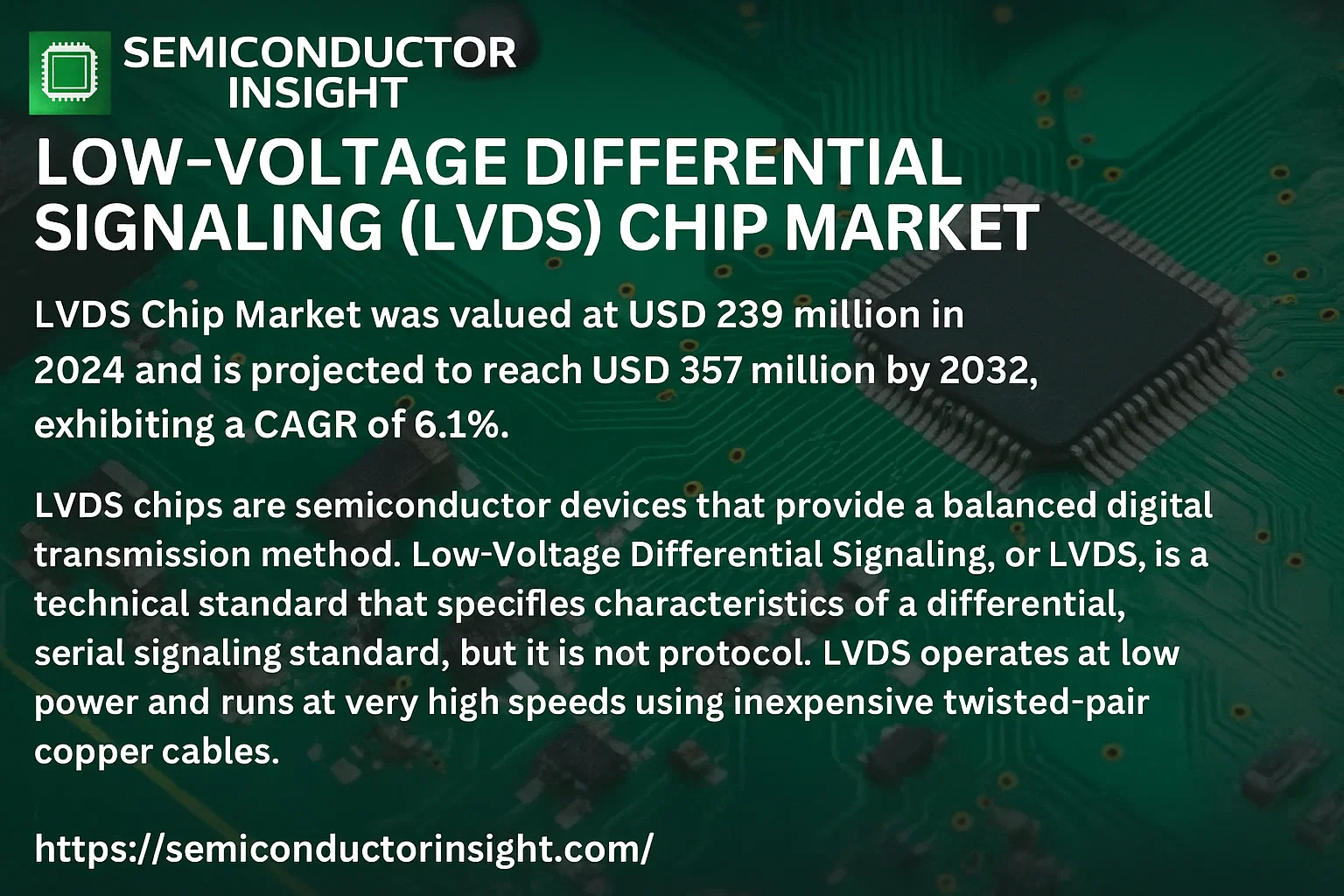
Global Low-Voltage Differential Signaling (LVDS) Chip Market was valued at USD 239 million in 2024 and is projected to reach USD 357 million by 2032, exhibiting a CAGR of 6.1% during the forecast period.

LVDS chips are semiconductor devices that provide a means of a balanced digital transmission method. Low-voltage differential signaling, or LVDS, is a technical standard that specifies electrical characteristics of a differential, serial signaling standard, but it is not a protocol. LVDS operates at low power and can run at very high speeds using inexpensive twisted-pair copper cables. LVDS is a physical layer specification only; many data communication standards and applications use it and add a data link layer as defined in the OSI model on top of it.

The market is experiencing growth due to several factors, including the increasing demand for high-speed data transmission in consumer electronics and automotive applications, the proliferation of IoT devices requiring efficient communication, and the ongoing miniaturization of electronic components. Additionally, the rising adoption of advanced driver-assistance systems (ADAS) and in-vehicle infotainment systems is contributing to market expansion. Key players in the market are also focusing on developing more power-efficient and cost-effective solutions to cater to a wider range of applications.

Global Low-Voltage Differential Signaling (LVDS) Chip includes Texas Instruments and Maxim Integrated, etc. Global top two companies hold a share over 60%. China is the largest market, with a share about 35%, followed by USA and Europe with the share about 22% and 17%.
Low-Voltage Differential Signaling (LVDS) Chip Market

MARKET DRIVERS


Proliferation of High-Resolution Displays

The global demand for high-resolution displays in consumer electronics, automotive infotainment, and medical imaging equipment is a primary driver for the LVDS chip market. LVDS technology is extensively used for transmitting high-speed data with low noise and low power consumption, which is essential for high-definition video interfaces. The transition to 4K and 8K resolutions in televisions and monitors continues to fuel the adoption of LVDS serializers and deserializers.

Growing Automotive Electronics Sector

The automotive industry’s rapid integration of advanced driver-assistance systems (ADAS), digital instrument clusters, and in-vehicle entertainment systems significantly boosts the demand for robust interface solutions. LVDS chips offer the electromagnetic compatibility (EMC) and signal integrity required for the harsh automotive environment, supporting the high data rates needed for camera and display links.

The global market for LVDS chips is projected to grow at a CAGR of approximately 6% over the next five years, driven by the expansion of the consumer electronics and automotive sectors.

Furthermore, the inherent low power consumption of LVDS technology makes it highly suitable for battery-powered portable devices, aligning with the industry-wide push for improved energy efficiency.

MARKET CHALLENGES


Increasing Competition from Alternative Interfaces

A significant challenge facing the LVDS market is the emergence and rapid adoption of newer interface standards like MIPI D-PHY, C-PHY, and embedded DisplayPort (eDP). These alternatives often offer higher data rates or lower pin counts for space-constrained mobile applications, pressuring the established LVDS market in certain segments.

Other Challenges

Design Complexity in High-Speed Systems
As data rates increase to support higher resolutions, maintaining signal integrity over longer cables or through complex printed circuit board (PCB) layouts becomes more challenging. This necessitates sophisticated design and simulation, which can increase development time and cost for system integrators.

Price Erosion and Commoditization
LVDS is a mature technology, and the market for standard interface chips is highly competitive. This leads to continuous price pressure, challenging manufacturers to maintain profitability while investing in product development.

MARKET RESTRAINTS


Technology Maturity and Saturation in Legacy Applications

LVDS is a well-established technology that has been the backbone of display and data communication interfaces for decades. While this provides stability, it also means that growth in certain mature application areas, such as industrial control and certain PC peripherals, is limited. The market is seeing slower growth as many potential applications have already adopted the technology.

Limitations in Ultra-High-Speed Data Transmission

For applications requiring data rates significantly beyond 3 Gbps per channel, LVDS faces limitations compared to serializers/deserializers (SerDes) based on more advanced standards like PAM4. This restrains its adoption in cutting-edge data centers and high-performance computing applications where maximum bandwidth is critical.

MARKET OPPORTUNITIES


Emerging Applications in Industrial Automation and Medical Devices

The robust noise immunity of LVDS presents significant opportunities in industrial automation, including factory robotics and machine vision systems, as well as in medical imaging equipment like digital X-ray and ultrasound machines. These sectors require reliable data transmission in electrically noisy environments, a key strength of LVDS technology.

Advancements in Automotive Display Technology

The trend toward larger, higher-resolution, and more numerous displays within vehicles—including curved screens and pillar-to-pillar dashboards—creates a sustained demand for reliable video interfaces. LVDS remains a cost-effective and proven solution for many of these applications, especially with the continued electrification of vehicles.

Integration with FPD-Link for Long-Distance Transmission

The evolution of LVDS-based standards like FPD-Link, which enables high-speed video transmission over coaxial cable or twisted pair over longer distances, opens new opportunities in automotive camera systems and surveillance systems. This extends the relevance of LVDS core technology in modern connectivity solutions.

Low-Voltage Differential Signaling (LVDS) Chip Market Trends
Sustained Market Growth Driven by High-Speed Data Transmission Needs

The global Low-Voltage Differential Signaling (LVDS) Chip market, valued at 239 million in 2024, is projected to reach US$ 357 million by 2032, exhibiting a Compound Annual Growth Rate (CAGR) of 6.1%. This steady growth is primarily fueled by the persistent demand for high-speed, low-power data transmission across various electronic applications. LVDS technology’s fundamental advantage lies in its ability to operate at very high speeds using cost-effective twisted-pair copper cables while consuming minimal power. This makes it an enduring solution for applications requiring robust data links with low electromagnetic interference, securing its relevance in an evolving technological landscape.

Other Trends

Automotive Sector Emergence as a Key Growth Segment

The application of LVDS chips in the automotive industry represents a significant growth vector. As modern vehicles incorporate more advanced driver-assistance systems (ADAS), infotainment consoles, and high-resolution displays, the need for reliable, high-speed data buses within the vehicle’s architecture intensifies. LVDS interfaces are well-suited for transmitting video and data across the challenging electrical environment of an automobile, positioning this segment for accelerated adoption.

Dominance of High Data Rate Chips

The market is experiencing a clear trend towards chips supporting higher data rates, particularly those in the 800-3000 Mb/s and above 3000 Mb/s segments. This shift is driven by the increasing resolution of displays in consumer electronics like televisions and computer monitors, and the data-intensive requirements of industrial cameras and medical imaging equipment. Manufacturers are focusing R&D on enhancing the performance of LVDS solutions to meet these escalating bandwidth demands.

Geographical Market Concentration and Competitive Landscape

Geographically, the market demonstrates concentrated demand, with China being the largest market, accounting for approximately 35% of the global share, followed by the USA and Europe with shares of about 22% and 17%, respectively. The competitive landscape is equally concentrated, with the top two companies, Texas Instruments and Maxim Integrated, collectively holding over 60% of the market share. This high level of consolidation underscores the technical expertise and significant barriers to entry in the semiconductor sector, with innovation and established supply chains being critical for maintaining a competitive edge.

COMPETITIVE LANDSCAPE

Key Industry Players

A Market Dominated by Established Semiconductor Giants and Strategic Specialists

The global Low-Voltage Differential Signaling (LVDS) chip market exhibits a semi-consolidated structure, characterized by the leadership of a few major players. Texas Instruments and Maxim Integrated (now part of Analog Devices) collectively hold a dominant share of over 60% of the global market. This significant market control is largely attributed to their extensive product portfolios, strong R&D capabilities, and established relationships across key end-use industries such as automotive, consumer electronics (TVs, computers), and industrial automation. The competitive dynamics are heavily influenced by technological expertise in high-speed data transmission, product reliability, and the ability to offer integrated solutions. China represents the largest regional market, accounting for approximately 35% of global demand, which intensifies competition among global players seeking to capitalize on this growth.

Beyond the market leaders, the competitive landscape features several other significant players who have secured strong positions by focusing on niche applications or specific technological advancements. Companies like onsemi, NXP Semiconductors, and Renesas Electronics are prominent participants, leveraging their broad semiconductor expertise to offer robust LVDS solutions, particularly for the automotive and industrial sectors. Specialized manufacturers such as ROHM Semiconductor also compete effectively by providing high-reliability components. The market is further populated by a number of specialized IC designers and fabless semiconductor companies that contribute to the diversity of available solutions, catering to specific data rate requirements ranging from below 800 Mb/s to above 3000 Mb/s.

List of Key Low-Voltage Differential Signaling (LVDS) Chip Companies Profiled

Segment Analysis:

Segment Category Sub-Segments Key Insights
By Type
  • Less than 800 Mb/s
  • 800-3000 Mb/s
  • Above 3000 Mb/s
800-3000 Mb/s chips are the workhorse of the LVDS market, offering an optimal balance between high-speed performance and power efficiency. This segment is favored for its robust performance in mainstream applications like computer monitors and automotive displays. While the above 3000 Mb/s segment is critical for cutting-edge, high-resolution displays, its adoption is tempered by higher power consumption and design complexity. The less than 800 Mb/s segment remains relevant for cost-sensitive applications with moderate data transfer requirements.
By Application
  • Automotive
  • Computers
  • TVs
  • Cameras
  • Others
Automotive application is the most dynamic and high-growth segment, driven by the proliferation of in-vehicle displays for infotainment, digital clusters, and advanced driver-assistance systems (ADAS). The inherent noise immunity of LVDS is critical in the challenging electrical environment of automobiles. The computer segment remains a substantial market, underpinned by constant demand for high-resolution laptop and desktop monitors. The TVs segment, while mature, continues to see steady demand for LVDS interfaces in large-screen displays.
By End User
  • Consumer Electronics
  • Automotive OEMs
  • Industrial Equipment Manufacturers
Automotive OEMs represent the most demanding and quality-focused end-user segment. Their requirements for reliability, temperature tolerance, and long product lifecycles drive innovation in LVDS chip design and testing. Consumer Electronics end users prioritize cost-effectiveness and integration for high-volume products like televisions and laptops. Industrial Equipment Manufacturers value the robustness and noise immunity of LVDS for applications in medical devices, test and measurement equipment, and factory automation systems.
By Signal Direction
  • Transmitters
  • Receivers
  • Transceivers
Transceivers are the most versatile and increasingly dominant segment, as they combine both transmission and reception functions in a single chip, simplifying board design and reducing the overall component count. This integration is highly valued in space-constrained applications like smartphones and tablets. Standalone transmitters and receivers continue to be essential for point-to-point display links in applications like desktop monitors, where the functional separation allows for optimized performance and cost structures.
By Channel Configuration
  • Single-Channel
  • Multi-Channel
  • Serializer/Deserializer (SerDes)
Serializer/Deserializer (SerDes) configurations represent the high-performance segment, enabling the transmission of multiple data streams over a single differential pair. This technology is fundamental for reducing cable complexity and connector size in advanced applications like automotive camera systems and high-resolution displays. Multi-channel chips are widely used for parallel data transmission in standard display interfaces. Single-channel chips serve simpler applications but face competition from more integrated solutions.

Regional Analysis: Low-Voltage Differential Signaling (LVDS) Chip Market

Asia-Pacific

The Asia-Pacific region firmly leads the Low-Voltage Differential Signaling (LVDS) chip market, driven by its robust electronics manufacturing ecosystem and insatiable demand for consumer and industrial technology. This dominance is anchored by major manufacturing hubs in China, South Korea, Japan, and Taiwan, which are the primary production centers for a vast array of electronic devices requiring high-speed data interfaces. The proliferation of applications in consumer electronics, particularly smartphones, tablets, and high-resolution displays, creates a massive and continuous demand for LVDS chips, which are prized for their low power consumption and high noise immunity. Furthermore, significant investments in next-generation infrastructure, such as 5G networks, advanced automotive electronics, and industrial automation, are accelerating the adoption of LVDS technology across the region. The presence of leading semiconductor foundries and a strong supply chain for electronic components further consolidates the region’s position as the global epicenter for LVDS chip consumption and innovation.

Manufacturing & Supply Chain Synergy
The region’s unparalleled strength lies in its integrated electronics manufacturing supply chain. From semiconductor fabrication and component suppliers to final assembly plants for devices like laptops and automotive infotainment systems, this synergy ensures cost-effectiveness and rapid time-to-market for products incorporating LVDS interfaces, making it the most attractive market for manufacturers.
Consumer Electronics Demand Engine
Asia-Pacific is the world’s largest consumer electronics market. The relentless demand for slimmer, higher-resolution displays in smartphones, tablets, and televisions directly fuels the need for LVDS chips, which are essential for transmitting high-speed video data with minimal electromagnetic interference, a critical feature in densely packed modern devices.
Industrial & Automotive Applications
The rapid modernization of manufacturing and the automotive sector in countries like China, Japan, and South Korea is a major growth driver. LVDS technology is increasingly used in industrial machine vision systems, robotics, and in-vehicle displays and cameras, benefiting from the region’s strong focus on automation and smart transportation solutions.
Government Support & Technological Investment
Proactive government initiatives promoting domestic semiconductor production and technological self-sufficiency, particularly in China, create a favorable environment for the entire chip industry, including LVDS. Significant R&D investments in telecommunications and display technologies ensure the region remains at the forefront of developing and deploying LVDS-based solutions.

North America
North America represents a highly advanced and innovation-driven market for LVDS chips, characterized by significant demand from the aerospace, defense, and high-performance computing sectors. The region is home to numerous leading technology companies and research institutions that pioneer applications requiring robust, high-speed data transmission in challenging environments. The medical device industry also presents a strong market, utilizing LVDS interfaces in high-resolution imaging equipment. While not a major manufacturing hub, North America’s strength lies in its design and development of cutting-edge technologies that incorporate LVDS, driving demand for high-reliability components.

Europe
Europe maintains a strong position in the LVDS chip market, underpinned by its world-class automotive industry and a robust industrial automation sector. German and French automakers extensively use LVDS for in-vehicle infotainment systems, digital dashboards, and advanced driver-assistance systems (ADAS). The region also sees significant application in industrial equipment, medical technology, and telecommunications infrastructure. A strong focus on quality, reliability, and adherence to stringent regulatory standards shapes the demand for high-performance LVDS components from European manufacturers and system integrators.

South America
The LVDS chip market in South America is emerging, with growth primarily linked to the gradual expansion of its consumer electronics and industrial sectors. Brazil is the largest market, driven by local manufacturing of televisions and an increasing adoption of automation in manufacturing processes. The market faces challenges such as economic volatility and a less developed local semiconductor industry, but the growing demand for modern communication infrastructure and digital displays in urban centers provides a steady, albeit slower, growth trajectory for LVDS technology adoption.

Middle East & Africa
The Middle East & Africa region presents a developing market for LVDS chips, with growth potential concentrated in specific sectors and geographies. The Gulf Cooperation Council (GCC) countries, with their investments in smart city projects, telecommunications upgrades, and digital signage for retail and hospitality, are the primary drivers. In Africa, the market is nascent, with growth tied to the gradual expansion of mobile network infrastructure and the consumer electronics market. Overall, the region’s growth is promising but dependent on broader economic development and infrastructure investment.

Report Scope

This market research report provides a comprehensive analysis of the Low-Voltage Differential Signaling (LVDS) Chip Market , covering the forecast period 2025–2032. It offers detailed insights into market dynamics, technological advancements, competitive landscape, and key trends shaping the industry.

Key focus areas of the report include:

  • Market Overview: The report begins with an overview outlining its current market scenario, key growth indicators, and industry transformation drivers. It discusses macroeconomic factors, demand–supply balance, regulatory landscape, and the strategic role of semiconductors in powering advancements across industries such as automotive, telecommunications, consumer electronics, and industrial automation.
  • Market Size & Forecast: Historical data and future projections for revenue, unit shipments, and market value across major regions and segments.
  • Segmentation Analysis: Detailed breakdown by product type, technology, application, and end-user industry to identify high-growth segments and investment opportunities.
  • Regional Insights: Insights into market performance across North America, Europe, Asia-Pacific, Latin America, and the Middle East & Africa, including country-level analysis where relevant.
  • Competitive Landscape: Profiles of leading market participants, including their product offerings, R&D focus, manufacturing capacity, pricing strategies, and recent developments such as mergers, acquisitions, and partnerships.
  • Technology Trends & Innovation: Assessment of emerging technologies, integration of AI/IoT, semiconductor design trends, fabrication techniques, and evolving industry standards.
  • Market Drivers & Restraints: Evaluation of factors driving market growth along with challenges, supply chain constraints, regulatory issues, and market-entry barriers.
  • Stakeholder Insights: Insights for component suppliers, OEMs, system integrators, investors, and policymakers regarding the evolving ecosystem and strategic opportunities.

Primary and secondary research methods are employed, including interviews with industry experts, data from verified sources, and real-time market intelligence to ensure the accuracy and reliability of the insights presented.

FREQUENTLY ASKED QUESTIONS:

What is the current market size of Low-Voltage Differential Signaling (LVDS) Chip Market?

-> Low-Voltage Differential Signaling (LVDS) Chip market was valued at USD 239 million in 2024 and is projected to reach USD 357 million by 2032, exhibiting a CAGR of 6.1% during the forecast period.

Which key companies operate in Low-Voltage Differential Signaling (LVDS) Chip Market?

-> Key players include Texas Instruments, Maxim Integrated, onsemi, NXP Semiconductors, Renesas Electronics, Analog Devices, and ROHM Semiconductor, among others. Global top two companies hold a share over 60%.

What are the key growth drivers?

-> Key growth drivers include the demand for high-speed data transmission, low power consumption, and the proliferation of LVDS chips in applications such as TVs, computers, cameras, and automotive systems.

Which region dominates the market?

-> China is the largest market, with a share of about 35%, followed by USA and Europe with shares of about 22% and 17%, respectively.

What are the emerging trends?

-> Emerging trends include the segmentation by data rate (Less than 800 Mb/s, 800-3000 Mb/s, Above 3000 Mb/s) and the increasing adoption in various applications requiring robust and efficient serial communication.

Low-Voltage Differential Signaling (LVDS) Chip Market, Emerging Trends, Technological Advancements, and Business Strategies 2025-2032

Get Sample Report PDF for Exclusive Insights

Report Sample Includes

  • Table of Contents
  • List of Tables & Figures
  • Charts, Research Methodology, and more...

PDF Icon Download Sample Report PDF

Download Sample Report

Table of Content

1 Introduction to Research & Analysis Reports
1.1 Low-Voltage Differential Signaling (LVDS) Chip Market Definition
1.2 Market Segments
1.2.1 Segment by Data Rate
1.2.2 Segment by Application
1.3 Global Low-Voltage Differential Signaling (LVDS) Chip Market Overview
1.4 Features & Benefits of This Report
1.5 Methodology & Sources of Information
1.5.1 Research Methodology
1.5.2 Research Process
1.5.3 Base Year
1.5.4 Report Assumptions & Caveats
2 Global Low-Voltage Differential Signaling (LVDS) Chip Overall Market Size
2.1 Global Low-Voltage Differential Signaling (LVDS) Chip Market Size: 2024 VS 2031
2.2 Global Low-Voltage Differential Signaling (LVDS) Chip Market Size, Prospects & Forecasts: 2020-2031
2.3 Global Low-Voltage Differential Signaling (LVDS) Chip Sales: 2020-2031
3 Company Landscape
3.1 Top Low-Voltage Differential Signaling (LVDS) Chip Players in Global Market
3.2 Top Global Low-Voltage Differential Signaling (LVDS) Chip Companies Ranked by Revenue
3.3 Global Low-Voltage Differential Signaling (LVDS) Chip Revenue by Companies
3.4 Global Low-Voltage Differential Signaling (LVDS) Chip Sales by Companies
3.5 Global Low-Voltage Differential Signaling (LVDS) Chip Price by Manufacturer (2020-2025)
3.6 Top 3 and Top 5 Low-Voltage Differential Signaling (LVDS) Chip Companies in Global Market, by Revenue in 2024
3.7 Global Manufacturers Low-Voltage Differential Signaling (LVDS) Chip Product Type
3.8 Tier 1, Tier 2, and Tier 3 Low-Voltage Differential Signaling (LVDS) Chip Players in Global Market
3.8.1 List of Global Tier 1 Low-Voltage Differential Signaling (LVDS) Chip Companies
3.8.2 List of Global Tier 2 and Tier 3 Low-Voltage Differential Signaling (LVDS) Chip Companies
4 Sights by Product
4.1 Overview
4.1.1 Segment by Data Rate – Global Low-Voltage Differential Signaling (LVDS) Chip Market Size Markets, 2024 & 2031
4.1.2 Less than 800 Mb/s
4.1.3 800-3000 Mb/s
4.1.4 Above 3000 Mb/s
4.2 Segment by Data Rate – Global Low-Voltage Differential Signaling (LVDS) Chip Revenue & Forecasts
4.2.1 Segment by Data Rate – Global Low-Voltage Differential Signaling (LVDS) Chip Revenue, 2020-2025
4.2.2 Segment by Data Rate – Global Low-Voltage Differential Signaling (LVDS) Chip Revenue, 2026-2031
4.2.3 Segment by Data Rate – Global Low-Voltage Differential Signaling (LVDS) Chip Revenue Market Share, 2020-2031
4.3 Segment by Data Rate – Global Low-Voltage Differential Signaling (LVDS) Chip Sales & Forecasts
4.3.1 Segment by Data Rate – Global Low-Voltage Differential Signaling (LVDS) Chip Sales, 2020-2025
4.3.2 Segment by Data Rate – Global Low-Voltage Differential Signaling (LVDS) Chip Sales, 2026-2031
4.3.3 Segment by Data Rate – Global Low-Voltage Differential Signaling (LVDS) Chip Sales Market Share, 2020-2031
4.4 Segment by Data Rate – Global Low-Voltage Differential Signaling (LVDS) Chip Price (Manufacturers Selling Prices), 2020-2031
5 Sights by Application
5.1 Overview
5.1.1 Segment by Application – Global Low-Voltage Differential Signaling (LVDS) Chip Market Size, 2024 & 2031
5.1.2 TVs
5.1.3 Computers
5.1.4 Cameras
5.1.5 Automotive
5.1.6 Others
5.2 Segment by Application – Global Low-Voltage Differential Signaling (LVDS) Chip Revenue & Forecasts
5.2.1 Segment by Application – Global Low-Voltage Differential Signaling (LVDS) Chip Revenue, 2020-2025
5.2.2 Segment by Application – Global Low-Voltage Differential Signaling (LVDS) Chip Revenue, 2026-2031
5.2.3 Segment by Application – Global Low-Voltage Differential Signaling (LVDS) Chip Revenue Market Share, 2020-2031
5.3 Segment by Application – Global Low-Voltage Differential Signaling (LVDS) Chip Sales & Forecasts
5.3.1 Segment by Application – Global Low-Voltage Differential Signaling (LVDS) Chip Sales, 2020-2025
5.3.2 Segment by Application – Global Low-Voltage Differential Signaling (LVDS) Chip Sales, 2026-2031
5.3.3 Segment by Application – Global Low-Voltage Differential Signaling (LVDS) Chip Sales Market Share, 2020-2031
5.4 Segment by Application – Global Low-Voltage Differential Signaling (LVDS) Chip Price (Manufacturers Selling Prices), 2020-2031
6 Sights by Region
6.1 By Region – Global Low-Voltage Differential Signaling (LVDS) Chip Market Size, 2024 & 2031
6.2 By Region – Global Low-Voltage Differential Signaling (LVDS) Chip Revenue & Forecasts
6.2.1 By Region – Global Low-Voltage Differential Signaling (LVDS) Chip Revenue, 2020-2025
6.2.2 By Region – Global Low-Voltage Differential Signaling (LVDS) Chip Revenue, 2026-2031
6.2.3 By Region – Global Low-Voltage Differential Signaling (LVDS) Chip Revenue Market Share, 2020-2031
6.3 By Region – Global Low-Voltage Differential Signaling (LVDS) Chip Sales & Forecasts
6.3.1 By Region – Global Low-Voltage Differential Signaling (LVDS) Chip Sales, 2020-2025
6.3.2 By Region – Global Low-Voltage Differential Signaling (LVDS) Chip Sales, 2026-2031
6.3.3 By Region – Global Low-Voltage Differential Signaling (LVDS) Chip Sales Market Share, 2020-2031
6.4 North America
6.4.1 By Country – North America Low-Voltage Differential Signaling (LVDS) Chip Revenue, 2020-2031
6.4.2 By Country – North America Low-Voltage Differential Signaling (LVDS) Chip Sales, 2020-2031
6.4.3 United States Low-Voltage Differential Signaling (LVDS) Chip Market Size, 2020-2031
6.4.4 Canada Low-Voltage Differential Signaling (LVDS) Chip Market Size, 2020-2031
6.4.5 Mexico Low-Voltage Differential Signaling (LVDS) Chip Market Size, 2020-2031
6.5 Europe
6.5.1 By Country – Europe Low-Voltage Differential Signaling (LVDS) Chip Revenue, 2020-2031
6.5.2 By Country – Europe Low-Voltage Differential Signaling (LVDS) Chip Sales, 2020-2031
6.5.3 Germany Low-Voltage Differential Signaling (LVDS) Chip Market Size, 2020-2031
6.5.4 France Low-Voltage Differential Signaling (LVDS) Chip Market Size, 2020-2031
6.5.5 U.K. Low-Voltage Differential Signaling (LVDS) Chip Market Size, 2020-2031
6.5.6 Italy Low-Voltage Differential Signaling (LVDS) Chip Market Size, 2020-2031
6.5.7 Russia Low-Voltage Differential Signaling (LVDS) Chip Market Size, 2020-2031
6.5.8 Nordic Countries Low-Voltage Differential Signaling (LVDS) Chip Market Size, 2020-2031
6.5.9 Benelux Low-Voltage Differential Signaling (LVDS) Chip Market Size, 2020-2031
6.6 Asia
6.6.1 By Region – Asia Low-Voltage Differential Signaling (LVDS) Chip Revenue, 2020-2031
6.6.2 By Region – Asia Low-Voltage Differential Signaling (LVDS) Chip Sales, 2020-2031
6.6.3 China Low-Voltage Differential Signaling (LVDS) Chip Market Size, 2020-2031
6.6.4 Japan Low-Voltage Differential Signaling (LVDS) Chip Market Size, 2020-2031
6.6.5 South Korea Low-Voltage Differential Signaling (LVDS) Chip Market Size, 2020-2031
6.6.6 Southeast Asia Low-Voltage Differential Signaling (LVDS) Chip Market Size, 2020-2031
6.6.7 India Low-Voltage Differential Signaling (LVDS) Chip Market Size, 2020-2031
6.7 South America
6.7.1 By Country – South America Low-Voltage Differential Signaling (LVDS) Chip Revenue, 2020-2031
6.7.2 By Country – South America Low-Voltage Differential Signaling (LVDS) Chip Sales, 2020-2031
6.7.3 Brazil Low-Voltage Differential Signaling (LVDS) Chip Market Size, 2020-2031
6.7.4 Argentina Low-Voltage Differential Signaling (LVDS) Chip Market Size, 2020-2031
6.8 Middle East & Africa
6.8.1 By Country – Middle East & Africa Low-Voltage Differential Signaling (LVDS) Chip Revenue, 2020-2031
6.8.2 By Country – Middle East & Africa Low-Voltage Differential Signaling (LVDS) Chip Sales, 2020-2031
6.8.3 Turkey Low-Voltage Differential Signaling (LVDS) Chip Market Size, 2020-2031
6.8.4 Israel Low-Voltage Differential Signaling (LVDS) Chip Market Size, 2020-2031
6.8.5 Saudi Arabia Low-Voltage Differential Signaling (LVDS) Chip Market Size, 2020-2031
6.8.6 UAE Low-Voltage Differential Signaling (LVDS) Chip Market Size, 2020-2031
7 Manufacturers & Brands Profiles
7.1 Texas Instruments
7.1.1 Texas Instruments Company Summary
7.1.2 Texas Instruments Business Overview
7.1.3 Texas Instruments Low-Voltage Differential Signaling (LVDS) Chip Major Product Offerings
7.1.4 Texas Instruments Low-Voltage Differential Signaling (LVDS) Chip Sales and Revenue in Global (2020-2025)
7.1.5 Texas Instruments Key News & Latest Developments
7.2 Maxim Integrated
7.2.1 Maxim Integrated Company Summary
7.2.2 Maxim Integrated Business Overview
7.2.3 Maxim Integrated Low-Voltage Differential Signaling (LVDS) Chip Major Product Offerings
7.2.4 Maxim Integrated Low-Voltage Differential Signaling (LVDS) Chip Sales and Revenue in Global (2020-2025)
7.2.5 Maxim Integrated Key News & Latest Developments
7.3 onsemi
7.3.1 onsemi Company Summary
7.3.2 onsemi Business Overview
7.3.3 onsemi Low-Voltage Differential Signaling (LVDS) Chip Major Product Offerings
7.3.4 onsemi Low-Voltage Differential Signaling (LVDS) Chip Sales and Revenue in Global (2020-2025)
7.3.5 onsemi Key News & Latest Developments
7.4 NXP Semiconductors
7.4.1 NXP Semiconductors Company Summary
7.4.2 NXP Semiconductors Business Overview
7.4.3 NXP Semiconductors Low-Voltage Differential Signaling (LVDS) Chip Major Product Offerings
7.4.4 NXP Semiconductors Low-Voltage Differential Signaling (LVDS) Chip Sales and Revenue in Global (2020-2025)
7.4.5 NXP Semiconductors Key News & Latest Developments
7.5 Renesas Electronics
7.5.1 Renesas Electronics Company Summary
7.5.2 Renesas Electronics Business Overview
7.5.3 Renesas Electronics Low-Voltage Differential Signaling (LVDS) Chip Major Product Offerings
7.5.4 Renesas Electronics Low-Voltage Differential Signaling (LVDS) Chip Sales and Revenue in Global (2020-2025)
7.5.5 Renesas Electronics Key News & Latest Developments
7.6 Analog Devices
7.6.1 Analog Devices Company Summary
7.6.2 Analog Devices Business Overview
7.6.3 Analog Devices Low-Voltage Differential Signaling (LVDS) Chip Major Product Offerings
7.6.4 Analog Devices Low-Voltage Differential Signaling (LVDS) Chip Sales and Revenue in Global (2020-2025)
7.6.5 Analog Devices Key News & Latest Developments
7.7 ROHM Semiconductor
7.7.1 ROHM Semiconductor Company Summary
7.7.2 ROHM Semiconductor Business Overview
7.7.3 ROHM Semiconductor Low-Voltage Differential Signaling (LVDS) Chip Major Product Offerings
7.7.4 ROHM Semiconductor Low-Voltage Differential Signaling (LVDS) Chip Sales and Revenue in Global (2020-2025)
7.7.5 ROHM Semiconductor Key News & Latest Developments
8 Global Low-Voltage Differential Signaling (LVDS) Chip Production Capacity, Analysis
8.1 Global Low-Voltage Differential Signaling (LVDS) Chip Production Capacity, 2020-2031
8.2 Low-Voltage Differential Signaling (LVDS) Chip Production Capacity of Key Manufacturers in Global Market
8.3 Global Low-Voltage Differential Signaling (LVDS) Chip Production by Region
9 Key Market Trends, Opportunity, Drivers and Restraints
9.1 Market Opportunities & Trends
9.2 Market Drivers
9.3 Market Restraints
10 Low-Voltage Differential Signaling (LVDS) Chip Supply Chain Analysis
10.1 Low-Voltage Differential Signaling (LVDS) Chip Industry Value Chain
10.2 Low-Voltage Differential Signaling (LVDS) Chip Upstream Market
10.3 Low-Voltage Differential Signaling (LVDS) Chip Downstream and Clients
10.4 Marketing Channels Analysis
10.4.1 Marketing Channels
10.4.2 Low-Voltage Differential Signaling (LVDS) Chip Distributors and Sales Agents in Global
11 Conclusion
12 Appendix
12.1 Note
12.2 Examples of Clients
12.3 DisclaimerList of Tables
Table 1. Key Players of Low-Voltage Differential Signaling (LVDS) Chip in Global Market
Table 2. Top Low-Voltage Differential Signaling (LVDS) Chip Players in Global Market, Ranking by Revenue (2024)
Table 3. Global Low-Voltage Differential Signaling (LVDS) Chip Revenue by Companies, (US$, Mn), 2020-2025
Table 4. Global Low-Voltage Differential Signaling (LVDS) Chip Revenue Share by Companies, 2020-2025
Table 5. Global Low-Voltage Differential Signaling (LVDS) Chip Sales by Companies, (M Units), 2020-2025
Table 6. Global Low-Voltage Differential Signaling (LVDS) Chip Sales Share by Companies, 2020-2025
Table 7. Key Manufacturers Low-Voltage Differential Signaling (LVDS) Chip Price (2020-2025) & (US$/Unit)
Table 8. Global Manufacturers Low-Voltage Differential Signaling (LVDS) Chip Product Type
Table 9. List of Global Tier 1 Low-Voltage Differential Signaling (LVDS) Chip Companies, Revenue (US$, Mn) in 2024 and Market Share
Table 10. List of Global Tier 2 and Tier 3 Low-Voltage Differential Signaling (LVDS) Chip Companies, Revenue (US$, Mn) in 2024 and Market Share
Table 11. Segment by Data Rate – Global Low-Voltage Differential Signaling (LVDS) Chip Revenue, (US$, Mn), 2024 & 2031
Table 12. Segment by Data Rate – Global Low-Voltage Differential Signaling (LVDS) Chip Revenue (US$, Mn), 2020-2025
Table 13. Segment by Data Rate – Global Low-Voltage Differential Signaling (LVDS) Chip Revenue (US$, Mn), 2026-2031
Table 14. Segment by Data Rate – Global Low-Voltage Differential Signaling (LVDS) Chip Sales (M Units), 2020-2025
Table 15. Segment by Data Rate – Global Low-Voltage Differential Signaling (LVDS) Chip Sales (M Units), 2026-2031
Table 16. Segment by Application – Global Low-Voltage Differential Signaling (LVDS) Chip Revenue, (US$, Mn), 2024 & 2031
Table 17. Segment by Application – Global Low-Voltage Differential Signaling (LVDS) Chip Revenue, (US$, Mn), 2020-2025
Table 18. Segment by Application – Global Low-Voltage Differential Signaling (LVDS) Chip Revenue, (US$, Mn), 2026-2031
Table 19. Segment by Application – Global Low-Voltage Differential Signaling (LVDS) Chip Sales, (M Units), 2020-2025
Table 20. Segment by Application – Global Low-Voltage Differential Signaling (LVDS) Chip Sales, (M Units), 2026-2031
Table 21. By Region – Global Low-Voltage Differential Signaling (LVDS) Chip Revenue, (US$, Mn), 2025-2031
Table 22. By Region – Global Low-Voltage Differential Signaling (LVDS) Chip Revenue, (US$, Mn), 2020-2025
Table 23. By Region – Global Low-Voltage Differential Signaling (LVDS) Chip Revenue, (US$, Mn), 2026-2031
Table 24. By Region – Global Low-Voltage Differential Signaling (LVDS) Chip Sales, (M Units), 2020-2025
Table 25. By Region – Global Low-Voltage Differential Signaling (LVDS) Chip Sales, (M Units), 2026-2031
Table 26. By Country – North America Low-Voltage Differential Signaling (LVDS) Chip Revenue, (US$, Mn), 2020-2025
Table 27. By Country – North America Low-Voltage Differential Signaling (LVDS) Chip Revenue, (US$, Mn), 2026-2031
Table 28. By Country – North America Low-Voltage Differential Signaling (LVDS) Chip Sales, (M Units), 2020-2025
Table 29. By Country – North America Low-Voltage Differential Signaling (LVDS) Chip Sales, (M Units), 2026-2031
Table 30. By Country – Europe Low-Voltage Differential Signaling (LVDS) Chip Revenue, (US$, Mn), 2020-2025
Table 31. By Country – Europe Low-Voltage Differential Signaling (LVDS) Chip Revenue, (US$, Mn), 2026-2031
Table 32. By Country – Europe Low-Voltage Differential Signaling (LVDS) Chip Sales, (M Units), 2020-2025
Table 33. By Country – Europe Low-Voltage Differential Signaling (LVDS) Chip Sales, (M Units), 2026-2031
Table 34. By Region – Asia Low-Voltage Differential Signaling (LVDS) Chip Revenue, (US$, Mn), 2020-2025
Table 35. By Region – Asia Low-Voltage Differential Signaling (LVDS) Chip Revenue, (US$, Mn), 2026-2031
Table 36. By Region – Asia Low-Voltage Differential Signaling (LVDS) Chip Sales, (M Units), 2020-2025
Table 37. By Region – Asia Low-Voltage Differential Signaling (LVDS) Chip Sales, (M Units), 2026-2031
Table 38. By Country – South America Low-Voltage Differential Signaling (LVDS) Chip Revenue, (US$, Mn), 2020-2025
Table 39. By Country – South America Low-Voltage Differential Signaling (LVDS) Chip Revenue, (US$, Mn), 2026-2031
Table 40. By Country – South America Low-Voltage Differential Signaling (LVDS) Chip Sales, (M Units), 2020-2025
Table 41. By Country – South America Low-Voltage Differential Signaling (LVDS) Chip Sales, (M Units), 2026-2031
Table 42. By Country – Middle East & Africa Low-Voltage Differential Signaling (LVDS) Chip Revenue, (US$, Mn), 2020-2025
Table 43. By Country – Middle East & Africa Low-Voltage Differential Signaling (LVDS) Chip Revenue, (US$, Mn), 2026-2031
Table 44. By Country – Middle East & Africa Low-Voltage Differential Signaling (LVDS) Chip Sales, (M Units), 2020-2025
Table 45. By Country – Middle East & Africa Low-Voltage Differential Signaling (LVDS) Chip Sales, (M Units), 2026-2031
Table 46. Texas Instruments Company Summary
Table 47. Texas Instruments Low-Voltage Differential Signaling (LVDS) Chip Product Offerings
Table 48. Texas Instruments Low-Voltage Differential Signaling (LVDS) Chip Sales (M Units), Revenue (US$, Mn) and Average Price (US$/Unit) & (2020-2025)
Table 49. Texas Instruments Key News & Latest Developments
Table 50. Maxim Integrated Company Summary
Table 51. Maxim Integrated Low-Voltage Differential Signaling (LVDS) Chip Product Offerings
Table 52. Maxim Integrated Low-Voltage Differential Signaling (LVDS) Chip Sales (M Units), Revenue (US$, Mn) and Average Price (US$/Unit) & (2020-2025)
Table 53. Maxim Integrated Key News & Latest Developments
Table 54. onsemi Company Summary
Table 55. onsemi Low-Voltage Differential Signaling (LVDS) Chip Product Offerings
Table 56. onsemi Low-Voltage Differential Signaling (LVDS) Chip Sales (M Units), Revenue (US$, Mn) and Average Price (US$/Unit) & (2020-2025)
Table 57. onsemi Key News & Latest Developments
Table 58. NXP Semiconductors Company Summary
Table 59. NXP Semiconductors Low-Voltage Differential Signaling (LVDS) Chip Product Offerings
Table 60. NXP Semiconductors Low-Voltage Differential Signaling (LVDS) Chip Sales (M Units), Revenue (US$, Mn) and Average Price (US$/Unit) & (2020-2025)
Table 61. NXP Semiconductors Key News & Latest Developments
Table 62. Renesas Electronics Company Summary
Table 63. Renesas Electronics Low-Voltage Differential Signaling (LVDS) Chip Product Offerings
Table 64. Renesas Electronics Low-Voltage Differential Signaling (LVDS) Chip Sales (M Units), Revenue (US$, Mn) and Average Price (US$/Unit) & (2020-2025)
Table 65. Renesas Electronics Key News & Latest Developments
Table 66. Analog Devices Company Summary
Table 67. Analog Devices Low-Voltage Differential Signaling (LVDS) Chip Product Offerings
Table 68. Analog Devices Low-Voltage Differential Signaling (LVDS) Chip Sales (M Units), Revenue (US$, Mn) and Average Price (US$/Unit) & (2020-2025)
Table 69. Analog Devices Key News & Latest Developments
Table 70. ROHM Semiconductor Company Summary
Table 71. ROHM Semiconductor Low-Voltage Differential Signaling (LVDS) Chip Product Offerings
Table 72. ROHM Semiconductor Low-Voltage Differential Signaling (LVDS) Chip Sales (M Units), Revenue (US$, Mn) and Average Price (US$/Unit) & (2020-2025)
Table 73. ROHM Semiconductor Key News & Latest Developments
Table 74. Low-Voltage Differential Signaling (LVDS) Chip Capacity of Key Manufacturers in Global Market, 2023-2025 (M Units)
Table 75. Global Low-Voltage Differential Signaling (LVDS) Chip Capacity Market Share of Key Manufacturers, 2023-2025
Table 76. Global Low-Voltage Differential Signaling (LVDS) Chip Production by Region, 2020-2025 (M Units)
Table 77. Global Low-Voltage Differential Signaling (LVDS) Chip Production by Region, 2026-2031 (M Units)
Table 78. Low-Voltage Differential Signaling (LVDS) Chip Market Opportunities & Trends in Global Market
Table 79. Low-Voltage Differential Signaling (LVDS) Chip Market Drivers in Global Market
Table 80. Low-Voltage Differential Signaling (LVDS) Chip Market Restraints in Global Market
Table 81. Low-Voltage Differential Signaling (LVDS) Chip Raw Materials
Table 82. Low-Voltage Differential Signaling (LVDS) Chip Raw Materials Suppliers in Global Market
Table 83. Typical Low-Voltage Differential Signaling (LVDS) Chip Downstream
Table 84. Low-Voltage Differential Signaling (LVDS) Chip Downstream Clients in Global Market
Table 85. Low-Voltage Differential Signaling (LVDS) Chip Distributors and Sales Agents in Global Market

List of Figures
Figure 1. Low-Voltage Differential Signaling (LVDS) Chip Product Picture
Figure 2. Low-Voltage Differential Signaling (LVDS) Chip Segment by Data Rate in 2024
Figure 3. Low-Voltage Differential Signaling (LVDS) Chip Segment by Application in 2024
Figure 4. Global Low-Voltage Differential Signaling (LVDS) Chip Market Overview: 2024
Figure 5. Key Caveats
Figure 6. Global Low-Voltage Differential Signaling (LVDS) Chip Market Size: 2024 VS 2031 (US$, Mn)
Figure 7. Global Low-Voltage Differential Signaling (LVDS) Chip Revenue: 2020-2031 (US$, Mn)
Figure 8. Low-Voltage Differential Signaling (LVDS) Chip Sales in Global Market: 2020-2031 (M Units)
Figure 9. The Top 3 and 5 Players Market Share by Low-Voltage Differential Signaling (LVDS) Chip Revenue in 2024
Figure 10. Segment by Data Rate – Global Low-Voltage Differential Signaling (LVDS) Chip Revenue, (US$, Mn), 2024 & 2031
Figure 11. Segment by Data Rate – Global Low-Voltage Differential Signaling (LVDS) Chip Revenue Market Share, 2020-2031
Figure 12. Segment by Data Rate – Global Low-Voltage Differential Signaling (LVDS) Chip Sales Market Share, 2020-2031
Figure 13. Segment by Data Rate – Global Low-Voltage Differential Signaling (LVDS) Chip Price (US$/Unit), 2020-2031
Figure 14. Segment by Application – Global Low-Voltage Differential Signaling (LVDS) Chip Revenue, (US$, Mn), 2024 & 2031
Figure 15. Segment by Application – Global Low-Voltage Differential Signaling (LVDS) Chip Revenue Market Share, 2020-2031
Figure 16. Segment by Application – Global Low-Voltage Differential Signaling (LVDS) Chip Sales Market Share, 2020-2031
Figure 17. Segment by Application -Global Low-Voltage Differential Signaling (LVDS) Chip Price (US$/Unit), 2020-2031
Figure 18. By Region – Global Low-Voltage Differential Signaling (LVDS) Chip Revenue, (US$, Mn), 2025 & 2031
Figure 19. By Region – Global Low-Voltage Differential Signaling (LVDS) Chip Revenue Market Share, 2020 VS 2024 VS 2031
Figure 20. By Region – Global Low-Voltage Differential Signaling (LVDS) Chip Revenue Market Share, 2020-2031
Figure 21. By Region – Global Low-Voltage Differential Signaling (LVDS) Chip Sales Market Share, 2020-2031
Figure 22. By Country – North America Low-Voltage Differential Signaling (LVDS) Chip Revenue Market Share, 2020-2031
Figure 23. By Country – North America Low-Voltage Differential Signaling (LVDS) Chip Sales Market Share, 2020-2031
Figure 24. United States Low-Voltage Differential Signaling (LVDS) Chip Revenue, (US$, Mn), 2020-2031
Figure 25. Canada Low-Voltage Differential Signaling (LVDS) Chip Revenue, (US$, Mn), 2020-2031
Figure 26. Mexico Low-Voltage Differential Signaling (LVDS) Chip Revenue, (US$, Mn), 2020-2031
Figure 27. By Country – Europe Low-Voltage Differential Signaling (LVDS) Chip Revenue Market Share, 2020-2031
Figure 28. By Country – Europe Low-Voltage Differential Signaling (LVDS) Chip Sales Market Share, 2020-2031
Figure 29. Germany Low-Voltage Differential Signaling (LVDS) Chip Revenue, (US$, Mn), 2020-2031
Figure 30. France Low-Voltage Differential Signaling (LVDS) Chip Revenue, (US$, Mn), 2020-2031
Figure 31. U.K. Low-Voltage Differential Signaling (LVDS) Chip Revenue, (US$, Mn), 2020-2031
Figure 32. Italy Low-Voltage Differential Signaling (LVDS) Chip Revenue, (US$, Mn), 2020-2031
Figure 33. Russia Low-Voltage Differential Signaling (LVDS) Chip Revenue, (US$, Mn), 2020-2031
Figure 34. Nordic Countries Low-Voltage Differential Signaling (LVDS) Chip Revenue, (US$, Mn), 2020-2031
Figure 35. Benelux Low-Voltage Differential Signaling (LVDS) Chip Revenue, (US$, Mn), 2020-2031
Figure 36. By Region – Asia Low-Voltage Differential Signaling (LVDS) Chip Revenue Market Share, 2020-2031
Figure 37. By Region – Asia Low-Voltage Differential Signaling (LVDS) Chip Sales Market Share, 2020-2031
Figure 38. China Low-Voltage Differential Signaling (LVDS) Chip Revenue, (US$, Mn), 2020-2031
Figure 39. Japan Low-Voltage Differential Signaling (LVDS) Chip Revenue, (US$, Mn), 2020-2031
Figure 40. South Korea Low-Voltage Differential Signaling (LVDS) Chip Revenue, (US$, Mn), 2020-2031
Figure 41. Southeast Asia Low-Voltage Differential Signaling (LVDS) Chip Revenue, (US$, Mn), 2020-2031
Figure 42. India Low-Voltage Differential Signaling (LVDS) Chip Revenue, (US$, Mn), 2020-2031
Figure 43. By Country – South America Low-Voltage Differential Signaling (LVDS) Chip Revenue Market Share, 2020-2031
Figure 44. By Country – South America Low-Voltage Differential Signaling (LVDS) Chip Sales, Market Share, 2020-2031
Figure 45. Brazil Low-Voltage Differential Signaling (LVDS) Chip Revenue, (US$, Mn), 2020-2031
Figure 46. Argentina Low-Voltage Differential Signaling (LVDS) Chip Revenue, (US$, Mn), 2020-2031
Figure 47. By Country – Middle East & Africa Low-Voltage Differential Signaling (LVDS) Chip Revenue, Market Share, 2020-2031
Figure 48. By Country – Middle East & Africa Low-Voltage Differential Signaling (LVDS) Chip Sales, Market Share, 2020-2031
Figure 49. Turkey Low-Voltage Differential Signaling (LVDS) Chip Revenue, (US$, Mn), 2020-2031
Figure 50. Israel Low-Voltage Differential Signaling (LVDS) Chip Revenue, (US$, Mn), 2020-2031
Figure 51. Saudi Arabia Low-Voltage Differential Signaling (LVDS) Chip Revenue, (US$, Mn), 2020-2031
Figure 52. UAE Low-Voltage Differential Signaling (LVDS) Chip Revenue, (US$, Mn), 2020-2031
Figure 53. Global Low-Voltage Differential Signaling (LVDS) Chip Production Capacity (M Units), 2020-2031
Figure 54. The Percentage of Production Low-Voltage Differential Signaling (LVDS) Chip by Region, 2024 VS 2031
Figure 55. Low-Voltage Differential Signaling (LVDS) Chip Industry Value Chain
Figure 56. Marketing Channels