
How Big Is the Integrated Copper Cabling Market in 2026 and Why Is It Still Essential for AI Computing?
Artificial intelligence, cloud computing, semiconductor manufacturing, and hyperscale data centers often capture attention through advanced processors and graphics accelerators. However, the efficiency of these technologies depends equally on the physical connections that move massive volumes of information every second. Integrated copper cabling has become one of the most reliable solutions for short-distance, high-speed communication inside servers, networking switches, storage systems, and semiconductor testing environments.
Modern copper interconnects combine high electrical conductivity with advanced shielding techniques, allowing data to travel with minimal latency while maintaining signal integrity. As AI clusters become denser and server racks continue increasing in processing power, integrated copper cabling is evolving alongside semiconductor technologies rather than being replaced entirely by optical alternatives.
One reason for this sustained demand is practicality. Copper solutions remain cost-effective for short-reach applications while offering simplified installation, lower power consumption for certain workloads, and compatibility with existing Ethernet infrastructure. These advantages continue to make integrated copper cabling indispensable across enterprise computing environments.
Industry Indicators Highlighting Growth Potential
- The Ethernet ecosystem continues expanding rapidly across enterprise and cloud infrastructure. According to the IEEE and Ethernet Alliance, Ethernet technology now supports communication speeds ranging from 10 Mbps to 800 Gbps, with development efforts already progressing toward 6 Tbps networking.
- The Bluetooth and Wi-Fi revolution has increased wireless connectivity, but wired infrastructure remains fundamental inside computing facilities. The Uptime Institute estimates that modern hyperscale data centers may contain tens of thousands of interconnected servers, each relying on multiple high-speed copper or optical connections for internal communication.
- Another significant indicator comes from the semiconductor industry itself. SEMI reports that global semiconductor fabrication investments continue expanding through new wafer fabrication facilities across North America, Europe, and Asia, creating demand for highly reliable testing equipment, manufacturing systems, and networking infrastructure where integrated copper assemblies remain widely deployed.
Where Copper Still Holds a Competitive Advantage
Integrated copper cabling continues to dominate applications requiring dependable short-distance transmission with extremely low latency. Inside AI servers, storage arrays, top-of-rack switches, and high-performance computing systems, copper assemblies provide consistent electrical performance while simplifying maintenance.
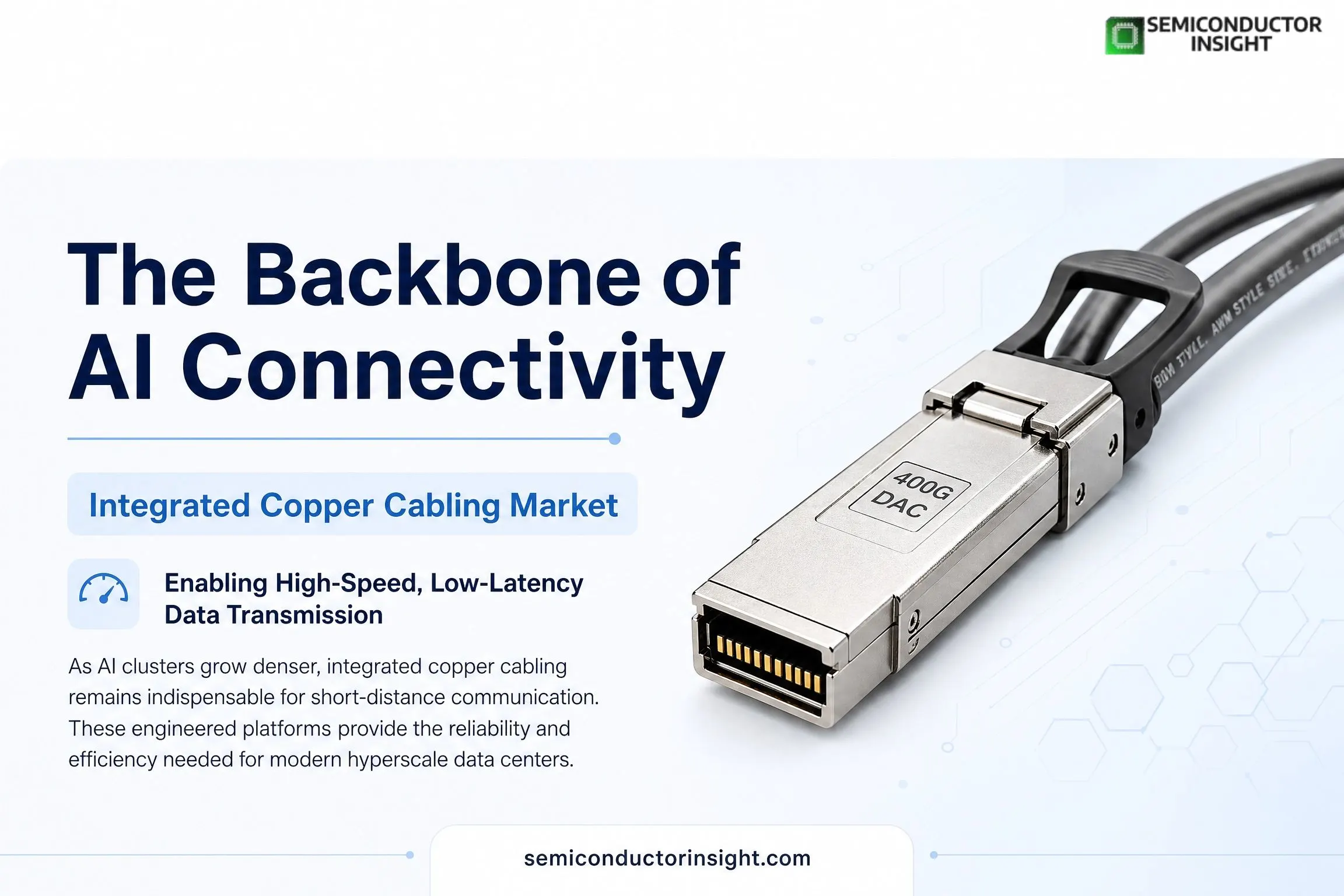
- Recent innovations include twinax direct attach copper cables supporting 400 Gigabit Ethernet, active copper cables with integrated signal conditioning, and enhanced shielding technologies that reduce electromagnetic interference inside densely packed server environments.
These developments demonstrate that copper is no longer viewed simply as traditional wiring. Instead, it has become an engineered communication platform optimized for modern semiconductor ecosystems.
The Connectivity Journey inside an AI Server
AI Accelerator
│
▼
High-Speed Interface
│
▼
Integrated Copper Cable Assembly
│
▼
Ethernet Switch
│
▼
Storage Network
│
▼
Cloud Processing Platform
Rather than acting merely as a physical connector, integrated copper cabling ensures synchronized communication between processors, storage devices, memory resources, and networking hardware. Every improvement in shielding, connector precision, or cable geometry contributes directly to overall computing efficiency.
Don’t Forget to Surf Our Updated Report for More Detailed Analysis: https://semiconductorinsight.com/report/integrated-copper-cabling-market/
AI Infrastructure Is Redefining Cable Engineering
The rapid deployment of AI infrastructure has changed design priorities for integrated copper cabling manufacturers. Instead of focusing solely on transmission speed, engineers now optimize thermal performance, bend radius, cable density, and airflow compatibility. High-density server racks leave limited space for cable management, making compact integrated assemblies increasingly valuable.
- Manufacturers are also incorporating recyclable insulation materials, precision-manufactured connectors, and advanced signal integrity testing into production processes.
- These improvements align with growing sustainability initiatives while supporting increasingly demanding computing environments.
Major technology companies including NVIDIA, Intel, Broadcom, Cisco, and Arista Networks continue introducing networking platforms capable of supporting ultra-high-speed copper connectivity alongside optical technologies.
This balanced approach highlights that integrated copper cabling remains a critical component of modern semiconductor infrastructure rather than a legacy solution awaiting replacement.

Comments (0)