AI-Driven Electromagnetic Interference Prediction Market Insights
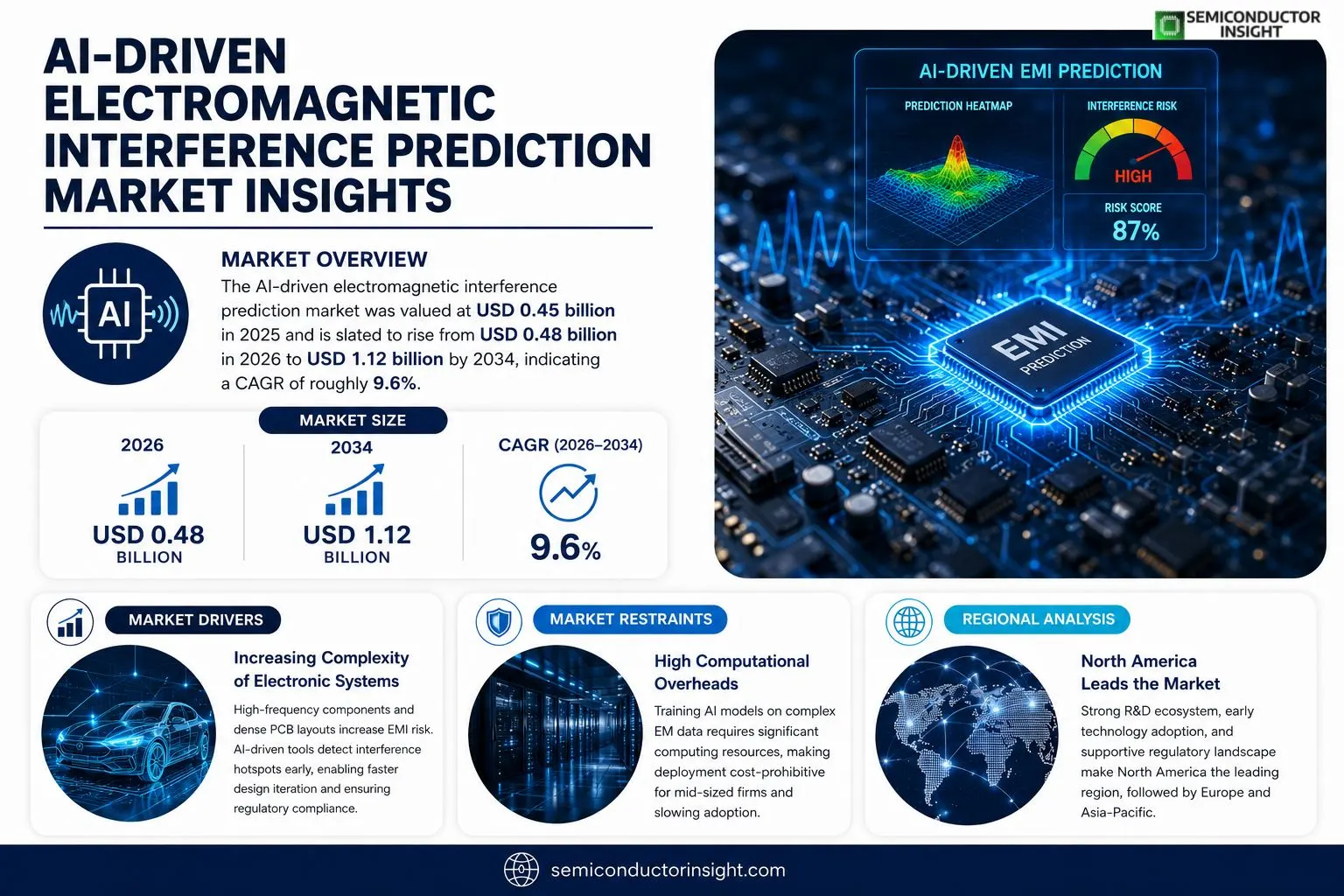
AI-driven electromagnetic interference prediction market size was valued at USD 0.45 billion in 2025 and is slated to rise from USD 0.48 billion in 2026 to USD 1.12 billion by 2034, indicating a CAGR of roughly 9.6%.
The technology leverages machine‑learning algorithms combined with high‑frequency simulation data to anticipate electromagnetic compatibility issues before physical prototyping. By analysing patterns in circuit layouts, component placements and operating environments, the solutions can flag potential interference hotspots early in the design cycle.The upward trajectory stems from heightened regulatory scrutiny on electromagnetic emissions, growing adoption of electric vehicles and IoT devices, and increasing R&D spend on digital twins for hardware design. Recent developments include Ansys’s launch of an AI‑enhanced EM solver in March 2023 and Siemens’ partnership with startup EM‑Insights in February 2024 to integrate predictive analytics into its PLM suite. Major suppliers such as Keysight Technologies, Altair Engineering and Mentor Graphics continue expanding their portfolios.
MARKET DRIVERS
Increasing Complexity of Electronic Systems
The surge in high‑frequency components, wireless modules, and densely packed printed‑circuit boards has amplified susceptibility to electromagnetic interference (EMI). Traditional rule‑based simulations struggle to capture the nuanced interactions across multi‑layered architectures, prompting designers to turn to data‑centric AI approaches that can infer interference patterns from real‑world measurements. AI‑Driven Electromagnetic Interference Prediction Market benefits from this shift, as firms seek faster, more accurate risk assessments before physical prototyping.
Regulatory Pressure for Compliance
Stricter electromagnetic compatibility (EMC) standards across automotive, aerospace, and medical sectors compel manufacturers to document mitigation strategies early in the product lifecycle. AI‑enabled prediction tools reduce the number of costly compliance iterations by flagging problematic design zones during the virtual phase. Consequently, organizations that embed these solutions see shorter certification timelines and lower labor overhead.
➤ “AI‑based EMI models cut validation cycles by roughly 30 % while preserving safety margins,”
These dynamics drive investment in platforms that combine machine‑learning inference with physics‑based simulation, creating a fertile environment for vendors that can demonstrate measurable time‑to‑market advantages.
MARKET CHALLENGES
Data Scarcity for Model Training
High‑quality, labeled EMI datasets remain limited because manufacturers guard test results as proprietary assets. Without a robust corpus, AI models risk overfitting to niche scenarios, undermining confidence in predictions for novel configurations. Companies are therefore forced to augment sparse data with synthetic generation techniques, which introduce additional validation layers.
Other Challenges
Integration with Legacy Tools
Most design teams operate within entrenched CAE ecosystems that lack native interfaces for AI modules. Bridging this gap requires custom middleware, extending project timelines and raising budgetary ceilings. The friction between cutting‑edge analytics and established workflows slows widespread adoption.
MARKET RESTRAINTS
High Computational Overheads
Training deep‑learning models on electromagnetic field data demands GPU clusters and extensive memory footprints. For midsize firms, the capital outlay for such infrastructure can outweigh the perceived ROI, especially when legacy simulation tools already satisfy baseline requirements.
MARKET OPPORTUNITIES
Cloud‑Native AI Platforms for EMI
Cloud service providers are rolling out specialized AI instances optimized for scientific workloads, offering pay‑as‑you‑go access to GPU resources. This model lowers entry barriers, allowing smaller players to experiment with advanced EMI prediction without upfront hardware investment. As subscription‑based offerings mature, the AI‑Driven Electromagnetic Interference Prediction Market is likely to see a broadened user base across diverse verticals.
AI-Driven Electromagnetic Interference Prediction Market Trends
Regulatory Pressure and High‑Growth Sectors Drive Adoption
The market’s momentum stems from tightening emissions standards enforced by regulators in North America, Europe and Asia. Companies now confront mandatory testing that penalises non‑compliant products, compelling designers to embed AI‑enabled interference prediction early in the development workflow. By anticipating hotspots before physical prototyping, manufacturers cut redesign cycles, preserve margin and meet launch deadlinesadvantages that matter in fast‑moving electric‑vehicle and IoT segments. The AI‑Driven Electromagnetic Interference Prediction Market therefore benefits directly from a risk‑averse, compliance‑driven buying climate.
Other Trends
Integration with Digital Twin Platforms
Hardware teams are layering predictive analytics onto digital twins, creating a continuously validated virtual replica of a circuit or system. This approach permits engineers to test design variations under multiple environmental loads without incurring the cost of physical builds. The result is a leaner R&D spend and a tighter feedback loop, which aligns with the agile product‑development methodologies adopted by leading OEMs.
Adoption in Autonomous Vehicle Power Electronics
Autonomous drivetrains rely on dense power‑electronic architectures where even minor electromagnetic disturbances can jeopardise sensor fidelity. Suppliers are turning to AI‑driven models to map interference pathways across power‑stage modules, allowing corrective layout tweaks during the CAD phase. Early detection translates into higher functional safety ratings and smoother certification processes, two criteria that are non‑negotiable for self‑driving platforms.
Strategic Partnerships Accelerate Innovation
Recent collaborations illustrate a deliberate move toward ecosystem play. Siemens’ 2024 alliance with EM‑Insights integrates predictive modules directly into its PLM suite, granting end‑users real‑time risk assessment. Likewise, Ansys launched an AI‑enhanced electromagnetic solver in early 2023, expanding its portfolio beyond pure simulation. These partnerships signal that leading vendors recognize the necessity of marrying domain expertise with advanced machine‑learning capabilities to stay relevant.
COMPETITIVE LANDSCAPE
Key Industry Players
AI‑Driven Electromagnetic Interference Prediction – Market Competitive Overview
The market is anchored by a handful of firms that have converted traditional electromagnetic simulation capabilities into AI‑augmented services. Ansys leads the field, leveraging its deep‑rooted solver portfolio to embed machine‑learning models that generate interference forecasts directly from CAD data. Siemens follows closely, having integrated the startup EM‑Insights into its broader PLM ecosystem, which enables customers to anticipate compatibility issues during the systems‑engineering stage. Both companies benefit from extensive sales networks and long‑standing relationships with OEMs in automotive, aerospace, and consumer electronics, allowing them to capture the majority of high‑value contracts. Their pricing power and continual investment in R&D create substantial entry barriers for newcomers, reinforcing a tiered competitive structure where the top two dominate large‑scale deployments while a secondary tier competes for niche and mid‑market projects.Beyond the dominant duopoly, a diverse set of specialists is expanding the solution space. Keysight Technologies applies its test‑and‑measurement heritage to develop AI‑driven predictive modules that complement hardware‑centric validation workflows. Altair Engineering couples its simulation platform with data‑science tools to offer customizable interference‑prediction pipelines for industrial designers. Smaller innovators such as EM‑Insights, CST (Dassault Systemes), and COMSOL provide focused capabilities that appeal to start‑ups and research institutions seeking flexible licensing. MathWorks integrates interference prediction into its MATLAB environment, attracting academic and R&D users, while National Instruments, Rohde & Schwarz, and TDK supply sensor‑rich data streams that feed back into the learning loops of many vendors. The overall picture is one of a layered ecosystem where the leading players secure large contracts, and a vibrant cohort of niche providers fuels innovation and addresses specialized market segments.
List of Key AI-Driven Electromagnetic Interference Prediction Companies Profiled
- Ansys
- Siemens
- Keysight Technologies
- Altair Engineering
- EM‑Insights
- CST (Dassault Systemes)
- COMSOL
- MathWorks
- National Instruments
- Rohde & Schwarz
- TDK
- Mentor Graphics
- Texas Instruments
- Verisk Analytics
- Qualcomm
Segment Analysis:
| Segment Category | Sub-Segments | Key Insights |
| By Type |
|
Machine‑Learning‑Only Models – dominate early adoption due to rapid development cycles and flexibility in handling diverse circuit topologies. – enable designers to capture subtle interference patterns without extensive physics expertise. – favored by innovators seeking quick prototyping and iterative validation. |
| By Application |
|
Automotive EMC Design – emerges as the leading application because vehicle electrification intensifies EMI challenges. – manufacturers value early‑stage prediction to avoid costly redesigns. – integration with digital twin workflows accelerates compliance with stringent emission regulations. |
| By End User |
|
OEMs – drive demand through internal design teams seeking integrated AI predictions within PLM suites. – prioritize solutions that align with regulatory roadmaps for automotive and aerospace. – collaborate closely with tool vendors to embed predictive capabilities directly into CAD environments. |
| By Technology |
|
Cloud‑Based Prediction Platforms – attract organizations that favor scalable, subscription models and seamless updates. – enable cross‑functional collaboration by centralising data and model assets. – align with the broader shift toward SaaS delivery for engineering tools. |
| By Use Case |
|
Design Verification – considered the most influential use case as engineers seek to eliminate EMI hotspots before prototype builds. – fosters rapid iteration by surfacing issues in virtual layouts. – supports broader digital transformation initiatives within product development pipelines. |
Regional Analysis: AI-Driven Electromagnetic Interference Prediction Market
North America
The U.S. Federal Communications Commission and the Department of Defense have issued joint guidance encouraging AI‑augmented interference modeling, granting firms a quasi‑certified status that eases procurement for large OEMs. Canada’s spectrum management agency mirrors this approach, fostering cross‑border consistency that benefits multinational players.
Aerospace and automotive sectors dominate demand, as both require tighter electromagnetic compliance for autonomous systems. Parallel growth in high‑frequency wireless infrastructure pushes telecom equipment manufacturers to integrate predictive tools early in the product lifecycle.
Recent breakthroughs in deep‑learning‑based signal classification reduce false‑positive rates, making AI solutions cost‑effective for midsize firms. Cloud‑native deployment models further lower capital outlay, encouraging broader diffusion across the supply chain.
Established chip designers are acquiring niche AI analytics startups, creating integrated offerings that bundle hardware and predictive software. New entrants differentiate by focusing on vertical‑specific datasets, carving out specialist niches within the broader market.
Europe
European stakeholders leverage stringent electromagnetic compatibility directives to justify investments in AI‑driven prediction. Countries such as Germany and France host consortia that combine automotive giants with university labs, fostering a collaborative ecosystem that prioritizes safety‑critical applications. While funding mechanisms are more fragmented than in North America, the EU’s Horizon programs provide substantial grants that de‑risk early‑stage development, allowing firms to experiment with hybrid on‑premise and edge‑computing architectures tailored for the continent’s diverse regulatory environment.
Asia‑Pacific
The Asia‑Pacific region is characterized by rapid industrialization and a surging demand for high‑frequency communication equipment. Nations like Japan, South Korea, and Singapore invest heavily in smart‑factory initiatives, where AI‑based interference prediction becomes a prerequisite for maintaining production line reliability. Although standardization efforts lag behind Western counterparts, local manufacturers are forging proprietary models that align with national spectrum policies, positioning the region as a formidable challenger in the coming years.
South America
In South America, emerging telecom operators and nascent aerospace programs drive cautious interest in predictive interference technology. Brazil’s federal research agencies are piloting joint projects with multinational vendors to test AI models on regional frequency bands, aiming to mitigate interference in dense urban environments. Market growth is tempered by limited capital availability, yet strategic public‑private partnerships are laying the groundwork for future scalability.
Middle East & Africa
The Middle East & Africa region exhibits a varied adoption profile, with Gulf Cooperation Council states allocating significant budgets toward smart‑city infrastructure that relies on reliable electromagnetic environments. Conversely, many African markets face bandwidth constraints, prompting telecom operators to explore AI tools that maximize spectrum efficiency. Collaborative hubs in the United Arab Emirates are becoming testing grounds for AI‑enhanced prediction platforms, offering a gateway for vendors to access both affluent and developing economies.
Report Scope
This market research report provides a comprehensive analysis of the AI-Driven Electromagnetic Interference Prediction Market , covering the forecast period 2026–2034. It offers detailed insights into market dynamics, technological advancements, competitive landscape, and key trends shaping the industry.
Key focus areas of the report include:
- Market Overview: The report begins with an overview outlining its current market scenario, key growth indicators, and industry transformation drivers. It discusses macroeconomic factors, demand–supply balance, regulatory landscape, and the strategic role of semiconductors in powering advancements across industries such as automotive, telecommunications, consumer electronics, and industrial automation.
- Market Size & Forecast: Historical data and future projections for revenue, unit shipments, and market value across major regions and segments.
- Segmentation Analysis: Detailed breakdown by product type, technology, application, and end-user industry to identify high-growth segments and investment opportunities.
- Regional Insights: Insights into market performance across North America, Europe, Asia-Pacific, Latin America, and the Middle East & Africa, including country-level analysis where relevant.
- Competitive Landscape: Profiles of leading market participants, including their product offerings, R&D focus, manufacturing capacity, pricing strategies, and recent developments such as mergers, acquisitions, and partnerships.
- Technology Trends & Innovation: Assessment of emerging technologies, integration of AI/IoT, semiconductor design trends, fabrication techniques, and evolving industry standards.
- Market Drivers & Restraints: Evaluation of factors driving market growth along with challenges, supply chain constraints, regulatory issues, and market-entry barriers.
- Stakeholder Insights: Insights for component suppliers, OEMs, system integrators, investors, and policymakers regarding the evolving ecosystem and strategic opportunities.
Primary and secondary research methods are employed, including interviews with industry experts, data from verified sources, and real-time market intelligence to ensure the accuracy and reliability of the insights presented.
FREQUENTLY ASKED QUESTIONS:
What is the current market size of AI-Driven Electromagnetic Interference Prediction Market?
-> AI-Driven Electromagnetic Interference Prediction Market was valued at USD 0.45 billion in 2025 and is expected to reach USD 1.12 billion by 2034, indicating a CAGR of roughly 9.6%.
Which key companies operate in AI-Driven Electromagnetic Interference Prediction Market?
-> Key players include Keysight Technologies, Altair Engineering, Mentor Graphics, Ansys, and Siemens, among others.
What are the key growth drivers?
-> Key growth drivers include heightened regulatory scrutiny on electromagnetic emissions, growing adoption of electric vehicles and IoT devices, and increasing R&D spend on digital twins for hardware design.
Which region dominates the market?
-> The reference does not specify a dominant region.
What are the emerging trends?
-> Emerging trends include AI‑enhanced EM solvers, partnerships integrating predictive analytics into PLM suites, and expanding portfolios by major suppliers.
Get Sample Report PDF for Exclusive Insights
Report Sample Includes
- Table of Contents
- List of Tables & Figures
- Charts, Research Methodology, and more...
 Download Sample Report PDF