

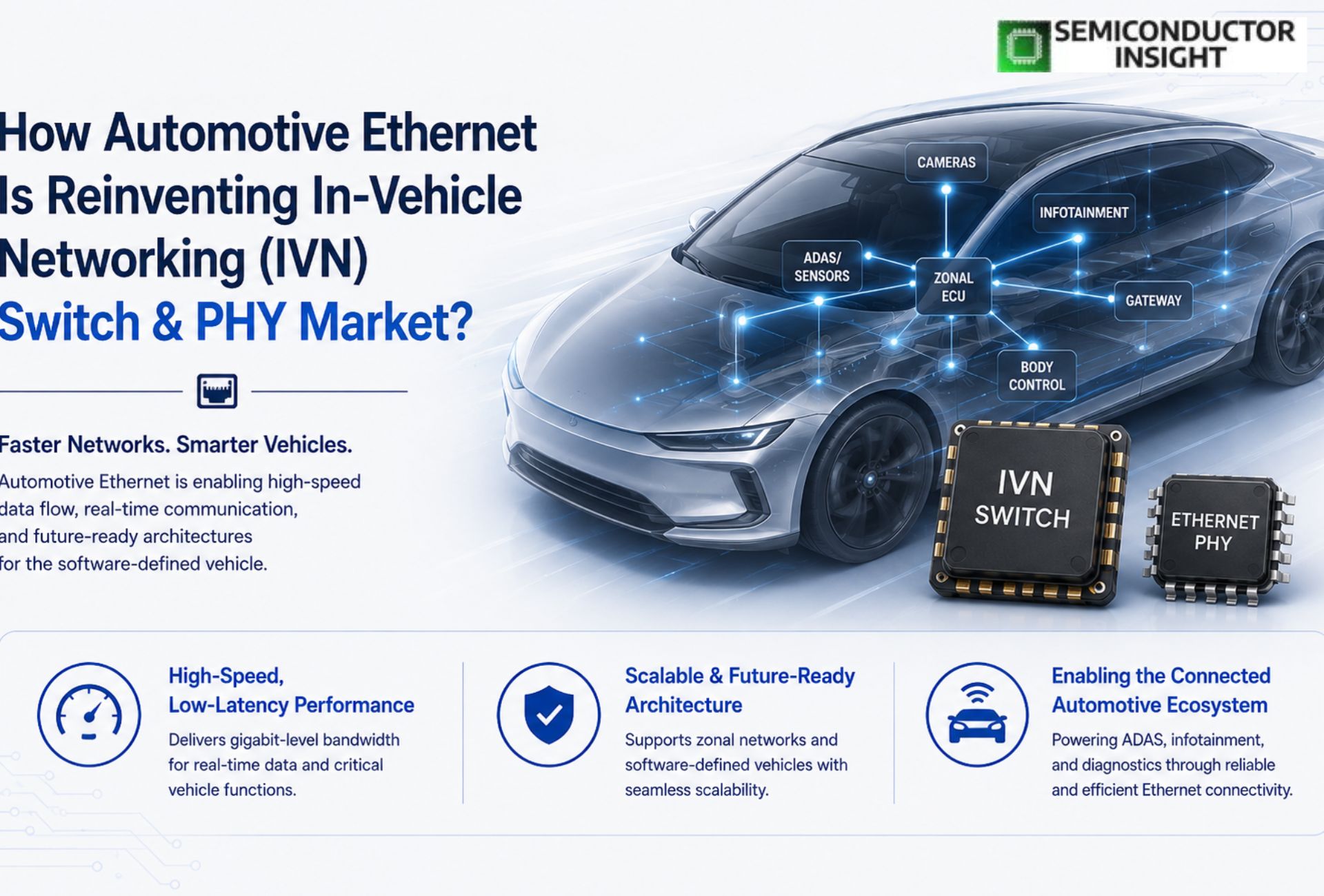
How Automotive Ethernet Is Reinventing In-Vehicle Networking (IVN) Switch & PHY Market?
Modern vehicles are rapidly becoming rolling data centres. A premium electric vehicle now contains more than 100 million lines of software code and processes several terabytes of sensor and infotainment data every day. Behind this digital transformation sits a less visible but critical semiconductor layer known as In-Vehicle Networking (IVN) Switch and PHY technology.
As automakers race toward autonomous driving, centralised computing, and connected mobility, IVN semiconductor components are becoming foundational to automotive electronics architecture. Switches manage data traffic between vehicle domains, while PHY chips establish high-speed physical communication links across Ethernet networks embedded inside vehicles.
The transition is no longer experimental. Companies including NVIDIA, Tesla, Mercedes-Benz Group, and BMW are redesigning vehicle platforms around centralised networking systems capable of handling real-time AI workloads and over-the-air updates.
Gigabit Automotive Ethernet Moves Into Mainstream Vehicle Platforms
- Automotive Ethernet is becoming the preferred communication backbone for next-generation vehicles. Traditional CAN and LIN systems still operate in body electronics, but they cannot support the enormous bandwidth demands created by high-resolution cameras, LiDAR, radar modules, and immersive infotainment systems.
- According to the IEEE, automotive Ethernet standards now support speeds ranging from 100 Mbps to 10 Gbps for advanced vehicle architectures. Modern Level 2 and Level 3 ADAS systems may require data transfer rates exceeding 20 Gbps across multiple electronic control units.
- A single autonomous test vehicle can generate nearly 4 TB of data daily, according to engineering studies published by Intel. This has pushed automakers to adopt Ethernet PHY solutions capable of ultra-low latency communication and deterministic networking.
- In 2025, several luxury EV platforms began integrating multi-gigabit Ethernet switches directly into zonal controllers. This architectural shift reduces wiring complexity while improving data reliability and software scalability.
Curious about the report? Dive into our newest updated version at no cost: https://semiconductorinsight.com/report/in-vehicle-networking-ivn-switch-phy-market/
Zonal Vehicle Architecture Is Replacing Traditional Domain Networks
One of the most important structural shifts in automotive electronics is the move from domain architecture to zonal architecture. Instead of dozens of distributed electronic control modules, automakers are consolidating functions into centralised compute clusters connected through high-speed Ethernet switches.
This redesign significantly reduces copper wiring. Research published by the International Energy Agency notes that advanced EV platforms can cut vehicle wiring weight by up to 30 kilograms through centralised networking layouts.
For semiconductor manufacturers, this transition is creating demand for compact IVN switch chips with integrated security, low power consumption, and thermal efficiency. Automotive-grade PHY devices are also evolving to support real-time diagnostics, predictive maintenance, and software-defined functions.
Broadcom recently expanded automotive Ethernet switch deployments for software-defined vehicles, while Marvell Technology introduced multi-gig automotive PHY platforms designed for autonomous driving systems.
AI-Powered Cockpits Are Increasing Internal Vehicle Data Traffic
- The modern digital cockpit is now one of the largest consumers of in-vehicle bandwidth. Ultra high definition displays, AI voice assistants, driver monitoring systems, augmented reality navigation, and cloud-linked entertainment require constant high-speed communication between processors and sensors.
- A 2025 connected mobility report from GSMA estimated that connected cars worldwide surpassed 370 million active units, with next-generation infotainment features becoming a major semiconductor demand catalyst.
- In China, several EV manufacturers are launching cockpit systems powered by triple-screen dashboards and AI copilots that rely heavily on automotive Ethernet connectivity. This trend is especially visible among smart EV brands integrating centralised AI chips with high-bandwidth networking switches.
- As cabin intelligence expands, PHY chipsets supporting electromagnetic interference protection and low-latency streaming are becoming increasingly important for maintaining seamless user experiences.
Cybersecurity Chips Become Essential in Vehicle Networking Systems
As vehicle connectivity increases, cybersecurity risks are also intensifying. Modern connected vehicles communicate with cloud systems, charging infrastructure, smartphones, and traffic networks. Every connection point introduces potential vulnerabilities.
The National Highway Traffic Safety Administration has repeatedly emphasised cybersecurity as a critical area for connected vehicle safety standards. IVN switch manufacturers are now embedding encryption, authentication, and intrusion detection directly into networking hardware.
Several semiconductor firms are integrating hardware security modules within Ethernet switches to secure over-the-air software updates and protect autonomous driving data pipelines. This hardware-level protection is becoming essential as software-defined vehicles continue expanding globally.
Semiconductor Supply Chains Are Reprioritising Automotive Networking Chips
The automotive semiconductor shortage exposed the strategic importance of networking chips inside vehicles. Since 2021, automakers have increasingly partnered directly with semiconductor suppliers to secure access to Ethernet PHY and switch technologies.
Global automotive semiconductor spending crossed USD 69 billion in 2025, according to industry estimates from technology associations and annual reports from major chipmakers. A growing portion of this investment is being directed toward networking semiconductors supporting EVs and intelligent mobility systems.
With autonomous mobility, AI-enabled cabins, and centralised vehicle computing gaining momentum, IVN switch and PHY technologies are moving from supporting components to core enablers of next-generation transportation.

Comments (0)