
How Are Semiconductor Innovations Transforming VR Gaming Hardware Chipsets Market Worldwide?
Virtual reality gaming has reached a stage where players expect experiences to feel almost indistinguishable from natural movement. That expectation places extraordinary demands on semiconductor engineering.
Modern VR gaming hardware chipsets are no longer designed solely to increase frame rates they must process graphics, sensor inputs, spatial audio, eye tracking and AI-driven rendering simultaneously while maintaining extremely low latency.
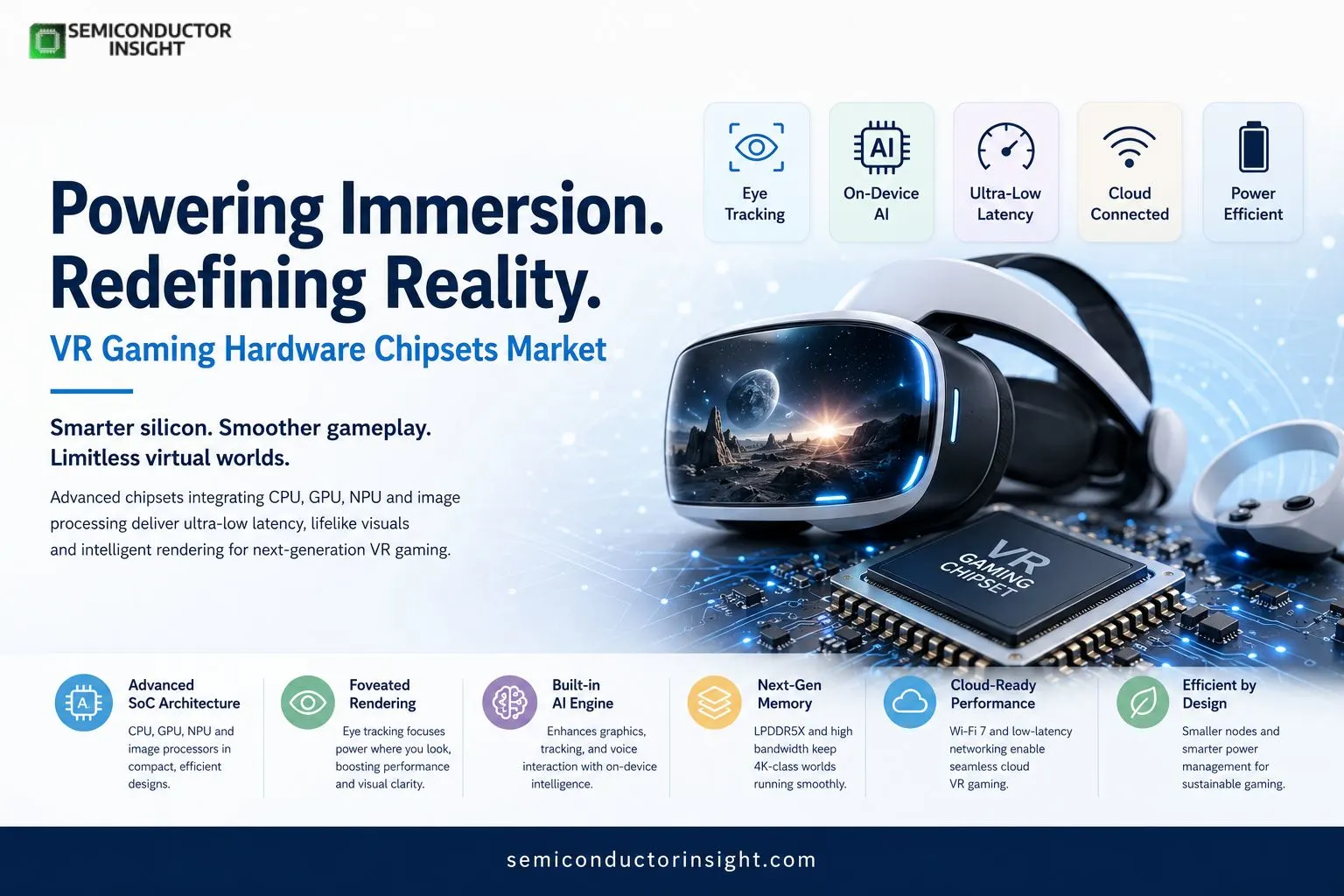
Industry leaders are introducing specialised architectures that combine CPUs, GPUs, neural processing units (NPUs) and dedicated image processors into compact system-on-chip (SoC) designs. These highly integrated chipsets reduce power consumption while delivering smoother immersive gameplay across standalone and PC-connected VR devices.
Eye Tracking Has Become a Semiconductor Performance Multiplier
- One of the biggest developments in VR hardware is eye tracking combined with foveated rendering.
- Instead of rendering every pixel at maximum resolution, the chipset concentrates computing resources on the exact area where the user’s eyes are focused.
- Sony’s PlayStation VR2 uses integrated eye-tracking technology to improve rendering efficiency, while Meta has expanded research into dynamic rendering techniques for advanced headsets.
- According to Sony Interactive Entertainment, PlayStation VR2 includes OLED displays offering 2,000 × 2,040 pixels per eye, demonstrating how modern semiconductor processing supports increasingly detailed visual experiences without proportionally increasing hardware power requirements.
- The result is higher image quality alongside more efficient silicon utilisation.
AI Engines Are Becoming Standard Components Instead of Premium Features
Artificial intelligence is rapidly becoming embedded directly into gaming chipsets. Dedicated NPUs now assist with image enhancement, gesture recognition, voice interaction and predictive frame generation.
Qualcomm’s Snapdragon XR platforms integrate AI acceleration capable of handling multiple concurrent camera streams, environmental mapping and hand tracking without relying heavily on cloud computing. Local AI processing reduces latency while enabling more responsive interactions during gameplay.
As mixed reality applications become more sophisticated, AI engines are evolving into essential semiconductor blocks rather than optional accelerators.
Smaller Manufacturing Nodes Continue Expanding Processing Efficiency
The semiconductor industry’s transition toward advanced fabrication technologies is directly benefiting VR gaming hardware.
Chipsets manufactured using 5 nm, 4 nm and emerging 3 nm process technologies pack billions of transistors into compact silicon dies while improving energy efficiency. According to TSMC, advanced process nodes enable higher transistor density and lower operating power, helping manufacturers deliver lighter headsets with longer battery life.
These improvements are particularly important for standalone VR devices where thermal management, battery capacity and overall weight directly affect user comfort during extended gaming sessions.
High Bandwidth Memory Keeps Virtual Worlds Moving Smoothly
- Immersive gaming depends on moving enormous volumes of graphical data with minimal delay.
- Modern VR chipsets increasingly rely on LPDDR5X memory and ultra-fast internal bandwidth to process high-resolution textures, spatial mapping and AI-generated visual effects.
- Many premium headsets now operate with 90 Hz and 120 Hz refresh rates, while supporting resolutions approaching 4K-class visuals across both displays.
- Higher refresh rates reduce motion blur and motion sickness, making semiconductor memory architecture just as important as graphics performance.
- This balance between computing capability and memory bandwidth is becoming one of the defining characteristics of next-generation VR silicon.
Cloud Connected Gaming Is Changing Chip Design Priorities
Cloud gaming does not eliminate the need for powerful chipsets it changes what they prioritise.
Modern VR processors increasingly optimise wireless connectivity through Wi-Fi 7, Bluetooth LE Audio and ultra-low latency networking. Dedicated networking accelerators reduce transmission delays between cloud servers and headsets while maintaining synchronised rendering.
NVIDIA CloudXR continues demonstrating how high-end rendering workloads can be streamed from powerful GPUs to lightweight VR hardware, allowing semiconductor designers to balance local processing with cloud-assisted graphics.
This hybrid architecture represents an important evolution in immersive computing.
Gaming Studios Are Influencing Semiconductor Roadmaps
Chip development is no longer driven exclusively by semiconductor manufacturers. Major game developers increasingly collaborate with silicon designers to optimise engines for emerging hardware capabilities.
Technologies such as Unreal Engine 5’s Nanite virtualised geometry and Lumen global illumination require chipsets capable of handling increasingly complex graphical calculations in real time. Close collaboration between engine developers and semiconductor companies helps ensure new hardware fully supports future gaming workloads.
This partnership shortens optimisation cycles while enabling developers to push visual fidelity without sacrificing responsiveness.
Lastly before we wrap up, don’t forget to look at our most recent exclusive report for in-depth insights: https://semiconductorinsight.com/report/vr-gaming-hardware-chipsets-market-2/
Sustainability Is Quietly Becoming Part of Gaming Hardware Engineering
Efficiency has become a design objective alongside raw performance. Semiconductor companies are reducing package sizes, improving power management algorithms and adopting advanced packaging technologies that minimise material usage while increasing computing density.
The Semiconductor Industry Association notes that continued advances in chip efficiency support broader sustainability goals by lowering energy consumption across consumer electronics. As VR adoption expands beyond gaming into education, healthcare and industrial training, energy-efficient chipsets will play an increasingly important role in reducing the environmental footprint of immersive technologies.

Comments (0)