
AI Smartphone System-on-Chip Market Insights
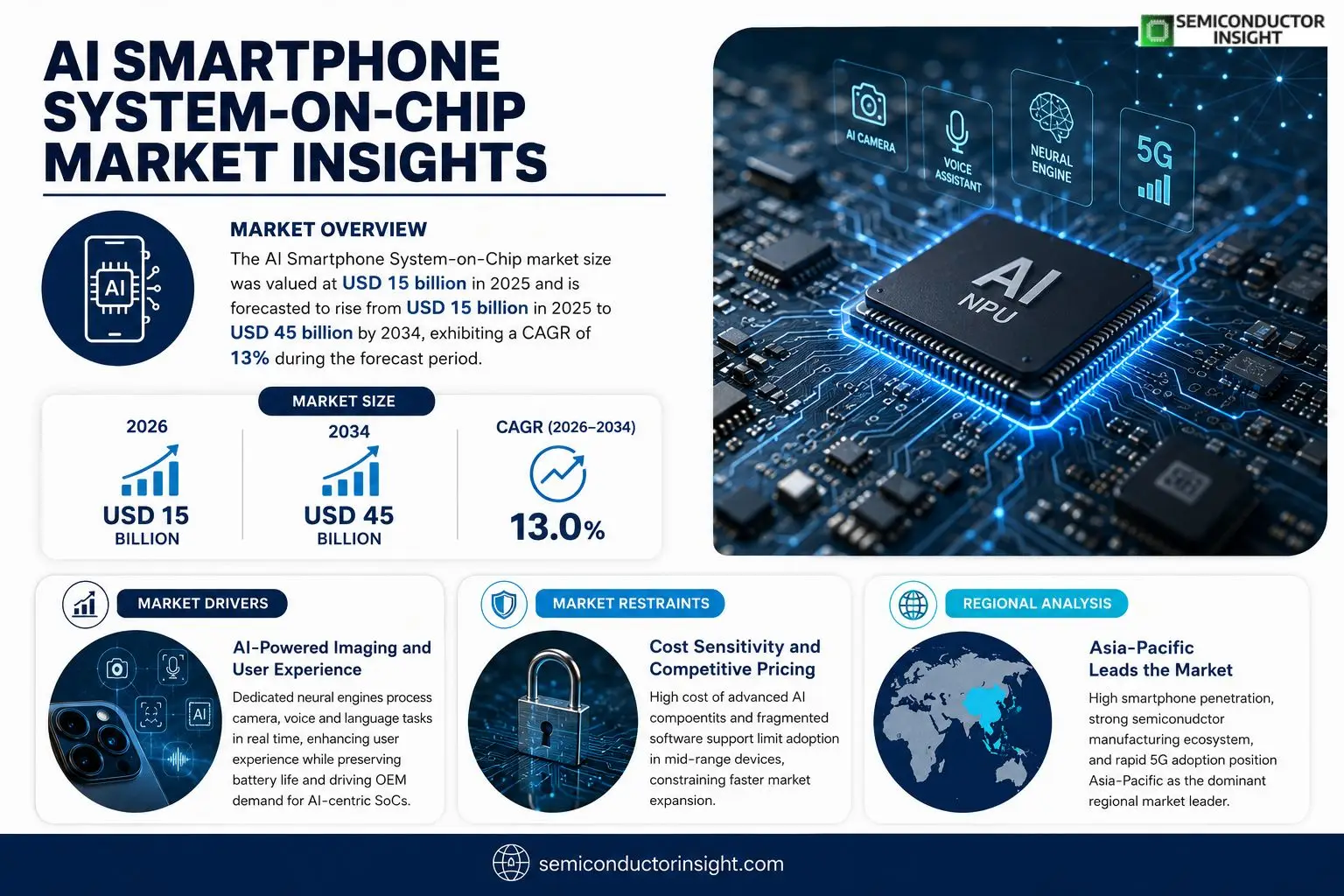
AI Smartphone System-on-Chip market size was valued at USD 15 billion in 2025. The market is forecasted to rise from USD 15 billion in 2025 to USD 45 billion by 2034, exhibiting a CAGR of 13 % during the forecast period.
AI Smartphone System‑on‑Chip integrates a central processing unit, graphics processor and dedicated neural processing unit on a single die, enabling on‑device inference for vision, voice and language tasks while preserving battery life. These chips also embed memory controllers and modem functions, creating a compact platform that powers next‑generation mobile experiences.The upward trajectory stems from escalating consumer demand for real‑time AI features such as photography enhancement and virtual assistants, coupled with manufacturers’ push toward edge computing to reduce latency. Moreover, strategic alliancese.g., Qualcomm’s partnership with Google announced in February 2024 to optimise TensorFlow Lite on Snapdragon platformsare accelerating adoption. Leading suppliers including Qualcomm, MediaTek and Apple continue expanding their portfolios, reinforcing the market’s momentum.
MARKET DRIVERS
AI‑Powered Imaging and User Experience
Consumers now choose smartphones based on how intelligently the device can enhance photos, translate speech, or anticipate usage patterns. AI Smartphone System-on-Chip Market benefits because manufacturers embed dedicated neural engines that process sensor data in real time, eliminating latency and reducing battery drain. This capability transforms ordinary hardware into a differentiated experience, prompting OEMs to prioritize AI‑centric silicon in flagship models.
5G Integration and Edge Compute
The rollout of 5G networks creates a fertile environment for on‑device inference. With millisecond‑level connectivity, the pressure to offload every AI task to the cloud wanes, encouraging chip designers to allocate more silicon to edge compute blocks. As a result, the market sees a surge in SoCs that couple high‑throughput modem subsystems with AI accelerators, delivering richer services such as augmented reality overlays without compromising privacy.
➤ “The convergence of AI and 5G is reshaping how smartphones handle data, making on‑device intelligence a commercial necessity rather than a luxury.”
Beyond photography and connectivity, enterprises are integrating smartphones into workflow automation, from inventory scanning to real‑time translation. Those use cases demand low‑latency inferencing, reinforcing the strategic shift toward more powerful AI silicon. Companies that fail to adopt next‑gen SoCs risk eroding market share as user expectations evolve.
MARKET CHALLENGES
Regulatory and Ecosystem Frictions
Data‑privacy regulations in major economies impose strict limits on how biometric and location data may be processed. Chip vendors must embed privacy‑preserving mechanisms, such as on‑device encryption and federated learning support, which adds engineering complexity and lengthens time‑to‑market. Simultaneously, the fragmented Android ecosystem forces designers to certify across a myriad of device configurations, inflating development costs.
Other Challenges
Supply Chain Bottlenecks
The reliance on advanced lithography nodes and specialty memory for AI accelerators has exposed the industry to periodic shortages. When wafer capacity tightens, OEMs experience lead‑time extensions that disrupt product launch calendars, ultimately slowing the overall momentum of AI Smartphone System-on-Chip Market.
MARKET RESTRAINTS
Cost Sensitivity and Competitive Pricing
Mid‑range smartphones dominate shipments, and price pressure forces manufacturers to balance AI performance against bill‑of‑materials cost. Integrating high‑end neural engines raises the unit price, prompting some brands to defer AI upgrades in favor of incremental camera improvements, thereby tempering the pace of SoC adoption.
Fragmented Software Support
Even when advanced AI hardware is available, developers often encounter mismatched SDKs and limited documentation, which hampers the creation of optimized applications. This software gap discourages some OEMs from investing heavily in next‑generation AI silicon, constraining market expansion.
MARKET OPPORTUNITIES
Emerging Form‑Factor Innovations
Foldable and rollable devices demand compact yet powerful processing solutions. AI Smartphone System-on-Chip Market can capitalize on this trend by delivering ultra‑thin AI accelerators that fit within limited chassis dimensions while maintaining high inference throughput. Early adopters that align chip architecture with novel form factors stand to capture premium segments and set new performance benchmarks.Additionally, the rise of on‑device health monitoringsuch as real‑time ECG interpretation and vision‑based fall detectionopens a revenue stream for SoC vendors willing to certify medical‑grade AI models. Partnerships with health‑tech firms could transform smartphones into regulated diagnostic platforms, expanding the addressable market beyond traditional consumer usage.
AI Smartphone System-on-Chip Market Trends
Integrated AI Processing on Mobile Devices
The convergence of CPU, GPU, and a dedicated neural processing unit onto a single die has become the structural backbone of AI Smartphone System-on-Chip Market. By housing vision, voice, and language inference engines next to memory controllers and modem blocks, manufacturers achieve millisecond‑scale response times while preserving battery endurance. This architectural shift enables features such as scene‑detect photography, on‑device translation, and always‑ready digital assistants without relying on cloud round‑trips. As smartphones increasingly serve as primary computing platforms, the pressure to deliver richer AI experiences within the constraints of a thin chassis directly drives the adoption of integrated SoC solutions.
Other Trends
Edge Computing and Latency Reduction
Consumer appetite for real‑time enhancementsranging from low‑light imaging to predictive textforces OEMs to move inference to the edge. Eliminating network latency not only improves user satisfaction but also addresses privacy concerns tied to data leaving the device. This pressure is prompting chipset designers to allocate larger silicon real estate to tensor accelerators and to refine power‑gating techniques that keep energy draw minimal during idle periods. The result is a virtuous cycle: as edge performance improves, developers embed more sophisticated AI functions, which in turn pushes silicon vendors to further refine their SoC roadmaps.
Strategic Partnerships Accelerating Adoption
Recent collaborations exemplify how ecosystem alignment accelerates market momentum. A notable partnership between a leading chipset maker and a dominant software platform, announced early 2024, focuses on optimizing neural network runtimes for Snapdragon‑based devices. By co‑engineering drivers and libraries, the duo shortens the time‑to‑market for new AI features and lowers integration costs for OEMs. Parallel moves by MediaTek and Apple to expand their AI‑centric portfolios reinforce a competitive environment where differentiation hinges on on‑device intelligence. For suppliers, these alliances translate into larger design wins and recurring revenue streams; for device makers, they provide a clearer pathway to differentiate premium models without inflating bill‑of‑materials.
COMPETITIVE LANDSCAPE
Key Industry Players
AI Smartphone System‑on‑Chip Competitive Overview
Qualcomm continues to dominate the AI‑enabled SoC segment, leveraging its Snapdragon line‑up that combines powerful CPU cores, advanced GPU architectures and a dedicated Neural Processing Engine. The company’s extensive software stack, including the Snapdragon Neural Processing SDK, enables OEMs to roll out on‑device AI features with minimal time‑to‑market. MediaTek follows closely, differentiating its Dimensity series through aggressive price‑performance ratios and early integration of 5G modems, which appeals to volume‑oriented manufacturers in emerging markets. Apple’s in‑house silicon, the A‑series and now M‑series derivatives, sets a premium benchmark; the tight coupling of hardware and iOS AI frameworks delivers superior image‑processing and voice‑assistant capabilities that reinforce brand loyalty. Collectively, these three firms control the bulk of revenue, dictate architectural standards, and shape the development of companion toolchains, creating a market structure where scale and ecosystem lock‑in become decisive competitive levers.Beyond the three giants, a cohort of niche players is reshaping specific value‑chains. Samsung Electronics supplies Exynos chips that prioritize integration with its own display and camera modules, targeting the high‑end South Korean and select segments. Huawei’s HiSilicon Kirin line, despite export restrictions, persists through domestic demand and AI‑centric optimizations for camera‑heavy devices. Unisoc (formerly Spreadtrum) captures low‑cost devices by bundling AI accelerators with modest CPU cores, catering to budget smartphones in Southeast Asia and Africa. Google’s Tensor SoC, although limited to its Pixel flagship, showcases a software‑first approach that tightly aligns AI models with hardware. Nvidia, while primarily a GPU supplier, offers a mobile‑grade inference engine that some OEMs integrate as a co‑processor to augment existing SoCs. These companies exploit differentiated roadmapsbe it cost, regional focus, or AI‑model co‑designto carve out sustainable niches within an otherwise concentrated market.
List of Key AI Smartphone System‑on‑Chip Companies Profiled
- Qualcomm
- MediaTek
- Apple
- Samsung Electronics
- Huawei (HiSilicon)
- Unisoc
- Google Tensor
- Nvidia
- Arm Holdings
- Intel Mobile Platforms
- TSMC (foundry partner)
- Analog Devices
Segment Analysis:
| Segment Category | Sub-Segments | Key Insights |
| By Type |
|
AI‑accelerated SoCs
|
| By Application |
|
Photography & Imaging
|
| By End User |
|
Premium Flagship Devices
|
| By Integration Level |
|
Fully Integrated NPU
|
| By Software Ecosystem |
|
TensorFlow Lite Optimized Platforms
|
Regional Analysis: AI Smartphone System-on-Chip Market
North America
Engineers are re‑architecting the traditional CPU‑GPU‑NPU hierarchy, embedding AI inference engines directly into cache hierarchies. This reduces latency for vision‑based features and enables new user experiences such as adaptive camera pipelines that learn from a single shot. The shift reflects a strategic move to differentiate hardware by software‑driven perception capabilities.
Recent semiconductor shortages prompted North American firms to diversify wafer fabs across the continent and to partner with foundries that specialize in advanced node processes. This dual‑sourcing model mitigates risk and shortens time‑to‑market for AI‑centric releases.
Legislation that limits cloud‑based AI processing for personal data has nudged OEMs to prioritize on‑device computation. Chipmakers respond by hardening security enclaves around AI workloads, aligning product roadmaps with compliance timelines.
Early adopters are gravitating toward devices that promise seamless AR overlays and predictive text that feels personal. This appetite drives OEMs to source SoCs that can sustain continuous AI inference without draining the battery, shaping the competitive set in premium smartphones.
Europe
European manufacturers are leveraging stringent energy‑efficiency directives to steer AI‑enabled SoC designs toward sub‑10‑watt consumption profiles. Automotive cross‑pollination, where vehicle‑grade AI accelerators inform mobile chipsets, has introduced a higher reliability standard. Meanwhile, collaborative research hubs in Germany and France accelerate prototype validation, ensuring that emerging AI features comply with GDPR‑aligned privacy models. The region’s focus on sustainable performance positions its suppliers to attract carriers seeking low‑operational‑cost devices.
Asia‑Pacific
Asia‑Pacific remains the manufacturing powerhouse, but its market dynamics are shifting from volume‑centric to value‑centric. Domestic brands are embedding AI cores that support multilingual voice assistants tailored to diverse linguistic markets, from Mandarin to Hindi. The rise of 5G rollout amplifies demand for on‑device AI to off‑load network congestion. Additionally, strategic partnerships between semiconductor giants and local AI start‑ups foster rapid iteration cycles, allowing AI Smartphone System-on-Chip Market to evolve at a pace matched to consumer hunger for immersive experiences.
South America
In South America, price sensitivity drives OEMs to adopt modular SoCs where AI functionality can be toggled according to market tier. Regional carriers are experimenting with edge‑AI services that enable localized content recommendation without relying on bandwidth‑intensive cloud calls. This approach not only reduces latency but also aligns with emerging data‑sovereignty policies, encouraging manufacturers to embed AI processing close to the user.
Middle East & Africa
The Middle East & Africa region is witnessing a nascent but accelerating interest in AI‑powered mobile experiences, particularly in fintech and e‑commerce. Mobile operators are piloting AI-driven fraud detection that runs directly on the handset, mitigating latency concerns in remote areas. Infrastructure constraints have prompted chip designers to prioritize low‑power AI blocks that can function reliably under variable network conditions, creating a distinct value proposition for this diverse market.
Report Scope
This market research report provides a comprehensive analysis of the AI Smartphone System-on-Chip Market , covering the forecast period 2026–2034. It offers detailed insights into market dynamics, technological advancements, competitive landscape, and key trends shaping the industry.
Key focus areas of the report include:
- Market Overview: ✅ The report begins with an overview outlining its current market scenario, key growth indicators, and industry transformation drivers. It discusses macroeconomic factors, demand–supply balance, regulatory landscape, and the strategic role of semiconductors in powering advancements across industries such as automotive, telecommunications, consumer electronics, and industrial automation.
- ✅ Market Size & Forecast: Historical data and future projections for revenue, unit shipments, and market value across major regions and segments.
- ✅ Segmentation Analysis: Detailed breakdown by product type, technology, application, and end-user industry to identify high-growth segments and investment opportunities.
- ✅ Regional Insights: Insights into market performance across North America, Europe, Asia-Pacific, Latin America, and the Middle East & Africa, including country-level analysis where relevant.
- ✅ Competitive Landscape: Profiles of leading market participants, including their product offerings, R&D focus, manufacturing capacity, pricing strategies, and recent developments such as mergers, acquisitions, and partnerships.
- ✅ Technology Trends & Innovation: Assessment of emerging technologies, integration of AI/IoT, semiconductor design trends, fabrication techniques, and evolving industry standards.
- ✅ Market Drivers & Restraints: Evaluation of factors driving market growth along with challenges, supply chain constraints, regulatory issues, and market-entry barriers.
- ✅ Stakeholder Insights: Insights for component suppliers, OEMs, system integrators, investors, and policymakers regarding the evolving ecosystem and strategic opportunities.
Primary and secondary research methods are employed, including interviews with industry experts, data from verified sources, and real-time market intelligence to ensure the accuracy and reliability of the insights presented.
FREQUENTLY ASKED QUESTIONS:
What is the current market size of AI Smartphone System-on-Chip Market?
-> AI Smartphone System-on-Chip Market was valued at USD 15 billion in 2025 and is expected to reach USD 45 billion by 2034.
Which key companies operate in AI Smartphone System-on-Chip Market?
-> Key players include Qualcomm, MediaTek, Apple, Samsung Electronics, and Huawei, among others.
What are the key growth drivers?
-> Key growth drivers include rising consumer demand for real-time AI features, edge computing to reduce latency, and strategic partnerships accelerating AI chip adoption.
Which region dominates the market?
-> Asia-Pacific dominates the market, driven by high smartphone penetration and leading semiconductor manufacturers.
What are the emerging trends?
-> Emerging trends include integration of advanced neural processing units, on‑device AI model optimization, and 5G‑enabled AI workloads.
Get Sample Report PDF for Exclusive Insights
Report Sample Includes
- Table of Contents
- List of Tables & Figures
- Charts, Research Methodology, and more...
 Download Sample Report PDF




