
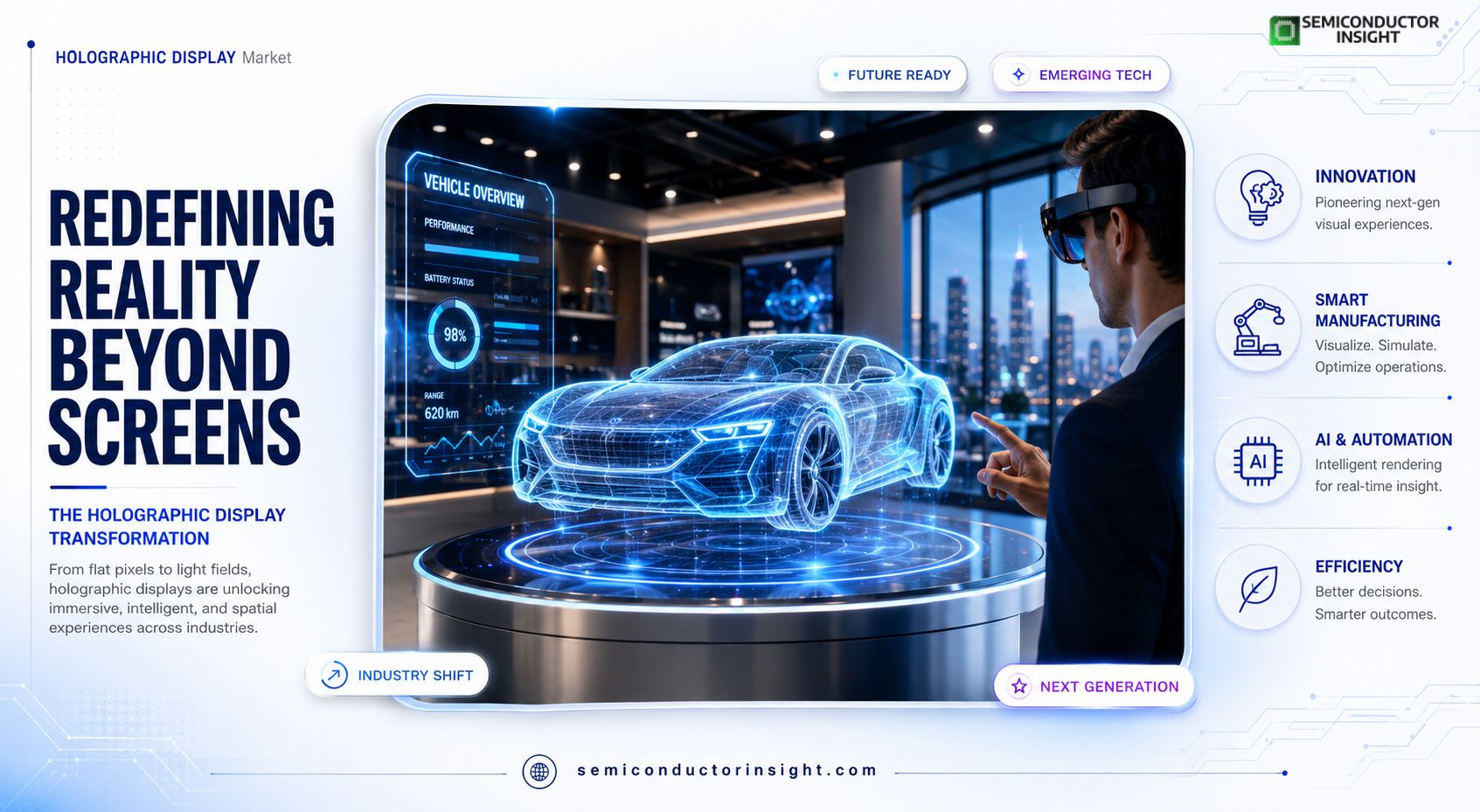
Holographic Display Market 2026 Connected to Billions of Dollars in XR and Spatial Computing Investments
For decades, digital displays have remained confined to flat surfaces. Whether on televisions, smartphones, monitors, or tablets, information has traditionally been presented in two dimensions. Holographic Display Market is changing that equation by introducing visual experiences that appear to exist in real space, allowing users to interact with three-dimensional images without relying on conventional screens.
As semiconductor technologies, photonics, artificial intelligence, and spatial computing converge, holographic displays are moving from research laboratories into commercial environments including healthcare, education, automotive systems, retail, and industrial engineering.
From Pixels to Light Fields
The evolution of holographic displays is not simply about producing sharper images. It represents a shift from pixel-based viewing toward light-based visualization.
Unlike traditional displays that project images on flat panels, holographic systems reconstruct light waves to create the perception of depth, enabling viewers to observe objects from multiple angles.
CRT Displays
↓
LCD and OLED Screens
↓
3D Displays
↓
AR and VR Interfaces
↓
Holographic Visualization
↓
Spatial Computing Environments
This transition is increasingly important as organizations seek more immersive methods of presenting information.
Where Semiconductor Innovation Enters the Picture
Modern holographic displays depend heavily on advanced semiconductor components. High-performance processors, image sensors, micro-LED architectures, optical waveguides, and photonic integrated circuits all contribute to real-time holographic rendering.
Recent advancements in AI accelerators and graphics processing units have significantly improved the ability to generate and process complex three-dimensional visual data. This capability is especially relevant as enterprises begin handling larger digital twins, engineering simulations, and immersive visualization projects.
Semiconductor Building Blocks Behind Holography
The advancement of holographic systems depends on a combination of high-performance semiconductor and photonic technologies that work together to create realistic three-dimensional visual experiences. Graphics Processing Units (GPUs) serve as the computational backbone, enabling real-time rendering of complex holographic images and dynamic visual content. Image sensors contribute by capturing depth information and spatial data from the surrounding environment, allowing holographic systems to accurately map and reconstruct objects in three dimensions.
At the display level, Micro-LED arrays provide highly precise light projection, delivering the brightness, resolution, and color accuracy required for immersive holographic visualization. Complementing these components, photonic chips manage and control optical signals with exceptional speed and efficiency, improving light manipulation within advanced holographic displays. Meanwhile, AI accelerators are becoming increasingly important for generating realistic 3D scenes, enhancing object recognition, and enabling real-time content adaptation. Together, these technologies form the foundation of next-generation holographic platforms used across healthcare, entertainment, industrial visualization, and spatial computing applications.
The Healthcare Visualization Revolution
One of the most active deployment areas for holographic displays is healthcare. Medical institutions are increasingly exploring holographic imaging for surgical planning, anatomy education, and diagnostic visualization.
A physician can examine a three-dimensional representation of organs, blood vessels, or skeletal structures from multiple viewing angles without relying solely on conventional scans displayed on monitors.
Clinical Workflow Example
Medical Imaging Scan
↓
3D Data Processing
↓
Holographic Reconstruction
↓
Interactive Examination
↓
Treatment Planning
This workflow improves spatial understanding and can enhance communication between medical teams.
Retail Stores Are Experimenting with Floating Products
Retail environments are increasingly adopting holographic experiences to capture consumer attention.
Instead of displaying static advertisements, brands are testing interactive floating product demonstrations that showcase items in three-dimensional space. Luxury products, consumer electronics, and automotive brands have been among the earliest adopters.
Recent exhibitions and technology showcases in Asia, Europe, and North America have demonstrated holographic storefront concepts capable of presenting detailed product visuals without requiring physical inventory displays.
Digital Twins Meet Holographic Interfaces
A growing trend involves combining holographic displays with industrial digital twins.
Engineers can visualize manufacturing equipment, infrastructure assets, or factory layouts in three-dimensional form while accessing live operational data.
Industrial Interaction Framework
Physical Asset
↓
Sensor Network
↓
Digital Twin Platform
↓
Real-Time Analytics
↓
Holographic Visualization
↓
Operational Decision Making
This approach enables teams to identify maintenance requirements, monitor performance metrics, and simulate operational changes more effectively.
Lastly, for more in-depth information, don’t forget to read our most recent exclusive report: https://semiconductorinsight.com/report/holographic-display-market-2/
Beyond Entertainment and Gaming
While gaming remains a visible use case, Holographic Display Market is increasingly linked to enterprise productivity. Universities are exploring immersive educational content, architects are presenting interactive building models, and automotive manufacturers are evaluating holographic interfaces for advanced cockpit systems.
The technology is gradually becoming a practical visualization tool rather than a futuristic novelty. As semiconductor performance, optical engineering, and AI-generated content continue advancing together, holographic displays are redefining how digital information can be experienced, understood, and shared across industries.

Comments (0)