
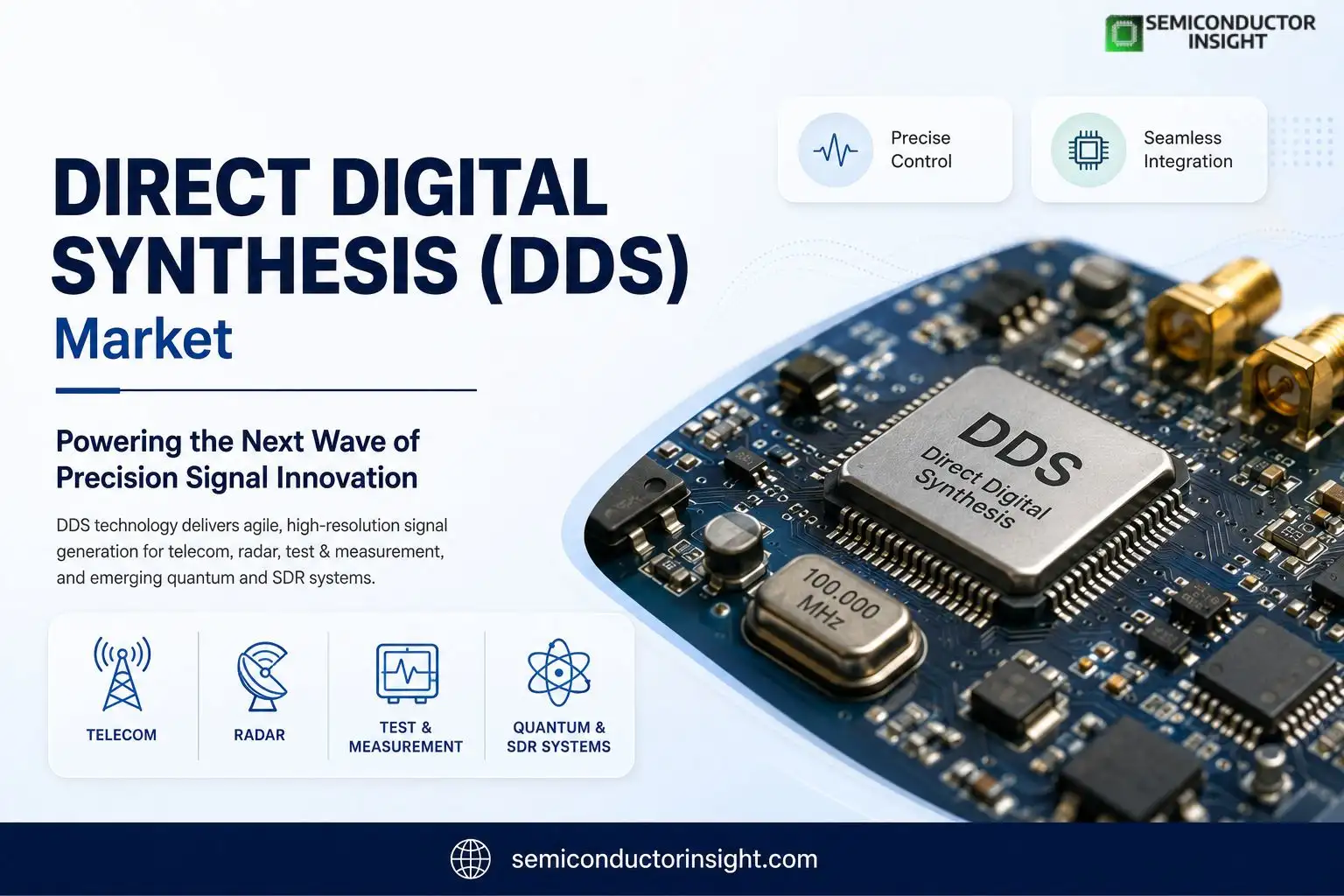
Global Direct Digital Synthesis Market 2026: USD 735 million to USD 1,172 million at 7.0% CAGR
Direct digital synthesis technology stands at the forefront of modern signal generation, transforming how engineers create precise waveforms across countless semiconductor-powered systems. This approach generates analog signals directly from digital data using a fixed reference clock, offering unmatched speed and flexibility compared to older analog methods.
Inside the Core Architecture Powering Modern DDS Systems
At its heart, a DDS setup relies on a phase accumulator, a lookup table for waveform values, and a digital-to-analog converter. The phase accumulator steps through digital values at the clock rate, pulling corresponding amplitude points from memory before conversion to an analog output. This structure allows sub-hertz frequency resolution and near-instantaneous frequency or phase shifts. Latest studies details this process clearly, noting its use in everything from function generators to communication local oscillators.
Engineers appreciate how a single crystal oscillator reference keeps the entire system stable while the digital core handles complex modulations. In practice, chips like those from established semiconductor houses integrate comparators, RAM, and mixers on one die, shrinking board space dramatically for portable and embedded designs.
Real-World Deployments Driving DDS Adoption Worldwide
- Telecommunications networks lean heavily on DDS for agile frequency control in base stations and handheld devices. During 5G rollouts, operators needed rapid frequency hopping to manage interference and support higher data rates. DDS chips deliver this by switching frequencies in microseconds, supporting advanced schemes like FSK and spread spectrum without the settling time issues of traditional PLLs.
- Radar systems provide another prime example. Distributed phased array radars use DDS to generate finely tuned chirp signals for target detection. One documented S-band design for such arrays highlighted how DDS improved waveform flexibility and precision in defense applications. Governments worldwide continue investing in these capabilities through modernization programs that emphasize electronic warfare readiness.
- In test and measurement, benchtop instruments now routinely feature DDS cores for producing clean sine, square, or arbitrary waveforms. National Instruments resources explain how this enables sub-hertz accuracy essential for calibrating sensitive equipment in labs and production lines.
Integration with Emerging Technologies Like SDR and Quantum Systems
Software-defined radio platforms have embraced DDS as a cornerstone for flexible tuning. A 2013 study available through public medical archives described a DDS-based design paired with clock multipliers for SDR applications, demonstrating reliable performance in dynamic environments.
Quantum computing research also benefits. Precise microwave signal generation is critical for qubit control, and DDS offers the phase stability and low noise needed. Research papers from university labs detail custom DDS implementations on FPGAs that achieve the timing precision quantum experiments demand.
Biomedical equipment manufacturers incorporate DDS for ultrasound and imaging systems where exact frequency control improves image quality and patient safety. Industrial automation uses similar principles for motor control and vibration analysis.
Performance Metrics Highlighting DDS Advantages
Manufacturers report systems achieving spurious-free dynamic ranges exceeding 80 dB in many configurations. Clock speeds often reach several hundred MHz, supporting output frequencies up to roughly one-third of the reference clock. Power consumption in modern low-power variants stays below 100 milliwatts for battery-operated field gear, a key factor in defense and remote sensing deployments.
Integration levels continue rising. Single-chip solutions now pack 14-bit DACs alongside full DDS logic, reducing component counts from dozens to just a handful. This shift has enabled compact modules used in satellite communications and airborne radar pods.
Take a Quick Glance at Our In-Depth Analysis Report: https://semiconductorinsight.com/report/direct-digital-synthesis-market/
Supply Chain and Manufacturing Evolutions Supporting Growth
Semiconductor fabs focused on mixed-signal processes have scaled production of DDS ICs to meet demand from multiple sectors. Analog Devices maintains a strong portfolio with parts featuring on-board PLLs and RAM for complex waveform storage. Their designs appear in products ranging from hobbyist signal generators to professional test gear.
Global supply efforts emphasize resilience. Initiatives similar to domestic manufacturing pushes in various countries encourage local production of critical components, reducing reliance on single geographic sources for defense-related chips.
Recent FPGA-based DDS implementations allow rapid prototyping and field upgrades. Spectrum Instrumentation announced generators capable of handling 50 tones per channel, showcasing how digital techniques scale for multi-channel applications.
Practical Benefits Reshaping Design Decisions
Designers value the digital control interface that lets microcontrollers or FPGAs reprogram frequencies on the fly. This capability proves invaluable in adaptive systems that must respond to changing conditions, such as cognitive radio networks or electronic countermeasures.
Cost efficiencies emerge at volume. While early DDS devices were premium components, widespread adoption across consumer and industrial segments has brought prices down, making the technology accessible for smaller projects and educational tools.
Thermal performance also stands out. Digital-heavy architectures generate less heat than analog equivalents in many scenarios, simplifying cooling in dense electronics like data center test equipment or portable military radios.
Forward Momentum in DDS-Enabled Applications
Ongoing work in higher-resolution DACs and faster memory access promises even cleaner signals at higher frequencies. Researchers explore hybrid approaches combining DDS with other synthesis methods for specialized needs.
- The technology’s role in secure communications grows as spectrum becomes more contested. Frequency agility helps systems evade jamming while maintaining clear channels for data transfer.
- Engineers experimenting with open-source tools frequently turn to DDS examples for learning digital signal processing fundamentals. Platforms like FPGA4fun provide accessible entry points that bridge theory and hardware implementation.
Direct digital synthesis continues evolving as semiconductors advance, embedding deeper into the fabric of global connectivity, defense, and scientific progress. Its combination of precision, speed, and integration positions it as a foundational element for next-generation electronic systems.

Comments (0)