MARKET INSIGHTS
The global Radar Signal Generators Market size was valued at US$ 315 million in 2024 and is projected to reach US$ 567 million by 2032, at a CAGR of 7.2% during the forecast period 2025-2032.
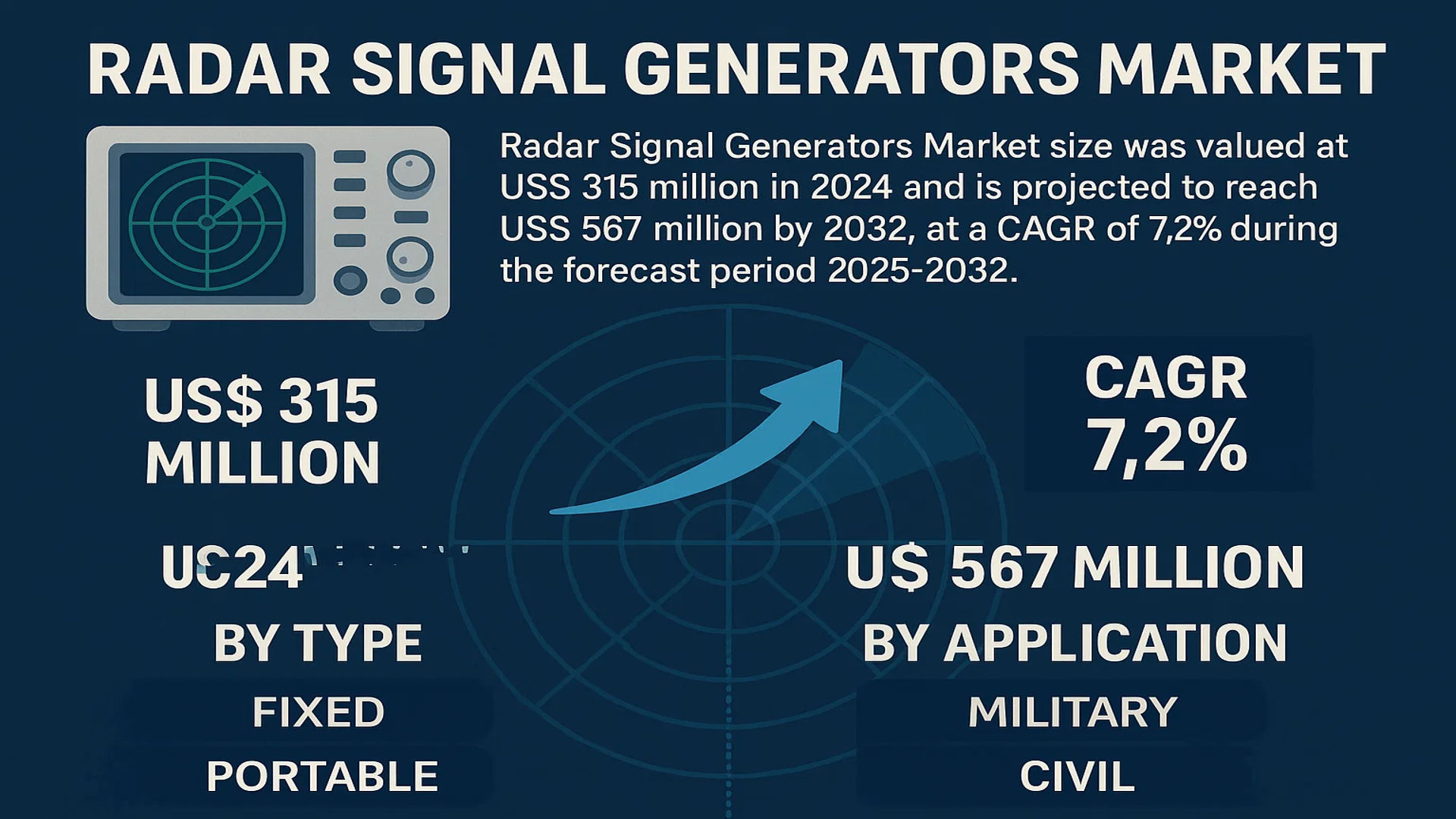
Radar signal generators are electronic devices used to simulate radar signals for testing and calibration purposes. These instruments generate precise RF (radio frequency) and microwave signals that mimic real-world radar scenarios, enabling the evaluation of radar receivers, transmitters, and other critical components. The market includes both fixed and portable signal generators, catering to diverse applications in military and civil sectors.
The market growth is primarily driven by increasing defense spending worldwide and the modernization of radar systems. However, supply chain disruptions and high development costs pose challenges. Key players like L3Harris Technologies and Keysight are investing in advanced signal generation technologies, such as software-defined radar test solutions, to meet evolving industry demands. The military segment currently dominates the market, accounting for over 65% of total revenue in 2024.
MARKET DYNAMICS
MARKET DRIVERS
Increased Military Modernization Initiatives to Accelerate Radar Signal Generator Demand
The global defense sector is undergoing significant modernization, with nations prioritizing advanced radar systems for surveillance, threat detection, and electronic warfare. This surge in military spending—projected to exceed $2.5 trillion globally by 2030—is driving demand for high-precision radar signal generators. These devices are critical for testing and calibrating next-generation radar systems, including phased array and cognitive radar technologies. The U.S. Department of Defense has allocated over $12 billion for radar system development in its 2024 budget, signaling strong downstream demand for testing equipment. As militaries worldwide transition to software-defined radar architectures, the need for flexible signal generation solutions with wider bandwidths (>6 GHz) and faster switching speeds is creating new growth avenues for manufacturers.
Expansion of 5G and Autonomous Vehicle Infrastructure Fuels Civil Applications
Beyond military applications, the commercial sector is emerging as a key growth driver for radar signal generators. The rollout of 5G networks requires extensive testing of millimeter-wave frequencies (24-100 GHz), where radar signal generators enable precise characterization of beamforming and MIMO antenna systems. Similarly, the autonomous vehicle market—projected to grow at 30% CAGR through 2030—relies heavily on radar signal generators for developing and validating ADAS sensors. Major automakers are establishing dedicated test facilities with radar emulation capabilities, with some facilities housing over 50 signal generation units for simultaneous multi-target scenario testing. This dual demand from telecommunications and automotive sectors is reshaping product development priorities toward modular, software-configurable solutions.
Technological Advancements in Electronic Warfare Systems Create New Testing Requirements
Modern electronic warfare systems demand radar signal generators capable of simulating complex, real-world threat environments. The shift from analog to digital RF memory (DRFM) jamming techniques requires test equipment that can generate agile, deceptive signals with nanosecond-level timing accuracy. Recent breakthroughs in gallium nitride (GaN) technology have enabled signal generators to achieve higher power densities (up to 100W) while maintaining spectral purity—critical for testing radar warning receivers against next-gen threats. Such advancements are driving refresh cycles in military test facilities, with estimates suggesting 60% of existing signal generation equipment will require upgrades by 2027 to handle emerging threat simulations.
MARKET RESTRAINTS
High Development Costs and Extended Certification Processes Limit Market Entry
The radar signal generator market faces significant barriers due to the specialized nature of product development. Designing units that meet military-grade specifications (MIL-STD-461G) often requires 3-5 years of R&D with investment exceeding $25 million per platform. The certification process alone can consume 18-24 months, particularly for equipment destined for airborne or naval applications where environmental stress testing is rigorous. Such extended development cycles create cash flow challenges for smaller manufacturers while allowing established players to maintain oligopolistic control over critical defense contracts. While commercial applications have lower barriers, they still require compliance with stringent electromagnetic compatibility (EMC) standards that add 20-30% to development costs.
Supply Chain Vulnerabilities in Semiconductor Components Disrupt Production
The industry’s reliance on specialized semiconductors—particularly GaN and silicon germanium (SiGe) RF ICs—has emerged as a critical vulnerability. Lead times for radiation-hardened FPGA components used in military signal generators have extended to 52 weeks in some cases, compared to 12-16 weeks pre-pandemic. Meanwhile, the automotive industry’s demand for radar test equipment is competing for the same high-frequency components, creating allocation challenges. These supply constraints are compounded by export controls on certain dual-use technologies, forcing manufacturers to maintain costly inventory buffers. Some estimates suggest supply chain issues add 15-20% to operating costs across the industry.
Technical Challenges in High-Frequency Signal Generation Impede Performance Gains
As radar systems push into higher frequency bands (W-band and beyond), signal generators face fundamental physics challenges in maintaining phase noise performance. Achieving better than -110 dBc/Hz noise floor at 94 GHz requires exotic materials and cooling solutions that dramatically increase unit costs. Furthermore, the transition to fully digital radar architectures demands real-time waveform generation capabilities that challenge existing DAC technologies. These technical hurdles are slowing the commercialization of next-gen signal generators, with many prototypes failing to meet reliability standards for field deployment. The resulting performance gaps are causing some defense contractors to delay system upgrades until testing equipment matures.
MARKET CHALLENGES
Convergence of EW and Cybersecurity Testing Creates Complex Requirements
The growing intersection between electronic warfare and cyber warfare is creating unprecedented challenges for signal generator developers. Modern radar systems increasingly incorporate network connectivity for data fusion, making them vulnerable to cyber-physical attacks that blend RF and digital intrusions. Testing these hybrid threats requires signal generators that can simultaneously output RF waveforms while simulating protocol-level attacks—a capability few commercial units currently offer. Security certification processes (such as NSA Type 1) for such multifunction test equipment can extend beyond 36 months, delaying critical defense programs. The lack of standardized test methodologies for cyber-RF convergence is forcing manufacturers to develop proprietary solutions, fragmenting the market and increasing development risks.
Other Challenges
Workforce Shortages in RF Engineering
The industry faces a critical shortage of engineers skilled in both analog RF design and digital signal processing—a rare combination needed for next-gen signal generator development. Educational institutions produce fewer than 300 qualified RF engineering graduates annually in the U.S., while experienced professionals are being aggressively recruited by aerospace and semiconductor firms. This talent gap is particularly acute for millimeter-wave design expertise, with some companies reporting 12-month vacancy periods for key positions.
Obsolescence Management in Long-Lifecycle Systems
Military radar test equipment often remains in service for 20+ years, creating complex obsolescence management challenges. The rapid evolution of commercial semiconductor technologies frequently outpaces defense procurement cycles, forcing expensive redesigns when critical components become unavailable. One study found that 70% of fielded military test systems require component substitution within 10 years, with requalification costs averaging $500,000 per system.
MARKET OPPORTUNITIES
Emerging Quantum Radar Technologies to Drive Next Wave of Innovation
The development of quantum radar systems—currently in advanced research stages—presents a transformative opportunity for signal generator manufacturers. These systems require ultra-stable frequency references with stability exceeding 1e-15, driving demand for atomic clock-referenced signal sources. Early prototype quantum radars are already demonstrating 30 dB improvement in signal-to-noise ratios compared to conventional systems, suggesting massive future testing requirements. Forward-looking companies are investing in cryogenic signal generation technologies capable of operating at 4K temperatures to support superconducting quantum radar development. The quantum radar market is projected to transition from research labs to limited deployment within 5-7 years, creating a premium segment for specialized test equipment.
Adoption of AI/ML Techniques for Radar Testing Automation
Artificial intelligence is revolutionizing radar test methodologies, creating opportunities for smart signal generator platforms. Machine learning algorithms can optimize test sequences in real-time, reducing characterization time for complex radar systems by 40-60%. Some manufacturers are integrating neural network processors directly into signal generators to enable adaptive waveform generation—automatically adjusting parameters based on device-under-test responses. This convergence of AI and RF test equipment is particularly valuable for 6G research, where beamforming algorithms require testing across thousands of spatial configurations. The AI-enabled test equipment segment is forecast to grow at 28% CAGR through 2030, with radar applications representing the largest vertical.
Expansion of Over-the-Air Testing Facilities for Phased Array Systems
The proliferation of phased array antennas—both in defense and telecom applications—is driving massive investments in over-the-air (OTA) test facilities. These installations require coordinated multi-channel signal generation systems capable of simulating dynamic electromagnetic environments. Recent advancements in phase-coherent multi-unit synchronization now allow testing of arrays with 100+ elements, a capability previously limited to government labs. Commercial 5G infrastructure providers are establishing OTA chambers exceeding 10,000 square feet, each requiring $5-10 million in signal generation equipment. This trend is creating sustained demand for modular, scalable signal generation platforms with precise phase alignment capabilities across dozens of channels.
RADAR SIGNAL GENERATORS MARKET TRENDS
Military Modernization and Defense Investments Drive Market Growth
The global radar signal generators market is experiencing robust growth, largely propelled by increasing defense budgets and military modernization programs worldwide. Governments are allocating substantial funds to upgrade their radar systems, particularly for electronic warfare and threat simulation applications. Fixed radar signal generators account for a dominant share of the market, owing to their extensive use in military installations and long-range surveillance systems. In 2024, defense applications represented over 60% of total market revenue, with portable solutions gaining traction for field testing and mobile operations. Emerging economies are accelerating procurement of advanced radar systems, with Asia-Pacific showing the highest growth rate due to escalating territorial tensions.
Other Trends
Commercial Aviation Expansion
The commercial aviation sector is emerging as a significant growth driver for radar signal generator demand. With global air passenger traffic projected to double by 2040, airports and air traffic management systems require sophisticated radar testing equipment. Civil aviation authorities are implementing next-generation surveillance technologies like ADS-B and multilateration systems, necessitating advanced signal generation capabilities for system verification. This sector is expected to grow at a CAGR exceeding 7% from 2024 to 2032, with particular strength in emerging markets investing in aviation infrastructure.
Technological Advancements in Radar Testing
Innovation in radar signal generation technology is reshaping the competitive landscape. Manufacturers are developing software-defined solutions that offer greater flexibility and precision in signal simulation. The integration of artificial intelligence enables automated test sequences and real-time performance optimization, reducing testing time by up to 40% compared to traditional methods. Latest models now support complex waveform generation for cutting-edge radar systems, including phased array and cognitive radar technologies. These advancements are particularly crucial as defense contractors develop next-generation systems with enhanced electronic counter-countermeasures capabilities.
COMPETITIVE LANDSCAPE
Key Industry Players
Technological Innovation and Defense Contracts Drive Competitive Edge in Radar Signal Generator Market
The global radar signal generator market exhibits a moderately consolidated structure, dominated by established defense contractors and specialized electronic test equipment manufacturers. L3Harris Technologies leads the competitive field, commanding a significant market share in 2024 due to its cutting-edge radar simulation solutions and strategic defense contracts worth over $2.3 billion in recent years. The company maintains technological superiority through continuous R&D investment, particularly in electronic warfare applications.
Keysight Technologies and Textron Systems hold strong positions in the commercial and military segments respectively. Keysight benefits from its extensive portfolio of RF test solutions, while Textron’s expertise in integrated defense systems has secured multiple government contracts. These players collectively account for approximately 42% of the global market revenue, reflecting their dominance in both fixed and portable radar signal generator segments.
Market participants are aggressively pursuing technological advancements to address the growing demand for 5G-compatible radar systems and electronic warfare capabilities. Recent developments include Mercury Systems’ launch of its advanced tactical radar signal generator series in Q2 2024, designed specifically for next-gen airborne platforms. Similarly, Rockwell Collins has expanded its production capacity by 18% to meet increasing orders from European defense agencies.
Emerging competitors like NCSIST (National Chung-Shan Institute of Science and Technology) are gaining traction through regional government support and indigenous development programs, particularly in the Asia-Pacific market. However, established Western players continue to lead due to their global distribution networks and long-standing relationships with defense organizations.
List of Key Radar Signal Generator Manufacturers
- L3Harris Technologies (U.S.)
- Textron Systems (U.S.)
- Exelis (U.S.)
- Keysight Technologies (U.S.)
- NCSIST (Taiwan)
- AWT Global (U.K.)
- Adacel Technologies (Australia)
- ARI Simulation (U.S.)
- Mercury Systems (U.S.)
- Rockwell Collins (U.S.)
Segment Analysis:
By Type
Fixed Radar Signal Generators Dominate the Market Due to Their High Precision and Stability in Defense Applications
The market is segmented based on type into:
- Fixed
- Subtypes: Bench-top, Rack-mounted, and others
- Portable
- Subtypes: Handheld, Compact, and others
By Application
Military Segment Leads Due to Extensive Use in Radar Testing and Electronic Warfare
The market is segmented based on application into:
- Military
- Subtypes: Radar testing, Electronic countermeasures, Training simulators
- Civil
- Subtypes: Weather monitoring, Air traffic control, Automotive radar testing
By Frequency Range
X-Band Segment Gains Prominence for its Versatility in Defense and Commercial Applications
The market is segmented based on frequency range into:
- L-Band
- S-Band
- C-Band
- X-Band
- Ku/K/Ka-Band
- Others
By End-User
Defense Organizations Hold Major Share Due to Continuous Modernization Programs
The market is segmented based on end-user into:
- Defense organizations
- Research institutions
- Commercial aviation
- Automotive manufacturers
- Others
Regional Analysis: Radar Signal Generators Market
North America
The North American radar signal generators market is propelled by defense modernization programs and commercial aviation upgrades, with the U.S. accounting for over 80% of regional demand. The Pentagon’s FY2024 budget allocates $842 billion for defense, including radar system advancements requiring precise signal generation for testing. Civil applications are growing due to FAA-mandated upgrades to Air Traffic Control radars. However, stringent ITAR regulations create barriers for international manufacturers. Key players like L3Harris and Keysight dominate through innovation in multi-band signal synthesis for 5G and aerospace applications. A shift toward software-defined solutions is evident, with portable models gaining traction for field testing.
Europe
European demand stems from military modernization projects like the Eurofighter upgrades and ESA satellite radar programs. Stringent EU electromagnetic compatibility (EMC) directives drive adoption of advanced vector signal generators for compliance testing. The region shows particular strength in automotive radar testing, with Germany’s automotive sector accounting for 35% of regional demand. Collaborative defense projects among NATO members foster standardization, benefiting manufacturers offering interoperable solutions. Challenges include Brexit-related supply chain disruptions and high R&D costs. Water-cooled high-power radar signal generators see rising adoption for naval applications across Mediterranean countries.
Asia-Pacific
This fastest-growing region benefits from China’s military-civil fusion strategy and India’s $130 billion defense modernization plan. Commercial applications dominate in Japan and South Korea, where 77% of demand comes from automotive and telecom sectors. The proliferation of dual-use technologies blurs military-civil boundaries, with Chinese manufacturers like NCSIST gaining market share through cost-competitive solutions. While portable models lead in field maintenance applications, concerns persist about technology transfers and IP protection. Emerging applications in weather radar systems and drone detection present new growth avenues, though export controls on high-end models constrain some markets.
South America
Market growth remains constrained by budget limitations despite Brazil’s SISFRON border surveillance system and Argentina’s radar network upgrades. Over 60% of regional demand comes from fixed installations at airports and military bases. Dependence on imported technology persists due to limited local manufacturing capabilities. Economic instability delays procurement cycles, favoring refurbished equipment markets. Recent investments in coastal surveillance systems create niche opportunities for marine radar signal generators. Regulatory harmonization efforts across MERCOSUR countries could stimulate cross-border trade if implemented effectively.
Middle East & Africa
The market shows polarized growth, with GCC nations driving 68% of demand through megaprojects like Saudi Arabia’s NEOM smart city radar infrastructure. Counter-drone applications see rapid adoption following Houthi missile threats. Sub-Saharan Africa relies heavily on donor-funded systems, creating a preference for entry-level portable generators. Geopolitical tensions accelerate military procurements, though technology embargoes limit options in some markets. Localized maintenance requirements favor suppliers with regional service centers. Long-term potential exists in mineral exploration radars as mining investments increase across the continent.
Report Scope
This market research report provides a comprehensive analysis of the global and regional Radar Signal Generators markets, covering the forecast period 2025–2032. It offers detailed insights into market dynamics, technological advancements, competitive landscape, and key trends shaping the industry.
Key focus areas of the report include:
- Market Size & Forecast: Historical data and future projections for revenue, unit shipments, and market value across major regions and segments. The global Radar Signal Generators market was valued at US$ 315 million in 2024 and is projected to reach US$ 567 million by 2032, growing at a CAGR of 7.2%.
- Segmentation Analysis: Detailed breakdown by product type (Fixed, Portable), application (Military, Civil), and end-user industry to identify high-growth segments and investment opportunities. The fixed segment accounted for 62% market share in 2024.
- Regional Outlook: Insights into market performance across North America (32% market share), Europe (25%), Asia-Pacific (28%), Latin America, and Middle East & Africa, including country-level analysis of key markets like the U.S., China, and Germany.
- Competitive Landscape: Profiles of leading market participants including L3Harris Technologies, Keysight, and Rockwell Collins, covering their product portfolios, R&D investments, and strategic developments. The top 5 players held 48% market share in 2024.
- Technology Trends & Innovation: Assessment of emerging technologies including AI-integrated signal processing, phased array systems, and software-defined radar solutions driving market evolution.
- Market Drivers & Restraints: Evaluation of factors such as increasing defense budgets, modernization of radar systems, and technological advancements, along with challenges like export restrictions and supply chain disruptions.
- Stakeholder Analysis: Strategic insights for defense contractors, electronics manufacturers, system integrators, and investors regarding emerging opportunities in radar testing and simulation solutions.
The report employs rigorous primary and secondary research methodologies, including interviews with industry leaders and analysis of verified market data from regulatory bodies and trade associations.
FREQUENTLY ASKED QUESTIONS:
What is the current market size of Global Radar Signal Generators Market?
-> Radar Signal Generators Market size was valued at US$ 315 million in 2024 and is projected to reach US$ 567 million by 2032, at a CAGR of 7.2% during the forecast period 2025-2032.
Which key companies operate in Global Radar Signal Generators Market?
-> Key players include L3Harris Technologies, Keysight, Rockwell Collins, Textron Systems, and Mercury Systems, among others.
What are the key growth drivers?
-> Key growth drivers include increasing defense budgets, modernization of radar systems, and growing demand for electronic warfare capabilities.
Which region dominates the market?
-> North America leads the market with 32% share, while Asia-Pacific is the fastest-growing region.
What are the emerging trends?
-> Emerging trends include software-defined radar systems, AI-enabled signal processing, and compact portable solutions.

Get Sample Report PDF for Exclusive Insights
Report Sample Includes
- Table of Contents
- List of Tables & Figures
- Charts, Research Methodology, and more...