Direct Digital Synthesis Market Insights
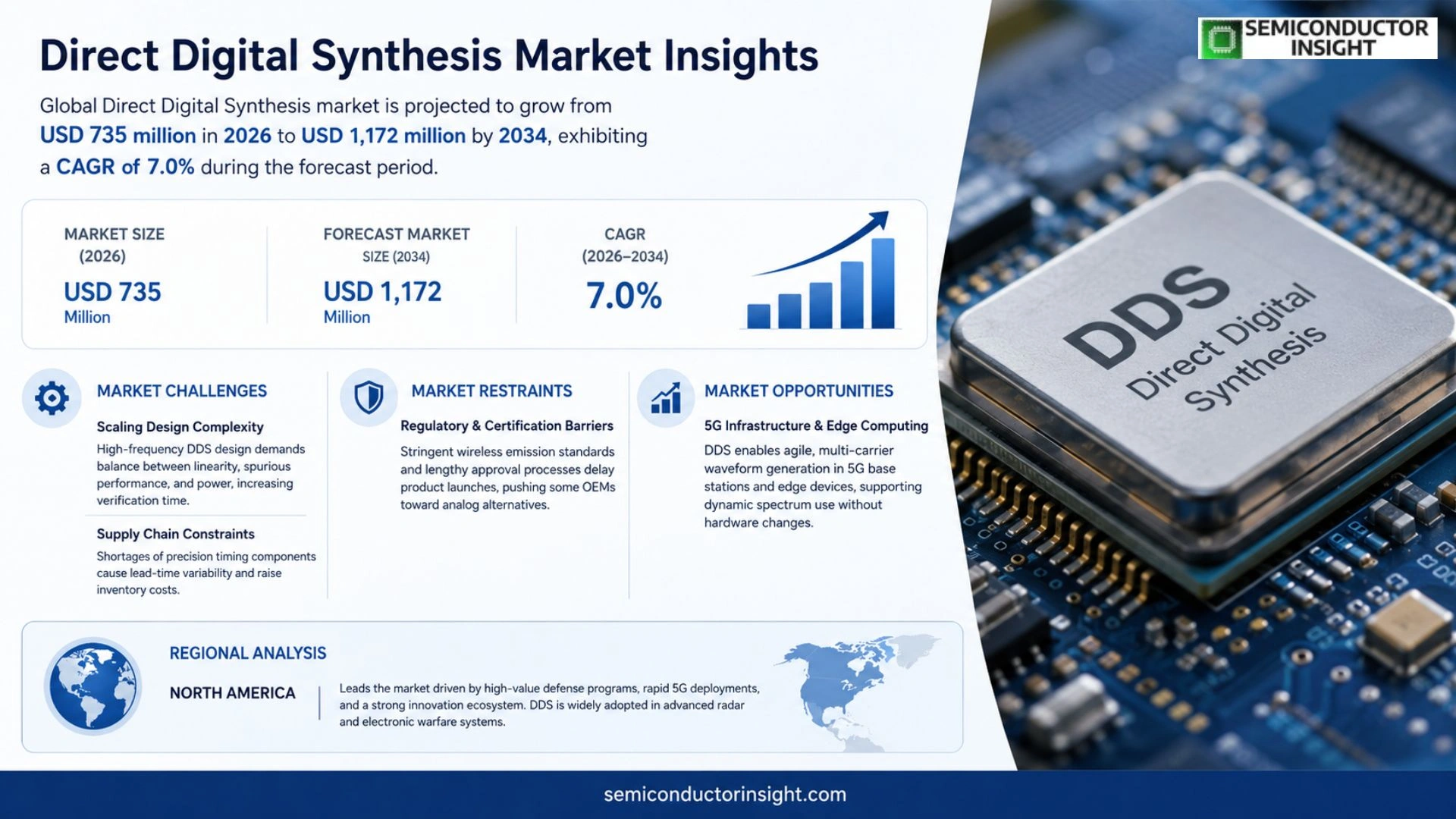
Global Direct Digital Synthesis market is projected to grow from USD 735 million in 2026 to USD 1,172 million by 2034, exhibiting a CAGR of 7.0% during the forecast period.
Direct Digital Synthesis products are a class of devices, IP cores, modules and instruments that use numerically controlled oscillation, phase accumulation, waveform lookup and digital‑to‑analog conversion to generate programmable signals in frequency, phase and amplitude directly in the digital domain. They address efficiency limitations of traditional signal sources by delivering fine frequency resolution, continuous phase continuity, rapid hopping and multi‑waveform output. As a result DDS appears not only in dedicated chips from Analog Devices, Renesas and Texas Instruments but also in Microchip’s CoreDDS IP and in function generators, arbitrary waveform generators and multichannel DDS systems from Fluke, B&K Precision, NF, RIGOL, UNI‑T, GW Instek, OWON, SIGLENT and Spectrum.
The market expands because electronics R&D laboratories, communications equipment vendors, semiconductor validation teams, research institutes and university teaching platforms increasingly require synchronized multi‑channel signal generation. Growth is reinforced by rising demand for high‑bandwidth RF testing, advanced experimental platforms and cost‑effective test instrumentation across North America, Europe and Asia. Key players such as Analog Devices Inc., Renesas Electronics Corp., Texas Instruments Inc., Microchip Technology Inc., B&K Precision Corp., Fluke Corp., Spectrum Instrumentation GmbH, NF Corporation, RIGOL TECHNOLOGIES CO., LTD., UNI‑TREND TECHNOLOGY (CHINA) CO., LTD., Fujian Lilliput Optoelectronics Technology Co., Ltd., Good Will Instrument Co., Ltd. and SIGLENT TECHNOLOGIES CO., LTD. are investing heavily in higher resolution (10‑16 bit) DDS solutions, IP licensing models and networked multichannel systems to capture premium value.
MARKET DRIVERS
Advancements in RF and Microwave Architecture
Direct Digital Synthesis Market benefits from the convergence of higher‑frequency RF front‑ends and tighter phase‑noise specifications. Designers are now able to replace legacy analog mixers with digitally controlled sources, shortening development cycles and reducing board space. This shift is especially pronounced in defense radars where accuracy translates directly into performance gains.
Cost‑Effective Volume Production
Modern semiconductor fabs have driven down the per‑unit cost of high‑speed DACs, enabling manufacturers to embed Direct Digital Synthesis (DDS) blocks into mass‑produced consumer chips. The resulting economies of scale are reshaping pricing models for telecom equipment, making DDS‑based solutions financially attractive even for mid‑range devices.
➤ “Adoption of DDS architectures has cut prototype lead times by up to 40 % across our product line,” remarks a senior engineer at a leading communications firm.
These forces collectively accelerate the diffusion of DDS technology, prompting OEMs to redesign product roadmaps around a digital synthesis core rather than a collection of discrete analog stages.
MARKET CHALLENGES
Scaling Design Complexity
As system frequencies climb toward millimeter‑wave bands, maintaining linearity and spurious‑free dynamic range in DDS chips becomes increasingly demanding. Engineers must balance high‑speed clock distribution with power‑budget constraints, a trade‑off that often prolongs verification phases.
Other Challenges
Supply Chain Constraints
Global shortages of high‑precision timing components introduce lead‑time variability, forcing manufacturers to hold larger inventories or seek alternative sources, both of which erode profit margins.
MARKET RESTRAINTS
Regulatory and Certification Barriers
Devices that incorporate DDS technology for wireless transmission must navigate a maze of regional emissions standards. The need to certify each new frequency band can delay product launches, especially in markets where approval processes are lengthy and costly. Consequently, some OEMs opt for proven analog alternatives to sidestep these procedural hurdles.
MARKET OPPORTUNITIES
5G Infrastructure and Edge Computing
The rollout of 5G networks and the growing demand for edge‑compute nodes create a fertile environment for DDS solutions that can generate agile, multi‑carrier waveforms on‑the‑fly. By embedding DDS engines directly into base‑station ASICs, operators gain the flexibility to re‑configure spectrum usage without hardware swaps, a capability that aligns with the dynamic nature of modern mobile traffic.
Direct Digital Synthesis Market Trends
Integration of DDS IP into System‑on‑Chip Platforms
The migration of Direct Digital Synthesis functionality from discrete chips to programmable IP cores embedded in system‑on‑chip (SoC) layouts is reshaping product roadmaps across communications, aerospace and test equipment manufacturers. By off‑loading waveform generation to silicon‑level blocks, designers eliminate external routing complexity, improve phase‑coherent performance, and shorten time‑to‑market. This shift also aligns with the growing need for on‑device calibration and remote software updates, allowing end‑users to re‑configure signal parameters without hardware changes. Consequently, the value proposition for suppliers moves from pure hardware sales to recurring licensing and support contracts, raising the strategic importance of software ecosystems within Direct Digital Synthesis Market.
Other Trends
Expansion of Multi‑Channel Test Instruments
Laboratories and validation teams are increasingly adopting multi‑channel DDS generators that synchronize dozens of outputs with sub‑nanosecond jitter. Vendors such as Spectrum, Fluke and RIGOL have introduced rack‑mountable platforms where each channel can be programmed independently yet remain phase‑locked, supporting sophisticated modulation schemes used in 5G and mmWave research. This trend reflects a dual pressure: the demand for higher bandwidth and the need for reproducible test conditions across multiple signal paths. As a result, the average selling price per instrument rises, and the aftermarket for firmware upgrades and channel‑expansion modules becomes a sizable revenue stream.
Geopolitical Influence on Supplier Landscape
Policy initiatives in the United States, Japan, the European Union and China are redefining competitive dynamics for Direct Digital Synthesis Market. Subsidies for domestic semiconductor design encourage U.S. and Japanese firms to deepen R&D on high‑performance DDS cores, while Chinese manufacturers leverage rapid product iteration to capture cost‑sensitive test‑equipment segments. German companies continue to dominate synchronized multi‑channel system integration, benefitting from a strong industrial base. These regional strengths translate into differentiated portfolios: premium precision devices, cost‑effective educational tools and highly configurable networked platforms. Companies that can navigate export controls, align with national investment programs and offer modular solutions are best positioned to secure long‑term contracts in research institutions and defense laboratories.
COMPETITIVE LANDSCAPE
Key Industry Players
Direct Digital Synthesis Market Competitive Overview
Analog Devices dominates the high‑performance DDS segment, leveraging its deep analog‑RF heritage to deliver chips that combine sub‑hertz frequency resolution with ultra‑low phase noise. The company’s portfolio, anchored by the AD9959 and AD9914 families, supplies OEMs in aerospace, defense, and telecom test equipment, reinforcing a tiered market where a handful of semiconductor leaders set the technical ceiling. Parallel to Analog Devices, Texas Instruments and Renesas maintain sizable shares by marrying DDS cores with integrated power‑management and mixed‑signal blocks, enabling board‑level validation customers to source complete solutions from a single supplier. This concentration at the silicon tier creates a clear hierarchy: a few global fabs drive innovation, while a broader set of midsize firms focus on licensing IP or assembling bench‑top instruments.
Beyond the silicon tier, a diverse array of instrument manufacturers occupies the downstream space. B&K Precision, Fluke, and NF Corporation address cost‑sensitive laboratory users with compact function generators that embed modest DDS cores. In contrast, Spectrum Instrumentation GmbH and RIGOL target advanced research labs by offering multi‑channel, network‑enabled platforms that exploit high‑resolution DDS engines for synchronized multi‑tone experiments. Chinese players such as UNI‑T, GW Instek, and SIGLENT have accelerated product cycles, undercutting incumbents on price while expanding feature sets, thereby pressuring mid‑range vendors to differentiate through software ecosystems and channel scalability. This nuanced ecosystem underscores the importance of both component differentiation and system‑level integration for sustaining market share.
List of Key Direct Digital Synthesis Companies Profiled
- Analog Devices, Inc.
- Texas Instruments Incorporated
- Renesas Electronics Corporation
- Microchip Technology Inc.
- B&K Precision Corporation
- Fluke Corporation
- Spectrum Instrumentation GmbH
- NF Corporation
- RIGOL TECHNOLOGIES CO., LTD.
- UNI‑TREND TECHNOLOGY (CHINA) CO., LTD.
- GW Instek
- SIGLENT TECHNOLOGIES CO., LTD.
- Fujian Lilliput Optoelectronics Technology Co., Ltd.
- Good Will Instrument Co., Ltd.
Segment Analysis:
| Segment Category | Sub-Segments | Key Insights |
| By Type |
|
Dedicated Chips
|
| By Application |
|
Communications & RF Development
|
| By End User |
|
Electronics R&D Laboratories
|
| By Delivery Form |
|
Standard IC Sales
|
| By Technology Trend |
|
High‑Resolution Waveform Generation
|
Regional Analysis: Direct Digital Synthesis Market
North America
Department of Defense spend plans prioritize wave‑form agility, making DDS the preferred choice for radar and electronic‑countermeasure modules. Suppliers are responding with hardened, radiation‑tolerant DDS chips that meet stringent military standards, accelerating adoption across new platform prototypes.
Carrier upgrades to carrier‑aggregation and massive MIMO rely on precise test signals. DDS generators, with their rapid frequency hopping, enable field engineers to validate spectrum efficiency without extensive hardware swaps, shortening deployment cycles for urban 5G nodes.
Leading universities host joint labs with chip makers, exploring ultra‑low‑power DDS designs for wearable health monitors. These collaborations generate intellectual property that quickly migrates to commercial prototyping platforms.
Recent amendments to FCC equipment authorization streamline testing procedures for software‑defined radios, indirectly reducing compliance costs for DDS‑based signal generators used in both consumer and industrial settings.
Europe
European manufacturers are leveraging the region’s strong standards framework to position DDS as the backbone of next‑generation satellite communications. National space agencies fund joint ventures that integrate DDS modules into phased‑array antennas, emphasizing spectral purity for deep‑space telemetry. Additionally, the automotive sector’s push toward advanced driver‑assistance systems fuels demand for compact, low‑latency signal generators, prompting several EU‑based firms to launch modular DDS kits tailored for automotive test benches.
Asia‑Pacific
In Asia‑Pacific, rapid urbanization and government‑sponsored smart‑city initiatives create fertile ground for DDS adoption in high‑frequency radar and IoT gateways. Chinese semiconductor startups are scaling production of integrated DDS solutions, capitalizing on cost‑sensitive consumer electronics markets. Meanwhile, Japanese firms focus on high‑performance DDS for industrial robotics, where deterministic timing is critical for precision assembly lines.
South America
South American economies are channeling investment into renewable‑energy monitoring, where DDS‑driven signal analyzers improve grid stability diagnostics. Brazilian telecom operators, expanding fiber‑to‑the‑home projects, require versatile test equipment to validate spectrum allocation, encouraging local distributors to stock DDS‑based instruments that combine flexibility with modest price points.
Middle East & Africa
The Middle East’s burgeoning defense modernization programs are integrating DDS into next‑generation missile guidance units, attracted by the technology’s resilience to jamming. In Africa, pilot projects for remote health diagnostics employ DDS‑enabled ultrasound devices, showcasing the technology’s adaptability to low‑resource environments while stimulating modest demand for ruggedized signal generators.
Report Scope
This market research report provides a comprehensive analysis of the Direct Digital Synthesis Market , covering the forecast period 2026–2034. It offers detailed insights into market dynamics, technological advancements, competitive landscape, and key trends shaping the industry.
Key focus areas of the report include:
- Market Overview: The report begins with an overview outlining its current market scenario, key growth indicators, and industry transformation drivers. It discusses macroeconomic factors, demand–supply balance, regulatory landscape, and the strategic role of semiconductors in powering advancements across industries such as automotive, telecommunications, consumer electronics, and industrial automation.
- Market Size & Forecast: Historical data and future projections for revenue, unit shipments, and market value across major regions and segments.
- Segmentation Analysis: Detailed breakdown by product type, technology, application, and end-user industry to identify high-growth segments and investment opportunities.
- Regional Insights: Insights into market performance across North America, Europe, Asia-Pacific, Latin America, and the Middle East & Africa, including country-level analysis where relevant.
- Competitive Landscape: Profiles of leading market participants, including their product offerings, R&D focus, manufacturing capacity, pricing strategies, and recent developments such as mergers, acquisitions, and partnerships.
- Technology Trends & Innovation: Assessment of emerging technologies, integration of AI/IoT, semiconductor design trends, fabrication techniques, and evolving industry standards.
- Market Drivers & Restraints: Evaluation of factors driving market growth along with challenges, supply chain constraints, regulatory issues, and market-entry barriers.
- Stakeholder Insights: Insights for component suppliers, OEMs, system integrators, investors, and policymakers regarding the evolving ecosystem and strategic opportunities.
Primary and secondary research methods are employed, including interviews with industry experts, data from verified sources, and real-time market intelligence to ensure the accuracy and reliability of the insights presented.
FREQUENTLY ASKED QUESTIONS:
What is the current market size of Direct Digital Synthesis Market?
-> Direct Digital Synthesis market is projected to grow USD 1,172 million by 2034, exhibiting a CAGR of 7.0% during the forecast period.
Which key companies operate in Direct Digital Synthesis Market?
-> Key players include Analog Devices, Inc., Renesas Electronics Corporation, Texas Instruments Incorporated, Microchip Technology Inc., B&K Precision Corporation, Fluke Corporation, Spectrum Instrumentation GmbH, NF Corporation, RIGOL TECHNOLOGIES CO., LTD., UNI‑TREND TECHNOLOGY (CHINA) CO., LTD., GW Instek, OWON, SIGLENT TECHNOLOGIES CO., LTD.
What are the key growth drivers?
-> Key growth drivers include increasing demand for high‑precision frequency synthesis, expanding semiconductor R&D activities, growth in communications and RF testing, rising adoption of programmable multi‑channel signal generation, and domestic substitution initiatives in major economies.
Which region dominates the market?
-> Asia‑Pacific is the fastest‑growing region, driven by strong demand in China, Japan, and South Korea, while North America remains the largest revenue contributor.
What are the emerging trends?
-> Emerging trends include integration of DDS IP cores into FPGA/ASIC platforms, development of direct‑RF DDS solutions, multi‑tone and quadrature generation for 5G/6G testing, and cloud‑enabled networked DDS instrumentation.
Get Sample Report PDF for Exclusive Insights
Report Sample Includes
- Table of Contents
- List of Tables & Figures
- Charts, Research Methodology, and more...
 Download Sample Report PDF