
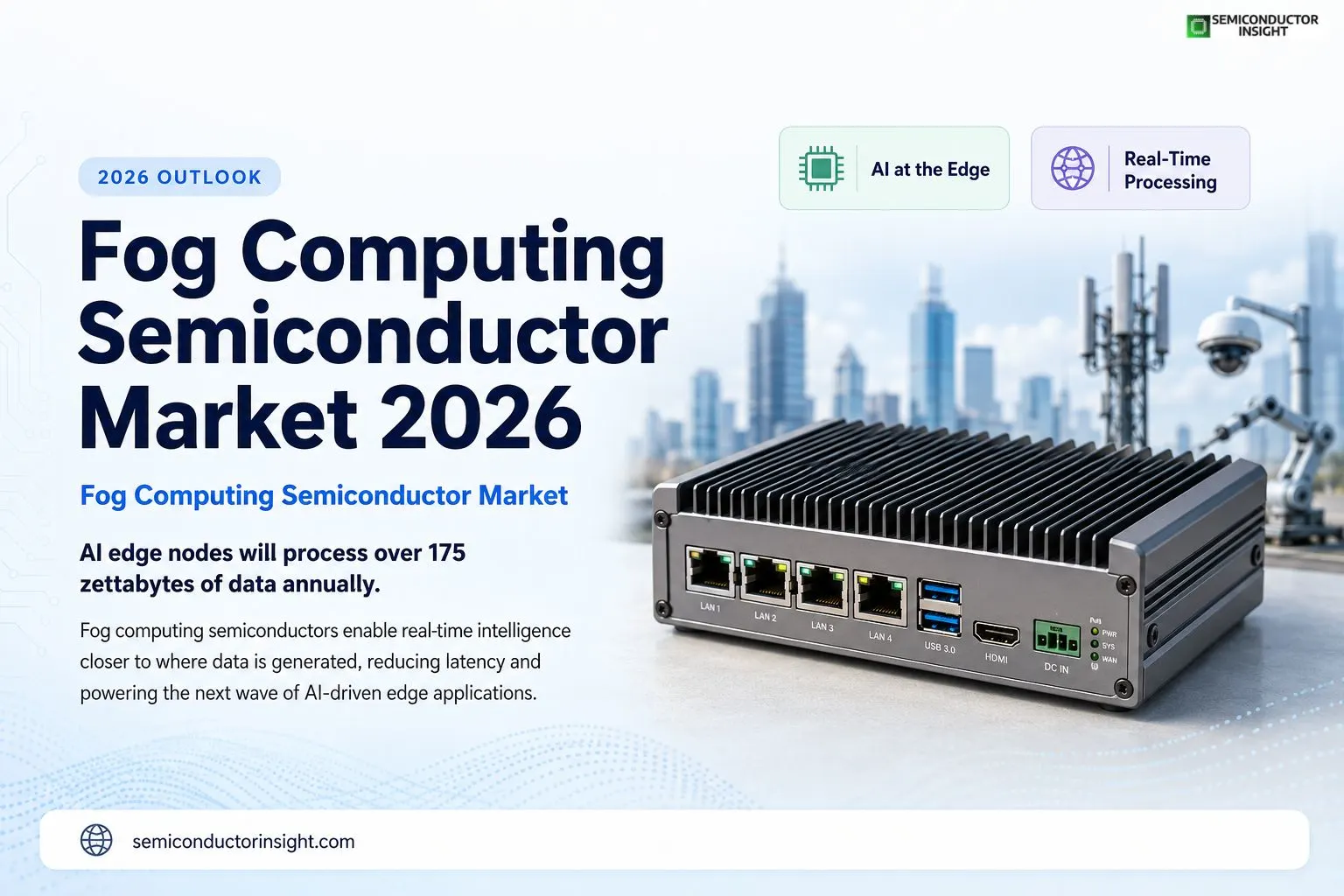
Fog Computing Semiconductor Market 2026 Featuring AI Edge Nodes Processing Over 175 Zettabytes of Data Annually
The semiconductor industry is entering a new computing phase where processing power is no longer concentrated only inside hyperscale cloud facilities. Fog computing semiconductors are increasingly being deployed between centralized cloud systems and endpoint devices, enabling real-time processing closer to where data is generated. This architectural shift is becoming essential as billions of connected sensors, industrial machines, autonomous systems, and AI-enabled devices continuously generate massive data volumes that cannot always be transmitted efficiently to distant cloud environments.
- Fog computing differs from traditional cloud processing because it distributes computational workloads across localized edge nodes, micro data centres, routers, industrial gateways, and embedded AI systems.
- Semiconductor companies are now designing specialized processors, low-power AI accelerators, networking chips, and edge-focused system-on-chip (SoC) platforms specifically optimized for decentralized computing environments.
- These semiconductors support low-latency decision-making in environments where milliseconds matter, including autonomous mobility, industrial robotics, smart energy grids, healthcare monitoring systems, and defence electronics.
The rise of fog computing has become particularly relevant as global internet traffic and connected device deployment continue to accelerate. According to Cisco’s networking projections and multiple infrastructure studies, connected IoT devices are expected to surpass 29 billion globally within the next few years, generating unprecedented real-time data loads. Traditional centralized cloud models alone are increasingly insufficient for handling this scale of distributed intelligence efficiently.
AI Inference at the Edge Is Redefining Chip Design Priorities
- One of the strongest forces reshaping the fog computing semiconductor landscape is the growing demand for edge AI inference.
- Edge AI requires small, energy-efficient semiconductors that can compute machine learning models locally with low latency, in contrast to cloud AI training systems that run inside enormous GPU clusters.
- Neural processing units (NPUs), AI accelerators, embedded GPUs, and heterogeneous computing architectures tailored for localised inference tasks have all benefited greatly from this.
- Companies such as NVIDIA, Qualcomm, Intel, AMD, and MediaTek are aggressively expanding edge AI semiconductor portfolios targeting industrial automation, automotive intelligence, video analytics, and smart surveillance
- NVIDIA’s Jetson platform, for example, is increasingly used in robotics and industrial edge computing systems requiring autonomous decision-making capabilities without constant cloud connectivity. Qualcomm has also expanded AI-enabled processors supporting intelligent cameras, connected vehicles, and industrial IoT gateways operating in decentralized environments.
- Recent deployments in manufacturing facilities highlight how fog computing semiconductors are transforming operational workflows. Smart factories equipped with AI-enabled machine vision systems can now identify product defects in real time directly on factory floors using localized processing hardware. This reduces bandwidth dependency while enabling faster operational responses compared with traditional cloud-only inspection systems.
Our most recent updated related study is available for free at this link: https://semiconductorinsight.com/report/fog-computing-semiconductor-market/
Telecom Infrastructure Is Becoming a Major Semiconductor Consumption Hub
The rapid expansion of 5G infrastructure is creating another major growth channel for fog computing semiconductors. Telecom operators increasingly rely on distributed edge architectures to reduce latency for high-bandwidth applications including immersive gaming, augmented reality, autonomous transportation systems, and industrial connectivity networks. This evolution is driving demand for programmable networking chips, data processing units (DPUs), field-programmable gate arrays (FPGAs), and edge server processors integrated within telecom infrastructure.
Telecommunications providers across the United States, Europe, South Korea, China, and Japan are deploying multi-access edge computing (MEC) systems that position localized processing resources closer to end users. Ericsson and Nokia have both expanded collaborations involving edge computing hardware optimized for real-time industrial and enterprise connectivity. Semiconductor vendors supporting telecom-grade fog infrastructure are increasingly prioritizing thermal efficiency, workload balancing, and AI-assisted network optimization capabilities.
Data volumes moving through these systems continue rising rapidly. According to global internet traffic estimates published by networking organizations and infrastructure analysts, annual global IP traffic surpassed several zettabytes in recent years, creating substantial pressure for distributed computing strategies capable of reducing centralized cloud congestion.
Automotive Intelligence Is Expanding Fog Semiconductor Adoption
- Connected vehicles and autonomous driving systems are becoming some of the most semiconductor-intensive fog computing environments globally.
- Modern vehicles now integrate dozens of sensors, LiDAR modules, radar systems, AI-assisted cameras, and real-time navigation platforms that generate enormous processing requirements directly inside the vehicle ecosystem.
- Fog computing semiconductors allow vehicles to process critical information locally rather than relying entirely on cloud-based instructions.
- Automotive semiconductor developers are designing edge processors capable of supporting advanced driver-assistance systems (ADAS), predictive maintenance analytics, and vehicle-to-everything (V2X) communication frameworks simultaneously.
- Tesla, Mercedes-Benz, Hyundai, and several autonomous mobility startups continue expanding onboard AI computing capabilities that require high-performance localized semiconductor processing.
- Recent smart transportation pilot projects in cities across Asia, Europe, and North America also demonstrate how roadside edge infrastructure supports traffic optimization, connected mobility management, and pedestrian safety systems.
- These deployments increasingly rely on fog computing architectures where semiconductors process large volumes of localized traffic and sensor data in near real time.
Semiconductor Packaging Innovation Is Quietly Supporting Fog Expansion
While processors and AI accelerators receive most public attention, advanced semiconductor packaging technologies are becoming equally important for fog computing infrastructure. Edge environments often require compact, thermally efficient, and ruggedized semiconductor designs capable of operating under demanding industrial conditions. This is accelerating investment in chiplet architectures, 3D packaging, heterogeneous integration, and low-power packaging technologies.
Advanced packaging allows semiconductor manufacturers to integrate CPUs, GPUs, AI accelerators, memory modules, and connectivity components into smaller and more efficient edge systems. TSMC, Samsung, and ASE Technology are all expanding advanced packaging initiatives supporting high-density edge computing workloads.
The increasing complexity of distributed AI infrastructure is also driving demand for semiconductors capable of balancing computational performance with energy efficiency. As governments, enterprises, and telecom operators continue scaling decentralized digital infrastructure globally, fog computing semiconductors are becoming foundational components enabling real-time intelligence beyond the traditional cloud.

Comments (0)