Fog Computing Semiconductor Market Insights
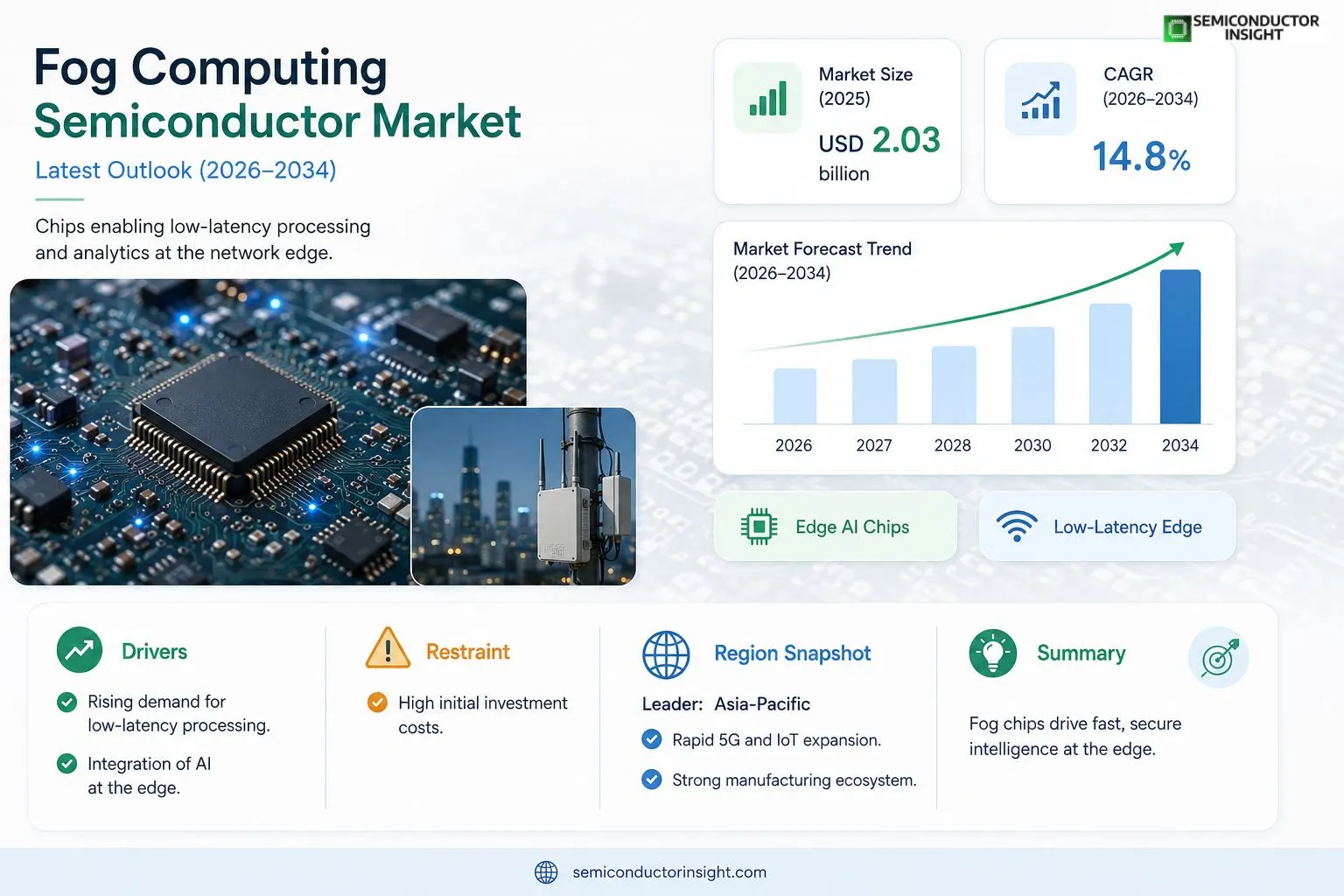
Global Fog Computing Semiconductor market size was valued at USD 2.03 billion in 2025. The market is projected to grow from USD 2.10 billion in 2026 to USD 7.12 billion by 2034, exhibiting a CAGR of 14.8% during the forecast period.
Fog Computing Semiconductors are purpose‑built integrated circuits that enable low‑latency data processing, analytics, and security at the network edge rather than in centralized cloud data centers.These chips combine micro‑controller units, AI accelerators, and networking interfaces to support distributed workloads such as real‑time video analytics, autonomous vehicle control, and industrial IoT monitoring.Because they reduce bandwidth consumption and improve response times, they are increasingly adopted in smart‑city infrastructure, manufacturing automation, and telecom edge nodes.Furthermore, advances in heterogeneous integration and power‑efficient architectures are driving cost reductions, making fog‑enabled devices more accessible across mid‑market segments.
MARKET DRIVERS
Rising Demand for Low‑Latency Processing
Fog Computing Semiconductor Market is gaining momentum as enterprises seek to reduce latency for real‑time analytics. By placing compute resources closer to data sources, fog nodes alleviate the bandwidth pressure on central clouds, enabling faster decision‑making in manufacturing, autonomous vehicles, and smart‑city applications.
Integration of AI at the Edge
Edge‑AI workloads require specialized semiconductor solutions that can handle inference tasks with low power consumption. The convergence of AI accelerators and fog architectures is driving chip designers to embed neural‑processing units, which in turn expands the addressable market for fog‑based semiconductor products.
➤ The adoption of 5G is expected to double the number of fog nodes deployed worldwide by 2028, creating a surge in demand for high‑performance, low‑power chips.
Investors are also recognizing the strategic value of fog‑enabled semiconductor platforms, as they provide a scalable pathway for legacy devices to migrate toward next‑generation edge intelligence.
MARKET CHALLENGES
Scalability and Interoperability
One of the primary challenges in Fog Computing Semiconductor Market is ensuring that diverse hardware can operate seamlessly across heterogeneous edge environments. Standards are still evolving, and manufacturers must invest in firmware that supports multiple protocols, which can increase development costs.
Other Challenges
Supply Chain Constraints
Global semiconductor shortages have placed pressure on component availability, leading to longer lead times for fog‑specific chips. This constraint hampers rapid deployment of fog nodes in emerging markets.
MARKET RESTRAINTS
High Initial Investment Costs
Deploying fog infrastructure requires upfront capital for specialized semiconductor hardware, edge gateways, and management software. For small and medium‑size enterprises, the cost barrier can delay adoption despite long‑term operational savings.Furthermore, the rapid evolution of chip technologies means that early adopters risk obsolescence, prompting cautious investment strategies that restrain market expansion.
MARKET OPPORTUNITIES
Growth in Industrial IoT Deployments
The expansion of Industry 4.0 initiatives creates a fertile landscape for fog‑centric semiconductor solutions. Manufacturers are deploying dense sensor networks that generate terabytes of data daily, necessitating on‑site processing to maintain production efficiency.Additionally, the rollout of smart‑grid and renewable‑energy systems offers new avenues for fog chips to manage distributed energy resources, positioning Fog Computing Semiconductor Market for sustained growth over the next decade.
Fog Computing Semiconductor Market Trends
Edge AI Integration Accelerates Adoption
Fog Computing Semiconductor Market is being reshaped by the convergence of AI acceleration and edge processing within a single chip package. Manufacturers are embedding neural‑network processors alongside traditional micro‑controller units, creating a unified platform that can perform inference on sensor streams without routing data to a central cloud. This architecture delivers sub‑millisecond response times for safety‑critical workloads such as autonomous vehicle guidance, real‑time video analytics in smart‑city surveillance, and predictive maintenance in industrial plants. By eliminating the round‑trip latency inherent in cloud‑centric designs, these semiconductor solutions also reduce bandwidth consumption, lower operational expenditures, and improve data privacy,a combination that is driving rapid adoption across telecom edge nodes and distributed enterprise environments.
Other Trends
Heterogeneous Integration Reduces Power Consumption
Advances in heterogeneous integration are allowing designers to co‑locate analog front‑ends, digital signal processors, AI accelerators, and high‑speed networking interfaces on a single silicon die or advanced package. This multi‑die stacking reduces interconnect length, minimizes parasitic losses, and enables power‑efficient operation that is essential for battery‑powered edge devices. The resulting chips can sustain continuous inference workloads while drawing only a few milliwatts, making them suitable for large‑scale deployments in smart‑city lighting, environmental monitoring stations, and low‑power industrial controllers. Moreover, the ability to customize functional blocks within a single package accelerates time‑to‑market for niche applications, fostering greater differentiation among OEMs.
Cost‑Effective Fabrication Expands Market Reach
Cost reductions achieved through the adoption of mature process nodes,such as 28 nm and 22 nm CMOS,are lowering the bill‑of‑materials for fog‑enabled semiconductor solutions. These nodes provide a balance between performance, power efficiency, and manufacturing yield, enabling high‑volume production at competitive pricing. As fab capacity for these processes remains abundant, suppliers can meet growing demand without incurring the premium expenses associated with leading‑edge nodes. This cost advantage is encouraging broader implementation of fog chips in mid‑market sectors, including manufacturing automation lines, edge data‑center gateways, and distributed retail analytics platforms. The combined effect of lower unit costs and enhanced functionality is expanding the addressable market, reinforcing the upward trajectory of the Fog Computing Semiconductor ecosystem.
COMPETITIVE LANDSCAPEKey Industry Players
Fog Computing Semiconductor Market – Competitive Landscape Overview
Fog Computing Semiconductor Market is dominated by a handful of large integrated‑circuit manufacturers that leverage deep R&D budgets and extensive edge‑device ecosystems. Intel and Qualcomm lead the space, offering heterogeneous processor families that combine micro‑controller cores, AI inference engines, and high‑speed networking blocks optimized for low‑latency workloads. Their platforms are embedded in smart‑city gateways, autonomous‑vehicle edge nodes, and telecom‑edge infrastructure, giving them a decisive share of the projected $7.1 billion market by 2034. These incumbents benefit from established supply chains, robust software toolkits, and strategic alliances with cloud providers, which reinforce a relatively consolidated top‑tier structure. Moreover, both firms are investing heavily in heterogeneous integration and power‑efficient architectures, accelerating time‑to‑market for 5G‑enabled fog nodes and expanding addressable segments such as industrial automation, connected health, and retail analytics.Beyond the marquee players, a vibrant set of niche innovators is expanding the competitive fabric. Companies such as NXP Semiconductors, MediaTek, Samsung Electronics, and Renesas Electronics focus on power‑efficient MCU‑AI hybrids for industrial IoT and consumer‑edge devices. Smaller but highly specialized firms,STMicroelectronics, Texas Instruments, Ambarella, Himax, and Analog Devices,deliver custom silicon for video analytics, sensor fusion, and 5G‑edge acceleration. Emerging entrants like Xilinx (now part of AMD), Broadcom, Marvell Technology, and Sony Semiconductor Solutions add differentiated FPGA, networking, and image‑signal‑processor capabilities, enabling system‑integrators to tailor fog‑node performance to niche verticals. These companies differentiate through vertical‑specific IP libraries, aggressive pricing, and partnerships with edge‑platform providers, allowing rapid deployment in regional markets across North America, Europe, and Asia‑Pacific.
List of Key Fog Computing Semiconductor Companies Profiled
- Intel Corporation
- Qualcomm Inc.
- Samsung Electronics
- NXP Semiconductors
- MediaTek Inc.
- Renesas Electronics
- STMicroelectronics
- Texas Instruments
- Ambarella Inc.
- Himax Technologies
- Analog Devices
- Xilinx (AMD)
- Broadcom Inc.
- Marvell Technology Group
- Sony Semiconductor Solutions
Segment Analysis:
| Segment Category | Sub-Segments | Key Insights |
| By Type |
|
Edge AI Processors
|
| By Application |
|
Industrial Automation
|
| By End User |
|
Telecommunications Providers
|
| By Architecture |
|
Heterogeneous Multi‑Core
|
| By Connectivity |
|
5G Edge Nodes
|
Regional Analysis: North America
North America
The industrial sector is a major driver for fog computing semiconductor adoption in North America. Real-time monitoring, predictive maintenance, and automation initiatives are creating a need for edge-based processing of sensor data, enhancing operational efficiency and reducing downtime.
The automotive industry in North America is at the forefront of integrating fog computing with semiconductor technology. Autonomous driving capabilities, advanced driver-assistance systems (ADAS), and connected car services rely heavily on real-time data processing at the edge, driving demand for specialized chips.
North American cities are increasingly deploying fog computing platforms to manage urban infrastructure, including traffic control, energy grids, and public safety systems. This requires robust semiconductor solutions for data acquisition, processing, and communication.
The healthcare sector in North America is leveraging fog computing and semiconductor technology for remote patient monitoring, telemedicine, and connected medical devices. This enables real-time analysis of patient data, improving healthcare outcomes and reducing costs.
Europe
Europe is witnessing a steady growth in Fog Computing Semiconductor Market, driven by stringent data privacy regulations and a focus on industrial automation. The region’s strong emphasis on cybersecurity and data sovereignty is influencing the development of edge computing solutions. While adoption rates may be slightly lower than in North America, the European market presents a significant opportunity for specialized semiconductor providers catering to specific industry needs.
Asia-Pacific
Asia-Pacific is poised for exponential growth in Fog Computing Semiconductor Market. The region’s rapid industrialization, increasing adoption of IoT devices, and supportive government policies are creating a favorable environment for market expansion. China, in particular, is emerging as a major hub for fog computing and semiconductor manufacturing, while other countries in the region are investing heavily in smart city initiatives and industrial automation.
South America
South America presents a developing market for fog computing semiconductors, with increasing adoption in agriculture, logistics, and energy sectors. The region’s growing focus on infrastructure development and digital transformation is driving demand for edge computing solutions that can address local challenges.
Middle East & Africa
The Middle East & Africa region is an emerging market for fog computing semiconductors, with opportunities in smart infrastructure, oil & gas, and transportation. The region’s ambitious smart city projects and increasing investments in digital technologies are expected to fuel market growth in the coming years.
Report Scope
This market research report provides a comprehensive analysis of the Fog Computing Semiconductor Market , covering the forecast period 2026–2034. It offers detailed insights into market dynamics, technological advancements, competitive landscape, and key trends shaping the industry.
Key focus areas of the report include:
- Market Overview: The report begins with an overview outlining its current market scenario, key growth indicators, and industry transformation drivers. It discusses macroeconomic factors, demand–supply balance, regulatory landscape, and the strategic role of semiconductors in powering advancements across industries such as automotive, telecommunications, consumer electronics, and industrial automation.
- Market Size & Forecast: Historical data and future projections for revenue, unit shipments, and market value across major regions and segments.
- Segmentation Analysis: Detailed breakdown by product type, technology, application, and end-user industry to identify high-growth segments and investment opportunities.
- Regional Insights: Insights into market performance across North America, Europe, Asia-Pacific, Latin America, and the Middle East & Africa, including country-level analysis where relevant.
- Competitive Landscape: Profiles of leading market participants, including their product offerings, R&D focus, manufacturing capacity, pricing strategies, and recent developments such as mergers, acquisitions, and partnerships.
- Technology Trends & Innovation: Assessment of emerging technologies, integration of AI/IoT, semiconductor design trends, fabrication techniques, and evolving industry standards.
- Market Drivers & Restraints: Evaluation of factors driving market growth along with challenges, supply chain constraints, regulatory issues, and market-entry barriers.
- Stakeholder Insights: Insights for component suppliers, OEMs, system integrators, investors, and policymakers regarding the evolving ecosystem and strategic opportunities.
Primary and secondary research methods are employed, including interviews with industry experts, data from verified sources, and real-time market intelligence to ensure the accuracy and reliability of the insights presented.
FREQUENTLY ASKED QUESTIONS:
What is the current market size of Fog Computing Semiconductor Market?
-> Global Fog Computing Semiconductor Market was valued at USD 2.03 billion in 2025 and is expected to reach USD 7.12 billion by 2034, exhibiting a CAGR of 14.8% during the forecast period.
Which key companies operate in Fog Computing Semiconductor Market?
-> Key players include Qualcomm Technologies, Intel Corporation, NVIDIA Corporation, MediaTek Inc., and Samsung Electronics, among others.
What are the key growth drivers?
-> Key growth drivers include rising demand for low‑latency edge processing, expansion of AI‑enabled IoT applications, bandwidth‑reduction requirements, and advances in heterogeneous integration and power‑efficient architectures.
Which region dominates the market?
-> Asia‑Pacific is emerging as the largest region due to aggressive 5G deployments and strong manufacturing ecosystems, while North America remains a significant contributor.
What are the emerging trends?
-> Emerging trends include integration of AI accelerators within fog chips, development of system‑in‑package (SiP) solutions, and the push toward ultra‑low‑power edge processors for industrial IoT and smart‑city deployments.
Get Sample Report PDF for Exclusive Insights
Report Sample Includes
- Table of Contents
- List of Tables & Figures
- Charts, Research Methodology, and more...
 Download Sample Report PDF