AI Surveillance Semiconductor Market Insights
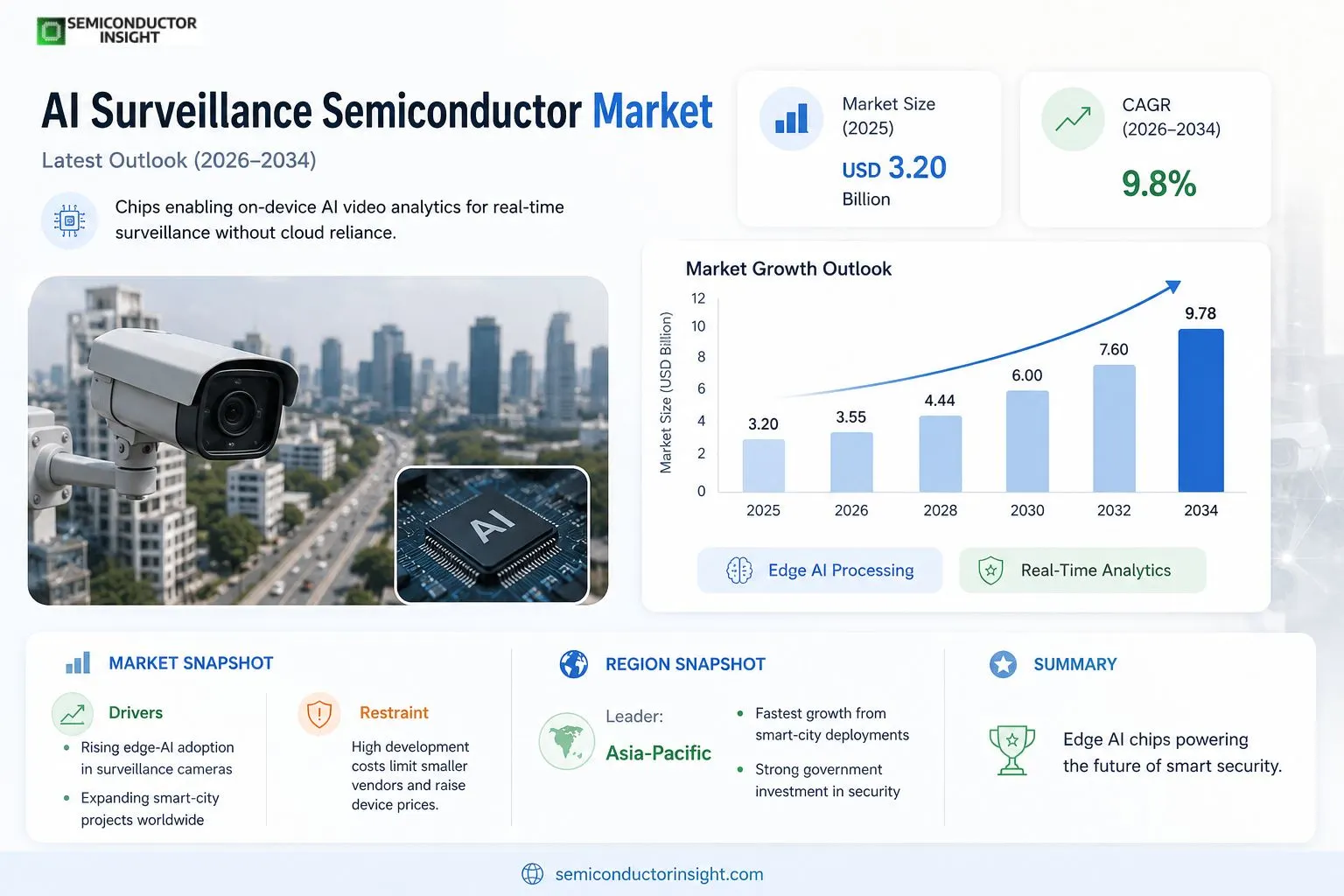
Global AI surveillance semiconductor market size was valued at USD 3.20 billion in 2025. The market is projected to grow from USD 3.55 billion in 2026 to USD 9.78 billion by 2034, exhibiting a CAGR of 9.8% during the forecast period.
AI surveillance semiconductors are specialized integrated circuits designed to process video streams and execute deep‑learning algorithms directly on edge devices such as security cameras and smart sensors. These chips combine image signal processing, neural‑network acceleration, and low‑power consumption features to enable real‑time object detection, facial recognition, and behavior analytics without reliance on cloud resources.The market is accelerating because of expanding smart city initiatives, heightened demand for contactless security solutions post‑COVID‑19, and continuous cost reductions in silicon fabrication. Furthermore, strategic partnerships,e.g., NVIDIA’s collaboration with Hikvision announced in March 2024,and the rollout of next‑generation vision processors by Ambarella are fueling adoption across public safety and private enterprise sectors.
MARKET DRIVERS
Rising Adoption of Edge‑AI Capabilities
AI Surveillance Semiconductor Market is being propelled by the shift toward edge‑AI processing, which reduces latency and bandwidth requirements for video analytics. Chip manufacturers are integrating dedicated neural processing units (NPUs) that enable real‑time object detection directly within cameras.
Expanding Smart‑City Initiatives
Municipalities worldwide are investing in smart‑city platforms that rely on high‑resolution surveillance streams. This drives demand for semiconductors that can handle 4K and higher resolutions while supporting advanced analytics such as facial recognition and behavior prediction.
➤ “Edge‑optimized AI chips are expected to capture over 60% of new surveillance deployments by 2028.”
In addition, the convergence of 5G connectivity with AI‑enabled sensors creates a virtuous cycle, encouraging OEMs to embed more powerful semiconductor solutions in next‑generation cameras.
MARKET CHALLENGES
Data Privacy Regulations
Stringent privacy laws in North America and Europe impose limits on the collection and processing of biometric data, requiring manufacturers to implement on‑device encryption and anonymization, which can increase design complexity and cost.
Other Challenges
Supply‑Chain Volatility
The semiconductor industry continues to face material shortages and geopolitical tensions, leading to lead‑time extensions that affect the rollout of AI‑driven surveillance solutions.
MARKET RESTRAINTS
High Development Costs
Designing AI‑centric chips requires extensive R&D investment, especially for low‑power architectures suitable for edge deployment. Smaller vendors often lack the capital to compete with established players, limiting market diversification.Moreover, integration of advanced security features such as trusted execution environments adds to bill‑of‑materials costs, which can deter price‑sensitive customers in emerging markets.
MARKET OPPORTUNITIES
Growth of AI‑Powered Cloud Analytics
While edge processing dominates, there is a parallel surge in cloud‑based analytics platforms that require high‑throughput data ingestion from distributed cameras. This creates a niche for semiconductors optimized for low‑latency data compression and secure transmission.Emerging applications such as autonomous retail monitoring and AI‑enhanced traffic management present untapped revenue streams, encouraging chip makers to develop customizable AI cores that can be re‑programmed for specific use cases.Strategic partnerships between semiconductor firms and software vendors are also accelerating time‑to‑market, allowing AI Surveillance Semiconductor Market to capitalize on cross‑industry innovation.
AI Surveillance Semiconductor Market Trends
Growth Driven by Smart City Deployments
AI Surveillance Semiconductor Market is experiencing rapid expansion as municipal smart‑city programs prioritize on‑site video analytics. Valued at roughly USD 3.20 billion in 2025, the market is projected to rise to USD 3.55 billion in 2026 and reach near USD 9.78 billion by 2034. This trajectory reflects strong investment in edge‑AI chips that can decode high‑resolution streams without reliance on cloud infrastructure. The convergence of lower silicon costs, heightened demand for contactless security following the COVID‑19 pandemic, and regulatory incentives for public‑safety technology are compressing adoption cycles. As a result, manufacturers are scaling production of low‑power vision processors that support real‑time object detection, facial recognition, and behavior analytics directly within cameras. These dynamics position AI Surveillance Semiconductor Market as a cornerstone for next‑generation security ecosystems across both public and private sectors.
Other Trends
Edge Processing Advances
Edge processing advances represent a pivotal sub‑trend within the sector. Modern chips integrate image signal processing, neural‑network acceleration, and power‑management circuits on a single die, enabling instantaneous analysis of video feeds. By eliminating the need for continuous data transmission to centralized servers, these solutions reduce latency, bandwidth consumption, and cyber‑risk exposure. Recent silicon generations achieve inference speeds under 10 ms while maintaining power draws below 500 mW, making them suitable for battery‑operated street‑light cameras and compact indoor sensors. The resulting capability to execute sophisticated analytics at the edge drives broader deployment in railway monitoring, parking management, and retail loss‑prevention applications.
Strategic Partnerships Accelerate Adoption
Strategic partnerships are accelerating adoption across AI Surveillance Semiconductor Market. In March 2024, NVIDIA announced a joint development program with Hikvision to embed its tensor‑core accelerators into the Chinese camera maker’s next‑generation platforms, promising a 2‑fold improvement in detection accuracy. Simultaneously, Ambarella has introduced a new family of vision processors that combine 8‑core CPU cores with dedicated deep‑learning engines, targeting autonomous‑vehicle perception and smart‑city surveillance. These collaborations not only shorten time‑to‑market for advanced features but also create standardized software stacks that simplify integration for system integrators. As enterprises seek turnkey, secure, and scalable video‑analytics solutions, the momentum generated by such alliances is expected to sustain the market’s robust growth through the next decade.
COMPETITIVE LANDSCAPEKey Industry Players
AI Surveillance Semiconductor Market Competitive Overview
AI Surveillance Semiconductor Market is currently anchored by a handful of large‑scale integrated circuit designers that provide end‑to‑end vision processors for edge cameras. NVIDIA, leveraging its GPU‑accelerated AI platform, leads the high‑performance segment through strategic collaborations such as the March 2024 partnership with Hikvision, enabling real‑time object detection on smart cameras. Ambarella follows closely, supplying ultra‑low‑power vision SoCs that power next‑generation security solutions in smart‑city deployments. Intel and Qualcomm round out the top tier by offering heterogeneous computing architectures that combine image signal processing with dedicated neural‑network accelerators, allowing OEMs to embed sophisticated facial‑recognition capabilities without cloud dependence. These companies dominate the market’s revenue share, benefit from deep fab relationships, and drive the overall CAGR of roughly 9.8 % projected through 2034.Beyond the marquee players, a diverse set of niche firms contributes specialized functionality that sustains innovation across verticals. Himax and ON Semiconductor focus on sensor‑level AI integration, delivering compact chips for low‑cost IP cameras. Horizon Robotics and SenseTime emphasize AI‑first chip designs for intelligent analytics, targeting edge‑AI workloads in retail and transportation. MediaTek, Samsung Electronics, and Sony provide multi‑media SoCs that incorporate AI vision blocks, catering to consumer‑grade surveillance devices. STMicroelectronics, Texas Instruments, Broadcom, and Graphcore supply ancillary components,such as power‑management ICs, high‑speed interconnects, and advanced tensor processors,that enable system‑level optimization for emerging use‑cases like contactless security and pandemic‑driven monitoring.
List of Key AI Surveillance Semiconductor Companies Profiled
- NVIDIA
- Ambarella
- Intel
- Qualcomm
- MediaTek
- Samsung Electronics
- Himax
- ON Semiconductor
- Horizon Robotics
- SenseTime
- STMicroelectronics
- Texas Instruments
- Broadcom
- Graphcore
- Sony
Segment Analysis:
| Segment Category | Sub-Segments | Key Insights |
| By Type |
|
Neural‑Network Accelerators drive the market by offering dedicated hardware for deep‑learning inference at the edge.
|
| By Application |
|
Smart City Surveillance is emerging as the dominant application segment.
|
| By End User |
|
Government Agencies prioritize robust, tamper‑resistant semiconductor solutions for critical infrastructure.
|
| By Technology |
|
Vision Processors with Integrated DSP are gaining traction because they blend traditional image processing with AI inference.
|
| By Deployment Scenario |
|
Outdoor Public Spaces constitute a critical growth niche as municipalities expand coverage.
|
Regional Analysis: North America
North America
The government and defense sectors in North America are key drivers for AI surveillance semiconductor adoption, particularly for border security, critical infrastructure protection, and military applications. The need for real-time threat detection and analysis necessitates high-performance and reliable semiconductor solutions.
The commercial security systems market in North America is witnessing significant growth, with businesses increasingly adopting AI-powered cameras and analytics for enhanced safety and operational efficiency. Retail, transportation, and healthcare sectors are key consumers driving this trend.
North America’s smart city initiatives are creating substantial opportunities for AI surveillance semiconductor vendors. The integration of intelligent video analytics into urban infrastructure enhances public safety, traffic management, and environmental monitoring.
The industrial sector is leveraging AI surveillance semiconductors for predictive maintenance, quality control, and worker safety applications. Real-time monitoring and anomaly detection capabilities are improving operational efficiency and reducing risks.
Europe
Europe presents a mature and highly regulated market for AI Surveillance Semiconductors. Stringent data privacy regulations, such as GDPR, influence the development and deployment of AI-powered surveillance systems. The focus on ethical AI and responsible data handling adds complexity but also fosters trust among consumers and businesses. The automotive and transportation industries are key adopters, focusing on autonomous driving and traffic management solutions.
Asia-Pacific
Asia-Pacific is emerging as the fastest-growing market for AI Surveillance Semiconductors. Rapid urbanization, increasing crime rates, and significant government investments in smart city projects are fueling demand. China, India, and Japan are key markets, each with unique regional dynamics and technological advancements. The focus on facial recognition technology and public safety enhances the market potential.
South America
South America’s AI Surveillance Semiconductor market is experiencing steady growth, driven by rising security concerns and increasing disposable incomes. Governments are investing in surveillance infrastructure to combat crime and enhance public safety. The retail and logistics sectors are key adopters, utilizing AI-powered analytics for inventory management and loss prevention.
Middle East & Africa
The Middle East & Africa region exhibits significant growth potential for AI Surveillance Semiconductors. Rapid economic development, urbanization, and increased security threats are driving demand. Government initiatives focused on smart cities, infrastructure development, and border security are creating opportunities for market expansion.
Report Scope
This market research report provides a comprehensive analysis of the AI Surveillance Semiconductor Market , covering the forecast period 2026–2034. It offers detailed insights into market dynamics, technological advancements, competitive landscape, and key trends shaping the industry.
Key focus areas of the report include:
- Market Overview: The report begins with an overview outlining its current market scenario, key growth indicators, and industry transformation drivers. It discusses macroeconomic factors, demand–supply balance, regulatory landscape, and the strategic role of semiconductors in powering advancements across industries such as automotive, telecommunications, consumer electronics, and industrial automation.
- Market Size & Forecast: Historical data and future projections for revenue, unit shipments, and market value across major regions and segments.
- Segmentation Analysis: Detailed breakdown by product type, technology, application, and end-user industry to identify high-growth segments and investment opportunities.
- Regional Insights: Insights into market performance across North America, Europe, Asia-Pacific, Latin America, and the Middle East & Africa, including country-level analysis where relevant.
- Competitive Landscape: Profiles of leading market participants, including their product offerings, R&D focus, manufacturing capacity, pricing strategies, and recent developments such as mergers, acquisitions, and partnerships.
- Technology Trends & Innovation: Assessment of emerging technologies, integration of AI/IoT, semiconductor design trends, fabrication techniques, and evolving industry standards.
- Market Drivers & Restraints: Evaluation of factors driving market growth along with challenges, supply chain constraints, regulatory issues, and market-entry barriers.
- Stakeholder Insights: Insights for component suppliers, OEMs, system integrators, investors, and policymakers regarding the evolving ecosystem and strategic opportunities.
Primary and secondary research methods are employed, including interviews with industry experts, data from verified sources, and real-time market intelligence to ensure the accuracy and reliability of the insights presented.
FREQUENTLY ASKED QUESTIONS:
What is the current market size of AI Surveillance Semiconductor Market?
-> AI Surveillance Semiconductor Market was valued at USD 3.20 billion in 2025 and is expected to reach USD 9.78 billion by 2034.
Which key companies operate in AI Surveillance Semiconductor Market?
-> Key players include NVIDIA, Hikvision, Ambarella, Sony, Intel, and MediaTek, among others.
What are the key growth drivers?
-> Key growth drivers include smart‑city initiatives, rising demand for contactless security solutions post‑COVID‑19, ongoing cost reductions in silicon fabrication, and strategic partnerships such as NVIDIA’s collaboration with Hikvision.
Which region dominates the market?
-> Adoption is strong across North America, Europe, and Asia‑Pacific, with no single region clearly dominating; the Asia‑Pacific region shows the fastest growth potential due to extensive smart‑city deployments.
What are the emerging trends?
-> Emerging trends include next‑generation vision processors, edge‑AI integration, and increasing collaborations between semiconductor firms and security camera manufacturers to deliver real‑time analytics on‑device.
Get Sample Report PDF for Exclusive Insights
Report Sample Includes
- Table of Contents
- List of Tables & Figures
- Charts, Research Methodology, and more...
 Download Sample Report PDF