
External NOR Flash Market Powering High-Reliability Embedded Memory Solutions
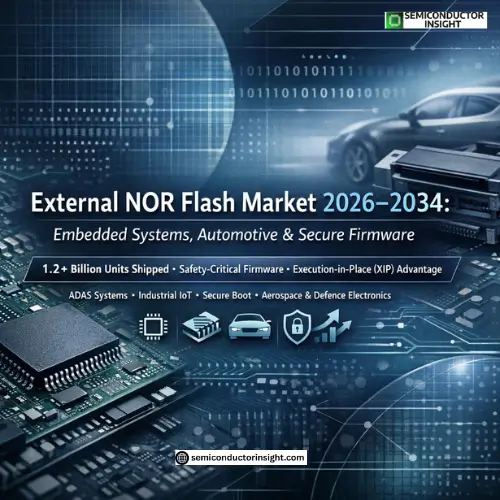
External NOR Flash Market has moved far beyond its early reputation as a legacy memory type for only basic firmware storage. Today, External NOR continues to be a crucial component in modern embedded systems, automotive computing, industrial IoT modules, and edge AI devices. What’s driving this resurgence? It’s performance characteristics NOR inherently offers: fast random access read speeds, reliable execution-in-place (XIP) capability, and endurance that can withstand millions of cycles qualities that newer memory types still struggle to match in critical applications.
In 2025, market estimates showed that NOR Flash shipments surpassed 1.2 billion units, reflecting stronger adoption than many analysts predicted just two years earlier. While NOR’s density and cost per bit traditionally lag behind NAND, its role in secure booting, firmware updates, and instant code execution remains unmatched in mission-critical systems. In smart meters, for example, External NOR memory often stores operational code that is been corrupted even during power loss, protecting systems that serve millions of households.
How External NOR Is Powering Automotive Compute and Safety-Critical Systems?
Modern vehicles are no longer mechanical machines they are complex computers on wheels. From advanced driver assistance systems (ADAS) to digital dashboards and infotainment, cars today embed more processors and data pathways than ever before. External NOR is often chosen in these contexts because of its predictable read performance and broad temperature tolerance.
In several electric vehicle models launched in late 2025, automakers confirmed partnerships with memory suppliers to integrate >128 Mb NOR flash devices dedicated to safety firmware and real-time control loops. This memory stores and executes critical software that interfaces with sensors, brakes, and networked vehicle systems. Unlike general-purpose storage, NOR’s architecture allows instant read and execution without needing to copy code into slower RAM a vital requirement for safety certification.
Emerging automotive ADAS standards now demand cryptographic verification of firmware at start up. External NOR supports code signing and secure boot processes natively something competing memory types can only approximate with added hardware overhead.
Embedded Systems and Consumer Devices Finding Renewed Value in NOR
Consumer electronics especially rugged and industrial IoT devices have found External NOR to be a reliable home for system firmware and configuration tables. Low-power industrial gateways installed in smart factories often rely on NOR modules sized between 32 Mb and 512 Mb to store firmware and calibration parameters. These devices may operate in environments where temperature swings exceed –40°C to +85°C, a range where NOR’s physical endurance and robust error correction help maintain data integrity over years.
In consumer wearables and medical monitoring tools, code stored in External NOR enables rapid booting and consistent performance without draining batteries. In late 2025, major wearable OEMs reported that NOR-based boot firmware reduced start up times by 20–30% compared with previous generations that used slower memory architectures.
The Chemistry Behind NOR Flash Stability and Reliability
At the heart of External NOR’s longevity and endurance lies its underlying semiconductor materials science. NOR Flash is constructed using a grid of floating-gate transistors built on silicon substrates doped with precise concentrations of impurities typically phosphorus or boron to create controlled regions where electrons can be stored and retained for long periods.
This controlled doping, combined with oxide layers that act as electron barriers, gives NOR memory its distinctive ability to retain data reliably without power. Modern manufacturing employs high-k dielectric materials to increase charge retention and improve write/erase cycles, a chemical advancement that significantly boosts usable life.
Recent chemical engineering breakthroughs have focused on reducing oxide trap densities defects in the insulating layers that can accelerate data loss over time. By innovating new deposition and annealing methods, memory fabs reported 25% improvements in data retention times, pushing guaranteed shelf life into the range of 10+ years for certain automotive-grade NOR chips.
To Know More about the Report, You Can Freely Browse Our Latest Updated Report:
https://semiconductorinsight.com/report/external-nor-flash-market/
NOR Flash in Aerospace and Defence Electronics
NOR Flash has long been trusted by aerospace and defence systems, where reliability cannot be compromised. Satellites, avionics modules, and rugged field radios require memory that can withstand high radiation, wide thermal variations, and decades of service life. NOR’s architecture makes it easier to implement error correction and redundant cell-level checks that protect systems against bit flips and cosmic interference.
In recent defence sector deployments, External NOR modules rated for Single Event Upset (SEU) mitigation were integrated into high-altitude drone navigation arrays and radar subsystem controllers. These programs demand memory devices that can endure particle bombardment without corruption a domain where NOR continues to outperform many emerging memory alternatives.
Flexible Form Factors and Packaging Advancements
- NOR Flash suppliers are innovating not just in density and chemistry but also in how memory is packaged and integrated.
- Traditional soldered BGA and TSOP packages are now being supplemented by WLP (Wafer-Level Packaging) and embedded die formats that fit neatly into compact board designs for wearable and edge computing systems.
- In 2025, memory manufacturers reported new embedded NOR solutions in sizes as small as 0.5 mm thickness, enabling integration into ultra-thin computing boards for smart glasses and augmented reality headsets. These devices require reliable code storage while maintaining power efficiency and structural compactness a demand NOR is uniquely equipped to fill.
NOR Flash and Secure Firmware Ecosystems
Security is no longer optional it is foundational. Firmware attacks and bootloader vulnerabilities are now among the top concerns for embedded system designers. External NOR memory often houses immutable boot code and secure elements that verify system integrity before execution.
By enabling cryptographic keys to remain in untouched memory regions and supporting tamper-resistant read protocols, NOR helps prevent unauthorized firmware modification. Some OEMs now combine NOR with hardware security modules (HSMs) to ensure every system boot begins from a trusted, verified state.
This trend accelerated dramatically after cyber security incidents in industrial control systems and critical infrastructure in 2024, which made secure boot mechanisms a procurement requirement across multiple sectors.

Comments (0)