Key Statistics
Key Takeaways
- Serial NOR Flash is the central growth and innovation format because SPI, QSPI and xSPI interfaces reduce pin count while delivering progressively higher read bandwidth for code storage and execute-in-place applications.
- Automotive and industrial demand provides the most defensible value pool: long qualification cycles, high endurance, extended availability and functional-safety requirements support differentiated products even when the total market grows slowly.
- Asia Pacific is the largest region, combining memory manufacturing, electronics production and a broad embedded-system customer base; China alone accounted for 29% of the report page’s 2024 global NOR Flash sales.
- The headline market is mature rather than declining. The rebased series moves from USD 3,032.4 million in 2025 to USD 3,109.2 million in 2034, but product mix is shifting toward higher-speed, lower-voltage and security-enabled devices.
- Density substitution and NAND competition constrain revenue growth. NOR retains a strong role for fast random reads, code execution and reliable boot storage, but it is not the preferred technology for bulk data storage.
NOR Flash Market Overview
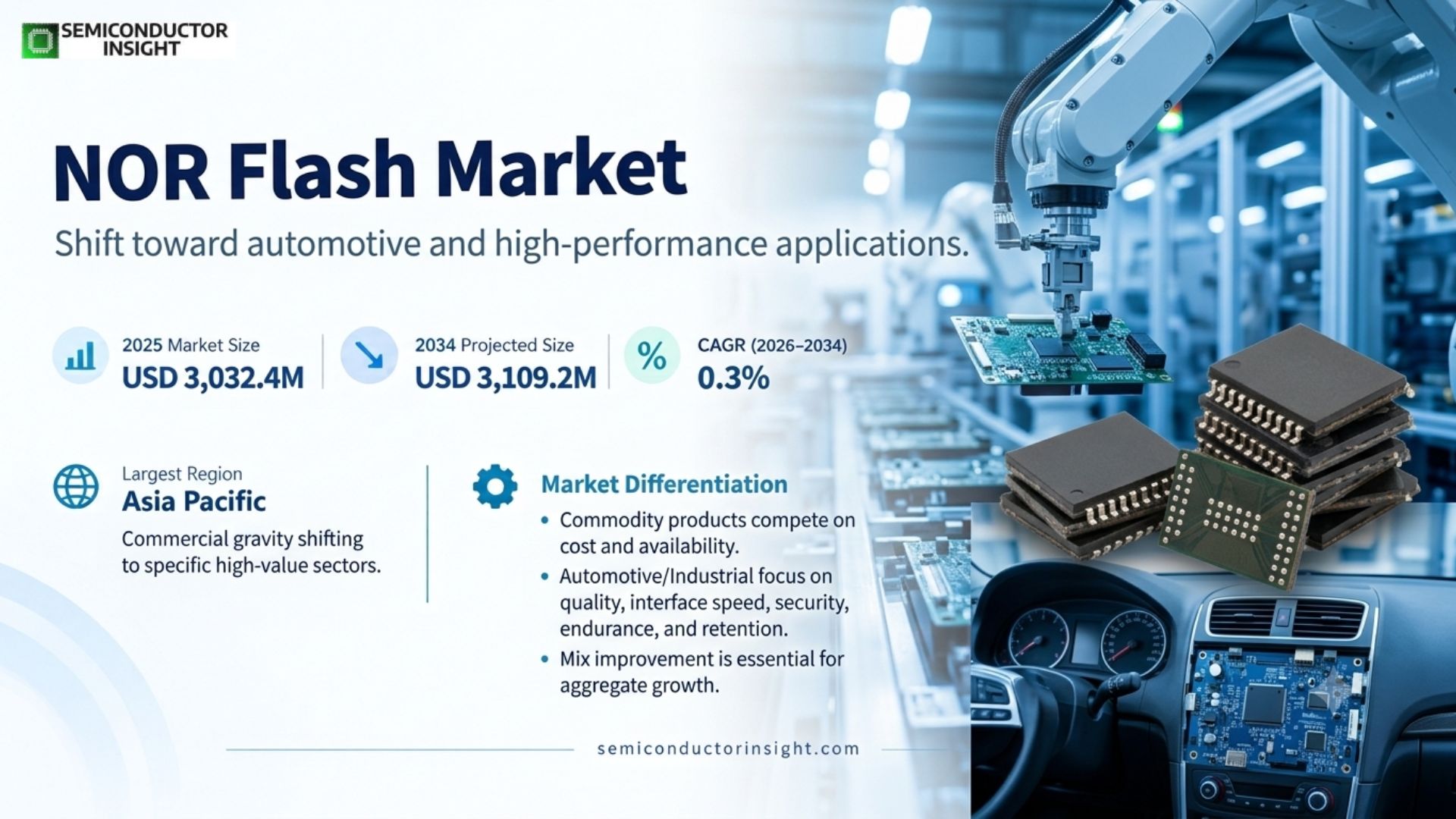
NOR Flash Market is rebased to USD 3,032.4 million in 2025 and is projected to reach USD 3,109.2 million by 2034, corresponding to a 0.3% CAGR during 2026–2034. Asia Pacific is the largest regional market, while the commercial center of gravity is shifting toward automotive, industrial, networking and high-performance serial NOR products rather than broad commodity bit growth.
NOR Flash is non-volatile memory optimized for random read access and direct code execution. Unlike NAND, which is designed around dense block-oriented storage, NOR can map code into the processor address space and deliver deterministic reads without first copying large blocks into DRAM. That makes it a persistent design choice for system boot, firmware, microcontroller companion memory, industrial control, automotive electronics and network infrastructure where predictable access, reliability and long lifecycle matter more than the lowest cost per bit.
The market’s low headline CAGR masks significant internal change. Higher-speed serial interfaces are absorbing functionality once associated with parallel devices, while xSPI architectures raise read bandwidth and reduce the gap between external Flash and memory-mapped execution requirements. GigaDevice’s GD25NX launch illustrates this direction with octal SPI at up to 200 MHz and data throughput up to 400 MB/s. Suppliers are also differentiating through dual-voltage operation, security functions, functional-safety processes and faster erase/program performance.
End-market quality requirements create a market structure in which qualified revenue can be more valuable than raw density. Automotive products are expected to meet AEC-Q100 requirements and often remain in production for many years. Microchip, for example, specifies 100,000 read/write cycles and 100-year data retention for its automotive SuperFlash portfolio. These requirements increase switching costs and protect established supplier positions even when aggregate NOR Flash revenue is nearly flat.
Segment Analysis: By Type
By type, the market is segmented into Serial NOR Flash and Parallel NOR Flash. Serial NOR is the main innovation path because low pin count, SPI-family interfaces and rising bandwidth fit modern embedded SoCs. Parallel NOR remains relevant in legacy and specialized systems where wide-bus access, established board designs or deterministic interface behavior justify the higher pin count.
| Type | Architecture | Market position and purchasing logic |
|---|---|---|
| Serial NOR Flash | Serial NOR transfers commands, addresses and data over SPI-family interfaces. QSPI and xSPI variants increase lane count or transfer rate while retaining fewer pins than a traditional parallel bus. This reduces PCB routing, package pins and controller complexity, which is especially valuable in space-constrained embedded designs. | Serial NOR is the principal growth and product-development segment. Buyers increasingly compare bandwidth, voltage domains, boot compatibility, security, erase/program latency, endurance and qualification status rather than capacity alone. High-performance products can serve edge AI, automotive, networking and data-center controllers where external firmware must be read rapidly without adding a large memory subsystem. |
| Parallel NOR Flash | Parallel NOR exposes a wider address/data interface and can provide straightforward memory-mapped access, but the additional pins increase package size and board routing. The architecture remains technically useful where an existing processor bus is already designed around it or where replacement compatibility is more important than pin-count reduction. | Parallel NOR is a mature replacement and legacy-design segment. Demand is supported by industrial, communications and long-lifecycle systems that avoid redesign unless a component becomes unavailable. The segment faces structural pressure from serial NOR because modern SoCs increasingly include high-speed serial memory controllers, making serial devices cheaper to route and easier to scale across multiple density options. |
Density and interface evolution
The report additionally segments NOR Flash by density and interface. Low-density devices up to 256 Mb remain common for firmware and embedded control, medium-density products from 256 Mb to 1 Gb support richer code images and connected systems, and high-density products above 1 Gb address more software-intensive platforms. On the interface side, SPI remains the baseline, QSPI increases throughput with four data lines, and newer octal/xSPI implementations extend serial performance further. The commercial shift is toward more bandwidth and functionality per pin rather than a simple race for maximum bit density.
| Secondary axis | Segments | Commercial meaning |
|---|---|---|
| Density | Low Density (Up to 256 Mb); Medium Density (256 Mb to 1 Gb); High Density (Above 1 Gb) | Density choice follows firmware size, code architecture, redundancy and future software headroom. Higher capacity can lift device value, but the customer still weighs boot performance, endurance and lifecycle assurance against cost. |
| Interface | SPI; QSPI; Parallel Interface; Others | Interface selection determines pin count, throughput and host compatibility. The strongest innovation is in faster serial protocols that preserve compact routing while raising execute-in-place and code-read performance. |
Segment Analysis: By Application
By application, the market is segmented into Telecommunication, Networking, Industrial, Automotive and Smart Grid Space. These applications share a need for persistent code storage, but qualification and product-life requirements differ sharply. Automotive and industrial designs place the greatest emphasis on reliability and lifecycle, while networking and telecommunications increasingly value read bandwidth and secure boot.
| Application | Demand characteristics and commercial implication |
|---|---|
| Telecommunication | Telecom equipment uses NOR Flash for boot code, configuration and firmware in radios, access equipment and control modules. Long field life and remote update requirements make data retention and secure firmware handling important. Suppliers benefit when a device family is qualified across multiple platform generations, because telecom OEMs seek continuity and avoid component changes that could trigger new validation in deployed infrastructure. |
| Networking | Routers, switches, storage appliances and data-center hardware require fast, reliable boot and persistent firmware storage. Higher-speed serial NOR can reduce initialization latency while keeping pin count low. Demand increasingly rewards xSPI throughput, low operating voltage and security functions, creating a higher-value segment even when broad NOR bit demand is stable. |
| Industrial | PLCs, drives, HMIs, meters and embedded controllers prioritize long availability, wide temperature support and predictable endurance. Industrial customers often maintain equipment for a decade or more, making product longevity and change notification important commercial differentiators. This installed base supports stable replacement demand and reduces the willingness to substitute unqualified low-cost memory. |
| Automotive | Automotive NOR Flash stores boot code and firmware across clusters, infotainment, ADAS, gateways and control units. AEC-Q100 qualification, functional-safety development and cybersecurity increasingly influence supplier selection. Vehicle production reached 96.38 million units globally in 2025, providing a large downstream hardware base even as the memory content per vehicle varies by electronic architecture. |
| Smart Grid Space | Grid controls, meters, protection equipment and related infrastructure use non-volatile firmware storage in systems expected to operate for long periods with limited service access. The buying logic emphasizes retention, endurance, supply assurance and temperature performance. Growth is linked to infrastructure modernization rather than consumer-device cycles, making this a smaller but comparatively stable application area. |
Regional Analysis
Asia Pacific is the largest NOR Flash region, combining memory supply, electronics manufacturing and embedded-system demand. North America and Europe are high-value markets because automotive, industrial and networking systems require qualified memory. South America and Middle East & Africa are more import-dependent, with demand transmitted through vehicle, industrial and communications equipment rather than local Flash fabrication.
What explains regional differences in NOR Flash demand?
Regional demand is driven by both semiconductor production and the installed base of systems that need persistent firmware storage. In 2025, SIA reported semiconductor sales growth of 45.0% for Asia Pacific and all other regions, 30.5% in the Americas, 17.3% in China and 6.3% in Europe. OICA reported 96.38 million vehicles produced globally in 2025, including 34.53 million in China, 10.24 million in the United States and 17.20 million across Europe. These are downstream indicators, not NOR Flash market shares.
| Region | Market position | Growth outlook | Demand profile | Key evidence / access factor |
|---|---|---|---|---|
| Asia Pacific | Largest | Mixed by country; strongest innovation base | Manufacturing and embedded electronics | China is the leading country in the report scope; regional supply includes Winbond, Macronix, GigaDevice, Samsung and other major memory vendors. |
| North America | High-value demand | Stable to selective growth | Automotive, networking and industrial | Americas semiconductor sales rose 30.5% in 2025; U.S. vehicle production was 10.24 million units. |
| Europe | High-specification demand | Stable | Automotive and industrial | Europe produced 17.20 million vehicles in 2025; AEC-Q100, safety and long-lifecycle requirements support qualified NOR. |
| South America | Smaller | Selective | Import-led automotive/industrial | South America produced 3.17 million vehicles in 2025, led by Brazil at 2.64 million. |
| Middle East & Africa | Smaller | Project led | Telecom, industrial and infrastructure | Africa produced 1.23 million vehicles in 2025; regional NOR demand is primarily embedded in imported systems. |
Key NOR Flash Manufacturers and Competitive Landscape
NOR Flash competition is segmented by application quality requirements. Commodity serial products compete on cost, density and availability, while automotive, industrial and high-performance xSPI products compete on qualification, interface speed, security, endurance, retention and lifecycle. The market’s low aggregate growth makes mix improvement essential: suppliers need to move customers toward higher-value features without losing mature-design revenue that remains profitable and sticky.
The supplier base includes large diversified semiconductor companies and specialists with deep NOR portfolios. Winbond, Macronix and GigaDevice are prominent serial-NOR suppliers, while Microchip emphasizes SuperFlash technology and long-life embedded applications. Samsung and Micron bring broader memory scale, and Cypress technology remains important in the market through its established embedded-memory footprint. The competitive advantage depends on the target application rather than a single global cost curve.
Automotive qualification creates one of the strongest barriers to entry. A device must meet quality and reliability standards, and the semiconductor supplier must support documentation, change control and long production life. Newer requirements add functional safety and cybersecurity to the evaluation. Macronix’s 2026 ArmorFlash announcement shows this evolution, while Microchip’s AEC-Q100 portfolio illustrates the durability and lifecycle expectations of automotive buyers.
High-speed serial NOR is another differentiation frontier. GigaDevice’s 200 MHz, 400 MB/s GD25NX demonstrates how octal interfaces can reposition NOR closer to performance-critical code storage. The commercial value lies in system simplification: faster external memory can reduce boot delay and avoid a wider parallel bus, creating a reason to upgrade even when the total installed NOR capacity does not grow materially.
Tier structure
| Competitive tier | Representative companies | How they compete |
|---|---|---|
| High-volume serial NOR leaders | Winbond, Macronix, GigaDevice | Compete on breadth of densities, SPI/QSPI/xSPI performance, cost, global supply and fast product refresh. Their scale supports broad embedded-market coverage and gives customers multiple package and voltage options. |
| Automotive/industrial qualified suppliers | Microchip, Cypress, Macronix, GigaDevice, ISSI | Compete on AEC-Q100 qualification, endurance, retention, functional-safety support, long lifecycle and customer documentation. Once designed into a vehicle or industrial platform, products can remain in revenue for years. |
| Diversified memory suppliers | Samsung, Micron and other broad memory vendors | Leverage manufacturing, customer relationships and broader memory portfolios. Their NOR strategy is typically selective, focused on applications where portfolio integration or supply scale creates an advantage. |
Key companies profiled
Cypress, Samsung, Winbond, Micron, Macronix, ISSI, Eon, Microchip, GigaDevice.
NOR Flash Production Capacity Analysis
NOR Flash capacity is shaped by mature-node wafer availability, product mix and supplier allocation rather than by demand for leading-edge lithography. Many NOR products use established processes that can compete for foundry or internal-fab capacity with microcontrollers, analog and other embedded semiconductors. The key capacity question is whether qualified mature-node output is available for long-lived product families while suppliers also invest in newer high-performance and automotive designs.
Mature-node economics are important because NOR bit growth is limited. Suppliers cannot justify expensive process migration solely to reduce die size if customer qualification or product-lifecycle costs offset the manufacturing benefit. This favors stable process platforms, incremental die shrinks and interface innovation. Long-term capacity commitments are particularly valuable for automotive and industrial customers that expect parts to remain available across extended equipment production and service periods.
Product mix can matter more than nominal wafer starts. A fab line may support low-density commodity serial NOR, larger high-density devices and automotive products with different test flows and yield targets. Suppliers allocate capacity toward combinations that maximize margin and strategic customer retention. When demand spikes in automotive or networking, low-value commodity products can experience tighter availability even if total industry wafer capacity has not changed.
Geographic concentration in Asia remains a supply-chain consideration. Taiwan, China, South Korea and Japan host major memory and semiconductor manufacturing resources. North American and European customers mitigate risk through multi-sourcing, inventory policy and long-term supply agreements rather than local NOR fabrication at scale. This creates commercial value for suppliers that can provide transparent capacity planning and stable qualified product transitions.
| Capacity variable | Operational effect | Market implication |
|---|---|---|
| Mature-node wafer allocation | NOR competes with other embedded and analog products for qualified wafer capacity on established process nodes. | Supply can tighten by product family even when total fab utilization appears adequate, supporting long-term agreements for strategic customers. |
| Automotive qualification | Automotive wafers, assembly and test flows must remain controlled and traceable across long programs. | Qualified capacity is less fungible than commodity capacity, strengthening incumbent suppliers and raising switching costs. |
| Test and package mix | Higher-performance, wide-temperature and safety-oriented products require more screening and documentation. | Back-end test throughput and product mix can constrain shipments independently of front-end wafer output. |
NOR Flash Market Dynamics: Drivers, Restraints and Opportunities
NOR Flash is a mature market with flat aggregate revenue but meaningful technology and mix shifts. The main drivers are embedded-system code growth, automotive electronics, industrial lifecycle requirements and higher-speed serial interfaces. Restraints come from NAND or managed-storage substitution, integrated Flash in microcontrollers and pricing pressure. Opportunities center on xSPI performance, automotive safety/security and long-life industrial firmware.
MARKET DRIVERS
Drivers Impact Analysis*
| Factor | Direction / Intensity* | Commercial transmission mechanism |
|---|---|---|
| Automotive electronics and firmware content | Medium–High | More ECUs and software-defined functions create persistent code-storage requirements with demanding qualification. |
| High-speed serial interfaces | Medium | xSPI and octal architectures increase value per device by raising bandwidth while preserving low pin count. |
| Industrial and infrastructure lifecycle | Medium | Long-lived equipment favors discrete NOR with predictable availability, retention and endurance. |
| Secure boot and cybersecurity | Medium | Connected systems need protected firmware and authenticated code, creating feature-based differentiation. |
Automotive electronics sustains qualified NOR demand
Vehicles require non-volatile storage for boot code and firmware across control, connectivity and user-interface systems. The strongest commercial effect is not simply more memory bits; it is higher specification. AEC-Q100 qualification, long product life and increasingly functional-safety or cybersecurity support make automotive NOR harder to replace, allowing qualified suppliers to defend value even when general-purpose serial NOR pricing is competitive.
xSPI turns serial NOR into a higher-performance memory
Faster serial interfaces address a historical limitation of external NOR: read bandwidth. Octal protocols, higher clock speeds and double-data-rate transfers allow designers to keep low pin count while improving boot and execute-in-place performance. GigaDevice’s 400 MB/s GD25NX is an example of this direction. The market implication is mix upgrading rather than broad volume growth, with performance becoming a purchasing criterion alongside density.
Industrial systems reward retention and lifecycle
Factory controls, meters, drives and embedded systems can remain deployed for many years. A memory change can require firmware validation, board redesign or safety review, so customers prefer devices with stable specifications and long availability. This creates a durable installed base for NOR and gives suppliers with strong product-longevity programs an advantage over vendors focused only on short consumer cycles.
Connected infrastructure raises security requirements
Networking, smart-grid and industrial devices increasingly boot authenticated software and receive field updates. NOR that incorporates protection, secure regions or cybersecurity-aligned development can become part of the platform security architecture. This adds value without requiring large density increases and gives suppliers another path to differentiation in a market where average bit demand is mature.
MARKET RESTRAINTS
Restraints Impact Analysis*
| Factor | Direction / Intensity* | Commercial transmission mechanism |
|---|---|---|
| NAND/eMMC/UFS substitution for bulk storage | High | NOR cannot compete economically with dense block-storage technologies for large data capacity. |
| Integrated MCU/SoC Flash | Medium–High | On-chip non-volatile memory can eliminate an external NOR device in lower-complexity designs. |
| Commodity price competition | Medium | Low-density serial NOR is widely available and exposed to aggressive pricing. |
| Mature market unit growth | Medium | Many applications are replacement or lifecycle driven, limiting broad revenue expansion. |
NOR is structurally disadvantaged for bulk storage
NAND and managed storage solutions provide much lower cost per bit at high capacities. When an application primarily stores data rather than executable code, NOR is rarely the economic choice. This limits expansion into storage-heavy consumer and computing use cases and keeps the market focused on firmware, boot and embedded applications where random read access and reliability justify the premium.
Embedded Flash can remove the discrete memory socket
Microcontrollers and SoCs often integrate enough non-volatile memory for basic firmware. If the code image fits on chip, a discrete NOR device adds cost, board area and supply-chain complexity. External NOR wins when firmware size, update flexibility, lifecycle or performance exceeds integrated capacity, but continued growth of on-chip memory places a ceiling on low-density companion demand.
Low-density products face persistent price pressure
Standard SPI NOR at mature densities has many qualified suppliers and relatively transparent specifications. Buyers can dual-source, creating price competition and limiting margin. Vendors counter this by offering automotive grades, wide temperature ranges, faster interfaces, security or long-life supply programs, but products that lack these differentiators remain vulnerable to down-cycle pricing and inventory corrections.
MARKET OPPORTUNITIES
Automotive safety and cybersecurity memory
Automotive programs increasingly combine functional safety with cybersecurity. NOR suppliers that align development with ISO 26262 and ISO/SAE 21434 can become strategic components of secure boot and control architectures. Qualification is expensive, but successful design wins can persist across vehicle platforms and support premium pricing relative to standard serial Flash.
High-speed xSPI for edge AI and networking
Edge AI, data-center controllers and networking systems need faster firmware and model initialization. High-speed serial NOR can provide a compact external code store without the routing burden of parallel memory. The opportunity favors vendors able to deliver high bandwidth at low I/O voltage while maintaining retention and error-management features.
Long-life industrial replacements
Industrial equipment makers need replacement parts for installed platforms that cannot be redesigned cheaply. Suppliers maintaining compatible densities, packages and commands can monetize mature technology through lifecycle programs. The commercial opportunity is less visible than a new consumer product launch but can generate stable margin with lower demand volatility.
Smart grid and infrastructure modernization
Meters, protection systems and communications gateways require durable firmware storage and remote update capability. Infrastructure programs can support low- and medium-density serial NOR with strong retention and security. Suppliers with broad temperature specifications, long product availability and distribution coverage are well positioned because these deployments value service life over maximum storage density.
NOR Flash Supply Chain Analysis
Value capture depends on both silicon technology and qualification position. A commodity serial NOR can be substituted when command sets and packages are compatible, but an automotive or industrial device becomes harder to replace once the system firmware, safety case and production process are validated around it. This makes customer qualification a supply-chain asset and explains why mature products can remain commercially important long after their process technology stops being leading edge.
Foundry and internal-fab relationships matter because NOR commonly uses mature nodes that also support analog, power-management and microcontroller products. Capacity allocation can therefore change with broader semiconductor cycles. Suppliers serving automotive and industrial customers mitigate this risk through longer planning horizons, controlled process changes and inventory commitments, while consumer-oriented products are more exposed to spot pricing and inventory corrections.
Distribution remains important for fragmented industrial and infrastructure customers. Large automotive and networking accounts buy through direct qualification programs, but thousands of smaller embedded customers rely on distributors for package variants, technical support and continuity. A broad channel can extend the commercial life of a NOR family and reduce the cost of serving low-volume designs.
Recent Developments in the NOR Flash Market
Macronix stated that the MX78 family was developed according to the ISO/SAE 21434 cybersecurity process and is compliant with ISO 26262 ASIL D. The development is commercially important because automotive NOR selection is expanding from endurance and temperature qualification into combined functional-safety and cybersecurity requirements, raising the value of process certification and embedded protection features.
The GD25NX uses a 1.8 V core and 1.2 V I/O, supports octal SPI up to 200 MHz and reaches data throughput up to 400 MB/s. The product targets wearables, data centers, edge AI and automotive electronics, illustrating how suppliers are using high-speed serial interfaces and lower I/O voltage to create growth inside an otherwise mature NOR market.
Microchip states that its automotive serial and parallel SuperFlash products are AEC-Q100 qualified, with 100,000 read/write cycles and 100-year data retention. The specifications demonstrate the reliability threshold required for automotive and industrial design wins and help explain why qualified NOR can retain pricing power despite low aggregate market growth.
REPORT SCOPE & SEGMENTATION
| Attribute | Coverage |
|---|---|
| Market | NOR Flash |
| Base year / forecast | 2025 base; 2026 estimate; 2034 forecast; 0.3% CAGR for 2026–2034 |
| By Type | Serial NOR Flash, Parallel NOR Flash |
| By Application | Telecommunication, Networking, Industrial, Automotive, Smart Grid Space |
| By Density | Low Density (Up to 256 Mb), Medium Density (256 Mb to 1 Gb), High Density (Above 1 Gb) |
| By Interface | SPI, QSPI, Parallel Interface, Others |
| Regions | North America, Europe, Asia Pacific, South America, Middle East & Africa |
| Companies profiled | Cypress, Samsung, Winbond, Micron, Macronix, ISSI, Eon, Microchip, GigaDevice |
Frequently Asked Questions
What is the current size of the NOR Flash market?
The NOR Flash market is rebased to USD 3,032.4 million in 2025 and is projected to reach USD 3,109.2 million by 2034, corresponding to a 0.3% CAGR during 2026–2034. The low headline growth reflects a mature memory category, but the internal mix is changing materially toward higher-speed serial interfaces, automotive qualification, security functions and long-life industrial products that can carry higher value than commodity low-density NOR.
Which region leads the NOR Flash market?
Asia Pacific is the largest NOR Flash region because it combines major memory suppliers, semiconductor manufacturing and the world’s largest electronics-production ecosystem. The report page identifies China as the largest country at 29% of global sales in 2024. Taiwan is also important through suppliers such as Macronix and Winbond, while Japan and South Korea contribute significant automotive, industrial and electronics demand alongside broader semiconductor manufacturing capabilities.
What are the main NOR Flash types?
The report divides NOR Flash into Serial NOR Flash and Parallel NOR Flash. Serial NOR uses SPI-family interfaces and has become the main innovation path because it reduces pin count while QSPI and xSPI increase bandwidth. Parallel NOR remains important in legacy and specialized systems where an existing wide-bus memory architecture is already qualified. New designs increasingly favor serial products because modern processors include high-speed serial memory controllers and compact routing reduces system cost.
Which applications drive NOR Flash demand?
The report scope covers Telecommunication, Networking, Industrial, Automotive and Smart Grid Space. Networking and telecom systems use NOR for boot and configuration, industrial equipment values retention and product longevity, and automotive platforms require rigorous qualification and long lifecycle. Smart-grid equipment adds infrastructure demand where field service is difficult. These applications favor predictable code storage and firmware integrity rather than the bulk-storage economics that drive NAND memory.
Why does NOR Flash still matter when NAND is much larger?
NOR and NAND solve different memory problems. NAND is optimized for dense, block-oriented storage at low cost per bit, while NOR provides fast random reads and supports direct code execution. A processor can boot or execute firmware from NOR without treating it like a mass-storage device. That makes NOR valuable in embedded systems where deterministic access, simple boot architecture, retention and long-term reliability are more important than storing very large volumes of user data.
What is changing in high-performance serial NOR?
High-performance serial NOR is moving toward wider serial protocols, higher clock rates and lower I/O voltage. GigaDevice’s GD25NX, for example, supports octal SPI up to 200 MHz and throughput up to 400 MB/s. These improvements reduce the performance penalty of using a low-pin-count external memory. The commercial effect is a mix shift toward value-added xSPI products for networking, edge AI, automotive and other systems that need faster boot or execute-in-place behavior.
How important is automotive NOR Flash?
Automotive is strategically important because qualification raises entry barriers and product lifecycles are long. NOR can store firmware for gateways, clusters, infotainment and control functions. Suppliers increasingly support AEC-Q100 quality, functional-safety processes and cybersecurity. Microchip specifies 100,000 read/write cycles and 100-year data retention for its automotive SuperFlash portfolio, while Macronix has announced ASIL D-compliant secure NOR. These requirements support higher-value revenue even when market-wide growth is modest.
Which companies are profiled in the NOR Flash report?
The report profiles Cypress, Samsung, Winbond, Micron, Macronix, ISSI, Eon, Microchip and GigaDevice. Their competitive positions differ by density, interface, manufacturing model and target application. Winbond, Macronix and GigaDevice are prominent in serial NOR; Microchip emphasizes SuperFlash and long-life embedded markets; diversified memory suppliers bring scale and large customer relationships. Automotive and industrial success additionally depends on qualification, change control and lifecycle support.
What are the biggest restraints on the NOR Flash market?
The largest structural restraints are substitution by NAND or managed storage for bulk capacity, integration of Flash directly into MCUs and SoCs, and price competition in standard low-density serial products. NOR must therefore remain concentrated on use cases where random reads, execute-in-place behavior, reliability or long lifecycle create a measurable system advantage. Suppliers that cannot differentiate through interface speed, qualification, security or support are more exposed to commodity pricing.
What is the 2026 NOR Flash market estimate?
The rebased series places the NOR Flash market at USD 3,040.9 million in 2026, compared with a USD 3,032.4 million 2025 base and a USD 3,109.2 million 2034 forecast. The 0.3% CAGR indicates a largely mature revenue pool. Growth opportunities therefore depend on favorable product mix—automotive, industrial, secure and high-speed serial NOR—rather than a broad increase in commodity memory capacity.
Research Sources & Evidence Base
View research sources used for this overview.
- Semiconductor Industry Association. Global Annual Semiconductor Sales Increase 25.6% to $791.7 Billion in 2025, regional semiconductor demand context, 6 February 2026.
- GigaDevice. GigaDevice Launches GD25NX Series xSPI NOR Flash, 200 MHz octal SPI, 400 MB/s throughput and dual-voltage architecture, 25 November 2025.
- Macronix. Macronix Secure NOR Flash Memory Family Certified for Vehicle Safety, Cybersecurity, ISO/SAE 21434 and ISO 26262 ASIL D automotive secure NOR, 8 June 2026.
- Microchip Technology. Automotive SuperFlash Memory, AEC-Q100 qualification, endurance and retention specifications.
- OICA. World Motor Vehicle Production by Country/Region and Type 2025, 2025 vehicle-production statistics used as downstream regional demand indicators.
Get Sample Report PDF for Exclusive Insights
Report Sample Includes
- Table of Contents
- List of Tables & Figures
- Charts, Research Methodology, and more...
 Download Sample Report PDF