MARKET INSIGHTS
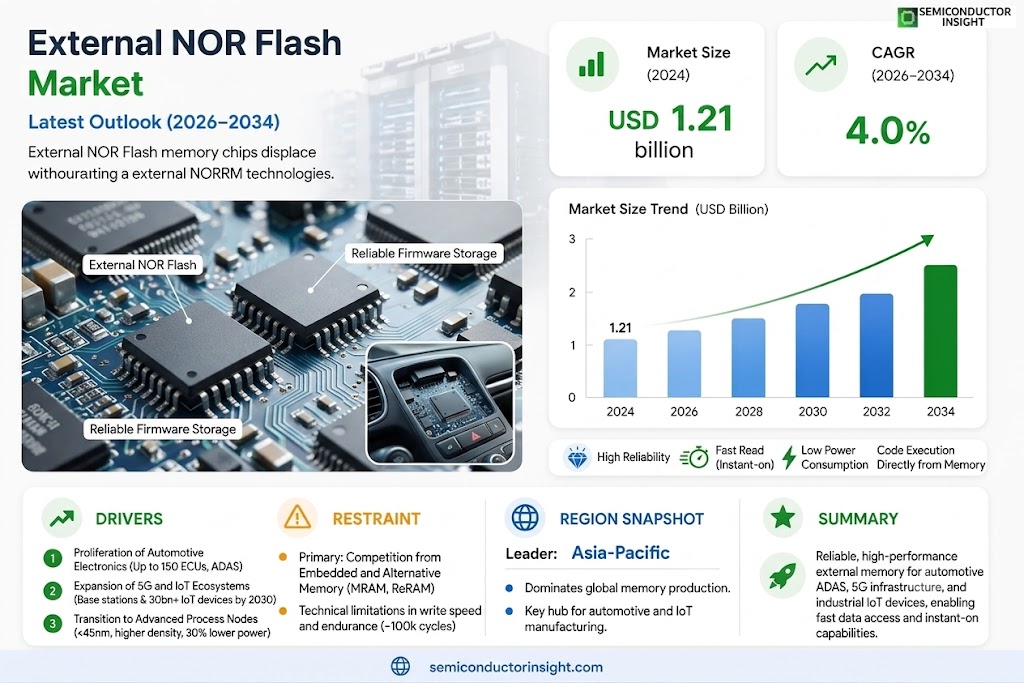
The global External NOR Flash Market was valued at 1213 million in 2024 and is projected to reach US$ 1597 million by 2032, at a CAGR of 4.0% during the forecast period.
External NOR Flash is a type of non-volatile memory that is externally connected to microcontrollers or processors, enabling systems with insufficient on-chip memory to store critical data such as boot code, firmware updates, or configuration settings. This technology is widely used across automotive, consumer electronics, industrial applications, and embedded systems due to its reliability and high-speed read capabilities.
The market is driven by increasing demand for advanced memory solutions in automotive infotainment systems and IoT devices, alongside rising adoption of 5G networks requiring NOR Flash for baseband processing. However, competition from NAND Flash and emerging storage technologies presents challenges. Key players like Cypress Semiconductor, Samsung, and Micron dominate the market, collectively holding over 50% of global revenue share in 2024. Recent innovations include higher-density NOR Flash chips catering to AIoT applications and automotive-grade solutions with extended temperature ranges.
MARKET DYNAMICS
MARKET DRIVERS
Proliferation of Automotive Electronics to Fuel External NOR Flash Demand
The automotive industry’s rapid digitization is creating substantial demand for External NOR Flash memory solutions. Modern vehicles now incorporate up to 150 electronic control units (ECUs) requiring reliable firmware storage, with premium vehicles demanding even higher capacities. NOR Flash is particularly vital for advanced driver assistance systems (ADAS), which require instant-on capability and high reliability in critical safety applications. The automotive NOR Flash market segment is projected to grow at a CAGR exceeding 6% through 2032, significantly outpacing the overall semiconductor memory market growth rate.
Expansion of 5G and IoT Ecosystems Driving Adoption
The global rollout of 5G networks and IoT infrastructure represents a key growth vector for External NOR Flash manufacturers. Base stations require NOR Flash for storing boot code and firmware, with each 5G small cell typically incorporating 128MB to 512MB of NOR Flash memory. The industrial IoT sector similarly depends on NOR Flash for device firmware in applications ranging from smart meters to factory automation controllers. With over 30 billion IoT devices expected to be deployed by 2030, this creates sustained demand for reliable external memory solutions with fast read speeds and low power consumption.
Transition to Advanced Process Nodes Improving Cost-Performance
Semiconductor manufacturers are migrating NOR Flash production to more advanced process nodes, with leading players now offering 45nm and 55nm products. This node shrinkage enables higher density chips (up to 2Gb capacity) while reducing power consumption by approximately 30% compared to previous generations. These technological improvements are making External NOR Flash increasingly competitive against alternative memory technologies in many applications, particularly where instant-on capability and code execution directly from memory are critical requirements.
MARKET RESTRAINTS
Competition from Embedded and Alternative Memory Technologies
The External NOR Flash market faces intensifying competition from both embedded NOR solutions and alternative memory types. Many modern microcontrollers now integrate sufficient on-chip flash memory, reducing the need for external components. Additionally, emerging non-volatile memory technologies like MRAM and ReRAM offer faster write speeds and better endurance, though currently at higher price points. These alternatives are particularly attractive for applications where frequent data updates are required, potentially limiting NOR Flash’s addressable market in certain segments.
Additional Constraints
Supply Chain Vulnerabilities
The semiconductor industry’s ongoing supply chain disruptions continue to impact NOR Flash availability. Lead times for certain NOR Flash products remain extended, particularly for automotive-grade components, creating challenges for system designers seeking stable component supplies. These constraints are exacerbated by the concentration of NOR Flash production among a limited number of suppliers.
Price Volatility
NOR Flash pricing has shown significant fluctuation in recent years, with periods of severe shortage followed by inventory corrections. This volatility makes long-term product planning difficult for OEMs and creates challenges for maintaining consistent profit margins throughout the supply chain.
MARKET CHALLENGES
Technical Limitations in Write Speed and Endurance
While NOR Flash excels in read performance, its write speeds and endurance characteristics present ongoing technical challenges. Typical NOR Flash components support only about 100,000 write cycles, significantly fewer than competing NAND Flash technologies. The relatively slow write speeds (often measured in microseconds per byte) also limit NOR Flash’s applicability in data-intensive applications. These technical constraints require system designers to implement complex wear-leveling algorithms in many use cases, increasing development complexity and bill-of-materials costs.
Increasing Power Efficiency Requirements
The growing emphasis on energy efficiency across all electronic systems presents additional design challenges for NOR Flash manufacturers. Battery-powered IoT devices demand ultra-low-power memory solutions, with sleep currents below 1µA becoming increasingly common requirements. Meeting these stringent power budgets while maintaining fast wake-up times and reliable data retention represents a significant technical hurdle, particularly for high-density NOR Flash devices operating at advanced process nodes.
MARKET OPPORTUNITIES
Emerging Applications in AI Edge Devices Creating New Demand
The rapid growth of edge AI applications presents significant opportunities for External NOR Flash adoption. Many AI edge devices require small-footprint, low-latency memory for storing neural network parameters and firmware. NOR Flash’s execute-in-place capability makes it particularly suitable for these applications, as it allows direct code execution without requiring transfer to RAM. With the edge AI processor market projected to exceed $15 billion by 2027, this creates substantial potential for NOR Flash manufacturers to develop optimized solutions tailored to machine learning workloads.
Automotive Functional Safety Requirements Driving Premium Solutions
Stringent automotive functional safety standards (ISO 26262) are creating demand for high-reliability NOR Flash solutions with advanced error correction and monitoring capabilities. These safety-critical applications command premium pricing and create opportunities for product differentiation. Automotive-grade NOR Flash with extended temperature ranges (-40°C to +125°C) and enhanced data retention characteristics represents one of the fastest-growing segments, with year-over-year growth rates consistently above 20%.
Industrial Automation Upgrade Cycles Offering Sustained Growth
The global push for Industry 4.0 implementations is driving sustained demand for industrial-grade NOR Flash solutions. Modern industrial equipment requires robust memory for firmware storage in harsh operating environments, with demand particularly strong for wide-temperature-range components with long lifecycle availability. Many industrial OEMs are currently upgrading legacy equipment, creating a multi-year upgrade cycle that provides visibility into future NOR Flash demand patterns.
EXTERNAL NOR FLASH MARKET TRENDS
Growing Demand for High-Performance Memory in Automotive Electronics
The automotive sector has emerged as a key driver for the External NOR Flash market, with increasing adoption in advanced driver-assistance systems (ADAS), infotainment, and vehicle telematics. As modern vehicles integrate more sophisticated electronics, the need for reliable non-volatile memory solutions has surged, particularly for storing firmware and configuration data. NOR Flash offers faster read speeds compared to NAND, making it ideal for execute-in-place (XIP) operations critical in automotive microcontrollers. The segment is projected to grow at a CAGR of over 5.2% between 2024 and 2032, fueled by rising vehicle electrification trends.
Other Trends
Edge AI and IoT Expansion
The proliferation of edge computing devices and IoT endpoints is creating new opportunities for External NOR Flash deployment in industrial automation and smart infrastructure. Low-power variants (1.8V) are gaining traction in battery-operated devices where energy efficiency is paramount. With the global IoT market expected to surpass 29 billion connected devices by 2030, memory solutions that balance performance with minimal power consumption will see sustained demand across smart city deployments and Industry 4.0 applications.
Technological Advancements in Memory Architecture
Recent innovations in NOR Flash technology are addressing historical limitations in density and cost-effectiveness. Manufacturers are introducing 512Mb to 2Gb solutions with advanced serial interfaces like Octal SPI that deliver throughputs exceeding 400MB/s. These developments bridge the performance gap with DRAM while maintaining NOR’s reliability advantages. The emergence of 3D NOR architectures promises further scaling potential, with several leading vendors initiating pilot production of stacked cell designs that could potentially triple current density capabilities by 2026.
COMPETITIVE LANDSCAPE
Key Industry Players
Innovation and Strategic Expansion Drive Market Leadership in External NOR Flash
The global External NOR Flash market is characterized by strong competition among semiconductor giants and specialized memory manufacturers. The competitive landscape remains dynamic, with companies vying for dominance through technological advancements, strategic partnerships, and geographic expansion. The top five players accounted for approximately 50% market share in 2024, reflecting the semi-consolidated nature of this specialized memory segment.
Cypress Semiconductor (now part of Infineon Technologies) maintains a leading position due to its robust product lineup and longstanding expertise in NOR Flash technology. The company’s 2019 acquisition by Infineon strengthened its market position through complementary product portfolios and expanded customer reach. Meanwhile, Winbond Electronics Corporation has gained significant traction with its focus on specialty memory solutions, particularly in the automotive and industrial sectors where reliability is paramount.
The market also sees active participation from major memory manufacturers like Micron Technology and Samsung Electronics, who leverage their scale and manufacturing expertise to compete in the NOR Flash space. While NOR Flash represents a smaller segment of their overall memory business, these players bring important innovations in process technology and packaging that drive the market forward.
Recent developments highlight the industry’s push toward higher density and lower power solutions. Macronix International has been particularly aggressive in developing 3D NOR technology, while GigaDevice has made significant inroads in the Chinese market through competitive pricing and localization strategies. These developments indicate an industry transitioning toward next-generation solutions to meet evolving application demands.
List of Key External NOR Flash Manufacturers Profiled
- Infineon Technologies (Germany) – includes former Cypress Semiconductor
- Samsung Electronics (South Korea)
- Winbond Electronics (Taiwan)
- Micron Technology (U.S.)
- Macronix International (Taiwan)
- Integrated Silicon Solution Inc. (ISSI) (U.S.)
- Eon Silicon Solutions (U.S.)
- Microchip Technology (U.S.)
- GigaDevice Semiconductor (China)
The competitive environment continues to evolve with emerging Chinese players challenging established vendors, particularly in the cost-sensitive consumer electronics segment. However, established players maintain their edge in automotive and industrial applications where reliability certifications and long-term supply commitments are critical. The coming years will likely see further consolidation as companies seek to strengthen their positions in this specialized but strategically important memory market.
Segment Analysis:
By Type
3.3V Segment Dominates the Market Due to Widespread Adoption in Automotive and Industrial Applications
The market is segmented based on voltage into:
- 3.3V
- 1.8V
- Others
By Application
Automotive Segment Leads Due to Growing Demand for Advanced Driver-Assistance Systems (ADAS)
The market is segmented based on application into:
- Automotive
- Subtypes: Passenger cars, Commercial vehicles
- Consumer Electronics
- Industrial
- Telecommunications
- Others
By Density
128Mb-256Mb Density Range Holds Significant Share for Embedded System Applications
The market is segmented based on density into:
- Up to 128Mb
- 128Mb-256Mb
- Above 256Mb
By Interface
SPI Interface Remains Preferred Choice for Cost-Sensitive Applications
The market is segmented based on interface protocol into:
- SPI (Serial Peripheral Interface)
- Parallel
- Others
Regional Analysis: External NOR Flash Market
The Asia-Pacific region dominates the global External NOR Flash market, holding the largest share due to its thriving semiconductor industry and massive electronics manufacturing base. China leads the regional demand, driven by its rapidly growing automotive, IoT, and consumer electronics sectors. The country’s push for technological self-sufficiency and strong government support for semiconductor production further boost market growth. Japan and South Korea follow closely, benefiting from established players like Samsung and Micron. These nations continue to innovate in high-performance memory solutions while leveraging their advanced R&D infrastructure. Despite cost pressures from regional competitors like India, which is expanding its electronics manufacturing capabilities, the APAC market is projected to maintain steady growth, supported by increasing demand for connected devices and smart technologies.
North America
A key hub for technological innovation, North America remains one of the largest markets for External NOR Flash, particularly for high-reliability applications in automotive and aerospace industries. The U.S. leads in automotive memory solutions, where NOR Flash is widely used for ADAS (Advanced Driver Assistance Systems) and firmware storage. Cypress Semiconductor (now Infineon Technologies) and Micron are among the influential players shaping market trends. Although the region faces competition from Asia-Pacific manufacturers, its focus on next-generation embedded systems and industrial IoT ensures sustained demand. Regulatory requirements, especially for industrial and medical applications, encourage the adoption of high-endurance NOR Flash products with extended temperature ranges.
Europe
Europe’s External NOR Flash market is anchored by its automotive and industrial electronics sectors, where functional safety and reliability are critical. Countries like Germany, France, and the U.K. lead in embedded system deployments, particularly in automotive telematics and industrial automation. Infineon Technologies and STMicroelectronics play pivotal roles in supplying memory solutions for these applications. Strict regulatory standards, such as the European Union’s automotive safety norms, further drive the adoption of high-quality NOR Flash memory. While the region lags behind Asia-Pacific in volume, it excels in premium applications, emphasizing long-term reliability and low-power consumption.
Middle East & Africa
The MEA market for External NOR Flash is still nascent but shows promising growth potential, primarily fueled by government-led digital transformation initiatives. Countries such as Saudi Arabia, the UAE, and Israel are investing heavily in smart infrastructure, which increases demand for memory solutions in IoT and telecom applications. However, the market remains constrained by limited local semiconductor manufacturing and reliance on imports from Asia and Europe. Despite this, growing 5G network deployments and smart city projects are expected to drive gradual market expansion over the next decade.
South America
South America’s External NOR Flash market is currently the smallest but has long-term growth opportunities in automotive and industrial sectors. Brazil and Argentina represent the primary demand centers, with increasing electronics manufacturing activities. However, economic volatility and limited semiconductor infrastructure hinder rapid market adoption. The region struggles with supply chain dependencies and high import costs, but regional trade agreements and local industry incentives could unlock future potential. Consumer electronics and automotive upgrades remain the primary drivers of NOR Flash consumption going forward.
Report Scope
This market research report provides a comprehensive analysis of the Global External NOR Flash market, covering the forecast period 2024–2032. It offers detailed insights into market dynamics, technological advancements, competitive landscape, and key trends shaping the industry.
Key focus areas of the report include:
- Market Size & Forecast: Historical data and future projections for revenue, unit shipments, and market value across major regions and segments. The Global External NOR Flash market was valued at USD 1,213 million in 2024 and is projected to reach USD 1,597 million by 2032, growing at a CAGR of 4.0%.
- Segmentation Analysis: Detailed breakdown by product type (3.3V, 1.8V, Others), application (Passenger Cars, Commercial Cars), and end-user industries to identify high-growth segments.
- Regional Outlook: Insights into market performance across North America, Europe, Asia-Pacific, Latin America, and the Middle East & Africa. The U.S. and China are key markets with significant growth potential.
- Competitive Landscape: Profiles of leading market participants including Cypress, Samsung, Winbond, Micron, Macronix, ISSI, Eon, Microchip, GigaDevice, and Infineon Technologies, with analysis of their market share, product portfolios, and strategic initiatives.
- Technology Trends & Innovation: Assessment of emerging memory technologies, integration with IoT devices, and advancements in automotive and industrial applications.
- Market Drivers & Restraints: Evaluation of factors such as increasing demand for automotive electronics, growth in IoT devices, and challenges like supply chain constraints and pricing pressures.
- Stakeholder Analysis: Strategic insights for semiconductor manufacturers, OEMs, system integrators, and investors regarding market opportunities and challenges.
The report employs both primary and secondary research methodologies, including interviews with industry experts and analysis of verified market data, to ensure accuracy and reliability.
FREQUENTLY ASKED QUESTIONS:
What is the current market size of Global External NOR Flash Market?
-> External NOR Flash Market was valued at 1213 million in 2024 and is projected to reach US$ 1597 million by 2032, at a CAGR of 4.0% during the forecast period.
Which key companies operate in Global External NOR Flash Market?
-> Key players include Cypress, Samsung, Winbond, Micron, Macronix, ISSI, Eon, Microchip, GigaDevice, and Infineon Technologies.
What are the key growth drivers?
-> Key growth drivers include increasing demand for automotive electronics, expansion of IoT applications, and growth in embedded systems.
Which region dominates the market?
-> Asia-Pacific is the fastest-growing region, driven by semiconductor manufacturing growth in China, South Korea, and Japan.
What are the emerging trends?
-> Emerging trends include higher density NOR Flash solutions, low-power designs for IoT, and increasing adoption in automotive ADAS systems.

Get Sample Report PDF for Exclusive Insights
Report Sample Includes
- Table of Contents
- List of Tables & Figures
- Charts, Research Methodology, and more...