
Electronic Torque Limiter Market Strengthens Role in High Precision Semiconductor Systems
Electronic torque limiter market is quietly becoming a critical layer in modern industrial ecosystems where precision, protection, and real-time responsiveness are non-negotiable. Electronic torque limiters are extremely essential in semiconductor-driven automation contexts because, in contrast to conventional mechanical systems, they incorporate sensor-based monitoring and control electronics.
In advanced manufacturing lines, especially those handling delicate semiconductor wafers or micro-components, even minor torque fluctuations can lead to product loss or equipment damage. This is where electronic torque limiters ensure controlled motion and overload protection, supporting both productivity and yield stability.
Smart Manufacturing Push Accelerating Adoption
- The rise of smart factories has significantly increased the deployment of intelligent motion control systems.
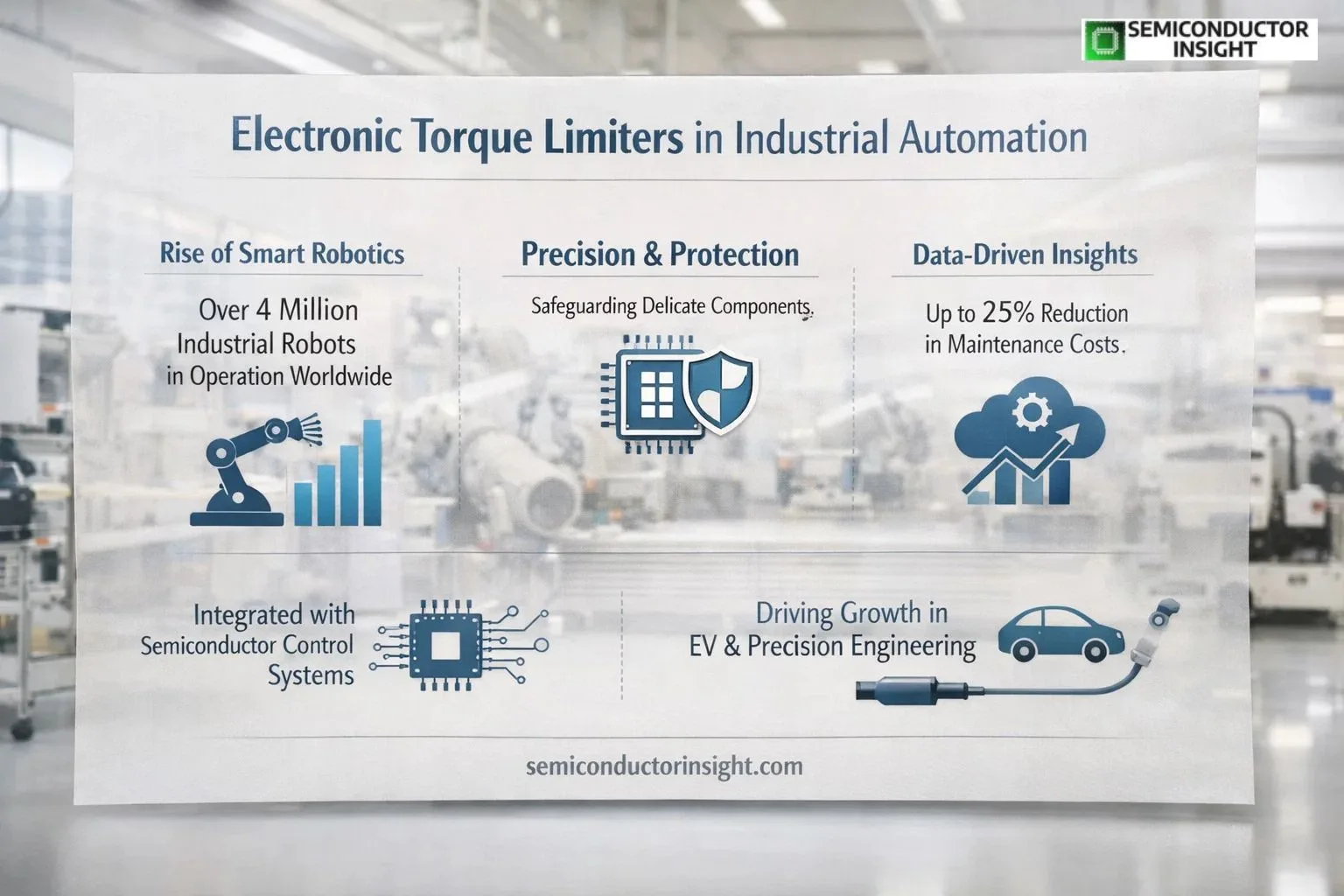
- According to data published by the International Federation of Robotics (IFR), over 4 million industrial robots were operational globally by 2023, with annual installations exceeding 550,000 units.
- Each of these systems relies on precise torque management to avoid mechanical stress and ensure operational continuity.
- Electronic torque limiters are increasingly embedded in robotic joints, conveyor systems, and automated assembly units, enabling real-time feedback loops and adaptive control. This shift from passive safety to active protection systems is a defining trend in industrial electronics.
- Additionally, reports from leading automation companies’ annual disclosures highlight that nearly 30-40% of unplanned downtime in automated plants is linked to mechanical overload or improper torque handling. This reinforces the growing importance of intelligent torque limiting solutions.
You have free access to peruse our most recent updated report to learn more about it: https://semiconductorinsight.com/report/electronic-torque-limiter-market/
Integration with Semiconductor Based Control Systems
One of the most notable transformations in this market is its deep integration with semiconductor technologies. Modern torque limiters are no longer standalone components; they are part of broader embedded systems powered by microcontrollers and signal processing units.
These systems leverage analog-to-digital conversion, real-time data processing, and communication protocols such as CAN or EtherCAT. This enables seamless coordination between torque limiters and central control units in complex machinery.
In semiconductor fabrication environments, where equipment uptime directly impacts profitability, electronic torque limiters contribute to maintaining process stability. Recent studies from industrial automation deployments show that integrating electronic torque monitoring reduced component failure rates by nearly 20% in high-speed assembly lines.
Industrial Robotics as the Primary Growth Engine
- No other industry has done more to boost the demand for electronic torque limiters than industrial robotics.
- A robotic cell, a cobot arm, or a servo-driven assembly station is a torque-sensitive system that needs to be safeguarded from programming mistakes, unanticipated jams, or parts that aren’t lined up correctly.
- The industrial automation and robotics segment is the main driver of torque limiters’ growth through 2035. As more factories around the world use robotic cells, collaborative robots (cobots), and automated assembly lines, the number of precision servo motors and gearboxes that need protection grows quickly.
- The International Federation of Robotics (IFR) shows that this pipeline has grown a lot by giving us the raw installation data.
- The IFR’s World Robotics 2025 study said that in 2024, there were 542,000 industrial robots placed around the world. This is more than twice as many as there were ten years before, and for the fourth year in a row, more than 500,000 robots were added each year. There were 4,664,000 industrial robots in use in the world in 2024, which is 9% more than the previous year.
Digitalization and Data Driven Torque Management
- The shift toward Industry 4.0 has brought torque limiting into the digital ecosystem. Modern electronic torque limiters are equipped with connectivity features that allow data transmission to cloud platforms and factory management systems.
- This enables data analytics, performance tracking, and system optimization at a granular level. For example, manufacturers can analyze torque patterns across production cycles to identify inefficiencies or potential risks.
- Industrial case references suggest that plants using data-driven torque management systems have achieved up to 25% reduction in maintenance costs through better diagnostics and operational insights.
Emerging Applications in Precision Engineering and EV Systems
Beyond traditional industrial use, electronic torque limiters are gaining traction in emerging sectors such as electric vehicles and precision engineering tools. In EV powertrains, torque control is essential for maintaining system balance and protecting drivetrain components.
Similarly, in high-precision tools used in semiconductor packaging and micro-assembly, electronic torque limiters ensure consistent performance and product quality. These expanding applications are opening new avenues for innovation and product differentiation.

Comments (0)