Wireless Torque Sensor Market Insights
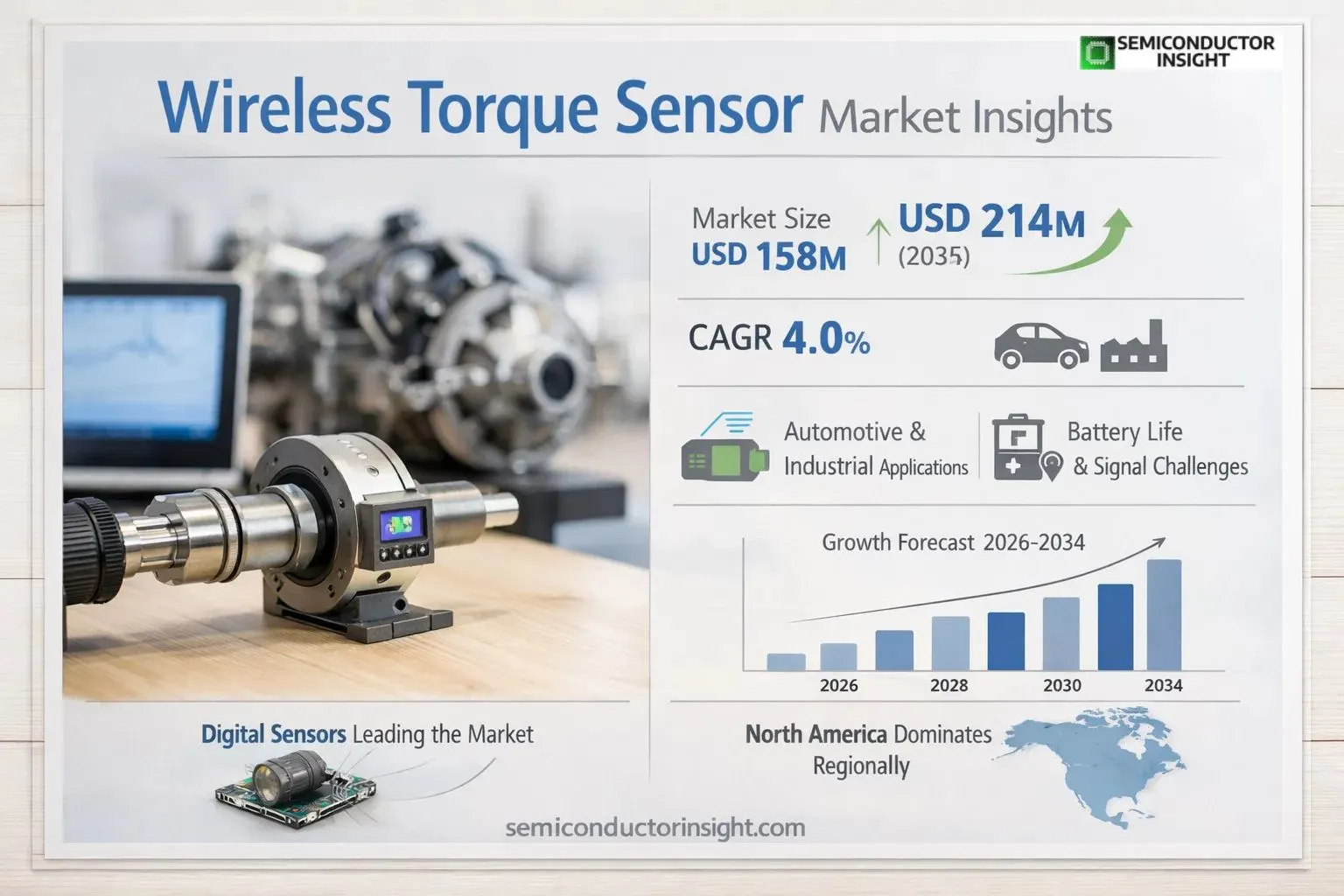
Global Wireless Torque Sensor market size was valued at USD 158 million in 2025. The market is projected to grow from USD 165 million in 2026 to USD 214 million by 2034, exhibiting a CAGR of 4.0% during the forecast period.
Wireless torque sensors are advanced measurement devices designed to monitor rotational force without physical connections, enabling real-time data transmission in industrial applications. These sensors utilize wireless technologies such as Bluetooth or Wi-Fi to provide accurate torque readings across automotive, aerospace, manufacturing, and energy sectors. Key variants include digital and analog wireless torque sensors, each catering to specific precision and connectivity requirements.
The market growth is driven by increasing industrial automation demands and the need for predictive maintenance solutions. However, high implementation costs and signal interference challenges in dense industrial environments may restrain adoption rates. Leading manufacturers like HBM and Honeywell are addressing these limitations through enhanced signal encryption and multi-protocol compatibility in their latest product iterations.
MARKET DRIVERS
Industry 4.0 and Smart Manufacturing Adoption
Wireless torque sensor market is experiencing significant growth driven by the rapid adoption of Industry 4.0 and smart manufacturing practices. These technologies require real-time torque monitoring for predictive maintenance and process optimization. Wireless solutions eliminate cabling constraints while providing accurate measurements in rotating machinery applications.
Automotive Testing and EV Development
Automotive OEMs and testing facilities are increasingly utilizing wireless torque sensors for powertrain testing, particularly in electric vehicle development. The market benefits from 40% faster test setups compared to wired alternatives, with no signal degradation in rotating applications. EV battery assembly lines also deploy these sensors for precision tightening operations.
➤ Wireless torque sensor installations in industrial environments grew 28% year-over-year as manufacturers prioritize IIoT connectivity
Additional growth comes from aerospace applications where wireless sensors enable torque monitoring in hard-to-access locations while reducing aircraft weight through cable elimination.
MARKET CHALLENGES
Power Consumption and Battery Life Constraints
Despite technological advances, wireless torque sensors face limitations in continuous operation scenarios. The need for frequent battery replacements in industrial settings creates maintenance challenges and potential downtime. Some high-speed applications experience data transmission latency during peak sampling rates.
Other Challenges
Signal Interference in Dense Environments
Industrial facilities with multiple wireless systems may encounter signal collision issues, requiring careful frequency management and protocol selection for reliable torque data transmission.
MARKET RESTRAINTS
High Initial Investment Costs
The premium pricing of industrial-grade wireless torque sensors remains a barrier for small and medium enterprises. While TCO benefits exist, the initial sensor cost is 45-60% higher than wired equivalents, slowing adoption in price-sensitive markets. Certification requirements for aerospace and medical applications further increase compliance costs.
MARKET OPPORTUNITIES
Energy Harvesting Technologies
Emerging energy harvesting solutions present opportunities to address battery limitations in wireless torque sensors. Piezoelectric and electromagnetic harvesting systems are being integrated to enable self-powered operation in rotating equipment. This innovation could eliminate battery replacement needs in 70% of industrial monitoring applications.
5G-enabled Torque Monitoring
The rollout of 5G networks enables new wireless torque sensor applications requiring ultra-low latency below 5ms. This supports real-time closed-loop control systems in automated manufacturing and enables cloud-based torque analytics across distributed facilities.
Wireless Torque Sensor Market Trends
Industry Shift Toward Wireless Technology Adoption
Wireless Torque Sensor market is experiencing accelerated growth due to the industrial transition toward Industry 4.0 capabilities. Major manufacturing sectors are replacing wired torque measurement systems with wireless alternatives to enhance mobility, reduce installation complexity, and improve real-time data collection. Key manufacturers like HBM, Honeywell, and ATI Industrial Automation are focusing on ruggedized wireless solutions for challenging industrial environments.
Other Trends
Expansion in Automotive Testing Applications
Automotive manufacturers are increasingly adopting wireless torque sensors for production line quality control and R&D testing. The ability to monitor rotating components without physical connectors has proven particularly valuable in electric vehicle powertrain development. Leading automotive OEMs now specify wireless torque measurement as standard equipment in their test protocols.
Advancements in Digital Signal Transmission
Recent technological improvements have enhanced digital wireless torque sensor capabilities, with market leaders introducing models featuring improved noise immunity and sampling rates exceeding 10kHz. The digital segment is gaining market share against analog alternatives, particularly in applications requiring high-precision measurements or data logging. This trend coincides with broader industrial digital transformation initiatives.
Diversification Across Industrial Verticals
Beyond traditional manufacturing applications, wireless torque sensors are seeing expanded use in aerospace component testing, medical device assembly, and railway maintenance operations. The flexibility of wireless solutions allows retrofitting into existing equipment without major modifications, driving adoption across multiple sectors. Particularly strong growth has been observed in Asia-Pacific markets developing advanced manufacturing capabilities.
Strategic Partnerships Among Key Players
Leading wireless torque sensor manufacturers are forming technology partnerships with industrial automation providers to integrate torque measurement capabilities directly into smart factory systems. Collaborative developments between sensor specialists and Industry 4.0 platform providers are creating more sophisticated condition monitoring solutions with predictive maintenance features.
COMPETITIVE LANDSCAPE
Key Industry Players
Wireless Torque Sensor Market Dominated by Technical Specialty Providers
The global wireless torque sensor market features a competitive landscape with HBM leading as the dominant player, holding significant market share along with ANDILOG Technologies and Texys forming the top three. These companies maintain strong positions through technological innovations in digital wireless torque measurement systems and strategic partnerships with industrial automation providers. The market structure indicates moderate consolidation with the top five players accounting for approximately XX% of global revenue in 2025.
Several niche players are making notable contributions, particularly in specialized industrial applications. Companies like ADI Artech Transducers and FORCEbit focus on high-precision measurement solutions, while ATI Industrial Automation and Honeywell cater to aerospace and medical sectors. Emerging Chinese manufacturers such as Beijing Ming Han Ya Cheng Technology are gaining traction in regional markets through cost-effective solutions.
List of Key Wireless Torque Sensor Companies Profiled
- HBM
- ANDILOG Technologies
- Texys
- KEMP
- ADI Artech Transducers
- FORCEbit
- Interface
- Applied Measurements
- Honeywell
- ATI Industrial Automation
- FUTEK
- Crane Electronics
- Kistler Holding
- PCB Piezotronics
- Beijing Ming Han Ya Cheng Technology
Segment Analysis:
| Segment Category | Sub-Segments | Key Insights |
| By Type |
|
Digital Wireless Torque Sensor dominates due to superior data accuracy and integration capabilities with modern IoT systems. Key advantages include:
|
| By Application |
|
Industrial Equipment remains the dominant application sector due to:
|
| By End User |
|
OEMs represent the largest end user segment because:
|
| By Technology |
|
Bluetooth Technology leads in adoption due to:
|
| By Measurement Range |
|
Medium Range (50-500 Nm) dominates market demand because:
|
Regional Analysis: Wireless Torque Sensor Market
North America
The United States leads in wireless torque sensor adoption through its Industry 4.0 initiatives and reshoring of manufacturing operations. Automotive assembly lines increasingly utilize wireless torque sensors for real-time fastener monitoring, while aerospace manufacturers implement them for critical component testing.
Canada’s wireless torque sensor market grows alongside its renewable energy projects, particularly in wind turbine maintenance where wireless solutions enable easier torque monitoring in remote installations. Oil sands operations also adopt wireless torque sensors for equipment condition monitoring.
Mexico’s position as an automotive manufacturing hub accelerates wireless torque sensor deployment in production facilities. The proximity to U.S. technology providers facilitates knowledge transfer, while cost advantages drive adoption among tier-2 automotive suppliers.
North American universities and corporate R&D centers pioneer new wireless torque sensor applications, including medical robotics and electric vehicle powertrain testing. Collaborative projects between sensor manufacturers and wireless protocol developers enhance measurement accuracy and transmission reliability.
Europe
Europe’s mature industrial base presents significant opportunities for wireless torque sensor manufacturers. Germany’s precision engineering sector leads adoption in high-value manufacturing, while Scandinavian countries prioritize wireless solutions for harsh environment applications. The EU’s emphasis on energy-efficient production processes creates demand for wireless condition monitoring systems. Automotive OEMs in the region increasingly standardize wireless torque sensors for quality assurance in electric vehicle production lines. Strict workplace safety regulations further drive replacement of wired sensors with wireless alternatives in hazardous industrial environments.
Asia-Pacific
The Asia-Pacific wireless torque sensor market grows rapidly alongside industrial automation investments across China, Japan, and South Korea. Chinese manufacturers focus on cost-effective wireless torque solutions for consumer electronics assembly, while Japanese firms lead in high-precision sensor development. India’s expanding automotive and aerospace sectors create new demand for wireless torque measurement technologies. Government initiatives supporting smart manufacturing and local sensor component production boost regional market potential, though challenges remain regarding standardization and measurement consistency across diverse industrial applications.
South America
South America’s wireless torque sensor adoption centers primarily around Brazil’s automotive and mining sectors. While market penetration remains lower than other regions, growing awareness of predictive maintenance benefits drives gradual implementation. Argentina’s agricultural equipment manufacturers begin experimenting with wireless torque monitoring for large machinery. Infrastructure limitations in rural areas create unique design requirements for wireless torque sensors with extended range capabilities in the region.
Middle East & Africa
The Middle East’s wireless torque sensor market concentrates on oil & gas applications, particularly for remote pipeline monitoring. UAE’s industrial diversification policies support adoption in aerospace and renewable energy sectors. Africa shows emerging potential in mining equipment monitoring, though infrastructure constraints limit widespread implementation. Regional manufacturers focus on developing ruggedized wireless torque sensors capable of withstanding extreme desert environments common across the Middle East.
Report Scope
This market research report provides a comprehensive analysis of Wireless Torque Sensor Market, covering the forecast period 2026–2034. It offers detailed insights into market dynamics, technological advancements, competitive landscape, and key trends shaping the industry.
Key focus areas of the report include:
- Market Overview: The report begins with an overview outlining its current market scenario, key growth indicators, and industry transformation drivers. It discusses macroeconomic factors, demand–supply balance, regulatory landscape, and the strategic role of semiconductors in powering advancements across industries such as automotive, telecommunications, consumer electronics, and industrial automation.
- Market Size & Forecast: Historical data and future projections for revenue, unit shipments, and market value across major regions and segments.
- Segmentation Analysis: Detailed breakdown by product type, technology, application, and end-user industry to identify high-growth segments and investment opportunities.
- Regional Insights: Insights into market performance across North America, Europe, Asia-Pacific, Latin America, and the Middle East & Africa, including country-level analysis where relevant.
- Competitive Landscape: Profiles of leading market participants, including their product offerings, R&D focus, manufacturing capacity, pricing strategies, and recent developments such as mergers, acquisitions, and partnerships.
- Technology Trends & Innovation: Assessment of emerging technologies, integration of AI/IoT, semiconductor design trends, fabrication techniques, and evolving industry standards.
- Market Drivers & Restraints: Evaluation of factors driving market growth along with challenges, supply chain constraints, regulatory issues, and market-entry barriers.
- Stakeholder Insights: Insights for component suppliers, OEMs, system integrators, investors, and policymakers regarding the evolving ecosystem and strategic opportunities.
Primary and secondary research methods are employed, including interviews with industry experts, data from verified sources, and real-time market intelligence to ensure the accuracy and reliability of the insights presented.
FREQUENTLY ASKED QUESTIONS:
What is the current market size of Wireless Torque Sensor Market?
-> Wireless Torque Sensor Market was valued at USD 158 million in 2025 and is expected to reach USD 214 million by 2034.
What is the CAGR of Wireless Torque Sensor Market?
-> Wireless Torque Sensor Market is projected to grow at a CAGR of 4.0% during the forecast period (2026-2034).
Which key companies operate in Wireless Torque Sensor Market?
-> Key players include HBM, ANDILOG Technologies, Texys, KEMP, ADI Artech Transducers, FORCEbit, Interface, Applied Measurements, Honeywell, ATI Industrial Automation, among others.
What are the main applications of Wireless Torque Sensors?
-> Main applications include Automotive Industry, Industrial, Electrical Industry, Medical Industry, Railway Industry, Aerospace Industry, and others.
Which region dominates Wireless Torque Sensor market?
-> The U.S. market size is estimated at $ million in 2025, while China is projected to reach $ million by 2034.
What is the growth outlook for Digital Wireless Torque Sensors?
-> The Digital Wireless Torque Sensor segment will reach $ million by 2034, with a % CAGR in the next six years.

Get Sample Report PDF for Exclusive Insights
Report Sample Includes
- Table of Contents
- List of Tables & Figures
- Charts, Research Methodology, and more...
 Download Sample Report PDF