Automotive CAN FD Transceivers Market, Trends, Business Strategies 2026-2034

Automotive CAN FD Transceivers Market size was valued at USD 567 million in 2024 and is projected to reach USD 1.24 billion by 2032, at a CAGR of 11.9% during the forecast period 2025-2032.

PDF Icon Download Sample Report PDF
  • Quick Dispatch

    All Orders

  • Secure Payment

    100% Secure Payment

Price range: $1,500.00 through $4,250.00

Clear

Automotive CAN FD Transceivers MARKET INSIGHTS

Global Automotive CAN FD Transceivers Market size was valued at USD 567 million in 2024 and is projected to reach USD 1.24 billion by 2032, at a CAGR of 11.9% during the forecast period 2025-2032.

Automotive CAN FD (Controller Area Network Flexible Data-rate) Transceivers are critical components that enable high-speed communication between electronic control units (ECUs) in vehicles. These transceivers support data rates up to 5 Mbps, significantly faster than traditional CAN networks, while maintaining robust noise immunity. The technology plays a vital role in modern vehicle architectures, facilitating advanced driver assistance systems (ADAS), infotainment, and electrification features.

The market growth is driven by increasing vehicle electrification and demand for faster in-vehicle networks. While traditional fuel vehicles still dominate production (81.6 million units globally in 2022), the rapid adoption of electric vehicles (EVs) is creating new opportunities. China leads production with 32% global share, followed by the US and Japan. Key players like NXP Semiconductors and Infineon Technologies are expanding their CAN FD portfolios to address evolving automotive networking requirements, particularly in ADAS and autonomous driving applications.
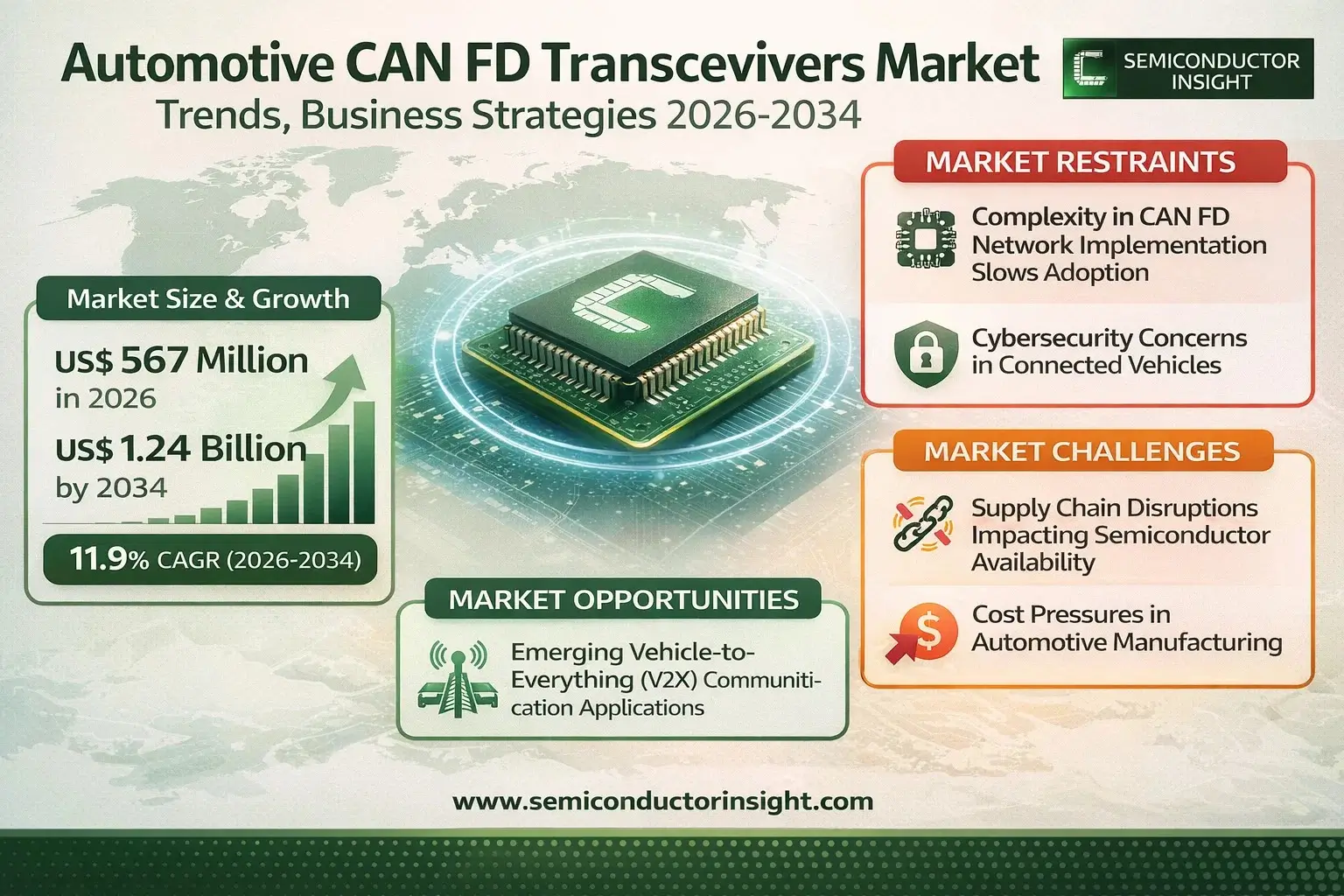
Automotive CAN FD Transceivers Market Share

Automotive CAN FD Transceivers MARKET DYNAMICS

Automotive CAN FD Transceivers MARKET DRIVERS

Increased Vehicle Electrification Driving Demand for High-Speed CAN FD Transceivers

The rapid electrification of vehicles worldwide is significantly boosting the CAN FD transceiver market growth. Modern electric vehicles require robust and high-speed communication networks to handle increasing data loads from advanced driver assistance systems (ADAS), battery management systems, and other electronic control units. CAN FD (Controller Area Network with Flexible Data Rate) transceivers provide the necessary bandwidth of up to 5 Mbps, compared to traditional CAN’s 1 Mbps, making them essential for next-generation automotive architectures. Global electric vehicle market is projected to grow at nearly 20% CAGR through 2030, directly correlating with increased adoption of CAN FD technology.

Advancements in Autonomous Driving Technologies Fueling Market Expansion

Autonomous vehicle development is accelerating market demand for reliable, high-speed in-vehicle networking solutions. CAN FD transceivers meet the stringent requirements of autonomous systems by providing deterministic communication with improved error detection capabilities. The enhanced data rates and larger payload capacity (up to 64 bytes versus classical CAN’s 8 bytes) make CAN FD ideal for handling the massive data streams from LiDAR, radar, and camera systems. Automakers are increasingly adopting SAE Level 2+ autonomous features, with projections indicating over 40% of new vehicles will incorporate some level of autonomous functionality by 2027.

Regulatory Push for Vehicle Safety Standards

Stringent global safety regulations are mandating advanced safety features that rely on robust communication networks. CAN FD transceivers enable compliance with these regulations by supporting critical safety functions like emergency braking, lane keeping assistance, and blind spot detection. The technology’s ability to maintain signal integrity in electrically noisy automotive environments while meeting stringent EMI/EMC requirements makes it particularly valuable for safety-critical applications. Regulatory bodies continue to expand mandatory safety feature requirements annually, driving continued adoption of CAN FD infrastructure.

Automotive CAN FD Transceivers MARKET RESTRAINTS

Complexity in CAN FD Network Implementation Slows Adoption

While CAN FD offers significant advantages, its implementation presents technical challenges that constrain market growth. The transition from classical CAN to CAN FD requires complete network redesigns, including updates to protocol stacks, hardware components, and testing methodologies. Many automotive manufacturers face difficulties in retrofitting existing vehicle architectures, particularly in cost-sensitive market segments. The need for specialized expertise in high-speed differential signaling and network optimization further complicates widespread adoption across all vehicle classes.

Cybersecurity Concerns in Connected Vehicles

The expanded data capacity of CAN FD networks presents new cybersecurity vulnerabilities that could deter adoption. As vehicles become more connected, the attack surface for potential cyber threats expands significantly. CAN FD’s higher bandwidth could potentially be exploited to execute more sophisticated attacks if proper security measures aren’t implemented. The automotive industry continues to struggle with establishing comprehensive security frameworks, with security-related recalls affecting major manufacturers annually. These challenges create hesitation among some automakers in fully committing to CAN FD architectures.

Automotive CAN FD Transceivers MARKET CHALLENGES

Supply Chain Disruptions Impacting Semiconductor Availability

The automotive semiconductor industry continues to face significant supply chain challenges that affect CAN FD transceiver production. Lead times for specialized automotive-grade components remain extended, with some parts facing allocations through 2025. The industry’s heavy reliance on a concentrated supply base creates vulnerabilities, as evidenced by recent production slowdowns among major automakers. These disruptions complicate planning for new vehicle programs that depend on stable CAN FD component supplies.

Cost Pressures in Automotive Manufacturing

Automotive OEMs face intense pressure to reduce electronic system costs while increasing functionality. CAN FD transceivers carry a cost premium over classical CAN solutions, creating budgetary challenges for high-volume vehicle programs. The need to validate and qualify new network architectures adds development costs that can be difficult to justify for entry-level vehicle segments. These economic realities slow the technology’s penetration across all vehicle classes, particularly in emerging markets where cost sensitivity is highest.

Automotive CAN FD Transceivers MARKET OPPORTUNITIES

Emerging Vehicle-to-Everything (V2X) Communication Applications

The development of vehicle-to-everything communication systems presents significant growth opportunities for CAN FD transceivers. These advanced networking applications require the high bandwidth and reliability that CAN FD provides for seamless integration between vehicle systems and infrastructure. Governments worldwide are investing heavily in smart city initiatives that will drive V2X adoption, with some regions mandating V2X technology in new vehicles as early as 2025. This regulatory push creates substantial market potential for CAN FD components in both vehicle and infrastructure applications.

Transition to Zonal Architectures in Vehicle Electronics

The automotive industry’s shift toward zonal electronic architectures represents a major opportunity for CAN FD technology. These new architectures consolidate functions into high-performance computing zones connected by high-speed networks. CAN FD is well-positioned to serve as the backbone for these systems due to its balance of performance and cost-effectiveness. The first production vehicles featuring zonal architectures launched in 2023, with projections indicating over 20% of new vehicles will adopt this approach by 2030.

AUTOMOTIVE CAN FD TRANSCEIVERS MARKET TRENDS

Growing Demand for High-Speed Data Transmission in Vehicles

The automotive industry is witnessing an exponential increase in demand for advanced in-vehicle communication networks, driving the adoption of Controller Area Network with Flexible Data-Rate (CAN FD) transceivers. These components enable faster data transmission rates of up to 8 Mbps, compared to the traditional CAN standard’s 1 Mbps, making them critical for modern automotive applications. The rise of connected vehicles, autonomous driving systems, and advanced driver-assistance systems (ADAS) has intensified the need for reliable, high-speed communication between electronic control units (ECUs). Over 90% of new vehicles now incorporate some form of CAN FD technology to support these features.

Other Trends

Electrification of Vehicles

Global shift toward electric vehicles (EVs) is another key driver for CAN FD transceivers. EVs require sophisticated battery management systems, charging control units, and power electronics that demand high-speed data exchange. As EV adoption grows with projections indicating 30% market penetration by 2030 the need for robust and efficient communication networks becomes even more critical. CAN FD transceivers, with their enhanced bandwidth and error-checking capabilities, are perfectly suited to meet these requirements.

Integration of Automotive IoT and V2X Communication

The emergence of Vehicle-to-Everything (V2X) communication is reshaping the automotive ecosystem, and CAN FD transceivers play a pivotal role in enabling these technologies. V2X relies on real-time data exchange between vehicles, infrastructure, and pedestrians, necessitating low-latency, high-throughput communication interfaces. Furthermore, the integration of the Internet of Things (IoT) in automotive applications such as predictive maintenance and over-the-air (OTA) updates demands scalable and secure networks. Automotive manufacturers are increasingly partnering with semiconductor companies to develop next-generation transceivers that support 5G and Ethernet convergence, ensuring seamless connectivity in future mobility solutions.

COMPETITIVE LANDSCAPE

Key Industry Players

Semiconductor Giants and Emerging Players Vie for Market Share in Automotive CAN FD Transceiver Space

Global Automotive CAN FD Transceivers Market features a mix of established semiconductor giants and specialized automotive electronics providers. NXP Semiconductors currently leads the competitive landscape, holding approximately 28% market share in 2024, thanks to its early adoption of CAN FD technology and strong relationships with major automakers. The company’s SJA1105EL series remains the industry benchmark for high-speed in-vehicle networking.

Following closely are Infineon Technologies and Texas Instruments (TI Semiconductor), which together account for nearly 35% of the market. These players have been aggressively expanding their product portfolios through both organic R&D and strategic acquisitions. Infineon’s acquisition of Cypress Semiconductor in 2020 significantly strengthened its position in automotive networking solutions, while TI continues to leverage its analog expertise to develop low-power CAN FD transceivers.

The market is witnessing intensified competition as ROHM Semiconductor and Microchip Technology ramp up production of cost-optimized solutions for mass-market vehicles. ROHM’s BD41040FJ-C series, launched in 2023, offers best-in-class electromagnetic compatibility (EMC) performance, making it particularly attractive for electric vehicle applications where noise immunity is critical.

Meanwhile, Analog Devices and ON Semiconductor are focusing on the premium segment, developing transceivers with advanced diagnostics and safety features for autonomous driving systems. Analog Devices’ recent collaboration with a leading European automaker to develop ISO 26262-compliant CAN FD solutions demonstrates this strategic direction.

List of Key Automotive CAN FD Transceiver Companies Profiled

The competitive dynamics are further intensified by regional players like China’s Silicon IoT, which is gaining traction in domestic markets with government-supported localization initiatives. As automakers increasingly demand customized solutions, smaller players with niche capabilities in areas like functional safety or power efficiency are finding opportunities to compete against industry heavyweights.

Segment Analysis:

By Type

Non-Isolated CAN FD Transceivers Segment Dominates Due to Cost-Effective Implementation and High Adoption in Mass-Market Vehicles

The market is segmented based on type into:

  • Isolated CAN FD Transceivers
    • Subtypes: Galvanically isolated, Optically isolated, and others
  • Non-isolated CAN FD Transceivers
  • Partial-isolation CAN FD Transceivers
  • Others

By Application

New Energy Vehicles Segment Shows Rapid Growth Owing to Increasing Electrification in Automotive Sector

The market is segmented based on application into:

  • Fuel Cars
    • Subtypes: Passenger vehicles, Commercial vehicles
  • New Energy Vehicles
    • Subtypes: Battery Electric Vehicles (BEVs), Hybrid Electric Vehicles (HEVs), Plug-in Hybrid Electric Vehicles (PHEVs)
  • Automotive Control Systems
  • Automotive Infotainment Systems

By Vehicle Type

Passenger Vehicles Segment Leads Due to Higher Production Volumes Globally

The market is segmented based on vehicle type into:

  • Passenger Vehicles
  • Commercial Vehicles
    • Subtypes: Light Commercial Vehicles, Heavy Commercial Vehicles
  • Off-Road Vehicles
  • Special Purpose Vehicles

By Communication Speed

High-Speed CAN FD Segment Maintains Dominance Supporting Advanced Automotive Network Requirements

The market is segmented based on communication speed into:

  • Classic CAN
  • CAN FD (Flexible Data-rate)
    • Subtypes: 2Mbps, 5Mbps, 8Mbps
  • CAN XL
  • Others

Regional Analysis: Automotive CAN FD Transceivers Market

North America
The North American market for Automotive CAN FD Transceivers is driven by stringent automotive safety standards and the rapid adoption of advanced driver assistance systems (ADAS) in vehicles. With approximately 16% of global automobile production concentrated in this region, manufacturers are prioritizing high-speed data communication solutions to meet growing demand for connected vehicle technologies. The U.S. remains the dominant market due to substantial investments in electric vehicles (EVs) and autonomous driving capabilities. Regulatory pressures favoring vehicle-to-everything (V2X) communication further accelerate CAN FD adoption, though cost sensitivity among legacy automakers presents a moderate challenge.

Europe
European automotive manufacturers lead in adopting CAN FD transceivers, supported by the region’s strong emphasis on automotive electronics standardization. With Germany producing over 20% of Europe’s vehicles, premium automakers are early adopters of CAN FD technology for enhanced in-vehicle networking. The EU’s strict emissions regulations and push for electrification create favorable conditions for market growth, particularly in powertrain applications. However, competition from alternative protocols like Automotive Ethernet presents a long-term challenge. Recent collaborations between semiconductor firms and automotive OEMs indicate sustained innovation in this space.

Asia-Pacific
As the world’s largest automotive production hub accounting for 56% of global output, Asia-Pacific dominates the CAN FD transceiver market volume. China’s rapidly expanding EV sector creates exceptional demand, with local manufacturers increasingly adopting CAN FD for battery management systems. Japan and South Korea remain technology leaders, though price competition pressures margins. While traditional CAN still dominates entry-level vehicles, the transition to higher bandwidth applications is accelerating throughout the region. Infrastructure limitations in emerging markets temporarily hinder full CAN FD implementation, but urbanization and rising consumer expectations ensure strong growth potential.

South America
The South American market shows gradual CAN FD adoption, primarily driven by multinational OEMs establishing regional production facilities. Brazil accounts for the majority of regional automotive output, with its focus on flex-fuel vehicles creating specialized demands for adaptable networking solutions. Economic instability and currency fluctuations have slowed investments in advanced automotive electronics, causing some manufacturers to delay CAN FD implementations. Nevertheless, the growing middle class and increasing safety regulations suggest promising long-term prospects as vehicle electrification gains traction across the region.

Middle East & Africa
This emerging market presents unique opportunities for CAN FD transceivers, particularly in luxury vehicle segments and commercial fleets. GCC countries show above-average adoption rates due to their preference for premium European and American vehicles featuring advanced networking capabilities. Africa’s automotive market remains constrained by economic factors, though increasing Chinese automotive investments introduce CAN FD technology through budget vehicle platforms. The absence of strong localized regulatory frameworks slows standardization, creating a fragmented implementation landscape across the region.

Report Scope

This market research report provides a comprehensive analysis of Global and regional Automotive CAN FD Transceivers Market, covering the forecast period 2025–2032. It offers detailed insights into market dynamics, technological advancements, competitive landscape, and key trends shaping the industry.

Key focus areas of the report include:

  • Market Size & Forecast: Historical data and future projections for revenue, unit shipments, and market value across major regions and segments. Global Automotive CAN FD Transceivers market was valued at USD 567 million in 2024 and is projected to reach USD 1.24 billion by 2032, growing at a CAGR of 11.9%.
  • Segmentation Analysis: Detailed breakdown by product type (isolated vs. non-isolated), application (fuel cars vs. new energy vehicles), and end-user industry to identify high-growth segments.
  • Regional Outlook: Insights into market performance across North America, Europe, Asia-Pacific, Latin America, and Middle East & Africa, with country-level analysis. Asia currently dominates with 56% market share.
  • Competitive Landscape: Profiles of 8 leading market participants including NXP Semiconductors, Infineon Technologies, and Texas Instruments, covering their product portfolios and strategic developments.
  • Technology Trends & Innovation: Assessment of emerging CAN FD protocols, integration with automotive Ethernet, and cybersecurity solutions for vehicle networks.
  • Market Drivers & Restraints: Evaluation of factors including increasing vehicle electrification (with 81.6 million vehicles produced globally in 2022) and challenges like semiconductor supply chain constraints.
  • Stakeholder Analysis: Strategic insights for automotive OEMs, tier-1 suppliers, semiconductor manufacturers, and investors regarding the evolving ecosystem.

The research methodology combines primary interviews with industry experts and analysis of verified market data from regulatory bodies including OICA (World Automobile Organization), ensuring report accuracy.

FREQUENTLY ASKED QUESTIONS:

What is the current market size of Global Automotive CAN FD Transceivers Market?

-> Automotive CAN FD Transceivers Market size was valued at USD 567 million in 2024 and is projected to reach USD 1.24 billion by 2032, at a CAGR of 11.9% during the forecast period 2025-2032.

Which key companies operate in this market?

-> Key players include NXP Semiconductors, Infineon Technologies, Texas Instruments, ROHM Semiconductor, and Microchip Technology, collectively holding 65% market share.

What are the key growth drivers?

-> Primary drivers include increasing vehicle electronics content (averaging USD 1,800 per vehicle), growth in electric vehicles, and mandatory safety regulations requiring advanced communication networks.

Which region dominates the market?

-> Asia-Pacific leads with 56% share, driven by China’s 32% global automotive production, followed by Europe (20%) and North America (16%).

What are the emerging trends?

-> Emerging trends include integration with automotive Ethernet, cybersecurity enhancements, and development of multi-protocol transceivers for next-generation vehicle architectures.
Automotive CAN FD Transceivers Market, Trends, Business Strategies 2026-2034

Get Sample Report PDF for Exclusive Insights

Report Sample Includes

  • Table of Contents
  • List of Tables & Figures
  • Charts, Research Methodology, and more...

PDF Icon Download Sample Report PDF

Download Sample Report

Table of Content

1 Introduction to Research & Analysis Reports
1.1 Automotive CAN FD Transceivers Market Definition
1.2 Market Segments
1.2.1 Segment by Type
1.2.2 Segment by Application
1.3 Global Automotive CAN FD Transceivers Market Overview
1.4 Features & Benefits of This Report
1.5 Methodology & Sources of Information
1.5.1 Research Methodology
1.5.2 Research Process
1.5.3 Base Year
1.5.4 Report Assumptions & Caveats
2 Global Automotive CAN FD Transceivers Overall Market Size
2.1 Global Automotive CAN FD Transceivers Market Size: 2024 VS 2032
2.2 Global Automotive CAN FD Transceivers Market Size, Prospects & Forecasts: 2020-2032
2.3 Global Automotive CAN FD Transceivers Sales: 2020-2032
3 Company Landscape
3.1 Top Automotive CAN FD Transceivers Players in Global Market
3.2 Top Global Automotive CAN FD Transceivers Companies Ranked by Revenue
3.3 Global Automotive CAN FD Transceivers Revenue by Companies
3.4 Global Automotive CAN FD Transceivers Sales by Companies
3.5 Global Automotive CAN FD Transceivers Price by Manufacturer (2020-2025)
3.6 Top 3 and Top 5 Automotive CAN FD Transceivers Companies in Global Market, by Revenue in 2024
3.7 Global Manufacturers Automotive CAN FD Transceivers Product Type
3.8 Tier 1, Tier 2, and Tier 3 Automotive CAN FD Transceivers Players in Global Market
3.8.1 List of Global Tier 1 Automotive CAN FD Transceivers Companies
3.8.2 List of Global Tier 2 and Tier 3 Automotive CAN FD Transceivers Companies
4 Sights by Product
4.1 Overview
4.1.1 Segment by Type – Global Automotive CAN FD Transceivers Market Size Markets, 2024 & 2032
4.1.2 Isolated
4.1.3 Non-isolated
4.2 Segment by Type – Global Automotive CAN FD Transceivers Revenue & Forecasts
4.2.1 Segment by Type – Global Automotive CAN FD Transceivers Revenue, 2020-2025
4.2.2 Segment by Type – Global Automotive CAN FD Transceivers Revenue, 2026-2032
4.2.3 Segment by Type – Global Automotive CAN FD Transceivers Revenue Market Share, 2020-2032
4.3 Segment by Type – Global Automotive CAN FD Transceivers Sales & Forecasts
4.3.1 Segment by Type – Global Automotive CAN FD Transceivers Sales, 2020-2025
4.3.2 Segment by Type – Global Automotive CAN FD Transceivers Sales, 2026-2032
4.3.3 Segment by Type – Global Automotive CAN FD Transceivers Sales Market Share, 2020-2032
4.4 Segment by Type – Global Automotive CAN FD Transceivers Price (Manufacturers Selling Prices), 2020-2032
5 Sights by Application
5.1 Overview
5.1.1 Segment by Application – Global Automotive CAN FD Transceivers Market Size, 2024 & 2032
5.1.2 Fuel Car
5.1.3 New Energy Vehicles
5.2 Segment by Application – Global Automotive CAN FD Transceivers Revenue & Forecasts
5.2.1 Segment by Application – Global Automotive CAN FD Transceivers Revenue, 2020-2025
5.2.2 Segment by Application – Global Automotive CAN FD Transceivers Revenue, 2026-2032
5.2.3 Segment by Application – Global Automotive CAN FD Transceivers Revenue Market Share, 2020-2032
5.3 Segment by Application – Global Automotive CAN FD Transceivers Sales & Forecasts
5.3.1 Segment by Application – Global Automotive CAN FD Transceivers Sales, 2020-2025
5.3.2 Segment by Application – Global Automotive CAN FD Transceivers Sales, 2026-2032
5.3.3 Segment by Application – Global Automotive CAN FD Transceivers Sales Market Share, 2020-2032
5.4 Segment by Application – Global Automotive CAN FD Transceivers Price (Manufacturers Selling Prices), 2020-2032
6 Sights by Region
6.1 By Region – Global Automotive CAN FD Transceivers Market Size, 2024 & 2032
6.2 By Region – Global Automotive CAN FD Transceivers Revenue & Forecasts
6.2.1 By Region – Global Automotive CAN FD Transceivers Revenue, 2020-2025
6.2.2 By Region – Global Automotive CAN FD Transceivers Revenue, 2026-2032
6.2.3 By Region – Global Automotive CAN FD Transceivers Revenue Market Share, 2020-2032
6.3 By Region – Global Automotive CAN FD Transceivers Sales & Forecasts
6.3.1 By Region – Global Automotive CAN FD Transceivers Sales, 2020-2025
6.3.2 By Region – Global Automotive CAN FD Transceivers Sales, 2026-2032
6.3.3 By Region – Global Automotive CAN FD Transceivers Sales Market Share, 2020-2032
6.4 North America
6.4.1 By Country – North America Automotive CAN FD Transceivers Revenue, 2020-2032
6.4.2 By Country – North America Automotive CAN FD Transceivers Sales, 2020-2032
6.4.3 United States Automotive CAN FD Transceivers Market Size, 2020-2032
6.4.4 Canada Automotive CAN FD Transceivers Market Size, 2020-2032
6.4.5 Mexico Automotive CAN FD Transceivers Market Size, 2020-2032
6.5 Europe
6.5.1 By Country – Europe Automotive CAN FD Transceivers Revenue, 2020-2032
6.5.2 By Country – Europe Automotive CAN FD Transceivers Sales, 2020-2032
6.5.3 Germany Automotive CAN FD Transceivers Market Size, 2020-2032
6.5.4 France Automotive CAN FD Transceivers Market Size, 2020-2032
6.5.5 U.K. Automotive CAN FD Transceivers Market Size, 2020-2032
6.5.6 Italy Automotive CAN FD Transceivers Market Size, 2020-2032
6.5.7 Russia Automotive CAN FD Transceivers Market Size, 2020-2032
6.5.8 Nordic Countries Automotive CAN FD Transceivers Market Size, 2020-2032
6.5.9 Benelux Automotive CAN FD Transceivers Market Size, 2020-2032
6.6 Asia
6.6.1 By Region – Asia Automotive CAN FD Transceivers Revenue, 2020-2032
6.6.2 By Region – Asia Automotive CAN FD Transceivers Sales, 2020-2032
6.6.3 China Automotive CAN FD Transceivers Market Size, 2020-2032
6.6.4 Japan Automotive CAN FD Transceivers Market Size, 2020-2032
6.6.5 South Korea Automotive CAN FD Transceivers Market Size, 2020-2032
6.6.6 Southeast Asia Automotive CAN FD Transceivers Market Size, 2020-2032
6.6.7 India Automotive CAN FD Transceivers Market Size, 2020-2032
6.7 South America
6.7.1 By Country – South America Automotive CAN FD Transceivers Revenue, 2020-2032
6.7.2 By Country – South America Automotive CAN FD Transceivers Sales, 2020-2032
6.7.3 Brazil Automotive CAN FD Transceivers Market Size, 2020-2032
6.7.4 Argentina Automotive CAN FD Transceivers Market Size, 2020-2032
6.8 Middle East & Africa
6.8.1 By Country – Middle East & Africa Automotive CAN FD Transceivers Revenue, 2020-2032
6.8.2 By Country – Middle East & Africa Automotive CAN FD Transceivers Sales, 2020-2032
6.8.3 Turkey Automotive CAN FD Transceivers Market Size, 2020-2032
6.8.4 Israel Automotive CAN FD Transceivers Market Size, 2020-2032
6.8.5 Saudi Arabia Automotive CAN FD Transceivers Market Size, 2020-2032
6.8.6 UAE Automotive CAN FD Transceivers Market Size, 2020-2032
7 Manufacturers & Brands Profiles
7.1 ROHM Semiconductor
7.1.1 ROHM Semiconductor Company Summary
7.1.2 ROHM Semiconductor Business Overview
7.1.3 ROHM Semiconductor Automotive CAN FD Transceivers Major Product Offerings
7.1.4 ROHM Semiconductor Automotive CAN FD Transceivers Sales and Revenue in Global (2020-2025)
7.1.5 ROHM Semiconductor Key News & Latest Developments
7.2 NXP Semiconductors
7.2.1 NXP Semiconductors Company Summary
7.2.2 NXP Semiconductors Business Overview
7.2.3 NXP Semiconductors Automotive CAN FD Transceivers Major Product Offerings
7.2.4 NXP Semiconductors Automotive CAN FD Transceivers Sales and Revenue in Global (2020-2025)
7.2.5 NXP Semiconductors Key News & Latest Developments
7.3 Infineon Technologies
7.3.1 Infineon Technologies Company Summary
7.3.2 Infineon Technologies Business Overview
7.3.3 Infineon Technologies Automotive CAN FD Transceivers Major Product Offerings
7.3.4 Infineon Technologies Automotive CAN FD Transceivers Sales and Revenue in Global (2020-2025)
7.3.5 Infineon Technologies Key News & Latest Developments
7.4 ON Semiconductor
7.4.1 ON Semiconductor Company Summary
7.4.2 ON Semiconductor Business Overview
7.4.3 ON Semiconductor Automotive CAN FD Transceivers Major Product Offerings
7.4.4 ON Semiconductor Automotive CAN FD Transceivers Sales and Revenue in Global (2020-2025)
7.4.5 ON Semiconductor Key News & Latest Developments
7.5 TI Semiconductor
7.5.1 TI Semiconductor Company Summary
7.5.2 TI Semiconductor Business Overview
7.5.3 TI Semiconductor Automotive CAN FD Transceivers Major Product Offerings
7.5.4 TI Semiconductor Automotive CAN FD Transceivers Sales and Revenue in Global (2020-2025)
7.5.5 TI Semiconductor Key News & Latest Developments
7.6 Microchip Technology
7.6.1 Microchip Technology Company Summary
7.6.2 Microchip Technology Business Overview
7.6.3 Microchip Technology Automotive CAN FD Transceivers Major Product Offerings
7.6.4 Microchip Technology Automotive CAN FD Transceivers Sales and Revenue in Global (2020-2025)
7.6.5 Microchip Technology Key News & Latest Developments
7.7 Analog Devices
7.7.1 Analog Devices Company Summary
7.7.2 Analog Devices Business Overview
7.7.3 Analog Devices Automotive CAN FD Transceivers Major Product Offerings
7.7.4 Analog Devices Automotive CAN FD Transceivers Sales and Revenue in Global (2020-2025)
7.7.5 Analog Devices Key News & Latest Developments
7.8 Silicon IoT
7.8.1 Silicon IoT Company Summary
7.8.2 Silicon IoT Business Overview
7.8.3 Silicon IoT Automotive CAN FD Transceivers Major Product Offerings
7.8.4 Silicon IoT Automotive CAN FD Transceivers Sales and Revenue in Global (2020-2025)
7.8.5 Silicon IoT Key News & Latest Developments
8 Global Automotive CAN FD Transceivers Production Capacity, Analysis
8.1 Global Automotive CAN FD Transceivers Production Capacity, 2020-2032
8.2 Automotive CAN FD Transceivers Production Capacity of Key Manufacturers in Global Market
8.3 Global Automotive CAN FD Transceivers Production by Region
9 Key Market Trends, Opportunity, Drivers and Restraints
9.1 Market Opportunities & Trends
9.2 Market Drivers
9.3 Market Restraints
10 Automotive CAN FD Transceivers Supply Chain Analysis
10.1 Automotive CAN FD Transceivers Industry Value Chain
10.2 Automotive CAN FD Transceivers Upstream Market
10.3 Automotive CAN FD Transceivers Downstream and Clients
10.4 Marketing Channels Analysis
10.4.1 Marketing Channels
10.4.2 Automotive CAN FD Transceivers Distributors and Sales Agents in Global
11 Conclusion
12 Appendix
12.1 Note
12.2 Examples of Clients
12.3 DisclaimerList of Tables
Table 1. Key Players of Automotive CAN FD Transceivers in Global Market
Table 2. Top Automotive CAN FD Transceivers Players in Global Market, Ranking by Revenue (2024)
Table 3. Global Automotive CAN FD Transceivers Revenue by Companies, (US$, Mn), 2020-2025
Table 4. Global Automotive CAN FD Transceivers Revenue Share by Companies, 2020-2025
Table 5. Global Automotive CAN FD Transceivers Sales by Companies, (K Units), 2020-2025
Table 6. Global Automotive CAN FD Transceivers Sales Share by Companies, 2020-2025
Table 7. Key Manufacturers Automotive CAN FD Transceivers Price (2020-2025) & (US$/K Units)
Table 8. Global Manufacturers Automotive CAN FD Transceivers Product Type
Table 9. List of Global Tier 1 Automotive CAN FD Transceivers Companies, Revenue (US$, Mn) in 2024 and Market Share
Table 10. List of Global Tier 2 and Tier 3 Automotive CAN FD Transceivers Companies, Revenue (US$, Mn) in 2024 and Market Share
Table 11. Segment by Type – Global Automotive CAN FD Transceivers Revenue, (US$, Mn), 2024 & 2032
Table 12. Segment by Type – Global Automotive CAN FD Transceivers Revenue (US$, Mn), 2020-2025
Table 13. Segment by Type – Global Automotive CAN FD Transceivers Revenue (US$, Mn), 2026-2032
Table 14. Segment by Type – Global Automotive CAN FD Transceivers Sales (K Units), 2020-2025
Table 15. Segment by Type – Global Automotive CAN FD Transceivers Sales (K Units), 2026-2032
Table 16. Segment by Application – Global Automotive CAN FD Transceivers Revenue, (US$, Mn), 2024 & 2032
Table 17. Segment by Application – Global Automotive CAN FD Transceivers Revenue, (US$, Mn), 2020-2025
Table 18. Segment by Application – Global Automotive CAN FD Transceivers Revenue, (US$, Mn), 2026-2032
Table 19. Segment by Application – Global Automotive CAN FD Transceivers Sales, (K Units), 2020-2025
Table 20. Segment by Application – Global Automotive CAN FD Transceivers Sales, (K Units), 2026-2032
Table 21. By Region – Global Automotive CAN FD Transceivers Revenue, (US$, Mn), 2025-2032
Table 22. By Region – Global Automotive CAN FD Transceivers Revenue, (US$, Mn), 2020-2025
Table 23. By Region – Global Automotive CAN FD Transceivers Revenue, (US$, Mn), 2026-2032
Table 24. By Region – Global Automotive CAN FD Transceivers Sales, (K Units), 2020-2025
Table 25. By Region – Global Automotive CAN FD Transceivers Sales, (K Units), 2026-2032
Table 26. By Country – North America Automotive CAN FD Transceivers Revenue, (US$, Mn), 2020-2025
Table 27. By Country – North America Automotive CAN FD Transceivers Revenue, (US$, Mn), 2026-2032
Table 28. By Country – North America Automotive CAN FD Transceivers Sales, (K Units), 2020-2025
Table 29. By Country – North America Automotive CAN FD Transceivers Sales, (K Units), 2026-2032
Table 30. By Country – Europe Automotive CAN FD Transceivers Revenue, (US$, Mn), 2020-2025
Table 31. By Country – Europe Automotive CAN FD Transceivers Revenue, (US$, Mn), 2026-2032
Table 32. By Country – Europe Automotive CAN FD Transceivers Sales, (K Units), 2020-2025
Table 33. By Country – Europe Automotive CAN FD Transceivers Sales, (K Units), 2026-2032
Table 34. By Region – Asia Automotive CAN FD Transceivers Revenue, (US$, Mn), 2020-2025
Table 35. By Region – Asia Automotive CAN FD Transceivers Revenue, (US$, Mn), 2026-2032
Table 36. By Region – Asia Automotive CAN FD Transceivers Sales, (K Units), 2020-2025
Table 37. By Region – Asia Automotive CAN FD Transceivers Sales, (K Units), 2026-2032
Table 38. By Country – South America Automotive CAN FD Transceivers Revenue, (US$, Mn), 2020-2025
Table 39. By Country – South America Automotive CAN FD Transceivers Revenue, (US$, Mn), 2026-2032
Table 40. By Country – South America Automotive CAN FD Transceivers Sales, (K Units), 2020-2025
Table 41. By Country – South America Automotive CAN FD Transceivers Sales, (K Units), 2026-2032
Table 42. By Country – Middle East & Africa Automotive CAN FD Transceivers Revenue, (US$, Mn), 2020-2025
Table 43. By Country – Middle East & Africa Automotive CAN FD Transceivers Revenue, (US$, Mn), 2026-2032
Table 44. By Country – Middle East & Africa Automotive CAN FD Transceivers Sales, (K Units), 2020-2025
Table 45. By Country – Middle East & Africa Automotive CAN FD Transceivers Sales, (K Units), 2026-2032
Table 46. ROHM Semiconductor Company Summary
Table 47. ROHM Semiconductor Automotive CAN FD Transceivers Product Offerings
Table 48. ROHM Semiconductor Automotive CAN FD Transceivers Sales (K Units), Revenue (US$, Mn) and Average Price (US$/K Units) & (2020-2025)
Table 49. ROHM Semiconductor Key News & Latest Developments
Table 50. NXP Semiconductors Company Summary
Table 51. NXP Semiconductors Automotive CAN FD Transceivers Product Offerings
Table 52. NXP Semiconductors Automotive CAN FD Transceivers Sales (K Units), Revenue (US$, Mn) and Average Price (US$/K Units) & (2020-2025)
Table 53. NXP Semiconductors Key News & Latest Developments
Table 54. Infineon Technologies Company Summary
Table 55. Infineon Technologies Automotive CAN FD Transceivers Product Offerings
Table 56. Infineon Technologies Automotive CAN FD Transceivers Sales (K Units), Revenue (US$, Mn) and Average Price (US$/K Units) & (2020-2025)
Table 57. Infineon Technologies Key News & Latest Developments
Table 58. ON Semiconductor Company Summary
Table 59. ON Semiconductor Automotive CAN FD Transceivers Product Offerings
Table 60. ON Semiconductor Automotive CAN FD Transceivers Sales (K Units), Revenue (US$, Mn) and Average Price (US$/K Units) & (2020-2025)
Table 61. ON Semiconductor Key News & Latest Developments
Table 62. TI Semiconductor Company Summary
Table 63. TI Semiconductor Automotive CAN FD Transceivers Product Offerings
Table 64. TI Semiconductor Automotive CAN FD Transceivers Sales (K Units), Revenue (US$, Mn) and Average Price (US$/K Units) & (2020-2025)
Table 65. TI Semiconductor Key News & Latest Developments
Table 66. Microchip Technology Company Summary
Table 67. Microchip Technology Automotive CAN FD Transceivers Product Offerings
Table 68. Microchip Technology Automotive CAN FD Transceivers Sales (K Units), Revenue (US$, Mn) and Average Price (US$/K Units) & (2020-2025)
Table 69. Microchip Technology Key News & Latest Developments
Table 70. Analog Devices Company Summary
Table 71. Analog Devices Automotive CAN FD Transceivers Product Offerings
Table 72. Analog Devices Automotive CAN FD Transceivers Sales (K Units), Revenue (US$, Mn) and Average Price (US$/K Units) & (2020-2025)
Table 73. Analog Devices Key News & Latest Developments
Table 74. Silicon IoT Company Summary
Table 75. Silicon IoT Automotive CAN FD Transceivers Product Offerings
Table 76. Silicon IoT Automotive CAN FD Transceivers Sales (K Units), Revenue (US$, Mn) and Average Price (US$/K Units) & (2020-2025)
Table 77. Silicon IoT Key News & Latest Developments
Table 78. Automotive CAN FD Transceivers Capacity of Key Manufacturers in Global Market, 2023-2025 (K Units)
Table 79. Global Automotive CAN FD Transceivers Capacity Market Share of Key Manufacturers, 2023-2025
Table 80. Global Automotive CAN FD Transceivers Production by Region, 2020-2025 (K Units)
Table 81. Global Automotive CAN FD Transceivers Production by Region, 2026-2032 (K Units)
Table 82. Automotive CAN FD Transceivers Market Opportunities & Trends in Global Market
Table 83. Automotive CAN FD Transceivers Market Drivers in Global Market
Table 84. Automotive CAN FD Transceivers Market Restraints in Global Market
Table 85. Automotive CAN FD Transceivers Raw Materials
Table 86. Automotive CAN FD Transceivers Raw Materials Suppliers in Global Market
Table 87. Typical Automotive CAN FD Transceivers Downstream
Table 88. Automotive CAN FD Transceivers Downstream Clients in Global Market
Table 89. Automotive CAN FD Transceivers Distributors and Sales Agents in Global Market

List of Figures
Figure 1. Automotive CAN FD Transceivers Product Picture
Figure 2. Automotive CAN FD Transceivers Segment by Type in 2024
Figure 3. Automotive CAN FD Transceivers Segment by Application in 2024
Figure 4. Global Automotive CAN FD Transceivers Market Overview: 2024
Figure 5. Key Caveats
Figure 6. Global Automotive CAN FD Transceivers Market Size: 2024 VS 2032 (US$, Mn)
Figure 7. Global Automotive CAN FD Transceivers Revenue: 2020-2032 (US$, Mn)
Figure 8. Automotive CAN FD Transceivers Sales in Global Market: 2020-2032 (K Units)
Figure 9. The Top 3 and 5 Players Market Share by Automotive CAN FD Transceivers Revenue in 2024
Figure 10. Segment by Type – Global Automotive CAN FD Transceivers Revenue, (US$, Mn), 2024 & 2032
Figure 11. Segment by Type – Global Automotive CAN FD Transceivers Revenue Market Share, 2020-2032
Figure 12. Segment by Type – Global Automotive CAN FD Transceivers Sales Market Share, 2020-2032
Figure 13. Segment by Type – Global Automotive CAN FD Transceivers Price (US$/K Units), 2020-2032
Figure 14. Segment by Application – Global Automotive CAN FD Transceivers Revenue, (US$, Mn), 2024 & 2032
Figure 15. Segment by Application – Global Automotive CAN FD Transceivers Revenue Market Share, 2020-2032
Figure 16. Segment by Application – Global Automotive CAN FD Transceivers Sales Market Share, 2020-2032
Figure 17. Segment by Application -Global Automotive CAN FD Transceivers Price (US$/K Units), 2020-2032
Figure 18. By Region – Global Automotive CAN FD Transceivers Revenue, (US$, Mn), 2025 & 2032
Figure 19. By Region – Global Automotive CAN FD Transceivers Revenue Market Share, 2020 VS 2024 VS 2032
Figure 20. By Region – Global Automotive CAN FD Transceivers Revenue Market Share, 2020-2032
Figure 21. By Region – Global Automotive CAN FD Transceivers Sales Market Share, 2020-2032
Figure 22. By Country – North America Automotive CAN FD Transceivers Revenue Market Share, 2020-2032
Figure 23. By Country – North America Automotive CAN FD Transceivers Sales Market Share, 2020-2032
Figure 24. United States Automotive CAN FD Transceivers Revenue, (US$, Mn), 2020-2032
Figure 25. Canada Automotive CAN FD Transceivers Revenue, (US$, Mn), 2020-2032
Figure 26. Mexico Automotive CAN FD Transceivers Revenue, (US$, Mn), 2020-2032
Figure 27. By Country – Europe Automotive CAN FD Transceivers Revenue Market Share, 2020-2032
Figure 28. By Country – Europe Automotive CAN FD Transceivers Sales Market Share, 2020-2032
Figure 29. Germany Automotive CAN FD Transceivers Revenue, (US$, Mn), 2020-2032
Figure 30. France Automotive CAN FD Transceivers Revenue, (US$, Mn), 2020-2032
Figure 31. U.K. Automotive CAN FD Transceivers Revenue, (US$, Mn), 2020-2032
Figure 32. Italy Automotive CAN FD Transceivers Revenue, (US$, Mn), 2020-2032
Figure 33. Russia Automotive CAN FD Transceivers Revenue, (US$, Mn), 2020-2032
Figure 34. Nordic Countries Automotive CAN FD Transceivers Revenue, (US$, Mn), 2020-2032
Figure 35. Benelux Automotive CAN FD Transceivers Revenue, (US$, Mn), 2020-2032
Figure 36. By Region – Asia Automotive CAN FD Transceivers Revenue Market Share, 2020-2032
Figure 37. By Region – Asia Automotive CAN FD Transceivers Sales Market Share, 2020-2032
Figure 38. China Automotive CAN FD Transceivers Revenue, (US$, Mn), 2020-2032
Figure 39. Japan Automotive CAN FD Transceivers Revenue, (US$, Mn), 2020-2032
Figure 40. South Korea Automotive CAN FD Transceivers Revenue, (US$, Mn), 2020-2032
Figure 41. Southeast Asia Automotive CAN FD Transceivers Revenue, (US$, Mn), 2020-2032
Figure 42. India Automotive CAN FD Transceivers Revenue, (US$, Mn), 2020-2032
Figure 43. By Country – South America Automotive CAN FD Transceivers Revenue Market Share, 2020-2032
Figure 44. By Country – South America Automotive CAN FD Transceivers Sales, Market Share, 2020-2032
Figure 45. Brazil Automotive CAN FD Transceivers Revenue, (US$, Mn), 2020-2032
Figure 46. Argentina Automotive CAN FD Transceivers Revenue, (US$, Mn), 2020-2032
Figure 47. By Country – Middle East & Africa Automotive CAN FD Transceivers Revenue, Market Share, 2020-2032
Figure 48. By Country – Middle East & Africa Automotive CAN FD Transceivers Sales, Market Share, 2020-2032
Figure 49. Turkey Automotive CAN FD Transceivers Revenue, (US$, Mn), 2020-2032
Figure 50. Israel Automotive CAN FD Transceivers Revenue, (US$, Mn), 2020-2032
Figure 51. Saudi Arabia Automotive CAN FD Transceivers Revenue, (US$, Mn), 2020-2032
Figure 52. UAE Automotive CAN FD Transceivers Revenue, (US$, Mn), 2020-2032
Figure 53. Global Automotive CAN FD Transceivers Production Capacity (K Units), 2020-2032
Figure 54. The Percentage of Production Automotive CAN FD Transceivers by Region, 2024 VS 2032
Figure 55. Automotive CAN FD Transceivers Industry Value Chain
Figure 56. Marketing Channels
