
How Electrochemical Chlorine Sensors Market Supports Cleanroom Precision?
In a semiconductor fabrication facility, even a trace amount of chlorine gas can quietly disrupt an entire production cycle. It is not always visible, not always immediate but when it interacts with sensitive processes, the consequences can be costly. This is exactly where electrochemical chlorine sensors market finds its relevance, operating behind the scenes as a silent safeguard in highly controlled environments.
These devices, in contrast to standard industrial sensors, are designed for ultra-sensitive detection, guaranteeing that even minute gas leaks are detected before they become contamination risks or safety issues. Such monitoring systems are integrated into the operational framework of semiconductor fabrication, where accuracy is measured at the atomic level.
Cleanroom Ecosystems and Gas Integrity Monitoring
- Semiconductor cleanrooms are designed to eliminate particles, but gas purity is just as critical as air cleanliness.
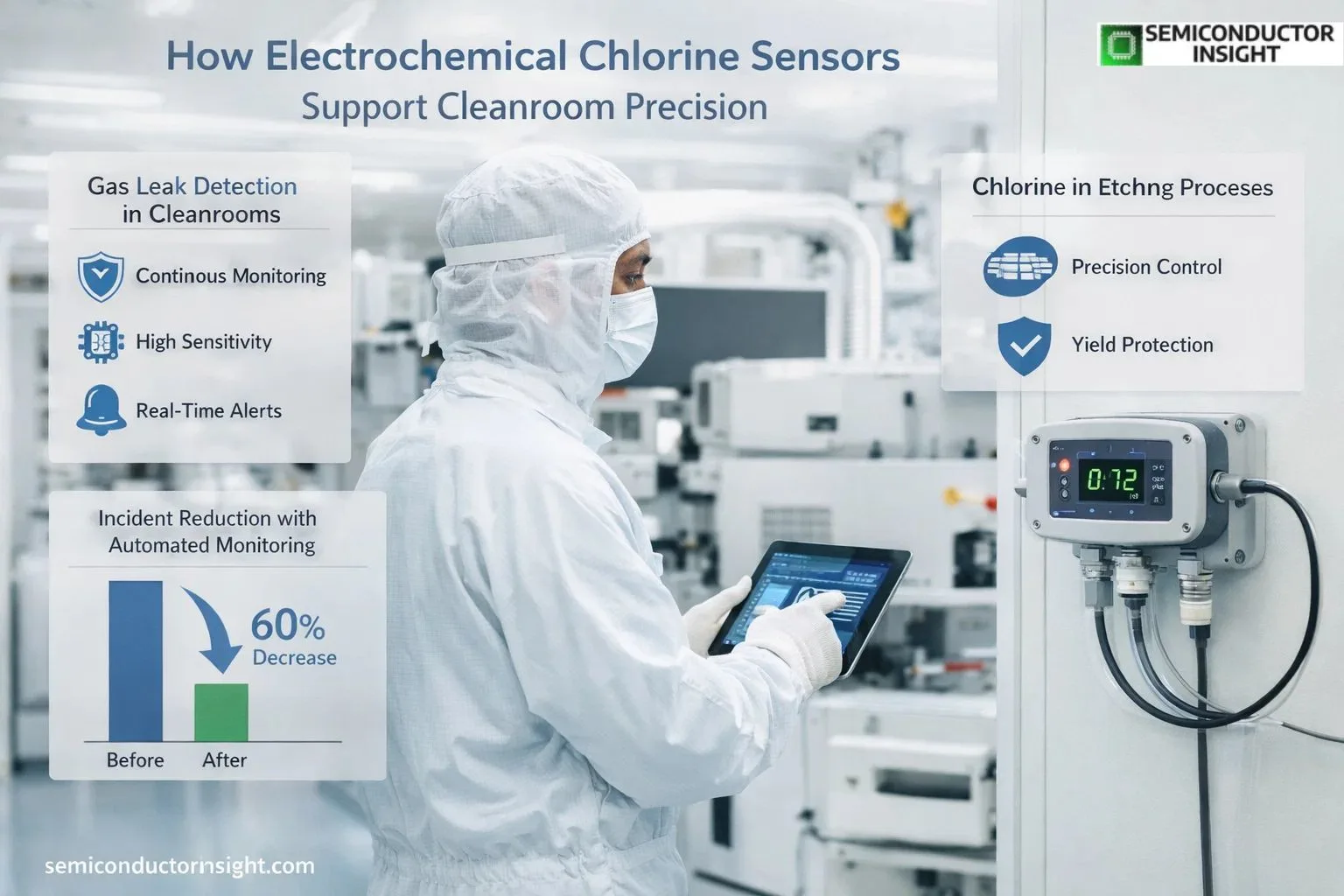
- Chlorine is widely used in etching and cleaning processes, making continuous monitoring essential.
- Modern fabrication plants integrate electrochemical chlorine sensors directly into gas delivery systems, exhaust lines, and cleanroom zones. These sensors continuously track concentration levels, ensuring that deviations are detected in real time.
- Industry safety documentation from organizations like Semiconductor Equipment and Materials International highlights that gas-related incidents account for a notable share of fab disruptions, reinforcing the importance of continuous gas surveillance in maintaining production stability.
Etching Processes and the Need for Precision Detection
Chlorine plays a central role in plasma etching, a process used to define intricate circuit patterns on silicon wafers. However, uncontrolled exposure or leakage can affect both equipment and wafer integrity.
Electrochemical sensors are specifically designed to function in these environments, where high sensitivity and rapid response times are essential. Their ability to detect low parts-per-million concentrations allows fabs to maintain strict process control.
In advanced nodes, where chip architectures are becoming increasingly complex, even slight inconsistencies in process gases can impact yield. This makes precision sensing systems a critical layer of protection within etching operations.
Integration with Smart Fab Automation Systems
Semiconductor manufacturing is steadily moving toward fully automated, data-driven fabs. Electrochemical chlorine sensors are now part of integrated monitoring networks connected to central control systems.
These sensors feed real-time data into facility management platforms, enabling automated alerts, shutdown protocols, and predictive maintenance workflows. Instead of reacting to incidents, fabs can proactively manage risks.
Reports from semiconductor equipment manufacturers indicate that automated gas monitoring systems can reduce incident response times by over 40%, significantly improving operational efficiency and safety.
This shift reflects a broader move toward smart sensing infrastructure, where sensors are not standalone devices but part of a connected ecosystem.
Harsh Environment Exposure Driving Demand for Advanced Material Compatibility in Long-Life Sensor Systems
- One of the lesser-discussed challenges in this market is material durability. Semiconductor environments expose sensors to corrosive gases, temperature variations, and continuous operation cycles.
- Manufacturers are focusing on developing sensors with enhanced electrode materials and protective coatings to extend lifespan and maintain accuracy. Stability over time is crucial, as frequent sensor replacement can disrupt operations and increase costs.
- The emphasis on durability engineering ensures that sensors can perform reliably without frequent recalibration, aligning with the high uptime requirements of semiconductor fabs.
Access the full report to explore detailed analysis and actionable insights: https://semiconductorinsight.com/report/electrochemical-chlorine-sensors-market/
Boosting Industrial Adoption outside Core Fab Operations
While semiconductor fabs remain the primary application area, the use of electrochemical chlorine sensors is expanding into adjacent sectors such as flat panel display manufacturing and advanced materials processing.
These industries share similar requirements for high-purity environments and precise gas control. As a result, sensor manufacturers are adapting their technologies to serve a broader range of high-tech applications.
This diversification highlights the growing importance of cross-industry sensing solutions, where expertise developed in semiconductor environments is being applied to other precision-driven sectors.
Competitive Innovation and Sensor Miniaturization Trends
Smaller, more effective, and simpler-to-integrate sensors are becoming more and more important in the competitive marketplace. More adaptable deployment inside intricate equipment architectures is made possible by miniaturisation.
At the same time, improvements in calibration techniques and digital interfaces are enhancing usability and data accuracy. Companies are also exploring wireless connectivity to simplify installation and maintenance.
This wave of innovation is shaping the next generation of sensors, where compact design meets high performance defining the future of advanced detection technologies in semiconductor ecosystems.

Comments (0)