Electrochemical Chlorine Sensors Market Insights
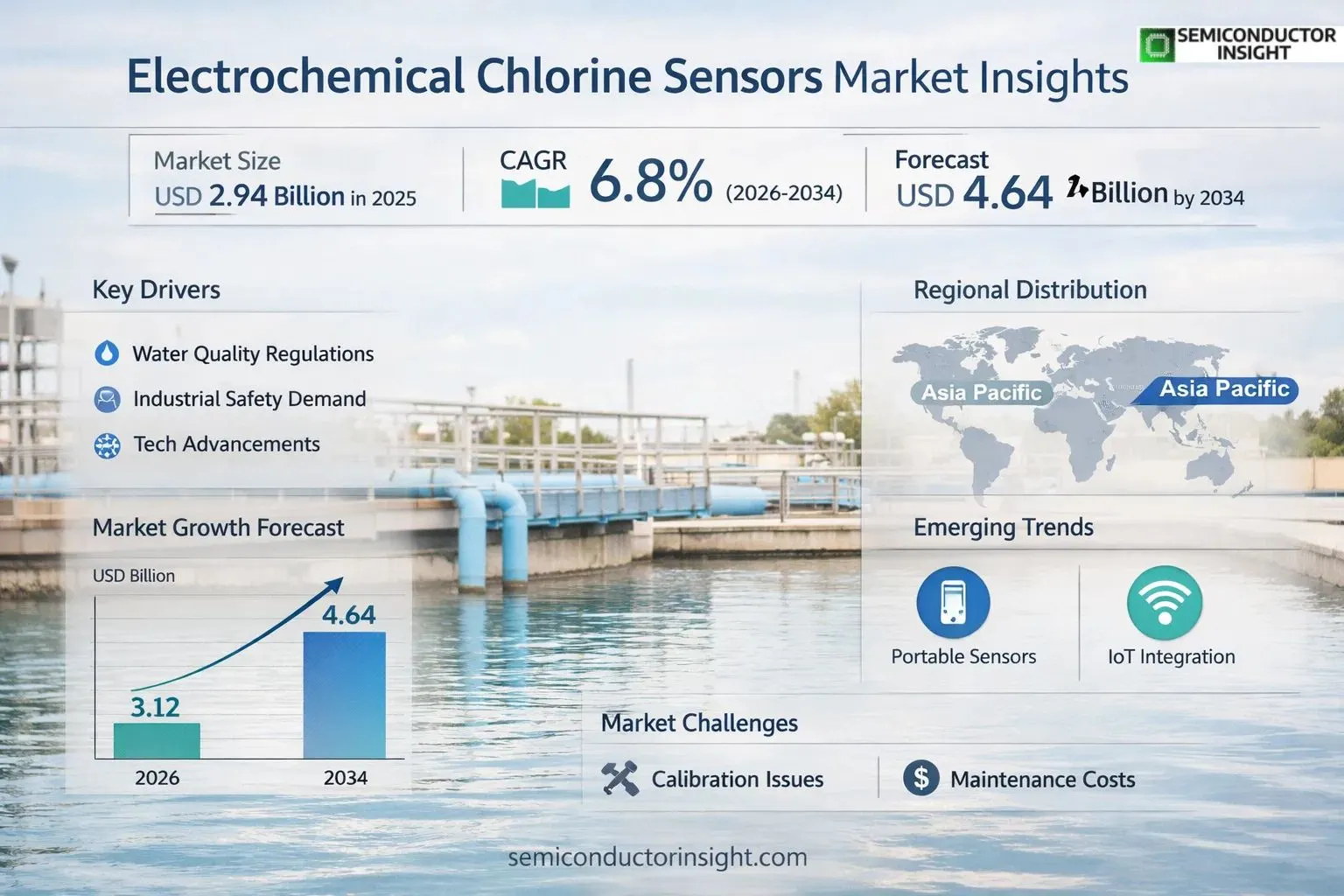
Global electrochemical chlorine sensors market size was valued at USD 2.94 billion in 2025. The market is projected to grow from USD 3.12 billion in 2026 to USD 4.64 billion by 2034, exhibiting a CAGR of 6.8% during the forecast period.
Electrochemical chlorine sensors are analytical instruments used to detect the concentration of chlorine gas or chloride ions in various environments. These sensors operate on electrochemical principles, leveraging redox reactions on specialized electrodes to generate measurable electrical signals proportional to chlorine levels. Known for their high sensitivity, selectivity, and rapid response times, they are indispensable in water treatment plants for residual chlorine monitoring and industrial settings for leak detection.
The market growth is driven by stringent environmental regulations, increasing water quality monitoring requirements, and rising industrial safety standards worldwide. Key players like Honeywell Analytics and Drägerwerk AG & Co. KGaA are expanding their portfolios with advanced sensor technologies, while emerging economies are witnessing accelerated adoption due to infrastructure development.
MARKET DRIVERS
Increasing Water Quality Regulations
Global Electrochemical Chlorine Sensors Market is experiencing significant growth due to stringent water quality regulations imposed by governments worldwide. Municipalities and industrial facilities are mandated to monitor chlorine levels in water treatment processes, driving demand for accurate electrochemical sensors. The U.S. Environmental Protection Agency’s Safe Drinking Water Act and similar regulations in Europe and Asia-Pacific are key factors propelling market expansion.
Technological Advancements in Sensor Design
Recent innovations in electrochemical chlorine sensor technology have improved detection limits to 0.01 ppm while enhancing sensor longevity. Manufacturers are developing sensors with reduced maintenance requirements and better resistance to fouling, making them more attractive for continuous monitoring applications. These technological improvements are driving adoption across multiple industries.
➤ Global water treatment chemicals market, valued at $38.2 billion in 2023, creates substantial ancillary demand for reliable chlorine monitoring solutions.
Growing awareness of waterborne diseases and the importance of disinfection in food processing plants is further accelerating market growth. The healthcare sector’s increasing use of electrochemical chlorine sensors for sterilization validation presents additional growth opportunities.
MARKET CHALLENGES
Sensor Calibration and Maintenance Requirements
A significant challenge facing Electrochemical Chlorine Sensors Market is the need for frequent calibration to maintain measurement accuracy. Operators in water treatment facilities often struggle with maintaining optimal sensor performance, particularly in harsh environmental conditions.
Other Challenges
Competition from Alternative Technologies
Optical chlorine sensors and colorimetric methods continue to compete with electrochemical sensors in certain applications, particularly where intermittent monitoring is sufficient. The higher initial cost of some electrochemical systems remains a barrier for budget-conscious facilities.
MARKET RESTRAINTS
High Replacement Costs
While electrochemical chlorine sensors offer numerous advantages, their total cost of ownership can be a restraint. Membrane replacement and electrolyte refill requirements add to operational expenses, with some industrial users reporting annual maintenance costs reaching 20% of the initial sensor investment.
MARKET OPPORTUNITIES
Emerging Smart Water Infrastructure Projects
The growing investment in smart city initiatives worldwide presents substantial opportunities for Electrochemical Chlorine Sensors Market. Integration of chlorine sensors with IoT-enabled monitoring systems allows for real-time water quality assessment, with projected deployment in over 35% of new urban water networks by 2025.
Expansion in Aquaculture Applications
The aquaculture industry’s rapid growth is creating new demand for precise chlorine monitoring in hatcheries and fish farms. Increasing awareness of the relationship between optimal chlorine levels and fish health is driving adoption rates in this sector, particularly in Asia-Pacific markets.
Electrochemical Chlorine Sensors Market Trends
Increasing Demand in Water Treatment Applications
Electrochemical chlorine sensors market is experiencing significant growth in water treatment applications due to stricter regulations on water safety. Municipalities and industrial facilities are adopting these sensors to maintain precise chlorine level monitoring in drinking water and wastewater systems. The technology’s fast response time and accuracy make it ideal for real-time process control in large-scale water distribution networks.
Other Trends
Portable Sensor Segment Growth
Portable electrochemical chlorine sensors are gaining traction for field testing and emergency response applications. These compact devices enable environmental agencies and industrial safety teams to conduct on-site chlorine measurements with laboratory-grade accuracy. The segment benefits from advancements in battery technology and miniaturized electrochemical cells.
Technological Advancements in Sensor Design
Manufacturers are developing electrochemical chlorine sensors with improved selectivity against interfering gases and longer service life. New electrode materials and membrane technologies are enhancing measurement stability in harsh industrial environments. Some latest models incorporate wireless connectivity for integration with IoT-based monitoring systems.
Expansion in Emerging Markets
Developing regions are investing heavily in water infrastructure and industrial safety, driving demand for electrochemical chlorine sensors. Governments in Asia and the Middle East are implementing stricter environmental monitoring regulations, creating new growth opportunities for sensor manufacturers.
Industry Consolidation and Strategic Partnerships
Electrochemical chlorine sensors market is witnessing consolidation as major players acquire specialized technology providers. Established safety equipment manufacturers are forming partnerships with sensor technology firms to develop integrated monitoring solutions for industrial applications.
COMPETITIVE LANDSCAPE
Key Industry Players
Strategic Positioning in the $4.6 Billion Chlorine Sensor Market
Electrochemical chlorine sensors market demonstrates a moderately concentrated competitive structure, with the top five players accounting for approximately XX% of global revenue as of 2025. Figaro Engineering Inc. and Honeywell Analytics currently lead the market, leveraging their extensive sensor portfolios and established distribution networks across industrial and municipal applications. Drägerwerk AG & Co. KGaA maintains strong positioning in occupational safety solutions, particularly in chemical processing environments requiring explosion-proof sensors.
Specialized manufacturers like Aeroqual and City Technology Ltd. have carved out significant niches in environmental monitoring and smart water networks through advanced electrode technologies. Emerging players such as Sensirion are gaining traction with innovative solid-state sensor designs that improve longevity in harsh conditions. The market also features regional specialists like GFG Instrumentation in Asia-Pacific and RKI Instruments in North America serving localized compliance requirements.
List of Key Electrochemical Chlorine Sensor Companies Profiled
- Figaro Engineering Inc.
- Honeywell Analytics
- Drägerwerk AG & Co. KGaA
- Aeroqual
- Industrial Scientific Corporation
- MSA Safety Incorporated
- RKI Instruments
- City Technology Ltd.
- GFG Instrumentation
- Biosensor Applications
- Emerson Electric
- Trolex Ltd.
- Sensirion
Segment Analysis:
| Segment Category | Sub-Segments | Key Insights |
| By Type |
|
Portable Chlorine Sensors dominate the type segment due to their versatility and ease of use in field applications.
|
| By Application |
|
Water Treatment Industry remains the primary application area with substantial growth potential.
|
| By End User |
|
Municipal Authorities constitute the largest end-user segment with critical applications in water safety.
|
| By Technology |
|
Amperometric Sensors lead in technology adoption due to superior performance characteristics.
|
| By Detection Range |
|
Medium Range Sensors represent the most demanded detection capability.
|
Regional Analysis: Electrochemical Chlorine Sensors Market
North America
The Safe Drinking Water Act and Clean Water Act mandate continuous chlorine monitoring, creating a stable regulatory-driven market. State-level compliance requirements ensure long-term demand for electrochemical sensors with EPA-approved performance standards. Recent updates to lead-and-copper rules have increased monitoring requirements in distribution systems.
North American water utilities increasingly adopt IoT-enabled electrochemical chlorine sensors for real-time monitoring. Smart sensor networks with predictive maintenance capabilities gain traction, especially in large metropolitan water systems. Wireless sensor technologies are replacing traditional wired configurations in new installations.
Food processing plants and pharmaceutical manufacturers are expanding electrochemical chlorine sensor deployment for process water monitoring. Cooling tower applications in power generation show increasing adoption for corrosion prevention. Microbrewery sector emerges as a growth segment requiring precise chlorine monitoring.
The region hosts numerous established electrochemical sensor manufacturers with strong R&D capabilities. Strategic partnerships between sensor producers and water analytics firms drive integrated solution development. Local service networks provide maintenance and calibration advantage over international competitors.
Europe
Europe maintains the second-largest market for electrochemical chlorine sensors, with Germany and France leading adoption. The EU Water Framework Directive mandates strict water quality monitoring, supporting steady market growth. Industrial wastewater treatment applications show particular strength in Northern European countries. Emerging smart water management projects in urban areas integrate advanced electrochemical sensors. The region benefits from strong collaboration between research institutions and sensor manufacturers developing low-maintenance solutions. Water scarcity concerns in Southern Europe drive demand for efficient disinfection monitoring systems.
Asia-Pacific
Asia-Pacific emerges as the fastest-growing electrochemical chlorine sensors market, led by China and Japan. Rapid urbanization and industrialization create substantial demand for water quality monitoring solutions across the region. Municipal water treatment plant expansions in developing nations present significant opportunities. Japan’s advanced sensor technology and China’s manufacturing capabilities contribute to regional market dynamics. Increasing environmental regulations in Southeast Asian countries stimulate adoption, though price sensitivity remains a challenge. Smart city initiatives in India and South Korea incorporate electrochemical chlorine monitoring in water infrastructure projects.
South America
South America shows moderate growth in electrochemical chlorine sensor adoption, concentrated in Brazil and Chile. Water treatment facility upgrades in urban centers drive basic demand, though market penetration remains below global averages. Mining industry applications represent a specialized segment with specific monitoring requirements. Limited local manufacturing capabilities lead to reliance on imported sensor technologies. Economic volatility occasionally impacts large-scale water infrastructure investments, creating demand fluctuations.
Middle East & Africa
The Middle East & Africa region displays divergent growth patterns for electrochemical chlorine sensors. Gulf Cooperation Council countries invest heavily in desalination plant monitoring systems, creating premium market segments. In Africa, sporadic water infrastructure development and limited maintenance capabilities constrain market growth. Municipal water systems in major African cities show gradual sensor adoption, supported by international development funding. The region’s extreme operating environments require specialized sensor designs for temperature and humidity resistance.
Report Scope
This market research report provides a comprehensive analysis of Electrochemical Chlorine Sensors Market, covering the forecast period 2026–2034. It offers detailed insights into market dynamics, technological advancements, competitive landscape, and key trends shaping the industry.
Key focus areas of the report include:
- Market Overview: The report begins with an overview outlining its current market scenario, key growth indicators, and industry transformation drivers. It discusses macroeconomic factors, demand–supply balance, regulatory landscape, and the strategic role of electrochemical sensors in water quality monitoring, environmental detection, and industrial applications.
- Market Size & Forecast: Historical data and future projections for revenue, unit shipments, and market value across major regions and segments.
- Segmentation Analysis: Detailed breakdown by product type, technology, application, and end-user industry to identify high-growth segments and investment opportunities.
- Regional Insights: Insights into market performance across North America, Europe, Asia-Pacific, Latin America, and the Middle East & Africa, including country-level analysis where relevant.
- Competitive Landscape: Profiles of leading market participants, including their product offerings, R&D focus, manufacturing capacity, pricing strategies, and recent developments such as mergers, acquisitions, and partnerships.
- Technology Trends & Innovation: Assessment of emerging technologies, sensor design trends, fabrication techniques, and evolving industry standards.
- Market Drivers & Restraints: Evaluation of factors driving market growth along with challenges, supply chain constraints, regulatory issues, and market-entry barriers.
- Stakeholder Insights: Insights for component suppliers, OEMs, system integrators, investors, and policymakers regarding the evolving ecosystem and strategic opportunities.
Primary and secondary research methods are employed, including interviews with industry experts, data from verified sources, and real-time market intelligence to ensure the accuracy and reliability of the insights presented.
FREQUENTLY ASKED QUESTIONS:
What is the current market size of Electrochemical Chlorine Sensors Market?
-> Electrochemical Chlorine Sensors Market was valued at USD 2938 million in 2025 and is expected to reach USD 4641 million by 2034, growing at a CAGR of 6.8% during the forecast period.
Which key companies operate in Electrochemical Chlorine Sensors Market?
-> Key players include Figaro Engineering Inc., Honeywell Analytics, Drägerwerk AG & Co. KGaA, Aeroqual, Industrial Scientific Corporation, MSA Safety Incorporated, RKI Instruments, City Technology Ltd., GFG Instrumentation, and Biosensor Applications, among others.
What are the key growth drivers?
-> Key growth drivers include increasing demand for water quality monitoring, stringent environmental regulations, and growth in industrial process control applications.
Which region dominates the market?
-> Asia is the fastest-growing region, with China showing strong market potential, while North America remains a dominant market.
What are the emerging trends?
-> Emerging trends include development of portable sensors, integration with IoT systems, and advancements in sensor sensitivity and selectivity.
Get Sample Report PDF for Exclusive Insights
Report Sample Includes
- Table of Contents
- List of Tables & Figures
- Charts, Research Methodology, and more...