
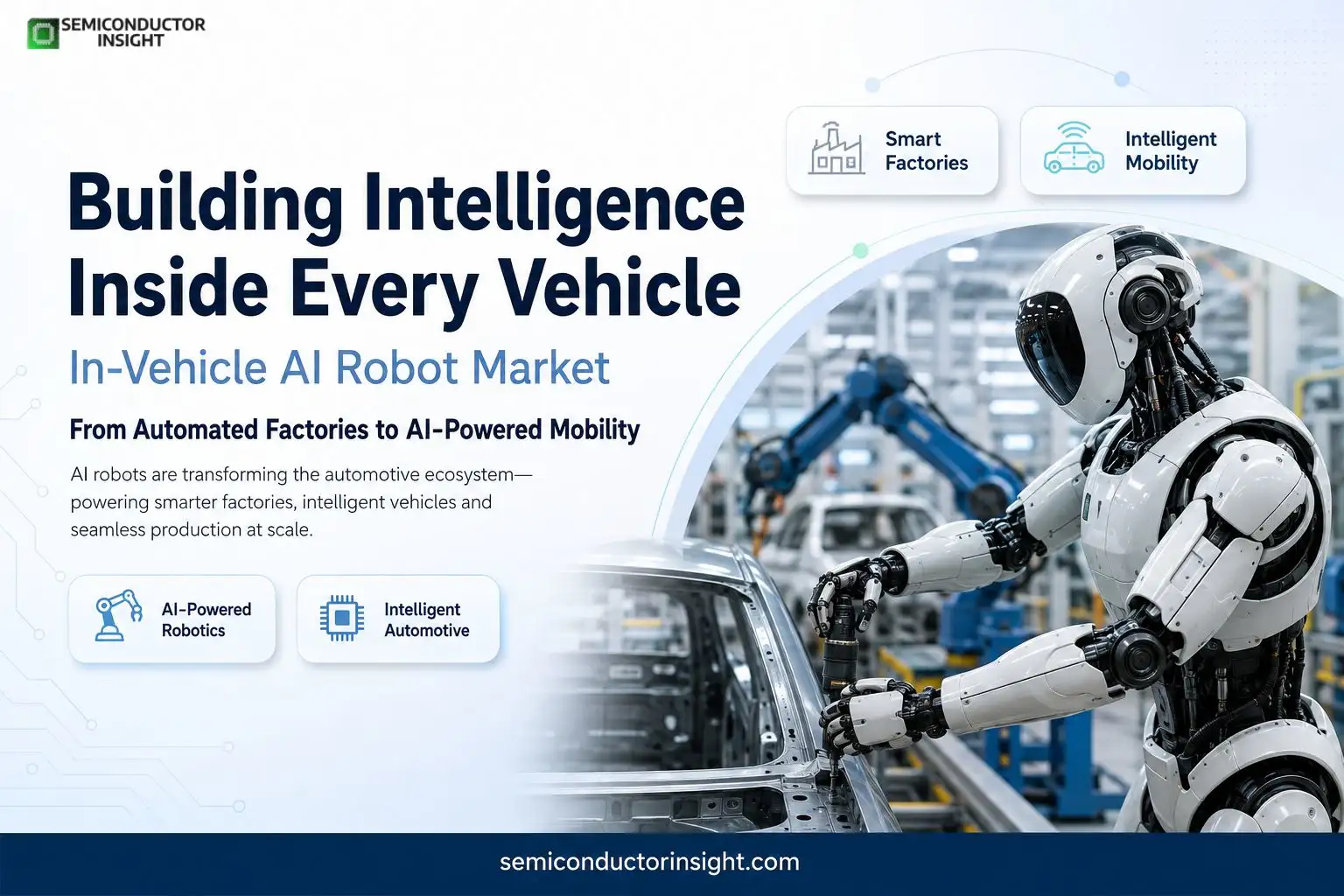
Edge AI vs. Cloud AI in In-Vehicle AI Robot Market and What Automakers Need Next
The automotive industry is moving beyond the idea of a vehicle as a machine that simply transports people. Increasingly, the same technologies used to make vehicles AI processors, advanced sensors, edge computing, robotics and machine-learning software are becoming part of an interconnected production and mobility ecosystem.
In-Vehicle AI Robot Market sits at this intersection. It covers AI-enabled robotic and autonomous systems associated with vehicle manufacturing, in-vehicle intelligence, factory logistics, inspection, material handling and emerging physical-AI applications.
Its importance is particularly strong within the semiconductor domain because every intelligent robot requires a combination of processors, memory, sensors, connectivity chips, motor-control electronics and power-management devices.
The Semiconductor Layer behind Physical AI
- An AI robot is only as capable as the computing architecture supporting it.
- Cameras, lidar, radar, force sensors and other inputs generate large amounts of information that must be interpreted rapidly. Instead of sending every decision to a remote data center, modern robotic systems increasingly process critical information locally through edge AI hardware.
- NVIDIA’s DRIVE AGX Thor, for example, is specified at more than 1,000 INT8 TOPS of AI performance and is designed for advanced automotive computing.
- Its Hyperion architecture incorporates 14 cameras, 9 radars, 1 lidar and 12 ultrasonic sensors, illustrating the extraordinary quantity of sensor information that next-generation automotive platforms may need to coordinate.
- This creates opportunities across the semiconductor stack, from high-performance computing and memory to image processing, networking and specialized AI accelerators.
Automotive Factories Are Becoming the First Real Testing Ground
The strongest evidence of this transition is appearing inside manufacturing plants rather than on public roads.
BMW announced in February 2026 that it was bringing Physical AI into European production through a humanoid-robot pilot at its Leipzig plant. The company had already completed a pilot deployment at its Spartanburg facility in the United States and plans to examine additional applications involving battery and component production.
BMW’s existing AI-enabled factory infrastructure gives an indication of the scale involved. Its logistics operation handles around 30 million parts every day from approximately 1,800 suppliers across 31 factories, while production reaches roughly 10,000 vehicles daily.
For semiconductor suppliers, this is significant because automotive robotics requires far more than a processor. It creates demand for a complete computing architecture capable of handling perception, navigation, manipulation and real-time control.
Robot Density Shows Where Adoption Is Already Deep
- The automotive industry is entering this new AI phase from a strong automation base.
- According to the International Federation of Robotics, European automotive manufacturers installed approximately 23,000 industrial robots in 2024, compared with 19,200 in North America.
- Japan’s automotive industry alone installed around 13,000 industrial robots in 2024, an 11% increase from the previous year and its highest level since 2020.
- These figures matter because AI-enabled robots are not entering empty factories. They are being introduced into highly automated environments where conventional robotics already provides the foundation.
From Programmed Machines to Learning Machines
Traditional industrial robots generally repeat carefully defined movements. AI-enabled robots are expected to interpret changing environments, identify objects, adjust movements and learn from operational data.
That difference is reshaping the semiconductor requirements.
Conventional robotics → fixed instructions → predictable environment
AI robotics → sensor perception → local inference → adaptive movement → continuous feedback
The transition increases the importance of GPUs, NPUs, high-speed memory, sensor processors and low-latency networking.
Research presented around the SAE World Congress 2026 has similarly emphasized that embodied AI must be treated as a complete systems-engineering problem involving safety, trust, governance and operational reliability not simply as an AI software upgrade.
You can freely browse our most recent updated report to learn more about it before scrolling further: https://semiconductorinsight.com/report/in-vehicle-ai-robot-market/
Humanoid Robots Bring a New Semiconductor Opportunity
Humanoid robotics is becoming particularly relevant to automotive production because these machines are designed around environments originally built for people. Their ability to operate in spaces containing existing tools, workstations and material flows could make them attractive for selected manufacturing tasks.
BMW’s 2026 Leipzig initiative is one current example. Meanwhile, automotive manufacturers and robotics companies globally are experimenting with humanoid systems for logistics, inspection and manufacturing activities.
The semiconductor opportunity extends into joint-actuator control, motor drivers, embedded vision, edge inference, wireless connectivity and battery-management electronics.
The Road Ahead Is Being Built Inside the Factory
- In-Vehicle AI Robot Market is therefore developing across two connected environments: the intelligent vehicle itself and the intelligent factory that produces it.
- Automakers increasingly need computing platforms capable of understanding physical surroundings, while semiconductor companies must deliver performance within strict automotive requirements for power efficiency, reliability and functional safety.
- The direction is already visible: more sensors, more localized computing, more intelligent machines and tighter integration between AI software and physical hardware.
As automotive factories move from fixed automation toward adaptive physical AI, the semiconductor industry becomes a central enabler of that transition. The next generation of automotive intelligence may not be defined solely by what happens inside the cabin it may also be defined by the machines that build, inspect and move every vehicle before it reaches the road.

Comments (0)