
In-vehicle AI Robot Market Insights
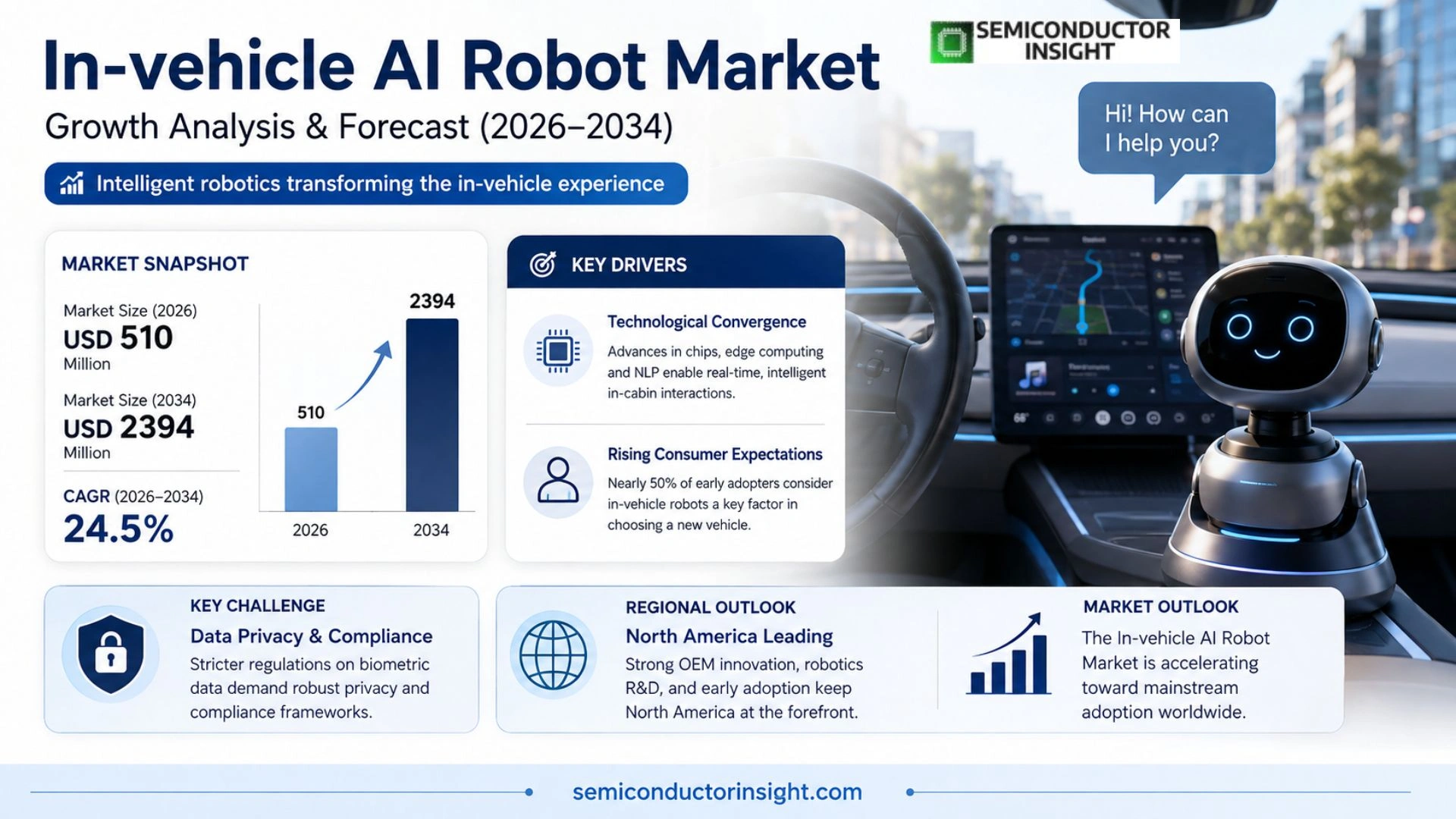
In-vehicle AI Robot market will increase from USD 510 million in 2026 to USD 2394 million by 2034, reflecting a CAGR of 24.5 % over the period.
An In‑vehicle AI robot is an intelligent system embedded within a vehicle that merges voice interaction, computer‑vision capabilities and on‑board computing. By processing multimodal sensor data it enables perception of the driving environment, natural human‑machine dialogue and assisted decision‑making, acting as the primary interface for navigation, driver support and cabin management. Production volumes are estimated at roughly 1.3 million units in 2025 with an average price near USD 430 per unit.
MARKET DRIVERS
Technological Convergence Accelerates Adoption
The convergence of advanced perception chips, edge‑computing platforms, and natural‑language processing has lowered the latency barrier that once confined robotic assistants to static environments. In the In‑vehicle AI Robot Market, manufacturers can now embed a full‑duplex dialogue engine that reacts within milliseconds, a capability that reshapes how occupants interact with navigation, entertainment, and safety functions.
Consumer Expectations Reshape Vehicle Interiors
Today’s drivers demand more than climate control; they expect a personal aide that can adjust seat ergonomics, summarize incoming messages, and even suggest optimal routes based on real‑time traffic. Surveys conducted in 2024 reveal that nearly half of early adopters consider an on‑board robot a decisive factor when selecting a new vehicle, prompting OEMs to redesign dashboards around modular robotic mounts.
➤ Integrating conversational AI with robotics transforms the cabin into an interactive workspace
These dynamics collectively create a feedback loop: higher consumer awareness fuels investment, which in turn accelerates component miniaturization, driving the In‑vehicle AI Robot Market toward broader mainstream acceptance.
MARKET CHALLENGES
Regulatory Hurdles Around Data Privacy
Regulators across Europe and North America are tightening rules on biometric data captured by cabin cameras and microphones. Companies that overlook consent protocols risk costly recalls and brand erosion, forcing them to allocate significant resources to compliance frameworks before scaling deployments.
Other Challenges
Manufacturing Scalability
Manufacturing scalability remains a pain point because robotic units require precision‑assembled actuators, custom‑grade AI chips, and rigorous durability testing to survive automotive temperature swings. Suppliers that cannot guarantee high‑volume yields at competitive cost will see their contracts ceded to rivals with established automotive‑grade supply chains.
Furthermore, integration complexity forces OEMs to synchronize software updates across vehicle ECUs, infotainment platforms, and the robot’s firmware. Misaligned versioning can trigger safety alarms, compelling manufacturers to invest in over‑the‑air update infrastructure that adds another layer of expense.
MARKET RESTRAINTS
High Cost of Sensor Suites
The cost premium associated with lidar arrays, high‑resolution depth cameras, and redundancy‑focused processors adds upwards of $800 to a vehicle’s bill of materials. For cost‑sensitive segments, this price tag dissuades fleet operators from retrofitting older models, limiting the In‑vehicle AI Robot Market to premium lines where margins can absorb the expense.
MARKET OPPORTUNITIES
Service‑Oriented Business Models
Service‑oriented business models,such as subscription‑based personality updates, context‑aware concierge services, and data‑driven health monitoring,present a lucrative revenue stream. By bundling these offerings with existing telematics packages, manufacturers can transform a one‑time hardware sale into a recurring income source, unlocking new profit levers in the In‑vehicle AI Robot Market.
In-vehicle AI Robot Market Trends
Deepening Contextual Intelligence
In-vehicle AI Robot Market is moving beyond voice‑only assistants toward systems that synthesize visual, auditory, and gesture data to anticipate driver intent and passenger comfort. By 2025, manufacturers will ship roughly 1.3 million units, each priced near $430, reflecting economies of scale and the maturation of automotive‑grade processors. This shift is fueled by higher bandwidth connectivity, the rollout of 5G, and the need for real‑time decision loops that combine edge compute with cloud‑based models. As vehicles become platforms for personalized services, contextual awareness,recognizing a driver’s mood, route preferences, and even seat‑belt status,translates directly into differentiated cockpit experiences and higher perceived value. The ripple effect is observable across OEMs that now treat the AI robot as a differentiator rather than an optional add‑on.
Other Trends
Profitability Shifts Toward Software Services
Hardware margins in In-vehicle AI Robot Market remain modest because automotive certification raises component costs and price competition pressures OEMs to keep unit prices low. Conversely, software layers,ranging from over‑the‑air updates to subscription‑based concierge functions,are delivering mid‑to‑high‑double‑digit gross margins. Companies that bundle data analytics, emotion‑recognition APIs, and location‑based recommendations can capture recurring revenue streams that offset the thin hardware profitability. This business model encourages larger players to invest in ecosystems that lock customers into long‑term service contracts, while newcomers face the hurdle of securing a viable software pipeline before scaling production.
Supply‑Chain Consolidation and Standardization
The upstream side of In-vehicle AI Robot Market is consolidating around a handful of chipmakers and sensor suppliers that provide automotive‑grade AI platforms. Firms such as NVIDIA and Qualcomm dominate the processor space, offering integrated solutions that reduce bill‑of‑materials complexity for OEMs. At the same time, the fragmentation of communication protocols across vehicle manufacturers is prompting industry consortia to push for unified standards. Alignment on data formats, safety certification, and cybersecurity safeguards is becoming a prerequisite for scaling production volumes. As standards coalesce, smaller suppliers that cannot meet the unified criteria are likely to exit, leaving a more streamlined set of partners that can accelerate time‑to‑market for new robot generations.
COMPETITIVE LANDSCAPE
Key Industry Players
Competitive Overview of In‑vehicle AI Robot Ecosystem
The market is anchored by a handful of technology powerhouses that control the upstream architecture. NVIDIA’s automotive‑grade GPUs and software stack dominate the high‑performance cockpit segment, while Qualcomm’s Snapdragon Ride platform supplies a broad base of midsize OEMs. These firms combine silicon, vision sensors and integrated AI frameworks, making it difficult for newcomers to compete on latency and power efficiency. Their scale translates into preferential OEM contracts, reinforcing a top‑down concentration where the bulk of revenue streams flow from hardware licensing and long‑term service agreements.
Beyond the tier‑one providers, a growing cluster of niche players is shaping specialized use cases. Companies such as Cerence AI and TomTom focus on voice‑driven navigation and contextual services, whereas Chinese automakers NIO and XPeng embed proprietary assistants to differentiate user experience in electric vehicle line‑ups. Mobility‑service operators and boutique manufacturers like Xiaomi and Chery experiment with removable magnetic modules, targeting after‑market upgrades. This diversification creates pockets of innovation that pressure incumbents to open APIs and adopt modular standards, ultimately expanding the overall addressable market.
List of Key In‑vehicle AI Robot Companies Profiled
- NVIDIA
- Qualcomm
- Mercedes‑Benz
- Tesla
- Stellantis
- Cerence AI
- TomTom
- XPeng
- NIO
- Xiaomi
- Chery
- Apple
- Samsung Electronics
- Huawei
- Google (Waymo)
Segment Analysis:
| Segment Category | Sub-Segments | Key Insights |
| By Type |
|
Multimodal Interaction drives the evolution of in‑vehicle AI robots by blending voice, vision, and tactile inputs.
|
| By Application |
|
Household Passenger Vehicles represent the core growth engine for AI robot adoption.
|
| By End User |
|
Private Car Owners prioritize convenience, safety, and entertainment.
|
| By Installation Position |
|
Center Console emerges as the preferred mounting point.
|
| By On‑Board Computing Power |
|
1‑10 TOPS is the sweet spot for current vehicle generations.
|
Regional Analysis: In-vehicle AI Robot Market
North America
Recent amendments to vehicle safety codes require demonstrable fail‑safe mechanisms for autonomous functions, nudging manufacturers toward AI‑powered robotic co‑pilots that can intervene when sensor data appears ambiguous. This regulatory pressure fuels rapid prototyping across the continent.
Surveys indicate that North American drivers value convenience and perceived safety above cost, prompting them to welcome robotic assistants that can manage climate control, route planning and emergency communication without manual input.
Partnerships between legacy automakers and tech firms such as NVIDIA and Boston Dynamics are producing modular robot platforms that can be retrofitted into existing vehicle lines, shortening time‑to‑market for AI‑enabled cabins.
The convergence of edge‑compute chips, 5G connectivity and advanced sensor suites creates an environment where in‑vehicle robots can process contextual data locally, reducing latency and enhancing driver trust.
Europe
European manufacturers are leveraging stringent emission standards to embed AI robot assistants that optimize route efficiency and energy consumption. Luxembourg and Germany have launched joint research programs that combine robotics with vehicle‑to‑infrastructure data, enabling cars to anticipate traffic signals and adjust driving behavior accordingly. Consumer expectations in the EU emphasize data privacy, prompting firms to design robots with on‑board encryption and transparent data‑usage dashboards. These dynamics encourage a market where compliance, sustainability and user control intersect, shaping product roadmaps for the next decade.
Asia‑Pacific
The Asia‑Pacific region benefits from a vast, tech‑savvy consumer base and aggressive government incentives for smart‑mobility projects. China’s “Intelligent Connected Vehicle” strategy places AI robot integration at the core of its automotive policy, while Japan’s robotics heritage feeds into cabin‑assistant designs that blend cultural aesthetics with functional AI. Rapid urbanization intensifies demand for vehicles that can manage congested traffic through predictive assistance, prompting OEMs to prioritize adaptive robot platforms that learn local driving patterns.
South America
In South America, emerging middle‑class mobility demands are driving interest in affordable AI robot solutions that enhance safety without heavyweight hardware. Local start‑ups focus on voice‑first interfaces that can operate in multilingual environments, addressing the region’s linguistic diversity. Governments in Brazil and Chile are beginning to draft standards for autonomous assistance, a move that signals future regulatory alignment with global best practices and offers a path for regional manufacturers to scale.
Middle East & Africa
The Middle East & Africa market is defined by a blend of high‑income Gulf states and rapidly urbanizing African economies. In the Gulf, luxury vehicle buyers expect premium robot companions that integrate with smart‑home ecosystems, creating a seamless lifestyle experience. Conversely, African cities are exploring AI robot pilots that can navigate uneven road conditions and provide real‑time diagnostics, a capability that could reduce maintenance costs and improve fleet reliability in resource‑constrained settings.
Report Scope
This market research report provides a comprehensive analysis of the In-vehicle AI Robot Market , covering the forecast period 2026–2034. It offers detailed insights into market dynamics, technological advancements, competitive landscape, and key trends shaping the industry.
Key focus areas of the report include:
- Market Overview: The report begins with an overview outlining its current market scenario, key growth indicators, and industry transformation drivers. It discusses macroeconomic factors, demand–supply balance, regulatory landscape, and the strategic role of semiconductors in powering advancements across industries such as automotive, telecommunications, consumer electronics, and industrial automation.
- Market Size & Forecast: Historical data and future projections for revenue, unit shipments, and market value across major regions and segments.
- Segmentation Analysis: Detailed breakdown by product type, technology, application, and end-user industry to identify high-growth segments and investment opportunities.
- Regional Insights: Insights into market performance across North America, Europe, Asia-Pacific, Latin America, and the Middle East & Africa, including country-level analysis where relevant.
- Competitive Landscape: Profiles of leading market participants, including their product offerings, R&D focus, manufacturing capacity, pricing strategies, and recent developments such as mergers, acquisitions, and partnerships.
- Technology Trends & Innovation: Assessment of emerging technologies, integration of AI/IoT, semiconductor design trends, fabrication techniques, and evolving industry standards.
- Market Drivers & Restraints: Evaluation of factors driving market growth along with challenges, supply chain constraints, regulatory issues, and market-entry barriers.
- Stakeholder Insights: Insights for component suppliers, OEMs, system integrators, investors, and policymakers regarding the evolving ecosystem and strategic opportunities.
Primary and secondary research methods are employed, including interviews with industry experts, data from verified sources, and real-time market intelligence to ensure the accuracy and reliability of the insights presented.
FREQUENTLY ASKED QUESTIONS:
What is the current market size of In-vehicle AI Robot Market?
-> In-vehicle AI Robot market will increase from USD 510 million in 2026 to USD 2394 million by 2034, reflecting a CAGR of 24.5 % over the period.
Which key companies operate in In-vehicle AI Robot Market?
-> Key players include NIO, XPENG, Mercedes-Benz, Stellantis, Tesla, TomTom, Cerence AI, Chery, Xiaomi, among others.
What are the key growth drivers?
-> Key growth drivers include advancements in autonomous driving, improved chip performance, 5G connectivity, rising demand for smart cockpit experiences, and increased vehicle connectivity.
Which region dominates the market?
-> Asia accounts for the largest share of the market, driven by high adoption rates in China, Japan, and South Korea, while Europe and North America also show strong growth.
What are the emerging trends?
-> Emerging trends include deeper integration of multimodal sensing, context‑aware and proactive AI interactions, cloud‑edge collaborative processing, and platform‑based ecosystems for in‑car services.

Get Sample Report PDF for Exclusive Insights
Report Sample Includes
- Table of Contents
- List of Tables & Figures
- Charts, Research Methodology, and more...
 Download Sample Report PDF