

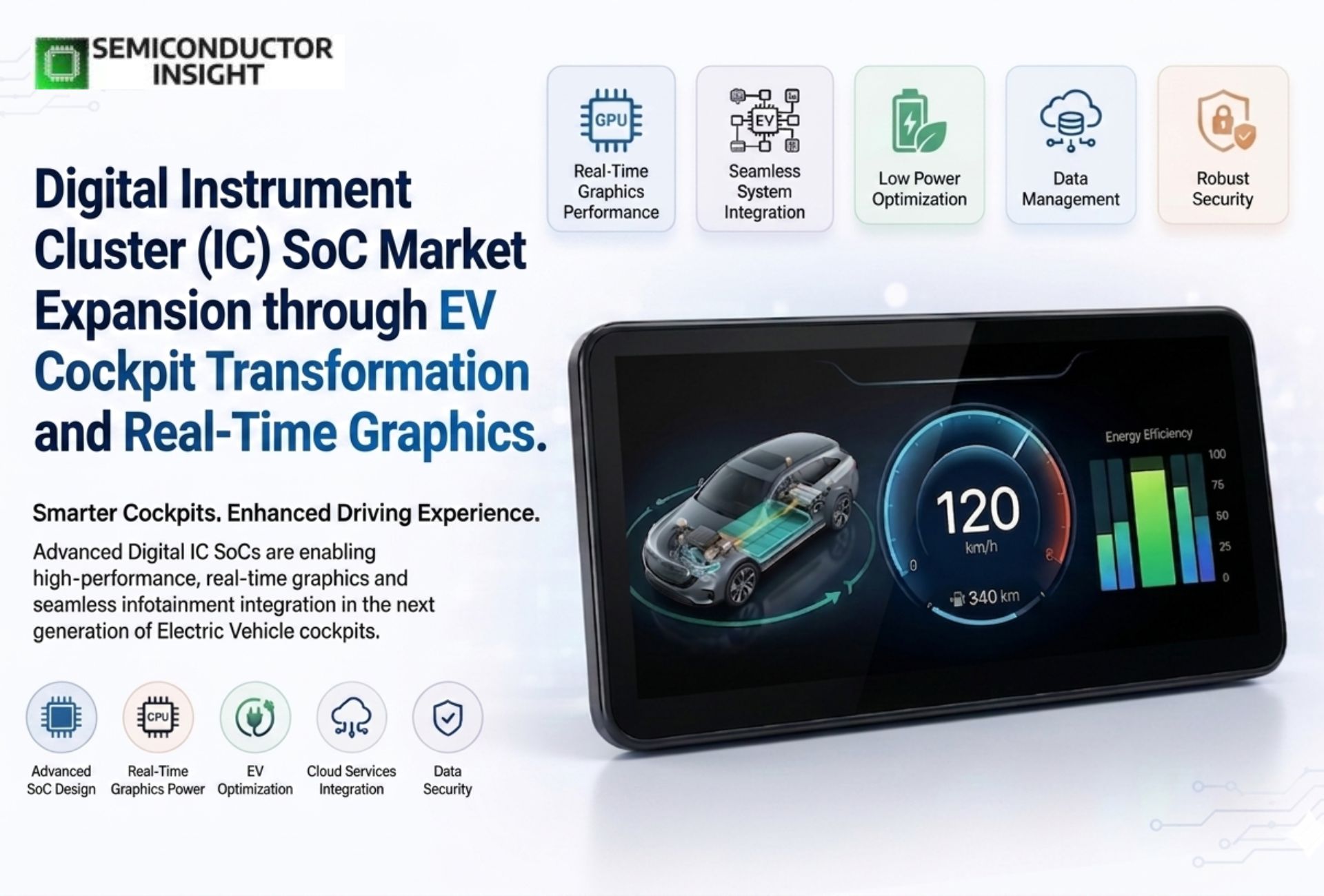
Digital Instrument Cluster (IC) SoC Market Expansion through EV Cockpit Transformation and Real-Time Graphics
Digital Instrument Cluster (IC) SoC Market refers to the global industry focused on the development, production, and integration of System-on-Chip (SoC) semiconductor solutions used in digital automotive instrument clusters.
The modern automobile dashboard has quietly transformed into one of the most advanced computing environments inside a vehicle. What was once a simple arrangement of analogue gauges has evolved into a fully digital, software-controlled cockpit powered by sophisticated semiconductor architectures. At the centre of this transformation sits the Digital Instrument Cluster (IC) SoC Market, a rapidly evolving semiconductor segment shaping the future of connected mobility, electric vehicles, and intelligent driver interaction systems.
- According to the European Automobile Manufacturers Association (ACEA), global vehicle electrification and connected vehicle integration continue to accelerate, increasing demand for advanced in-vehicle computing systems.
- Electric vehicles especially rely heavily on digital cockpit systems because battery analytics, charging visualisation, energy optimisation, and autonomous driving feedback require high-resolution graphical processing and uninterrupted real-time communication.
Smart Cockpits Are Becoming the New Automotive Identity Layer
One of the most significant developments in the Digital Instrument Cluster (IC) SoC Market is the emergence of software-defined cockpit ecosystems. Automakers are increasingly competing through digital user experience rather than traditional mechanical differentiation alone.
- Companies such as Mercedes-Benz Group, BMW Group, and Tesla have invested heavily in immersive cockpit architectures where instrument clusters seamlessly interact with infotainment systems, voice assistants, augmented reality navigation, and AI-powered personalisation tools.
- The Mercedes-Benz MBUX Hyperscreen, for example, integrates multiple display surfaces into a unified digital environment supported by high-performance semiconductor processors capable of handling billions of graphical calculations every second.
- Similarly, newer EV platforms increasingly depend on centralised cockpit computing systems rather than fragmented electronic control modules.
This transition is pushing semiconductor manufacturers to design automotive SoCs with stronger GPU performance, AI acceleration engines, cybersecurity protection, and thermal stability for long-duration vehicle operations.
Want to learn more about the report? Check out our latest updated version for free: https://semiconductorinsight.com/report/digital-instrument-cluster-ic-soc-market/
Semiconductor Complexity Inside Modern Clusters Is Increasing Rapidly
- The technological complexity of digital instrument clusters has expanded dramatically over the last five years. Modern SoCs now integrate CPUs, GPUs, neural processing units, memory controllers, connectivity systems, and security modules onto a single automotive-grade chip platform.
- A growing number of vehicles now support 3D visualisation, driver monitoring systems, and over-the-air software updates directly through cockpit processors. This requires semiconductor architectures capable of balancing computational power with low energy consumption.
- According to technical documentation published by Arm Holdings, advanced automotive SoCs are increasingly designed around heterogeneous computing models where AI workloads, graphical rendering, and safety-critical operations are processed simultaneously across different compute domains.
- Vehicle display resolutions are also climbing rapidly. Premium automotive clusters now commonly exceed 1920×720 resolution, while some luxury EV models are integrating pillar-to-pillar digital displays stretching across the dashboard. Supporting these visual systems requires substantial memory bandwidth and GPU
Automotive Safety Standards Are Reshaping SoC Engineering
Automotive semiconductors are subject to stringent reliability and safety regulations, in contrast to consumer electronics. One of the key factors influencing the development of Digital Instrument Cluster IC SoCs is now this.
Organisations such as the International Organisation for Standardisation (ISO) continue to influence automotive semiconductor development through standards like ISO 26262, which governs functional safety in road vehicles.
If a smartphone display freezes, it is inconvenient. If a digital speedometer or ADAS alert system fails during driving, the consequences could be severe. Because of this, automotive-grade SoCs are engineered with redundancy mechanisms, fail-safe architectures, error correction systems, and real-time monitoring frameworks.
Semiconductor suppliers are now embedding dedicated safety islands within cockpit SoCs to isolate critical driving information from entertainment workloads. This architectural separation is becoming increasingly important as autonomous and semi-autonomous vehicle functions expand globally.
AI-Enhanced Dashboards Are Moving Beyond Traditional Displays
- Artificial intelligence is rapidly becoming a central feature inside automotive cockpit systems. Digital instrument cluster processors are now expected to interpret driver behaviour, optimise information layouts, and deliver predictive vehicle insights dynamically.
- Several automakers are integrating machine learning algorithms that adapt dashboard interfaces based on driving habits, route patterns, weather conditions, and driver attention levels. AI-assisted clusters can prioritise battery alerts for EV users, highlight navigation hazards, or simplify interface layouts during high-speed driving conditions.
- NVIDIA’s automotive computing platforms and Qualcomm’s Snapdragon Cockpit systems have demonstrated how AI acceleration inside cockpit SoCs can support facial recognition, voice interaction, and real-time environmental analysis simultaneously.
- At the 2025 Consumer Electronics Show (CES), multiple automotive manufacturers showcased AI-powered cockpit systems capable of contextual interaction, including emotion-aware cabin responses and adaptive visualisation systems. These demonstrations reinforced how semiconductor innovation is becoming central to the future of automotive user experience.
Supply Chain Lessons Are Changing Semiconductor Priorities
The global semiconductor shortage exposed how dependent automotive production had become on advanced chip availability. During the peak shortage period, several automakers temporarily halted production because cockpit and control semiconductors were unavailable.
According to manufacturing updates from Toyota Motor Corporation and Volkswagen Group, semiconductor supply instability affected production planning across multiple vehicle categories between 2021 and 2023.
As a result, automakers are now strengthening direct semiconductor partnerships and increasing investment in localised chip supply ecosystems. Some vehicle manufacturers are even collaborating directly with semiconductor firms during SoC architecture development to ensure long-term supply continuity.
This shift is transforming automotive semiconductor strategy from a procurement function into a core business priority.

Comments (0)