

Can the Lightfield Displays Market Redefine Medical Imaging and Industrial Visualization by 2026?
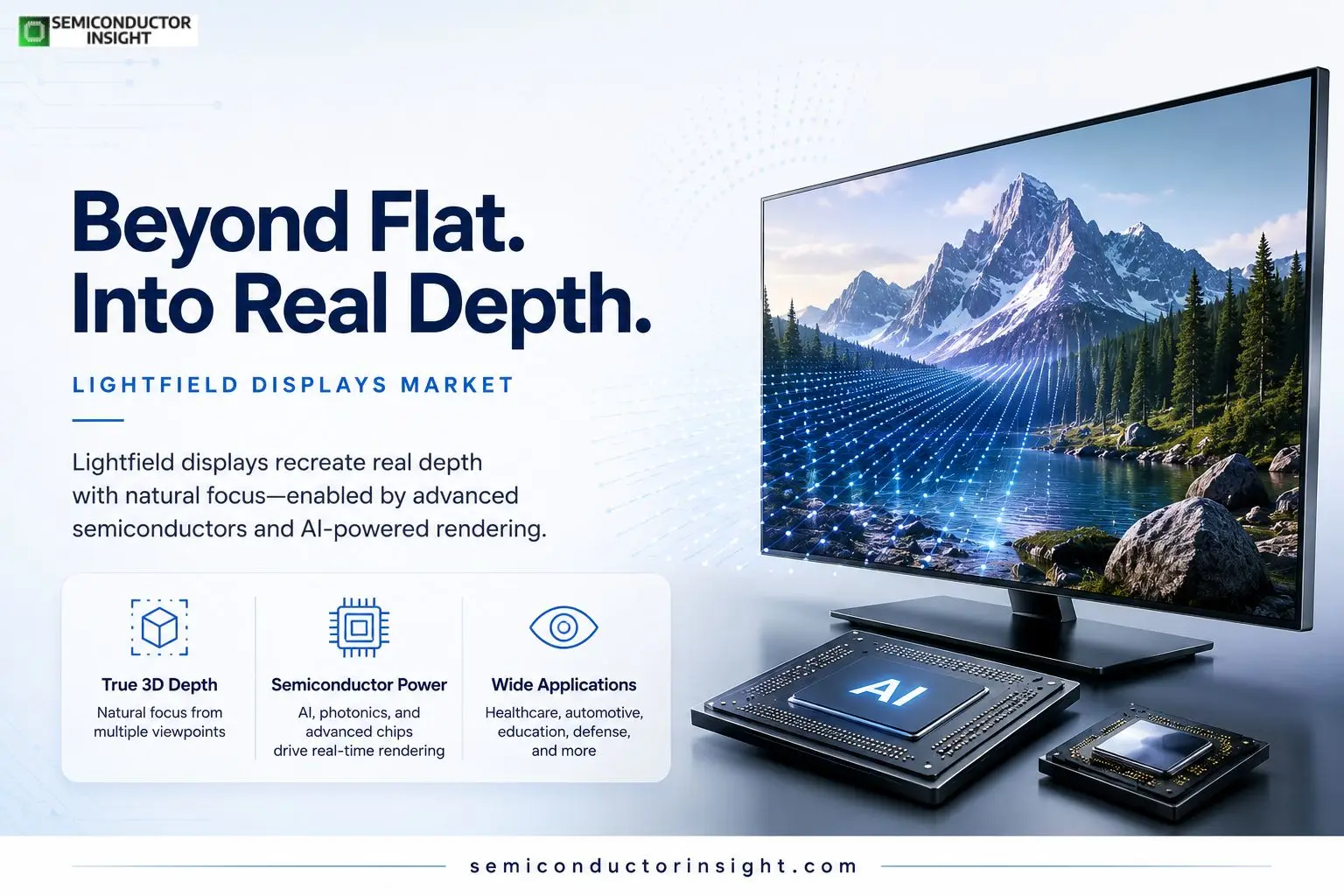
The evolution of semiconductor technology is changing not only how displays look but also how people interact with digital content. One of the most promising innovations emerging from this transformation is the lightfield display, a technology capable of recreating how light naturally enters the human eye. Instead of presenting flat pixels on a screen, lightfield displays generate multiple rays of light, allowing viewers to perceive depth, focus naturally, and experience realistic three dimensional visuals without wearing special glasses.
As opposed to conventional stereoscopic displays, lightfield systems reconstruct the directional light information so that the virtual objects appear three-dimensional from different viewpoints. This ability is attracting attention in medical imaging, automotive interfaces, defense simulation, industrial design, education, and spatial computing. As AI processors, photonic chips, and advanced semiconductor packaging continue to develop, lightfield displays are slowly migrating from research labs to commercial applications.
Why Semiconductor Innovation Is the Missing Piece Behind Lightfield Displays?
Producing a true lightfield image requires processing enormous volumes of visual information in real time. Every scene must be rendered from dozens or even hundreds of viewpoints simultaneously, creating an immense computational workload.
Modern semiconductor technologies are making this possible through high bandwidth memory, AI accelerators, advanced graphics processors, silicon photonics, and custom display driver integrated circuits. According to research published by NVIDIA and ACM Digital Library, real time lightfield rendering may require processing several gigabytes of image data every second depending on scene complexity and display resolution. This explains why recent advances in semiconductor performance have become essential for commercial lightfield products.
At the same time, innovations in Micro LED manufacturing, wafer level optics, CMOS image sensors, and advanced chiplet architectures are reducing system size while improving optical precision.
From Research Labs to Commercial Reality
Several technology companies have demonstrated working lightfield display systems over the past few years. Looking Glass Factory has introduced commercial lightfield displays supporting collaborative 3D visualization without headsets. Leia Inc. has integrated lightfield technology into mobile devices for immersive content experiences. Sony continues expanding spatial content creation tools, while NVIDIA’s Omniverse platform enables realistic three dimensional digital environments that complement advanced display technologies.
Medical institutions are also exploring lightfield imaging for surgical planning, allowing physicians to inspect anatomical structures with realistic depth perception before complex procedures. Automotive manufacturers are evaluating lightfield dashboards capable of presenting navigation data with natural depth while minimizing driver distraction.
Statistics that show how the technology is developing
- Innovation is more than simply financial indicators.
- Over the last decade, the World Intellectual Property Organization (WIPO) has published thousands of international patent applications related to three dimensional displays, computational imaging, optical waveguides and lightfield visualization, indicating ongoing research activity across Asia, North America and Europe.
- The HDMI 2.1 specification supports data transmission speeds of 48 Gbps required for the high resolution multi view content needed for advanced display technologies. In the meantime, DisplayPort 2.1 raises the maximum bandwidth to 80 Gbps, fulfilling the increasing demand for ultra high resolution immersive displays.
- Now consumer graphics processors have surpassed 100 teraflops of AI computing performance that can enable ever more sophisticated real time rendering required for computational lightfield applications.
Industries Quietly Preparing for Lightfield Adoption
Healthcare is emerging as one of the strongest early adopters. Surgeons can visualize organs from multiple viewing angles without specialized glasses, improving planning accuracy before operations.
Engineering companies are integrating lightfield visualization into digital twin platforms where complex industrial systems can be examined with realistic depth.
Education institutions are experimenting with interactive scientific models that allow students to observe molecular structures, human anatomy, and astronomical simulations from different perspectives.
Defense organizations continue investing in immersive simulation environments where accurate spatial visualization improves mission planning and operator training.
Entertainment companies are also exploring glasses free experiences for museums, digital advertising, gaming, and interactive storytelling.
To Know More about the Report, You Can Freely Browse Our Latest Updated Report: https://semiconductorinsight.com/report/lightfield-displays-market/
The AI and Spatial Computing Connection
- The rapid expansion of spatial computing is giving lightfield technology a practical commercial direction. Artificial intelligence now assists with scene reconstruction, view synthesis, depth estimation, and image optimization, dramatically reducing computational complexity.
- Apple’s Vision Pro, Meta’s mixed reality ecosystem, Qualcomm’s Snapdragon XR platforms, and NVIDIA’s AI based rendering technologies are accelerating demand for richer three dimensional content creation.
- Although these platforms primarily rely on head mounted displays today, the software infrastructure being developed will also benefit future lightfield display systems that eliminate wearable hardware.
- Generative AI is becoming another catalyst by automatically creating complex three dimensional environments that previously required extensive manual design, making lightfield visualization more accessible across industries.
What Researchers Are Solving Next?
Current research is focused on overcoming three technical barriers simultaneously. The first is increasing viewing angles without sacrificing image quality. The second is reducing power consumption through efficient semiconductor architectures. The third is lowering manufacturing costs by combining Micro LED technology, silicon photonics, and wafer level optics into scalable production methods.
Universities including Stanford University, MIT, and research organizations such as IMEC continue publishing breakthroughs in computational imaging and photonic semiconductor integration. As fabrication techniques mature and semiconductor performance continues to improve, lightfield displays are steadily transitioning from experimental prototypes into practical visualization platforms capable of reshaping how people experience digital information.

Comments (0)