
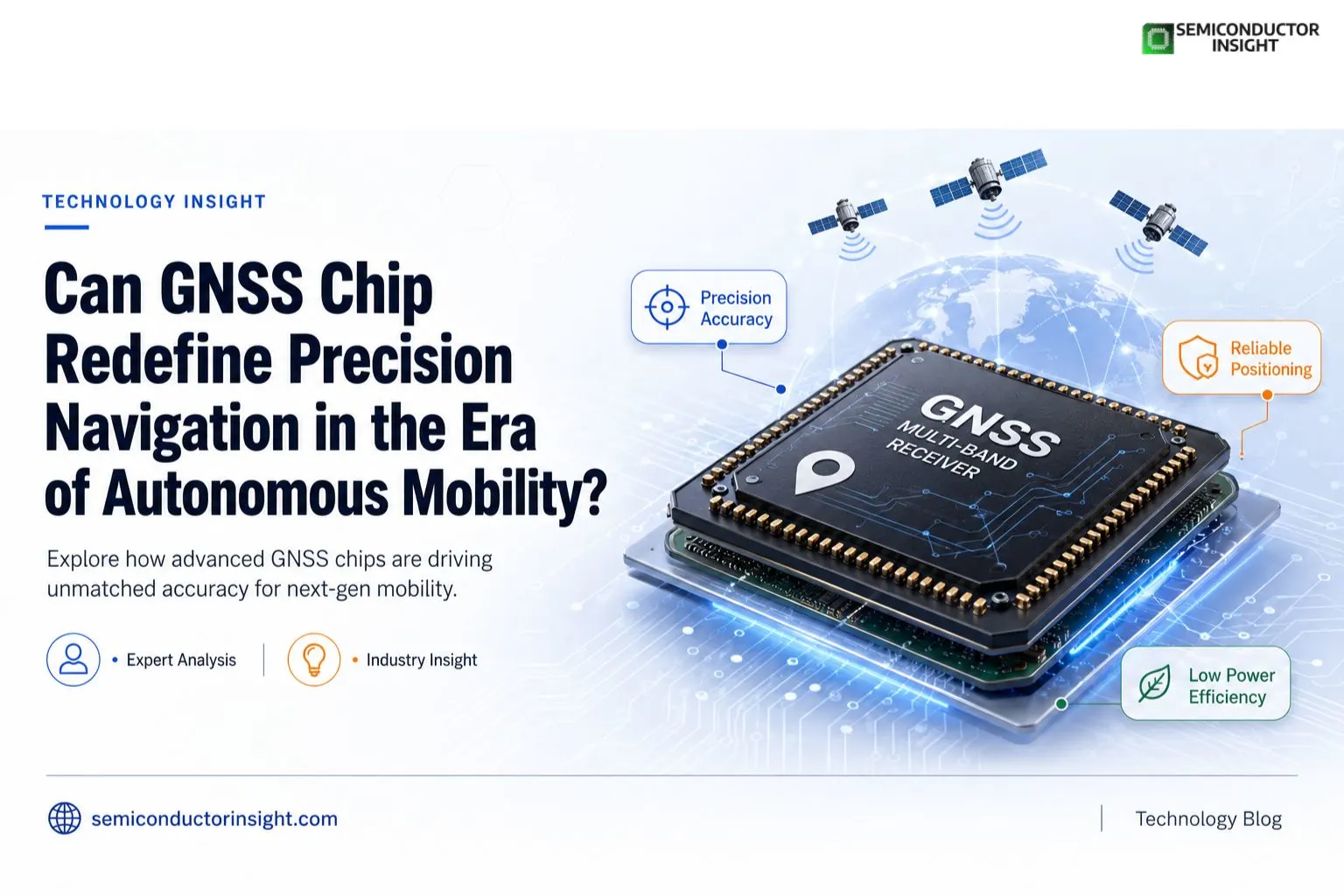
Can GNSS Chip Market Redefine Precision Navigation in the Era of Autonomous Mobility?
Location technology has evolved far beyond basic navigation. Today, GNSS chips sit at the heart of smartphones, autonomous vehicles, precision agriculture equipment, logistics fleets, drones, wearables, and industrial monitoring systems. GNSS Chip Market is becoming one of the most strategically important segments within the semiconductor ecosystem as industries increasingly depend on real-time positioning and timing data.
Global Navigation Satellite Systems (GNSS) combine signals from multiple constellations including GPS, Galileo, GLONASS, BeiDou, and QZSS. Modern semiconductor manufacturers are designing chips capable of simultaneously receiving signals from several satellite networks, significantly improving accuracy, reliability, and coverage.
From Orbit to Device How GNSS Data Reaches Everyday Electronics
The positioning process involves a complex semiconductor architecture that transforms satellite signals into usable location information.
Satellite Constellations
↓
RF Front-End Reception
↓
Signal Processing Engine
↓
Multi-Band GNSS Chip
↓
Position Calculation
↓
Navigation Application
This capability has become increasingly valuable as consumers and enterprises demand greater precision from connected devices.
Performance Benchmarks and Market Reach
According to data published by the European Union Agency for the Space Programme (EUSPA), billions of GNSS-enabled devices are currently active worldwide. Smartphones alone account for well over 6 billion subscriptions globally, with most new devices integrating advanced GNSS chipsets.
The global drone fleet continues to expand, with millions of commercial and recreational drones relying on GNSS positioning systems. In automotive applications, vehicle manufacturers are integrating GNSS technology into advanced driver assistance systems, fleet tracking modules, and connected mobility platforms.
Meanwhile, the European Galileo constellation has surpassed 30 operational satellites, while China’s BeiDou system operates more than 40 satellites, increasing positioning redundancy and reliability across global markets.
Why Accuracy Is Becoming the New Battleground?
Earlier navigation systems delivered positioning accuracy within several meters. Today’s advanced GNSS chips can achieve sub-meter performance and, in specialized applications, centimeter-level precision when combined with correction services.
Current use cases include:
- Automated agricultural machinery
- Surveying and geospatial mapping
- Autonomous delivery robots
- Smart city traffic management
- Infrastructure monitoring
- Industrial asset tracking
Several 2025 product launches from leading semiconductor suppliers introduced dual-frequency and triple-frequency receivers capable of reducing signal interference in dense urban environments.
Don’t Forget to Surf Our Updated Report for More Detailed Analysis: https://semiconductorinsight.com/report/gnss-chip-market/
Semiconductor Architectures Setting New Standards for Precision
Not all GNSS solutions deliver the same level of performance. High-end positioning systems increasingly depend on specialized semiconductor designs that optimize sensitivity, power efficiency, and signal integrity to meet demanding application requirements.
The most advanced GNSS chipsets typically offer multi-constellation support and dual-frequency reception, enabling greater accuracy and faster time-to-first-fix. They often include integrated RF front-end modules and low-power processing cores to reduce system complexity and extend battery life. Additional features such as anti-jamming capability and real-time kinematic (RTK) compatibility further enhance robustness and precision for professional, automotive, and industrial use cases.
Leading semiconductor manufacturers including Qualcomm, Broadcom, STMicroelectronics, MediaTek, and u-blox regularly introduce highly integrated solutions tailored for smartphones, automotive platforms, industrial equipment, and IoT deployments, driving the adoption of advanced positioning capabilities across markets.
The GNSS Components Delivering the Highest Positioning Performance
When evaluating semiconductor solutions for advanced navigation systems, several components consistently stand out for performance-critical applications.
High-Precision GNSS System
RF Front-End
↓
Baseband Processor
↓
Signal Correlator
↓
Multi-Frequency Receiver
↓
Positioning Engine
Multi-frequency receivers are currently considered among the most important performance enhancers because they process signals from multiple satellite frequencies simultaneously. Advanced correlators and low-noise RF front-end modules further improve signal acquisition in difficult operating environments such as urban canyons, forests, and industrial facilities.
For autonomous vehicles, drones, and surveying equipment, these semiconductor building blocks often determine overall positioning accuracy more than antenna design alone.
Unexpected Connections between Smart Homes and Location Technologies
- Although GNSS chips are not directly used for indoor lighting control, location-enabled ecosystems increasingly interact with smart home platforms.
- Geofencing features allow homeowners to automate lighting, climate control, and security systems based on their location.
- Among lighting brands, companies such as Philips Hue, Lutron, Nanoleaf, and Leviton are widely recognized for strong integration with smart home ecosystems including Apple HomeKit, Google Home, Amazon Alexa, and Samsung SmartThings.
- As location services become more precise, GNSS-enabled smartphones can trigger increasingly sophisticated home automation routines.
Recent Developments Reshaping Industry Applications
In 2025 and 2026, automotive manufacturers accelerated testing of highly automated driving systems that depend on multi-band GNSS positioning. Agricultural equipment makers expanded deployment of autonomous tractors capable of operating with centimeter-level guidance.
At the same time, logistics operators increasingly adopted GNSS-enabled asset tracking solutions to monitor shipping containers, trailers, and high-value cargo across international supply chains.
GNSS Chip Market is no longer solely about navigation. It is becoming a foundational semiconductor technology supporting precision mobility, intelligent infrastructure, industrial automation, and location-aware digital services across virtually every connected industry.

Comments (0)