

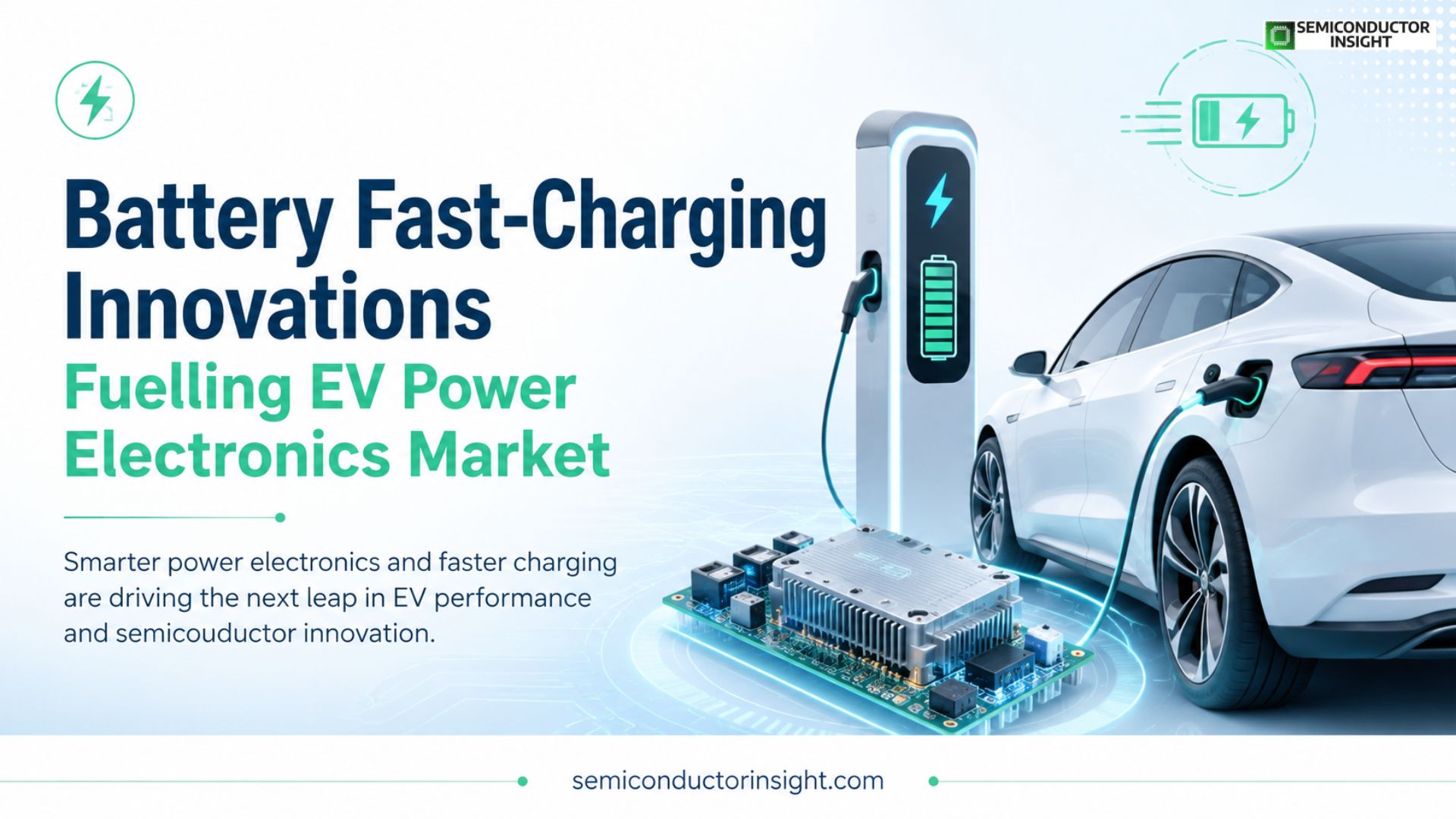
Battery Fast-Charging Innovations Fuelling EV power electronics market
Electric vehicles are often discussed in terms of batteries, charging stations, and driving range. Yet hidden beneath every electric drivetrain is a sophisticated electronic ecosystem that controls, converts, and manages power. This ecosystem known as EV power electronics has become one of the most critical segments of the semiconductor industry.
From traction inverters and onboard chargers to DC-DC converters and battery management systems, power electronics determine how efficiently electricity moves through a vehicle. As automakers race toward higher performance and faster charging, semiconductor innovation is becoming as important as battery chemistry.
The Silent Technology behind Every Kilometer
When an EV accelerates, charges, regenerates braking energy, or manages battery temperature, power electronics are continuously processing electrical energy.
A modern electric vehicle contains multiple power semiconductor modules working together:
- Traction inverter systems
- Onboard charging units
- Battery management electronics
- Power distribution controllers
- DC-DC conversion systems
- Thermal management controllers
These systems manage high electrical loads, frequently running at hundreds of volts and hundreds of amperes at once, in contrast to conventional vehicle electronics that are primarily concerned with information processing.
Why Silicon Carbide Is Changing Vehicle Design?
One of the most discussed developments in the industry is the transition toward silicon carbide (SiC) power semiconductors.
Compared with conventional silicon-based components, SiC devices can operate at higher temperatures, switch faster, and reduce energy losses during power conversion.
Recent vehicle launches from manufacturers including Tesla, Hyundai Motor Company, and Mercedes-Benz Group have highlighted increasing adoption of silicon carbide-based architectures to improve efficiency and extend driving range.
For vehicle manufacturers, even small efficiency gains can translate into additional kilometers of range without increasing battery size.
Stay connected for additional in-depth information right here: https://semiconductorinsight.com/report/ev-power-electronics-market-2/
Where Charging Speed Meets Semiconductor Innovation
Fast charging has become a major purchasing consideration for EV buyers. Achieving ultra-fast charging, however, depends heavily on power electronics rather than batteries alone.
New-generation charging systems are moving toward:
- 350 kW public charging infrastructure
- Bidirectional charging capabilities
- Vehicle-to-grid communication
- Intelligent power balancing
- High-efficiency conversion systems
The ability to safely manage these power levels requires increasingly sophisticated semiconductor solutions.
Which Technology Partners Are Building the Connected EV Ecosystem?
Just as smart homes depend on interoperable technology platforms, electric vehicles increasingly rely on integrated semiconductor ecosystems.
Several companies are playing influential roles in this connected environment:
- Infineon Technologies for automotive power modules
- onsemi for silicon carbide solutions
- STMicroelectronics for power management devices
- Wolfspeed for SiC wafer technology
- NXP Semiconductors for vehicle control architectures
Their technologies increasingly integrate with vehicle software platforms, charging networks, and energy management systems to create a connected mobility ecosystem.
The Shift toward Software-Controlled Power
A growing trend within the industry is the transition from hardware-centric vehicle design to software-defined power management.
Modern EV platforms can dynamically adjust power delivery, optimize charging behavior, improve battery health, and manage thermal systems through software updates. As a result, power electronics are no longer isolated hardware components; they have become intelligent systems capable of continuous optimization throughout a vehicle’s lifecycle.
From Energy Conversion to Mobility Intelligence
EV power electronics market is evolving beyond simple power conversion. It now represents the intersection of semiconductors, software, vehicle architecture, charging infrastructure, and energy management.
As electric mobility expands globally, advancements in power electronics will increasingly determine vehicle efficiency, charging performance, and overall driving experience, making this segment one of the most strategically important areas of the semiconductor industry.

Comments (0)