
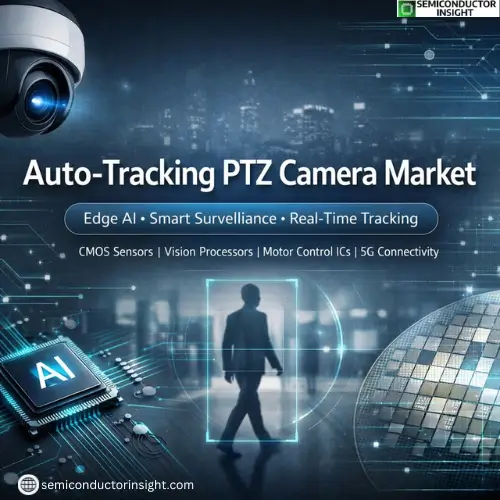
Auto-Tracking PTZ Camera Market Growth Increases Demand, Increases Share, and Quickens Forecast Momentum
Auto-tracking PTZ (Pan-Tilt-Zoom) Camera Market refers to the global industry focused on advanced camera systems that can automatically detect, follow, and zoom in on moving subjects without manual control. These systems are increasingly powered by semiconductor-based imaging sensors, AI processors, and edge computing chipsets, making them a fast-growing segment within smart surveillance and automation.
A Market Shaped by Smart Vision and Semiconductor Precision
Auto-tracking PTZ cameras are no longer limited to traditional CCTV setups. Today, they are evolving into real-time intelligent monitoring platforms, used in airports, stadiums, factories, smart cities, and even healthcare facilities.
What is driving this shift is not only better optics, but the semiconductor backbone behind these systems:
- High-resolution CMOS image sensors
- AI-enabled vision processors
- Edge inference chipsets
- Connectivity modules supporting 5G and Wi-Fi 6
This combination is turning cameras into decision-making devices rather than passive recorders.
The Semiconductor Engine inside PTZ Innovation
Unlike standard security cameras, auto-tracking PTZ models require instant processing and smooth motion control. This is where semiconductor advancements become critical.
Modern PTZ cameras integrate:
Image Signal Processors (ISPs) that enhance clarity in low light
AI acceleration chips that recognize humans, vehicles, or unusual movement
Motor control ICs that enable precise pan-tilt tracking
Memory components supporting real-time video buffering
As chip efficiency improves, manufacturers can deliver faster tracking accuracy while reducing power consumption.
The Shift Away from Cloud Dependence
A major transformation in this market is the rise of edge-based PTZ intelligence.
Instead of sending video streams to centralized cloud servers, cameras now process tracking decisions locally using onboard semiconductors. This delivers:
- Lower latency
- Higher privacy compliance
- Reduced bandwidth costs
- Faster incident response
This edge shift is especially relevant in regions strengthening data protection regulations.
You Can Go Through Our Latest Updated Insights Here:
https://semiconductorinsight.com/report/auto-tracking-ptz-camera-market/
Practical Pros and Limitations in Real Deployments
Auto-tracking PTZ cameras offer strong operational value, but deployment still requires balancing advantages and constraints.
- Key benefits include:
- Reduced need for manual monitoring staff
- Higher tracking accuracy in large spaces
- Better incident documentation through zoom automation
- Challenges still being addressed:
- Performance variation in crowded environments
- Higher upfront cost due to chip-intensive design
- Cybersecurity risks requiring embedded protection
The market is responding through smarter firmware, secure chip modules, and improved AI training.
Chip-level advancements like these will be crucial to the next stage of growth:
- Neuromorphic vision processors
- Higher dynamic range sensors
- AI models optimized for low-power edge devices
- Integration with 5G-based remote command networks
Over the coming years, PTZ cameras are expected to become core components of autonomous monitoring ecosystems, not just surveillance tools.
Key Takeaway Snapshot
- The market is expanding through AI-enabled edge semiconductor platforms
- Demand is rising across smart cities, industry, and infrastructure security
- Competitive advantage will depend on chip partnerships, automation quality, and regulatory readiness
Auto-tracking PTZ Camera Market is entering a new era where cameras operate less like recording devices and more like semiconductor-powered intelligent observers. As imaging chips, AI accelerators, and connectivity modules evolve, this market will continue to grow as a critical intersection of security, automation, and smart electronics.
In many ways, the future of PTZ is not just about where the camera looks but how intelligently the semiconductor core helps it decide what matters.

Comments (0)