Linear CMOS Image Sensors Market Insights
Linear CMOS Image Sensors market size was valued at USD 1,058 million in 2025 and will rise to USD 1,514 million by 2032, reflecting a compound annual growth rate of 4.7% over the forecast horizon.
A Linear CMOS Image Sensor captures image data along a single row of pixels (1‑D array) instead of the conventional two‑dimensional matrix. This line‑scan architecture enables continuous high‑speed detection of moving objects or uniform capture along a linear path, making it well suited for industrial inspection, document scanning and scientific measurement.
The market expands because of growing adoption of line‑scan imaging in automation, logistics and medical diagnostics, while advances in wafer fabrication and packaging lower unit costs. Leading manufacturers such as Sony, Samsung, OmniVision, STMicroelectronics and ON Semi are intensifying R&D efforts; recent product launches focus on higher quantum efficiency and integrated global shutter functionality to meet demanding B2B requirements.
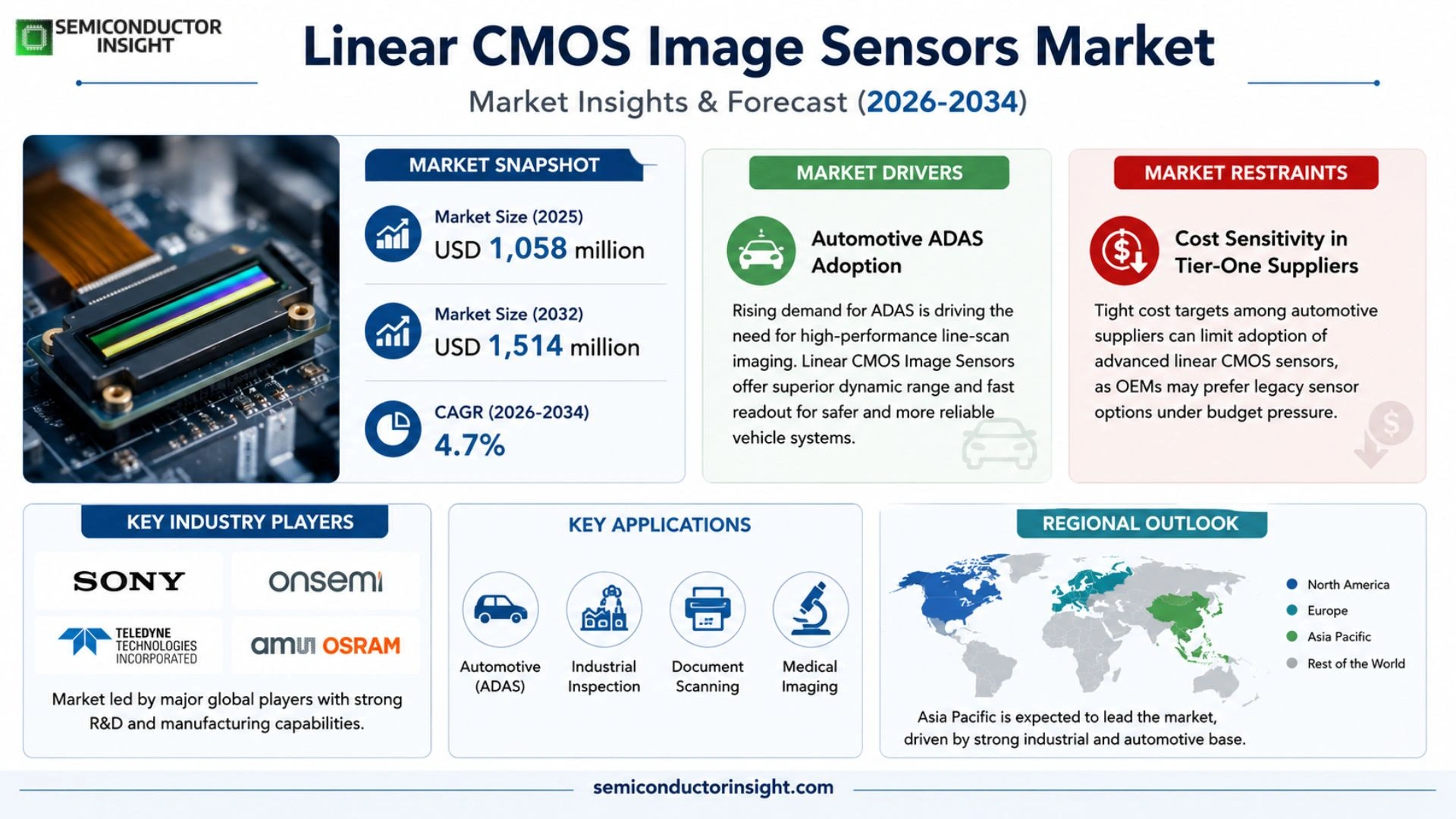
MARKET DRIVERS
Automotive ADAS Adoption
The surge in advanced driver‑assistance systems (ADAS) has forced OEMs to seek sensors that can deliver precise line‑scan imagery under varying lighting. Linear CMOS Image Sensors meet this demand by offering superior dynamic range and fast readout, which translates into more reliable lane‑keeping and forward‑collision warnings. As safety regulations tighten, suppliers who can embed these sensors into compact modules gain a decisive edge.
IoT and Industrial Imaging
Factories adopting smart‑manufacturing are integrating line‑scan cameras to monitor conveyor belts and product integrity. The low‑power profile of linear CMOS devices reduces operational cost, while their ability to operate at high frame rates satisfies real‑time quality‑control requirements. Companies that align sensor output with edge‑computing platforms are positioned to capture a growing slice of the industrial imaging spend.
➤ R&D budgets are increasingly earmarked for pixel‑level linearity enhancements, pushing performance thresholds above 95 %.
Beyond automotive and factory floors, the expansion of high‑resolution digital signage is prompting demand for sensors that can render crisp graphics on elongated displays. Integrating linear CMOS technology into display controllers enables manufacturers to offer thinner, lighter panels without sacrificing image fidelity, thereby opening a niche that blends consumer and professional markets.
MARKET CHALLENGES
Supply‑Chain Bottlenecks
Global wafer‑fab capacity remains constrained, and the specialized processes required for linear pixel architectures exacerbate lead‑time volatility. When silicon availability tightens, manufacturers often face elevated unit costs, which pressure pricing strategies and compress margins.
Other Challenges
Design Integration Complexity
Engineers must reconcile the linear sensor’s output format with existing image‑processing pipelines. Misalignment can cause latency or require additional firmware, increasing development overhead and slowing product launches.
MARKET RESTRAINTS
Cost Sensitivity in Tier‑One Suppliers
Tier‑one automotive suppliers operate under tight cost targets, and any premium associated with advanced linear CMOS devices can trigger push‑back from original equipment manufacturers. When budgetary pressures dominate, buyers may revert to legacy sensor families, limiting the overall market uptake of newer architectures.
Furthermore, the need for extensive validation testing to satisfy safety‑critical standards extends development cycles, deterring smaller players lacking deep validation resources.
MARKET OPPORTUNITIES
Emerging 3D Imaging Solutions
The convergence of linear CMOS sensors with time‑of‑flight (ToF) techniques is creating a hybrid imaging niche capable of delivering depth information alongside high‑resolution line scans. Early adopters in robotics and inspection systems see productivity gains by replacing separate depth and intensity cameras with a single, integrated module. Companies that can package this capability at competitive prices are likely to carve out a differentiated market segment.
Additionally, the rollout of 5G‑enabled edge devices is expanding the bandwidth available for transmitting high‑rate sensor data. By embedding compression algorithms directly within the sensor’s readout circuitry, manufacturers can offer turnkey solutions that capitalize on the new network infrastructure, thereby unlocking revenue streams in smart‑city and logistics applications.
Linear CMOS Image Sensors Market Trends
Industrial Automation Drives Unit Growth
The 2025 production run of roughly 429 million units, coupled with an average price of US$2.7 per sensor, signals a steady expansion of Linear CMOS Image Sensors Market. Manufacturers are responding to a surge in demand from factory‑floor vision systems that require relentless line‑by‑line capture at high frame rates. This demand is not a short‑lived spike; it reflects a broader shift toward continuous inspection lines where downtime costs outweigh incremental sensor pricing. Consequently, suppliers are prioritizing wafer‑scale yield improvements and tighter tolerances to keep unit costs in check while meeting the throughput expectations of large‑scale automation customers.
Other Trends
Supply‑Chain Consolidation and Business‑Model Evolution
Vertical integration is gaining traction as leading firms seek tighter control over core material sourcing, lithography equipment, and IP licensing. The traditional IDM approach coexists with the fabless‑plus‑foundry model, yet recent M&A activity shows a preference for hybrid structures that combine in‑house design with outsourced wafer fabrication. This convergence reduces lead times for new pixel architectures and strengthens bargaining power with a limited pool of equipment providers. For midstream players, the implication is a need to broaden service offerings,such as turnkey packaging and testing,to remain indispensable partners for both IDM and fabless customers.
Automotive High‑Dynamic‑Range Applications Accelerate Adoption
Automakers are integrating Linear CMOS sensors into advanced driver‑assistance systems that demand global shutter operation and high dynamic range to handle rapid lighting changes on the road. The shift from legacy area sensors to linear arrays enables a compact optical stack while preserving the line scan speed essential for lane‑keeping and obstacle detection. This transition forces sensor designers to refine readout circuitry, pushing pixel‑size efficiency without inflating the per‑unit cost. For Linear CMOS Image Sensors Market, the automotive segment now represents a high‑value niche that can offset slower growth in conventional consumer electronics, prompting R&D budgets to allocate more resources toward automotive‑grade reliability and temperature tolerance.
COMPETITIVE LANDSCAPE
Key Industry Players
Linear CMOS Image Sensors: Competitive Overview
The market is heavily weighted toward a handful of multinational OEMs that control both sensor design and high‑volume wafer fabrication. Sony remains the de‑facto leader, leveraging its extensive CMOS‑image‑sensor IP portfolio and a vertically integrated IDM model that couples chip architecture with in‑house lithography. Samsung follows closely, capitalizing on its advanced 14‑nm process line to deliver back‑side‑illuminated linear arrays for automotive and industrial vision. OmniVision, now part of a larger semiconductor group, distinguishes itself through aggressive cost engineering and a fabless‑plus‑foundry approach that accelerates time‑to‑market for niche applications such as document scanners. STMicroelectronics and ON Semiconductor round out the top tier, each combining a robust design team with strategic partnerships to secure foundry capacity for high‑speed global‑shutter devices. This concentration creates a competitive environment where scale, process technology access, and IP depth are decisive barriers to entry.
Beyond the headline names, a cohort of specialist manufacturers is carving out relevance in specific verticals. GalaxyCore leverages its strong presence in the Chinese market to supply low‑cost linear sensors for logistics and barcode readers. Panasonic applies its legacy in imaging to offer ruggedized modules for medical endoscopy. Smartsens Technology focuses on high‑precision industrial inspection, emphasizing global‑shutter performance. Canon, with its optics heritage, targets scientific imaging where pixel uniformity is paramount. Soitec brings expertise in silicon‑on‑insulator substrates, enabling thinner, low‑noise arrays for aerospace sensing. Emerging players such as Himax Technologies and ROHM Semiconductor are expanding their fabless portfolios, targeting automotive ADAS and high‑dynamic‑range industrial cameras. These niche firms rely on strategic alliances with OSATs and foundries to offset the capital intensity of IDM rivals, thereby sustaining a diversified supply chain.
List of Key Linear CMOS Image Sensors Companies Profiled
- Sony
- Samsung Electronics
- OmniVision Technologies
- STMicroelectronics
- ON Semiconductor
- GalaxyCore
- Panasonic
- Smartsens Technology
- Canon
- Soitec
- Himax Technologies
- ROHM Semiconductor
Segment Analysis:
| Segment Category | Sub-Segments | Key Insights |
| By Type |
|
Front Side Illuminated continues to dominate the linear sensor landscape because of its established manufacturing base and reliable performance.
|
| By Application |
|
Industrial Manufacturing is the leading application segment, driven by the need for precise, high‑speed line scanning on production lines.
|
| By End User |
|
Medical Imaging emerges as a strong end‑user segment where linear CMOS sensors are valued for their ability to capture continuous tissue cross‑sections.
|
| By Performance |
|
High‑Speed Capture is prioritized by manufacturers seeking to address demanding inspection and sorting lines.
|
| By Integration |
|
System‑on‑Chip (SoC) Integration drives the next wave of compact, power‑efficient imaging solutions.
|
Regional Analysis: Linear CMOS Image Sensors Market
Proximity between wafer manufacturers and sensor assemblers reduces lead times and lowers inventory costs. This spatial efficiency becomes a decisive factor when OEMs require rapid iterations for niche machine‑vision projects, reinforcing the region’s competitive edge.
Leading research institutes and corporate labs collaborate on pixel‑size reduction and on‑chip processing enhancements. Such partnerships accelerate the translation of laboratory breakthroughs into commercially viable linear sensor families.
Targeted fiscal incentives and streamlined export licensing encourage both domestic production and foreign investment, creating a virtuous cycle of capacity expansion and technology acquisition.
Growth in autonomous logistics, precision agriculture, and smart factory lines fuels demand for high‑speed linear arrays, prompting vendors to tailor product roadmaps toward these sectors.
North America
North America remains a pivotal arena for Linear CMOS Image Sensors Market, chiefly because of its deep integration of sensor technology within defense and advanced automotive platforms. Institutional customers value the reliability and performance pedigree of sensors sourced from established North‑American firms, which often embed rigorous quality‑assurance frameworks into their production lines. Concurrently, an ecosystem of venture capital and research universities nurtures niche startups that experiment with novel pixel geometries and AI‑enabled processing pipelines. The regional inclination toward higher‑margin, differentiated products encourages OEMs to allocate budget for premium sensor solutions, thereby sustaining a market segment that prizes precision over cost. While cost pressures are less pronounced than in other areas, regulatory scrutiny, particularly around automotive safety standards, continues to shape product specifications and testing regimes.
Europe
European manufacturers approach Linear CMOS Image Sensors Market with an emphasis on standards compliance and sustainability. The continent’s stringent environmental regulations inspire producers to adopt greener fabrication processes, which in turn attract customers seeking Eco‑design certifications for their imaging equipment. Automotive manufacturers, especially in Germany and France, prioritize sensor reliability for driver‑assistance systems, prompting a demand for robust linear arrays that can withstand harsh thermal cycles. Collaborative projects funded by the European Union often target cross‑border interoperability, fostering a shared technical foundation that eases component integration across multiple industries. This environment cultivates a market niche where product longevity and regulatory alignment outweigh pure cost considerations.
South America
In South America, Linear CMOS Image Sensors Market is anchored by expanding logistics networks and a nascent push toward smart‑city initiatives. Countries such as Brazil and Chile are modernizing their transportation infrastructure, integrating linear sensor arrays into toll‑gate scanners and railway monitoring systems. The region’s relatively modest manufacturing base leads many end‑users to import sensors, but local assemblers are beginning to add value through system integration services. This shift creates opportunities for firms that can offer tailored engineering support, especially for applications where ruggedness and low power consumption are critical. Although the overall market size remains modest, the trajectory points toward incremental growth driven by public‑sector investment.
Middle East & Africa
The Middle East & Africa present a distinct set of growth drivers for Linear CMOS Image Sensors Market, primarily linked to oil‑field automation and border‑security surveillance. In the Gulf Cooperation Council states, sensor‑based inspection systems are being deployed to monitor pipeline integrity, where linear arrays provide the resolution needed to detect micro‑defects. Meanwhile, several African nations are upgrading customs and immigration checkpoints with high‑throughput scanning solutions that rely on linear imaging technology. The regional landscape is characterized by a preference for turnkey solutions offered by global vendors, but there is a budding interest in local partnerships that can adapt sensor hardware to extreme climatic conditions. As infrastructure projects advance, demand for reliable linear sensors is likely to solidify.
Report Scope
This market research report provides a comprehensive analysis of the Linear CMOS Image Sensors Market , covering the forecast period 2026–2034. It offers detailed insights into market dynamics, technological advancements, competitive landscape, and key trends shaping the industry.
Key focus areas of the report include:
- Market Overview: The report begins with an overview outlining its current market scenario, key growth indicators, and industry transformation drivers. It discusses macroeconomic factors, demand–supply balance, regulatory landscape, and the strategic role of semiconductors in powering advancements across industries such as automotive, telecommunications, consumer electronics, and industrial automation.
- Market Size & Forecast: Historical data and future projections for revenue, unit shipments, and market value across major regions and segments.
- Segmentation Analysis: Detailed breakdown by product type, technology, application, and end-user industry to identify high-growth segments and investment opportunities.
- Regional Insights: Insights into market performance across North America, Europe, Asia-Pacific, Latin America, and the Middle East & Africa, including country-level analysis where relevant.
- Competitive Landscape: Profiles of leading market participants, including their product offerings, R&D focus, manufacturing capacity, pricing strategies, and recent developments such as mergers, acquisitions, and partnerships.
- Technology Trends & Innovation: Assessment of emerging technologies, integration of AI/IoT, semiconductor design trends, fabrication techniques, and evolving industry standards.
- Market Drivers & Restraints: Evaluation of factors driving market growth along with challenges, supply chain constraints, regulatory issues, and market-entry barriers.
- Stakeholder Insights: Insights for component suppliers, OEMs, system integrators, investors, and policymakers regarding the evolving ecosystem and strategic opportunities.
Primary and secondary research methods are employed, including interviews with industry experts, data from verified sources, and real-time market intelligence to ensure the accuracy and reliability of the insights presented.
FREQUENTLY ASKED QUESTIONS:
What is the current market size of Linear CMOS Image Sensors Market?
-> Linear CMOS Image Sensors market will rise to USD 1,514 million by 2032, reflecting a compound annual growth rate of 4.7% over the forecast horizon.
Which key companies operate in Linear CMOS Image Sensors Market?
-> Key players include Sony, Samsung, OmniVision, STMicroelectronics, On Semi, GalaxyCore, Panasonic, Smartsens Technology, Canon, SOI, among others.
What are the key growth drivers?
-> Key growth drivers include continuous high-speed detection, high dynamic range imaging, global shutter technology, and rising industrial automation demand.
Which region dominates the market?
-> No single region is identified as dominant; growth is observed across North America, Europe, and Asia-Pacific.
What are the emerging trends?
-> Emerging trends include the adoption of high dynamic range imaging, global shutter technology, and enhanced security monitoring applications.

Get Sample Report PDF for Exclusive Insights
Report Sample Includes
- Table of Contents
- List of Tables & Figures
- Charts, Research Methodology, and more...
 Download Sample Report PDF