MARKET INSIGHTS
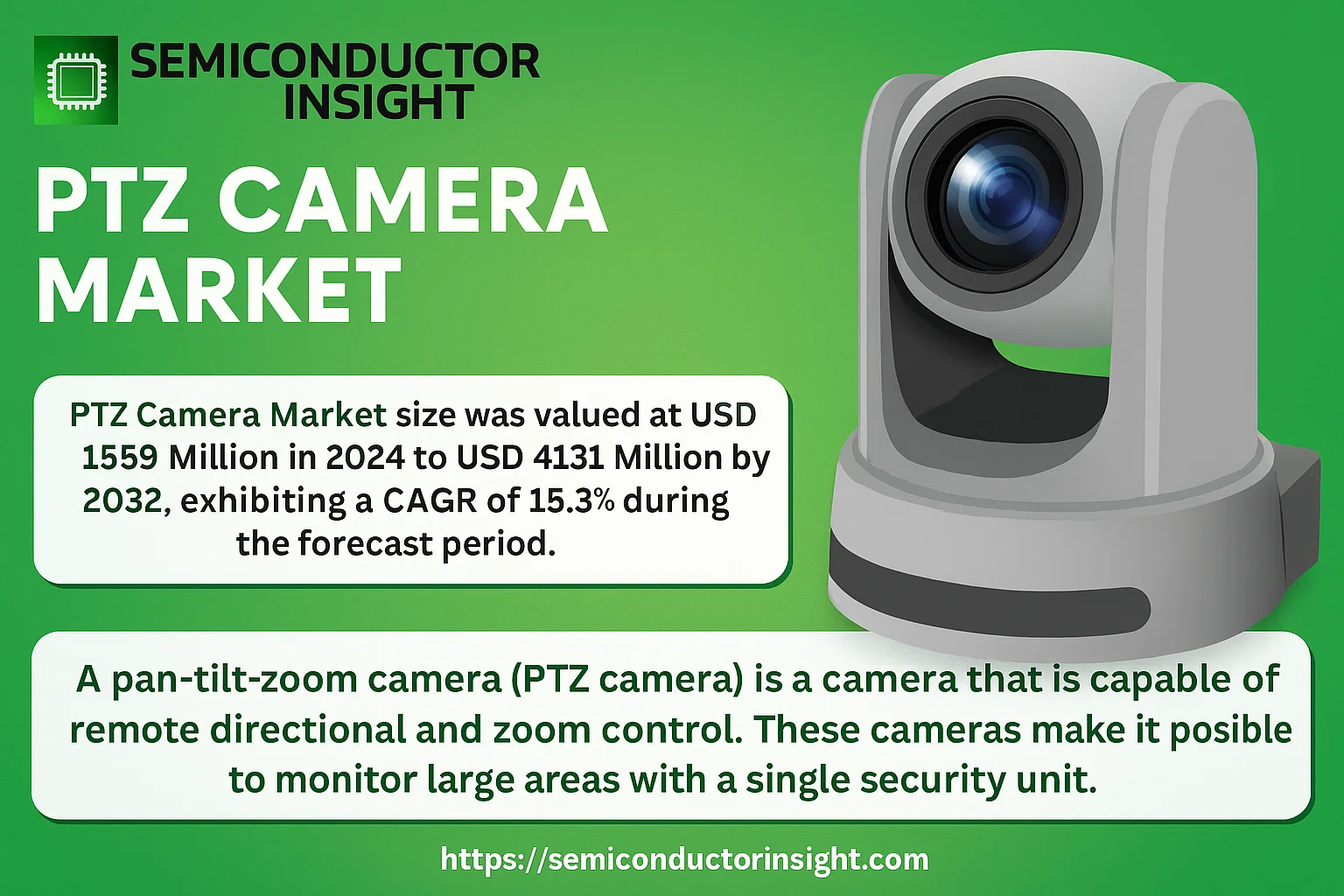
Global PTZ Camera Market size was valued at USD 1559 million in 2024 to USD 4121 million by 2032, exhibiting a CAGR of 15.3% during the forecast period.
A pan-tilt-zoom camera (PTZ camera) is a camera that is capable of remote directional and zoom control. These cameras make it possible to monitor large areas with a single security unit. The pan-tilt module allows for remote control of the viewing area, while mobile applications enable operation from virtually anywhere. The optical zoom feature provides the critical ability to focus on fine details such as faces or license plates.
The market is experiencing robust growth driven by increasing demand for advanced video surveillance across various sectors, including commercial, government, and industrial applications. While security concerns are a primary driver, the adoption of PTZ cameras is also accelerating due to advancements in AI-powered analytics and integration with IoT systems. Furthermore, key regional markets are contributing significantly to this expansion; the United States holds the largest market share at approximately 25%, followed closely by China at about 24%. The competitive landscape features prominent players such as Axis, FLIR, and Hikvision, with the top three companies collectively occupying about 34% of the market share.
MARKET DRIVERS
Rising Demand for Enhanced Security and Surveillance
Global PTZ Camera Market is primarily driven by the escalating need for high-performance surveillance systems across various sectors. The ability of PTZ cameras to provide panoramic coverage, zoom in on specific areas, and track objects automatically makes them indispensable for critical infrastructure protection, public safety, and commercial security. The transition from analog to high-resolution IP-based systems continues to be a significant catalyst for market growth, with investments increasing by over 12% annually.
Adoption in Live Events and Broadcasting
Beyond security, the media and entertainment industry is a major contributor to market expansion. The demand for dynamic, high-quality video footage for live sports, concerts, and news broadcasting is a key driver. PTZ cameras offer broadcasters the flexibility to capture multiple angles remotely, reducing the need for extensive camera crews and equipment on-site. This sector is projected to account for nearly 25% of the market’s revenue within the next five years.
Furthermore, technological advancements such as 4K and even 8K resolution, along with improved low-light performance, are making PTZ cameras more effective and appealing. The integration of AI for intelligent video analytics, including facial recognition and anomaly detection, is creating new use cases in retail analytics and smart city applications, pushing the market toward a valuation of over $2.5 billion.
MARKET CHALLENGES
High Initial Investment and Total Cost of Ownership
A significant challenge facing the PTZ Camera Market is the high upfront cost associated with advanced systems. High-end PTZ cameras with premium features like ultra-high-definition sensors, advanced optics, and sophisticated AI analytics command a premium price. Furthermore, the total cost of ownership extends beyond the hardware to include installation, integration with existing Video Management Software (VMS), and ongoing maintenance, which can be a barrier for small and medium-sized enterprises.
Other Challenges
Data Privacy and Security Concerns
As PTZ cameras become more connected and intelligent, they are increasingly vulnerable to cyber-attacks. Ensuring the security of video feeds and stored data is paramount, necessitating robust encryption and cybersecurity measures, which adds complexity and cost for end-users.
Complex Installation and Calibration
Proper installation of PTZ cameras requires technical expertise to ensure optimal field of view and performance. Incorrect calibration can lead to blind spots or ineffective tracking, undermining the system’s value and requiring costly re-installation or support services.
MARKET RESTRAINTS
Price Sensitivity in Emerging Markets
In price-sensitive emerging economies, the adoption of high-end PTZ cameras is restrained by budget constraints. Organizations in these regions often prioritize basic surveillance needs over advanced features, opting for more affordable fixed cameras. This limits the penetration of premium PTZ systems, confining a significant portion of the market growth to developed regions where security budgets are more substantial.
Limitations in Extreme Environmental Conditions
Despite advancements, some PTZ cameras still face performance challenges in harsh weather conditions such as heavy rain, fog, or extreme temperatures. While ruggedized models exist, they are often more expensive, and standard models may suffer from reduced image quality or mechanical failure, limiting their deployment in certain outdoor and industrial applications.
MARKET OPPORTUNITIES
Expansion in Smart City Infrastructure
Global push toward developing smart cities presents a substantial growth opportunity for the PTZ Camera Market. These cameras are essential for traffic management, crowd monitoring, and public safety initiatives. Governments worldwide are investing billions in urban security projects, creating a large-scale, long-term demand for intelligent surveillance solutions that PTZ cameras are well-positioned to fulfill.
Growth of Cloud-Based Video Surveillance
The shift toward Video Surveillance as a Service (VSaaS) and cloud-based storage is a key opportunity. This model reduces the need for on-premise infrastructure and offers scalability, making advanced surveillance more accessible. PTZ camera manufacturers that integrate seamlessly with cloud platforms can tap into the growing demand from SMEs and multi-site operations, a segment expected to grow at a CAGR of over 18%.
Integration with 5G Technology
The rollout of 5G networks enables higher bandwidth and lower latency, which is critical for transmitting high-resolution video streams from PTZ cameras in real-time. This will unlock new applications in remote monitoring, drone-based surveillance, and mobile command centers, creating significant opportunities for innovation and market expansion in the coming decade.
PTZ Camera Market Trends
Rapid Market Expansion and Geographic Diversification
Global PTZ Camera market is undergoing a period of significant expansion, with its valuation projected to surge from US$ 1559 million in 2024 to approximately US$ 4121 million by 2032. This growth, representing a compound annual growth rate (CAGR) of 15.3%, is driven by the increasing demand for advanced surveillance solutions across various sectors. The inherent capability of PTZ cameras to monitor large areas with remote directional and zoom control offers a cost-effective and efficient alternative to installing multiple fixed cameras, fueling their widespread adoption.
Other Trends
Dominance of Key Geographic Markets
The market landscape is currently led by the United States, which holds the largest share of approximately 25%. China follows closely as a major market with about 24% share, indicating a highly competitive and globally distributed industry. This geographic distribution underscores the universal need for sophisticated security and monitoring technologies. Growth is also accelerating in emerging economies within Asia, South America, and the Middle East & Africa as infrastructure development and security budgets increase.
Technological Integration and Application-Based Growth
Technological advancements are a primary driver of market trends. The integration of high-definition video, superior optical zoom capabilities for identifying fine details, and robust remote access via mobile applications are becoming standard expectations. The market is segmented into indoor and outdoor cameras, each tailored to specific environmental challenges. In terms of application, the commercial, government and military, industrial, and residential sectors are all significant contributors. The commercial sector, including retail, hospitality, and corporate offices, represents a particularly strong growth segment due to the need for asset protection and operational oversight, while government applications for public safety and critical infrastructure protection continue to demand advanced PTZ solutions.
COMPETITIVE LANDSCAPE
Key Industry Players
An Examination of Strategic Positioning and Market Concentration in Global Surveillance Solutions
Global PTZ (Pan-Tilt-Zoom) camera market, valued at US$ 1559 million in 2024, is characterized by intense competition among a mix of established technology giants and specialized security equipment manufacturers. The market structure is moderately concentrated, with the top three players—Hikvision, Dahua Technology, and Axis Communications—collectively holding approximately 34% of the market share as of 2024. These leading companies leverage their strong brand recognition, extensive global distribution networks, and significant investments in research and development to maintain their dominant positions. Their product portfolios are comprehensive, catering to a wide range of applications from government and military installations to commercial and residential security. The competitive dynamics are heavily influenced by technological innovation, particularly in areas such as higher resolution imaging, advanced analytics, AI-powered tracking, and seamless integration with broader security and video management systems.
Beyond the market leaders, the landscape includes several other significant players who compete effectively by focusing on specific niches or technological specialties. Companies like Sony and Canon bring their formidable expertise in imaging sensor technology and optics, making them key suppliers for high-end applications requiring superior image quality. Specialists such as Pelco (owned by Motorola Solutions) and Avigilon (a Motorola Solutions company) have deep roots in the professional security and surveillance sector. Firms like FLIR (now part of Teledyne Technologies) are renowned for their thermal imaging capabilities, which are critical for certain security and industrial applications. Other notable players, including Vaddio (a Legrand brand), Bosch Security Systems, and Infinova, compete by offering robust and reliable solutions tailored for corporate, education, and broadcast environments. This diverse ecosystem ensures a competitive market with continuous product evolution and specialization.
List of Key PTZ Camera Companies Profiled
- Axis Communications
- FLIR Systems (Teledyne FLIR)
- Hikvision
- Honeywell
- Panasonic
- Vaddio (A Legrand Brand)
- Dahua Technology
- Infinova
- Pelco (Motorola Solutions)
- Canon
- Sony
- Bosch Security Systems
- Vicon
- Avigilon (Motorola Solutions)
- YAAN
Segment Analysis:
| Segment Category | Sub-Segments | Key Insights |
| By Type |
|
Outdoor PTZ Camera represents the leading segment, primarily due to the critical need for robust surveillance solutions capable of withstanding harsh weather conditions and providing wide-area monitoring for public safety, critical infrastructure, and commercial perimeter security. The demand is driven by advanced features such as superior weatherproofing, longer-range optical zoom capabilities for identifying distant objects, and enhanced low-light performance, which are essential for 24/7 security operations in uncontrolled environments. This segment’s growth is further propelled by the expansion of smart city initiatives and investments in public safety infrastructure globally. |
| By Application |
|
Commercial applications are the dominant force in the PTZ Camera Market, leveraging the technology’s versatility for monitoring retail spaces, corporate campuses, hospitality venues, and educational institutions. The ability of a single PTZ camera to cover a large area, reducing the need for multiple fixed cameras, offers significant cost-efficiency and operational simplicity. Key drivers include the need for loss prevention, monitoring of high-traffic areas, and ensuring workplace safety. The integration of PTZ cameras with broader security and business intelligence systems for tasks like people counting and heat mapping further solidifies their value proposition in the commercial sector. |
| By End User |
|
Enterprise & Corporations constitute the leading end-user segment, driven by comprehensive security requirements for large facilities, data centers, and corporate headquarters. These users demand high-reliability systems that offer remote monitoring capabilities, integration with access control, and high-resolution imaging for forensic detail. The trend towards automated surveillance, where PTZ cameras are programmed for patrols or activated by motion sensors, is particularly appealing for enterprise security teams seeking to optimize resource allocation. The demand for cybersecurity-hardened devices is also a critical factor influencing purchasing decisions in this segment. |
| By Technology |
|
IP/Network-based PTZ cameras are the leading technological segment, favored for their superior integration capabilities, scalability, and advanced features like remote accessibility and Power over Ethernet (PoE). The shift towards IP-based systems is a cornerstone of the transition to smart and connected security ecosystems, allowing for centralized management and seamless integration with video management software and other IoT devices. This technology supports higher resolution video streaming, intelligent analytics, and more flexible installation options, making it the preferred choice for new installations and system upgrades in modern security infrastructure projects. |
| By Control System |
|
Software-based Control systems are emerging as the leading segment, reflecting the industry’s move towards digital and integrated security operations centers. These systems offer unparalleled flexibility, allowing operators to control multiple cameras from a single interface, create custom patrol patterns, and integrate PTZ control with alarm triggers and video analytics. The ability to manage camera movements, presets, and zoom functions through intuitive graphical user interfaces enhances situational awareness and operational efficiency. This trend is closely linked with the growth of cloud-based video surveillance solutions, which democratize access to advanced PTZ control for a wider range of users. |
Regional Analysis: PTZ Camera Market
The region’s dominance is underpinned by its role as the world’s primary manufacturing hub for electronic components and finished PTZ camera systems. This concentration allows for cost-effective production, rapid innovation cycles, and a robust supply chain that services both domestic and international markets efficiently.
Extensive government-driven smart city projects across China, India, and Singapore are major growth drivers. These initiatives involve deploying extensive surveillance networks in public spaces, transportation hubs, and critical infrastructure, creating a sustained and high-volume demand for advanced PTZ camera solutions with intelligent capabilities.
A vibrant tech ecosystem fosters continuous innovation in PTZ camera technology. Local companies are leaders in integrating AI-powered features like facial recognition, automatic tracking, and behavioral analysis, making their products highly attractive for advanced security and business intelligence applications globally.
Demand is diversified across numerous sectors beyond traditional security. The region sees strong uptake in verticals such as live event broadcasting, corporate telepresence, education for remote learning, and religious institutions, showcasing the versatility and adaptability of PTZ camera technology to local needs.
North America
North America represents a mature yet highly advanced market for PTZ cameras, characterized by stringent security regulations and early adoption of cutting-edge technologies. The demand is largely driven by upgrades to existing security infrastructure in critical sectors like government facilities, banking, and large corporate campuses. There is a strong emphasis on integrating PTZ cameras with broader IoT and analytics platforms for predictive security and operational efficiency. The region also sees significant application in non-security areas, including broadcasting for sports and entertainment, and in the education sector for lecture capture and distance learning solutions. The presence of major technology companies fosters a competitive environment focused on high-resolution imaging, low-light performance, and cybersecurity features.
Europe
The European market is shaped by strict data privacy regulations like GDPR, which influence the deployment and functionality of surveillance systems. Despite this, there is robust demand driven by the need for public safety in urban centers, transportation networks, and critical infrastructure protection. Western European countries, with their high security standards, are key consumers, while Eastern Europe shows growing potential. The market is also supported by applications in industrial automation and quality control within manufacturing plants. European manufacturers often focus on high-quality, durable products suitable for harsh environmental conditions, catering to both commercial and industrial clients who prioritize reliability and compliance with regional standards.
South America
The PTZ Camera Market in South America is experiencing steady growth, primarily fueled by rising security concerns in major urban areas and increasing investments in commercial infrastructure. Countries like Brazil and Argentina are at the forefront, with demand stemming from the retail, banking, and hospitality sectors. While the market is price-sensitive, there is a growing appreciation for the value of advanced features such as remote monitoring and analytics. Economic fluctuations can impact large-scale public sector projects, but the fundamental need for security in both public and private spaces continues to drive adoption. The market is characterized by a mix of international brands and local suppliers catering to specific regional requirements.
Middle East & Africa
This region presents a dynamic market with growth propelled by massive infrastructure development, particularly in the Gulf Cooperation Council (GCC) countries. Large-scale projects like smart cities, new airports, and tourist destinations create significant demand for high-end surveillance systems. Security remains a top priority for governments and commercial enterprises alike. In Africa, the market is more nascent but growing, driven by urbanization and the expansion of the banking and retail sectors. The challenges include varying economic conditions and infrastructure readiness, but the long-term potential is substantial as security becomes increasingly integrated into developmental planning across the continent.
Report Scope
This market research report provides a comprehensive analysis of the PTZ Camera Market, covering the forecast period 2025–2032. It offers detailed insights into market dynamics, technological advancements, competitive landscape, and key trends shaping the industry.
Key focus areas of the report include:
- Market Overview: The report begins with an overview outlining its current market scenario, key growth indicators, and industry transformation drivers. It discusses macroeconomic factors, demand–supply balance, regulatory landscape, and the strategic role of semiconductors in powering advancements across industries such as automotive, telecommunications, consumer electronics, and industrial automation.
- Market Size & Forecast: Historical data and future projections for revenue, unit shipments, and market value across major regions and segments.
- Segmentation Analysis: Detailed breakdown by product type, technology, application, and end-user industry to identify high-growth segments and investment opportunities.
- Regional Insights: Insights into market performance across North America, Europe, Asia-Pacific, Latin America, and the Middle East & Africa, including country-level analysis where relevant.
- Competitive Landscape: Profiles of leading market participants, including their product offerings, R&D focus, manufacturing capacity, pricing strategies, and recent developments such as mergers, acquisitions, and partnerships.
- Technology Trends & Innovation: Assessment of emerging technologies, integration of AI/IoT, semiconductor design trends, fabrication techniques, and evolving industry standards.
- Market Drivers & Restraints: Evaluation of factors driving market growth along with challenges, supply chain constraints, regulatory issues, and market-entry barriers.
- Stakeholder Insights: Insights for component suppliers, OEMs, system integrators, investors, and policymakers regarding the evolving ecosystem and strategic opportunities.
Primary and secondary research methods are employed, including interviews with industry experts, data from verified sources, and real-time market intelligence to ensure the accuracy and reliability of the insights presented.
FREQUENTLY ASKED QUESTIONS:
What is the current market size of PTZ Camera Market?
-> PTZ Camera Market size was valued at USD 1559 million in 2024 to USD 4121 million by 2032, exhibiting a CAGR of 15.3% during the forecast period.
Which key companies operate in PTZ Camera Market?
-> Key players include Axis, FLIR, Hikvision, Honeywell, Panasonic, Vaddio, Dahua Technology, Infinova, Pelco, Canon, Sony, Bosch Security Systems, Vicon, Avigilon, and YAAN, among others.
What are the key growth drivers?
-> Key growth drivers include the ability to monitor large areas with a single camera, remote directional and zoom control capabilities, and the integration of mobile apps for global remote access.
Which region dominates the market?
-> The United States is the largest PTZ Camera market, accounting for about 25% market share, followed by China with approximately 24% market share.
What are the emerging trends?
-> Emerging trends include the increasing demand for high-definition surveillance, the integration of advanced analytics and AI, and the expansion of applications across government, commercial, industrial, and residential sectors.

Get Sample Report PDF for Exclusive Insights
Report Sample Includes
- Table of Contents
- List of Tables & Figures
- Charts, Research Methodology, and more...
 Download Sample Report PDF